<ai-image title="Med-Peds residents discussing a patient case in a hospital workroom" location="headline" prompt="Professional DSLR photo of a diverse group of internal medicine–pediatrics (Med-Peds) residents in scrubs and white coats gathered around a workstation in a modern hospital ward, reviewing charts and discussing a patient case, bright clinical lighting, realistic, candid" "/>
The extra complexity of Med‑Peds is absolutely worth it—for the right kind of person. For the wrong person, it’s a 4‑year grind that leaves you half‑resentful and confused about your career.
You’re trying to answer one core question: “Is Med‑Peds actually a good deal, or am I just scared to give up age‑range flexibility?” Let me walk you through this like I would with a fourth‑year on a sub‑I who corners me in the workroom.
What Med‑Peds Actually Buys You (and What It Costs)
Internal Medicine–Pediatrics (Med‑Peds) is a 4‑year combined residency that makes you board‑eligible in both Internal Medicine and Pediatrics. No shortcuts, no watered‑down training. It’s essentially a full categorical IM plus a full categorical Peds, compressed and braided together.
Here’s the real trade:
You pay:
- 1 extra year vs most categorical programs (4 years vs 3)
- More frequent transitions between services and cultures (adult vs kids)
- More call variety and cognitive load
- Less straightforward identity early on (“Are you medicine or peds?”)
You get:
- Full training in both adult and pediatric medicine
- A-level versatility in complex transition‑age and chronic disease care
- Multiple viable long‑term career paths (clinic, hospital, subspecialty, admin)
- Strong fit for underserved, complex, and “fall through the cracks” patients
If you’re expecting some magical prestige bump or guaranteed better salary just because it’s “harder,” stop. That’s not what Med‑Peds gives you. What it really gives you is range.
Training Structure: How Different Is It Really?
The complexity people complain about is mostly the switching—moving between adult and pediatric worlds every few months.
A typical Med‑Peds schedule:
- 4 years total, usually:
- ~24 months Internal Medicine
- ~24 months Pediatrics
- Carefully structured to meet both board requirements
Most programs alternate in 3–4 month blocks: 3 months IM, 3 months Peds, repeat. A few flip more rapidly (q1 month), which is brutal for some people and energizing for others.
Compare that to categorical training:
| Path | Years | Boards Eligible In |
|---|---|---|
| Internal Med | 3 | Internal Medicine |
| Pediatrics | 3 | Pediatrics |
| Med-Peds | 4 | Internal Med + Pediatrics |
| Med + Peds (separate, sequential) | 6 | Internal Med + Pediatrics |
You’re not “half” of each specialty. The ACGME requirements are baked in so that when you graduate, you can sit for both boards like any categorical grad.
The real complexity isn’t logistical. It’s psychological:
- Different vital sign norms
- Different “sick,” “compensated,” and “crashing” patterns
- Different culture: ICU‑heavy adult medicine vs family‑centric pediatrics
- Different workflows: adult SNF discharges vs complex care clinics
If you like that flip—if switching between a 22‑year‑old with CF and a 78‑year‑old with HFpEF sounds fun—not stressful—that’s a clue you’re a good Med‑Peds fit.
Career Paths: What You Can Actually Do With Med‑Peds
The sales pitch is “You can do anything.” Technically true. Practically? There are patterns.
1. Combined Med‑Peds Primary Care
This is the archetypal path.
- Panel: newborns to 90‑year‑olds, but with a tilt toward:
- Complex congenital disease survivors
- Cystic fibrosis
- Childhood cancer survivors
- Developmental disabilities
- Transition‑age patients with chronic pediatric‑onset disease
Pros:
- Deep, long‑term relationships
- Real impact on a population most systems don’t serve well
- Your Med‑Peds identity is used daily
Cons:
- Lower pay compared with procedural specialties
- Requires a system that actually lets you keep dual‑age panels (many do, some don’t)
- RVU structures often don’t reward complexity
2. Hospital Medicine
You can be:
- Adult hospitalist
- Pediatric hospitalist
- Combined Med‑Peds hospitalist (some institutions explicitly recruit for this)
Real-world example: Many children’s hospitals embedded in adult systems want Med‑Peds hospitalists to flex between both sites or cover complex transition‑age services.
Pros:
- Shift‑based work; protected time off
- Academic roles available: QI, teaching, admin
- Your dual skill set is very attractive in certain systems
Cons:
- You may end up functionally doing 90% adult or 90% peds, especially in smaller hospitals
- Some groups don’t know how to use Med‑Peds, so they just slot you as “another adult hospitalist”
3. Subspecialty Training
You can subspecialize in either adult or pediatric fields:
- Adult fellowships: Cardiology, Pulm/CC, ID, Endo, Rheum, Heme/Onc, etc.
- Peds fellowships: NICU, PICU, Peds Card, Peds ID, etc.
- Some dual fellowships / combined training tracks (e.g., adult + peds ID, rheum, endocrinology) exist but are niche and often longer.
Here’s how Med‑Peds grads often think about it:
- If you love one population (kids with complex endocrine disease, adults with HIV), Med‑Peds was your “broad base,” but fellowship is where you narrow.
- If you truly love caring for the same disease across the age spectrum (e.g., CF from age 5 to 45), your Med‑Peds background plus a carefully chosen fellowship can set you up for a very targeted niche.
Subspecialty programs do not penalize Med‑Peds graduates. A strong Med‑Peds resident is as competitive as a strong categorical applicant.
Is the Extra Year “Worth It” Financially?
Everyone does this math at some point. And yes, you should.
Let’s be blunt: one extra resident year is one fewer attending year. That’s lost attending income. But the internet loves to overdramatize this.
Imagine, very roughly:
- Categorical IM or Peds: start attending year = t
- Med‑Peds: start attending year = t+1
If you’re comparing:
- Med‑Peds hospitalist vs IM hospitalist
- Med‑Peds PCM vs Peds PCM
Your job salary will usually be similar to your categorical peers in the same role. There isn’t a “Med‑Peds bonus” in most places. So the cost is:
- One year of lost attending income
- One year of resident pay (which is low)
Over a 25–30 year career, that year doesn’t usually make or break financial stability. The bigger differences in lifetime earnings will come from:
- Specialty choice (cards vs general peds)
- Practice setting (academic vs private)
- Geography
- Part‑time vs full‑time work
- Your negotiation skills and non‑clinical income streams
Where Med‑Peds can have an edge: you might have more job options in certain markets. That flexibility can help you land a better‑paying or better‑fitting role, which over years may offset that “lost” year.
To visualize the time trade:
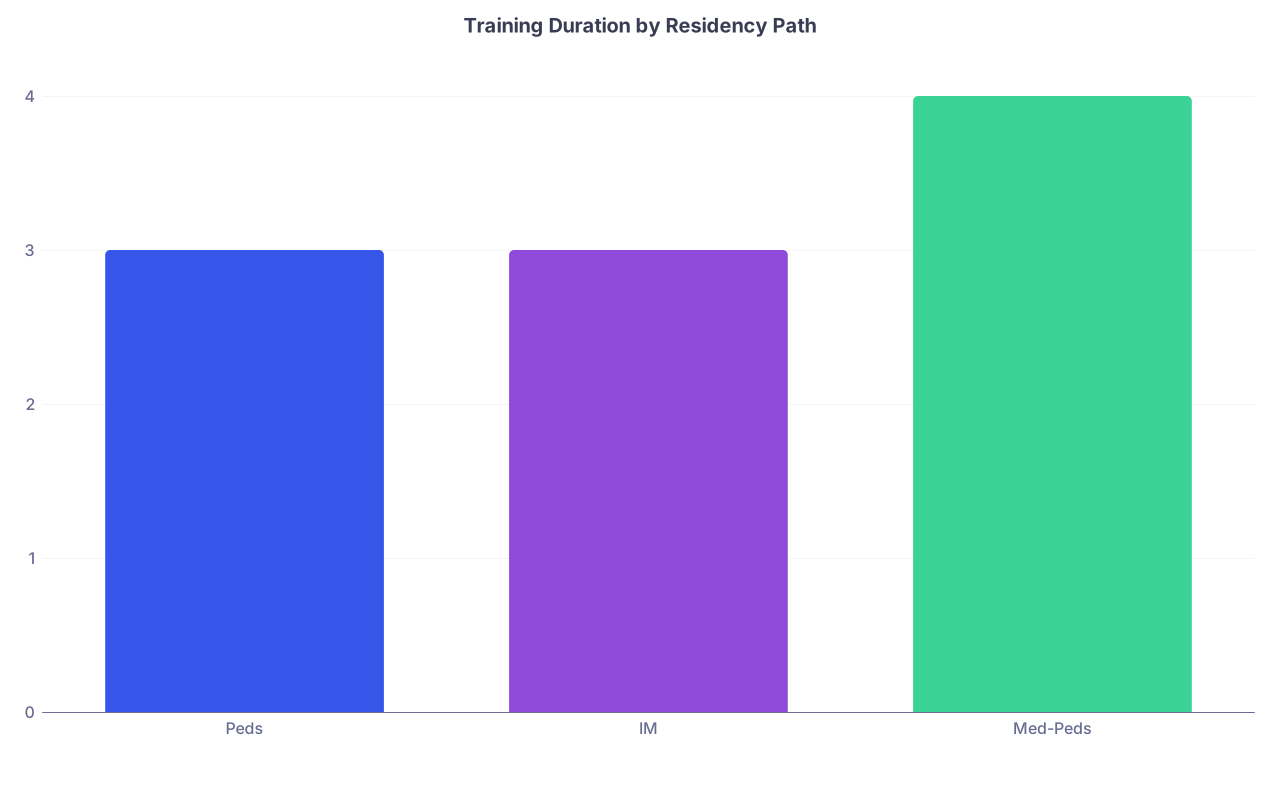
| Category | Value |
|---|---|
| Peds | 3 |
| IM | 3 |
| Med-Peds | 4 |
Bottom line: If the only reason you’re avoiding Med‑Peds is “it’s one more year,” but you strongly prefer dual‑age care, you’re probably over‑valuing that year.
Lifestyle and Burnout: Is Med‑Peds Harder?
Is Med‑Peds “harder” than IM or Peds? In some ways yes, in other ways no.
Harder because:
- Two separate board exams to prep for and pass
- Two distinct cultures and expectations
- You’re the go‑to person for “weird” cases that span age ranges or systems
- Early on, your brain has to switch gears constantly: different dosing, guidelines, and “normal” ranges
Easier because:
- You have more built‑in variety; less monotony
- You can pivot careers without restarting: adult → peds or vice versa
- Burnout sometimes hits later or less intensely because you can change your mix of adult vs pediatric work over time
I’ve seen two patterns of residents:
- People who feel chronically split. Always torn between two departments, never fully at home, annoyed by dual identities.
- People who thrive on the variety. They like being “the bridge,” the one who can translate between NICU notes and adult ICU notes for a 21‑year‑old with congenital heart disease.
If you’re the first type, Med‑Peds will grind you down. If you’re the second, it’ll protect you from stagnation.
When Med‑Peds Is Clearly the Right Choice
Let me be very clear: there are situations where Med‑Peds is obviously worth the complexity.
Strong signals Med‑Peds is right for you:
- You genuinely cannot pick between adult and pediatric medicine because you like both—not because you fear commitment.
- You’re drawn to:
- Transition clinics
- Congenital disease survivors
- Complex chronic care
- Underserved and safety‑net systems
- You like team‑based care and talking to lots of stakeholders (families, schools, adult specialists, pediatric specialists, social work).
- On rotations, you found yourself saying things like, “I wish I could follow this patient when they age out of Peds,” or “I want to see what this disease looks like in kids.”
Also:
- If you’re already leaning primary care or hospital medicine, and want to keep age flexibility, Med‑Peds is a strong play.
- If you’re eyeing admin, leadership, or system design work, having deep understanding of both adult and pediatric flows is a real asset.
When You Should Stick to Categorical IM or Peds
You don’t get extra points for picking a “harder” path. Some people seriously overestimate how much dual training will matter if their real passion is narrow.
Med‑Peds is probably not worth it if:
- You already know:
- “I want to be a pediatric cardiologist, nothing else.”
- “I only enjoy adult medicine, I hated working with kids.”
- Your main reason for Med‑Peds is “I’m scared I’ll regret not doing both” but your rotations clearly favored one side.
- The switching itself stresses you out; you felt much calmer staying in one system for longer.
- You’re doing it because you think it looks impressive or “keeps more doors open,” but you don’t have a concrete vision for using both.
If all your favorite attendings and role models are in adult ID, adult cards, or NICU, and you don’t care deeply about the cross‑age piece, a categorical path plus fellowship is cleaner and less chaotic.
How to Decide: A Simple Framework
Here’s a decision structure that actually works if you’re torn.

| Step | Description |
|---|---|
| Step 1 | Love adults, hate kids |
| Step 2 | Choose Internal Med |
| Step 3 | Love kids, hate adults |
| Step 4 | Choose Pediatrics |
| Step 5 | Like both adults and kids |
| Step 6 | Pick the one you prefer 60 percent of the time |
| Step 7 | Med Peds optional - consider lifestyle and length |
| Step 8 | Med Peds strongly favored |
| Step 9 | Enjoy switching worlds? |
| Step 10 | Care about transition or complex chronic care? |
Ask yourself:
- On which rotations did you feel most “yourself”?
- If I banned you from seeing either adults or children for the rest of your career, which ban would bother you more?
- Are you excited by the idea of following one cohort (e.g., CF, congenital heart, sickle cell) across their lifespan?
- Do you see role models living the kind of Med‑Peds career you want? Or is it just an abstract idea?
One last practical test: spend a day each with a Med‑Peds hospitalist, a Med‑Peds PCP, and at least one Med‑Peds subspecialist (like Med‑Peds ID or rheum). Watch their actual workflow. If you walk out thinking, “This is exactly how I want my days to feel,” then the extra complexity is probably worth it.
FAQs: Med‑Peds Worth It?
1. Will doing Med‑Peds hurt my chances of matching into a competitive fellowship later?
No. Strong Med‑Peds residents match into competitive fellowships regularly. Program directors care far more about your evaluations, research, letters, and performance than whether you did categorical vs combined. The only caveat: for highly structured, niche dual fellowships, you need to plan early and be at a program that supports those paths.
2. Can I realistically maintain both adult and pediatric practice long‑term?
Yes, but it depends heavily on your job and system. Many Med‑Peds physicians end up leaning mostly adult or mostly peds within a few years, especially in smaller communities. If you want a true combined panel or combined hospitalist role, target large academic centers or systems that already employ multiple Med‑Peds docs—they’re more likely to build roles that actually use both halves of your training.
3. Is Med‑Peds more competitive than categorical IM or Peds?
Usually, Med‑Peds sits somewhere between IM and Peds in competitiveness, but it’s very program‑specific. There are fewer Med‑Peds spots overall, and the applicant pool is often self‑selecting and strong. If you’re a solid IM or Peds candidate, you’re probably a solid Med‑Peds candidate. Focus your energy on programs whose graduates are doing what you want to do.
4. Do Med‑Peds doctors earn more than categorical IM or Peds doctors?
Not inherently. Your income is driven by what you actually practice—adult hospitalist, peds subspecialist, combined complex care clinic—not by “Med‑Peds” stamped on your diploma. In some markets, your flexibility may give you an edge in negotiating or job availability, but there’s no built‑in Med‑Peds pay premium.
5. If I’m still unsure, should I “default” to Med‑Peds to keep doors open?
No. That’s a bad reason. Med‑Peds adds complexity, one more year, dual boards, and an identity that’s powerful when used intentionally—but annoying if you don’t actually want it. Only choose Med‑Peds if you can clearly articulate how you’d like to use both sides of your training. If you can’t, you’re usually better off choosing the specialty where you felt most energized and fulfilled.
Key takeaways:
First, Med‑Peds is worth the extra complexity only if you truly want to live in both adult and pediatric worlds, not just “keep options open.” Second, it doesn’t automatically pay more or confer prestige; its real value is flexibility, range, and unique roles in transition and complex care. Third, if you light up at the idea of a career that straddles systems and age groups, the extra year is a bargain—not a burden.