
It is mid-January. You are sitting with a spreadsheet open, five residency programs side by side, and every single one tells you, “Our call schedule is very reasonable.” One program director says, “We do night float, so it is much better.” Another resident tells you, “Yeah, we technically follow 80 hours,” with a tone that makes you nervous.
You realize something: if you pick wrong, you will be living their definition of “reasonable” for the next 3–7 years.
You need a way to compare call schedules that cuts through the marketing language and gets to numbers, patterns, and lifestyle impact. Not vibes. Not anecdotes. A system.
This is that system.
Step 1: Get the Right Raw Data (And Stop Accepting Vague Answers)
First fix: stop asking, “How is the call schedule?” That question is useless. Everyone will tell you “good” or “manageable” because that is what you are supposed to say on interview day.
You need specific, comparable data.
Here is what you should gather for each program and each major rotation type (wards, ICU, ED, electives, subspecialty):
Structure
- Does the program use:
- Traditional 24-hour call?
- Night float?
- Shift-based coverage (e.g., 12s in ED)?
- Hybrid (mixed system)?
- Does the program use:
Frequency
- Wards:
- Number of 24-hour calls per 4-week block.
- Number of night-float weeks per year.
- ICU:
- Number of night shifts per 4-week block.
- Weekend call pattern (q2, q3, etc.).
- ED:
- Typical shifts per block.
- Percentage nights / evenings.
- Wards:
Hours and Caps
- Average weekly hours on:
- Wards.
- ICU.
- Consult services.
- Electives.
- How often they approach the 80-hour cap.
- Average number of “post-call” days that are genuinely off (not filled with didactics, conferences, etc.).
- Average weekly hours on:
Weekend Burden
- Number of weekends completely off per month.
- How many weekends you are:
- On call 24 hours.
- On night float.
- Day team with short call.
Golden Weekends
- Definition: both Saturday and Sunday off.
- How many golden weekends per year for interns? For seniors?
If you are not asking these exact questions, you are guessing.
How to Ask Without Sounding Awkward
On interview day or second looks, ask residents directly:
- “On a typical ward month as an intern, how many 24-hour calls do you take in a 4-week block?”
- “How many weeks per year are you on night float?”
- “In your busiest rotation, what is your realistic weekly hour range? 60s? 70s? Pushing 80?”
- “How many weekends per month do you actually get fully off?”
Aim your questions at PGY-2s and PGY-3s. Interns often do not know how abnormal or normal their experience is yet.
Step 2: Put Everything Into One Standardized Framework
Your brain cannot compare “q4 call with float cross-cover” at Program A to “night float system with short call weekends” at Program B. Not reliably. You will subconsciously overweight whichever resident you liked more.
You fix that by forcing everything into the same units.
Use These Core Comparison Units
For each program, convert schedule info into:
Call Nights per Month (24-hour or equivalent)
- Traditional 24h call: count as 1 call night.
- Night float:
- 5 consecutive nights = 5 “call nights.”
- 12-hour overnight shifts:
- You can count 2 of these as roughly 1.5 “call nights” if you want finer analysis, but do not get too fancy. For comparison, treat each overnight as 1 “call-equivalent” unit.
Night Weeks per Year
- Number of full weeks on:
- Night float.
- Night-heavy ED blocks.
- ICU nights.
- Number of full weeks on:
Average Weekly Hours per High-Intensity Rotation
- Wards.
- ICU.
- ED.
- Busy subspecialty months (e.g., cardiology, transplant).
Weekend Call Density
- Number of weekends per month with:
- No duties.
- Day call only.
- Night duty or 24-hour call.
- Number of weekends per month with:
Put all this in a spreadsheet. One program per row. One column for each metric above.
| Metric | Unit / Basis |
|---|---|
| Call nights per month | Nights / 4 weeks |
| Night weeks per year | Weeks / year |
| Avg hours wards month | Hours / week |
| Avg hours ICU month | Hours / week |
| Free weekends per month | Weekends / month |
You are not aiming for perfect precision. You are aiming for “clear differences” and “rough parity.” Big gaps will jump out.
Step 3: Build a Simple Scoring System That Actually Reflects Pain
Now you have numbers. Good. But you still need a way to summarize them without getting lost in details.
Here is a workable scoring system I have used with applicants:
A. Score Night Burden (0–10)
Define for intern year (most brutal year and the one programs tend to sugarcoat):
- 0–2: Very heavy nights
- ≥ 7 call-equivalent nights per 4-week ward block and ≥ 12 weeks of nights per year.
- 3–5: Moderate-heavy
- 5–6 call nights per ward block or 8–11 night weeks per year.
- 6–8: Moderate
- 3–4 call nights per block or 4–7 night weeks per year.
- 9–10: Light
- ≤ 2 call nights per block and ≤ 3 night weeks per year.
You are not writing a paper. You are scoring sanity.
B. Score Weekend Protection (0–10)
Base it on average free weekends per month and golden weekends per year:
- 0–2: Almost no protected weekends
- 0–1 free weekend most months; golden weekends rare.
- 3–5: Limited
- 1–2 free weekends but golden weekends uncommon.
- 6–8: Reasonable
- 2 free weekends most months; some golden weekends.
- 9–10: Strong protection
- ≥ 2 free weekends reliably; structured golden weekends.
C. Score Average Hours (0–10)
Look specifically at wards and ICU, not electives (everyone looks good on electives):
- 0–2: Frequently 75–80+ hours. Residents admit they are always near the cap.
- 3–5: Often 65–75 hours on heavy months.
- 6–8: Mostly 55–65 on heavy months.
- 9–10: Heavy rotations typically ≤ 55–60 hours. This is rare.
Then combine into an overall “Call Burden Score” out of 30.
To compare several programs’ overall call intensity visually:
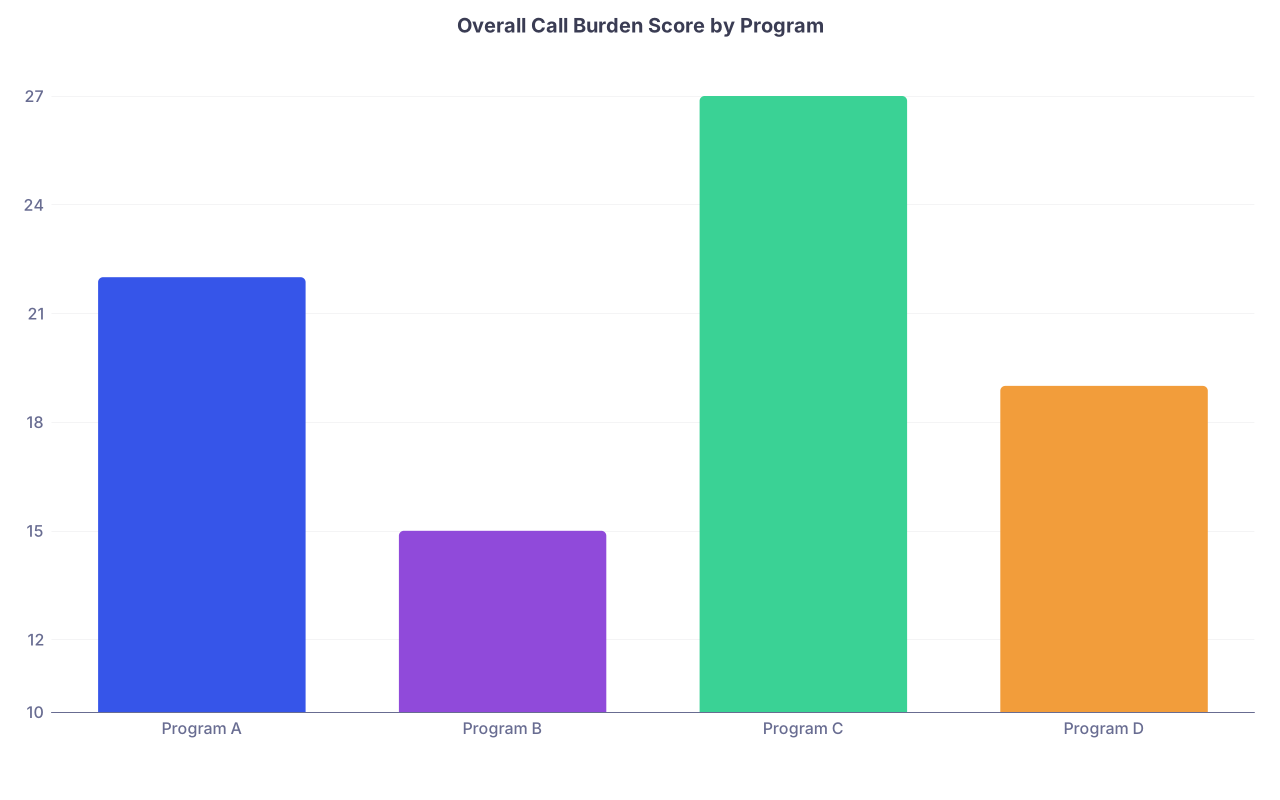
| Category | Value |
|---|---|
| Program A | 22 |
| Program B | 15 |
| Program C | 27 |
| Program D | 19 |
Higher is better (less painful). You can adjust the weights if, for example, nights bother you more than weekends.
Step 4: Decode The Different Call Models (And Their Hidden Costs)
People throw around “q4”, “night float”, “home call” like they are comparable. They are not.
Here is how to think about each model, without the sales pitch.
1. Traditional 24-hour (or 28-hour) Call
Pattern: You work all day, stay overnight, leave next day by late morning.
Pros:
- Fewer total days of “being on call.”
- Potentially more continuity of care.
- Some residents like clustering pain.
Cons:
- Fatigue is real. Post-call days are often partly wasted.
- If they are skirting the 80-hour rule, this model hurts the most.
- Recovery can chew up a full day off.
What to ask:
- “How many 24-hour calls per 4-week block on wards as an intern?”
- “Are you always truly post-call the next day, or do you stay for conferences / discharges?”
A “q4” schedule (every 4th night) is 7 calls in 28 days. That is huge.
2. Night Float
Pattern: 5–6 nights per week for 1–2 consecutive weeks, then back to days.
Pros:
- No 28-hour monsters.
- Some people tolerate being nocturnal for a short run.
Cons:
- You disappear from normal life for 1–2 weeks at a time.
- Often undercounted psychologically. Programs say “we do night float” like it is automatically better, but 12 weeks of nights is still 12 weeks of nights.
Key questions:
- “How many total weeks of night float per year as an intern?”
- “Do you still work a full Friday or Monday on either end of the week of nights?”
3. Shift-Based (ED-style)
Pattern: 8–12-hour shifts, scheduled across days, evenings, nights.
Pros:
- Hard stop times (usually).
- Predictable hours per shift.
Cons:
- If they schedule you 19 shifts of 12 hours in a month, it adds up.
- Flip-flopping circadian rhythm between days and nights.
Key questions:
- “How many ED shifts per 4-week block?”
- “What percentage are nights or late evenings?”
- “Any rule protecting against back-to-back night–day flips?”
4. Home Call
Everyone loves to downplay home call. “You are at home, it is fine.” Sometimes true. Sometimes a lie.
There is a simple test:
- If residents actually sleep most nights and log < 2–3 calls in per night regularly, that is reasonable.
- If home call means:
- You are constantly being paged.
- You keep getting called in.
- You sleep poorly because your phone is exploding.
Then it is basically in-house call without the lounge.
Ask:
- “On a week of home call, how many times are you typically called into the hospital?”
- “Do you get post-call days after heavy home call nights?”
Step 5: Model a “Representative Year” Instead of Just Reading Policies
Handbooks look good on paper. Reality lives in patterns.
You want to model a “typical PGY-1 year” schedule for each program, as close as you can.
How to Build That Model
Ask for the standard block schedule for interns.
- Many programs will show you a sample: e.g.,
- 4 blocks wards
- 2 ICU
- 1 ED
- 3 electives
- 2 subspecialty
- Many programs will show you a sample: e.g.,
For each block type, assign:
- Average weekly hours.
- Nights per block.
- Free weekends per block.
Multiply across the year.
Example:
- Wards: 4 blocks
- 65 hours/week, 4 calls/block, 1 free weekend/block.
- ICU: 2 blocks
- 70 hours/week, night float 2 weeks/block.
- ED: 1 block
- 16 shifts, 6 evenings, 4 nights, 2 free weekends.
- Electives: 3 blocks
- 45 hours/week, 3 free weekends/block.
- Subspecialty: 2 blocks
- 55 hours/week, q5 home call, 2 free weekends/block.
Now count:
- Total night weeks = night float + ED-heavy weeks.
- Total true free weekends.
- Months that are actually livable.
It is easier to see this as a rough workload distribution:
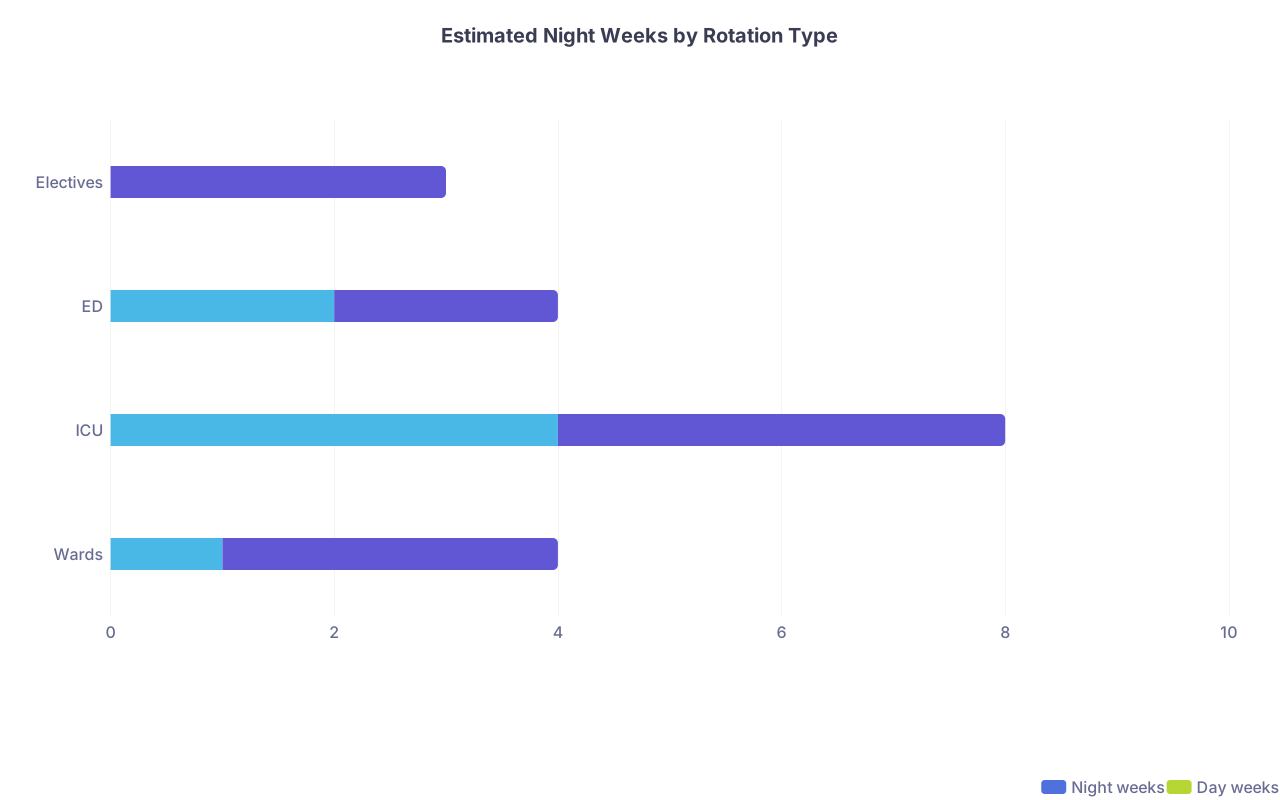
| Category | Night weeks | Day weeks |
|---|---|---|
| Wards | 1 | 3 |
| ICU | 4 | 4 |
| ED | 2 | 2 |
| Electives | 0 | 3 |
When you do this for multiple programs, patterns emerge fast:
- Program X: heavy front-loaded intern year, easier PGY-2/3.
- Program Y: nights spread more evenly but present every year.
- Program Z: one truly brutal ICU system that everyone hates but fewer total night weeks.
You can decide what you are willing to tolerate.
Step 6: Ask Residents The Right Reality-Check Questions
Numbers are great. But you still need the “how it actually feels” layer.
Most applicants ask: “Do residents feel overworked?” Bad question. No one is going to say “Yes, we are dying” to a stranger.
Ask these instead:
- “If you had to pick the roughest three months of the year, which are they and why?”
- “When was the last time you personally were close to violating the 80-hour rule?”
- “Do people routinely log hours accurately, or is there pressure to under-report?”
- “How often do your days end substantially later than the printed schedule?”
- “How many times a month do your days run past 7 pm?”
You are not asking if they survive. Almost everyone survives. You want to know:
- Are they chronically destroyed or normally tired?
- Do they have any control over swaps, vacations around heavy rotations, etc.?
You will hear subtle phrases:
- “You will learn a lot” = usually code for “You will work a ton.”
- “You get used to it” = it is worse than they want to say.
- “Administration is responsive when there are problems” = good sign. Shows they are at least trying.
Step 7: Adjust for Your Own Tolerance and Priorities
Not everyone wants the lightest call at all costs. Some people genuinely want:
- High-volume, high-acuity training, even with punishing call.
- A prestigious program, accepting the schedule as part of the deal.
Fine. But be honest with yourself.
Build a Personal Weighting System
Take your “Call Burden Score” (out of 30) and decide how much it matters relative to:
- Prestige.
- Location.
- Fellowship match rates.
- Family / partner situation.
For example, your total program score could be:
- 30% call burden
- 25% location
- 25% fellowship potential
- 20% program culture
If you have kids or a partner with a rigid job schedule, maybe:
- 45% call burden
- 20% location (near support system)
- 20% culture
- 15% career outcomes
This is not overkill. You are ranking several years of your life.
You can even visualize how programs stack up by what you actually care about:
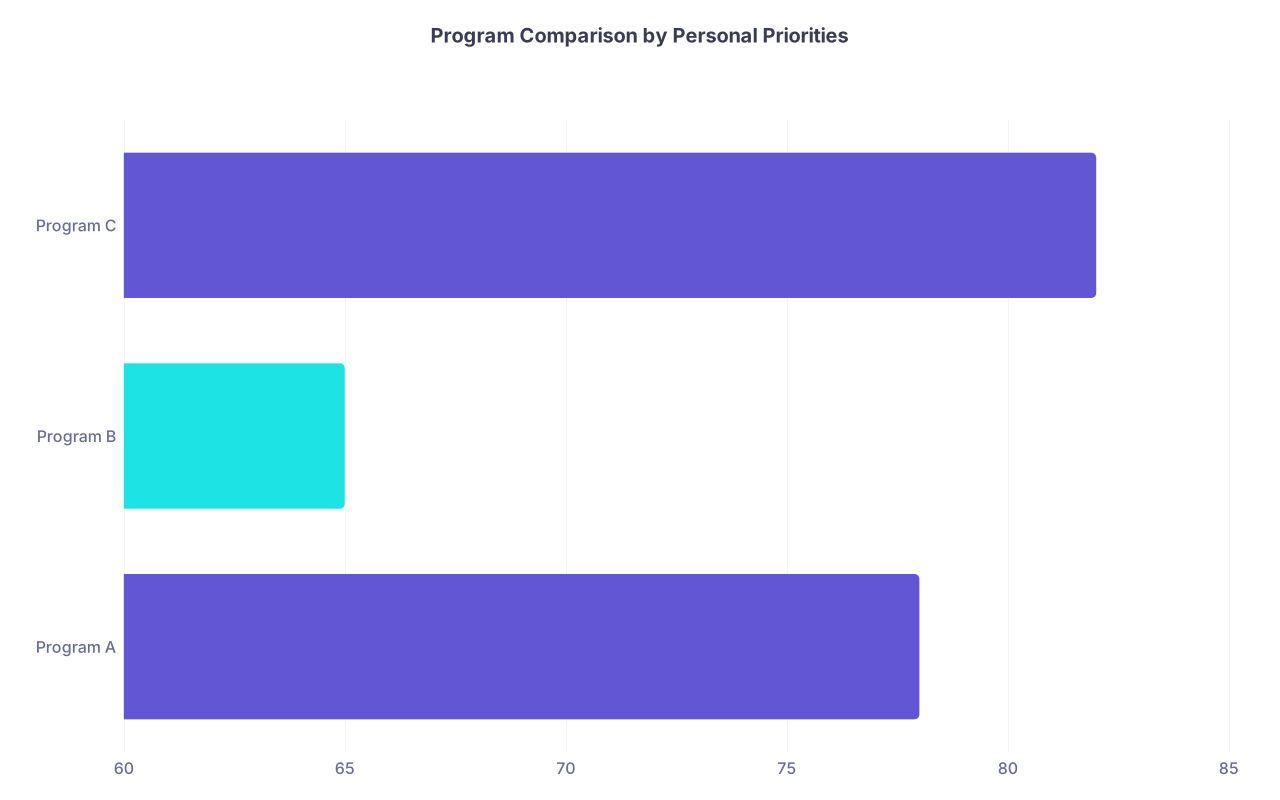
| Category | Value |
|---|---|
| Program A | 78 |
| Program B | 65 |
| Program C | 82 |
Where the values are your weighted overall scores (0–100).
Step 8: Watch for Red Flags and Common Traps
A few patterns I have seen repeatedly:
“We follow 80-hour rules” with a smirk.
Translation: Residents are hitting or exceeding 80 regularly and either under-report or nothing changes when they do report.“We do not schedule you for 24s, but sometimes things run late.”
If “run late” means you are routinely at 28–30 hours, this is not a small detail. Ask, “What is the latest you have actually left after being on overnight?”“Home call” that is basically in-house.
If they are called in multiple times per night, that is not soft call.Front-loaded pain with promises of later relief that never comes.
Ask senior residents if:- “PGY-2 and 3 actually get lighter, or do new responsibilities just fill the space?”
Cultural pressure to be a hero.
Programs that glorify “grinding” and “never saying no” often slide into abusing resident time. Residents should take pride in their work, not in violating duty hours.
When you sense any of these, lower the call burden score. Aggressively.
Step 9: Use a Visual One-Page Summary Per Program
Once you have everything, compress each program into a one-page snapshot:
- Top line: Name, location, specialty.
- Box 1: Call Burden Score breakdown:
- Nights: X/10
- Weekends: Y/10
- Hours: Z/10
- Box 2:
- Total night weeks per year.
- Average hours on wards / ICU.
- Free weekends per month.
- Box 3:
- Pros (concrete: “Only 2 night blocks/year”).
- Cons (concrete: “ICU notorious for 75–80 hours”).
Then put those pages next to each other. You will almost always find:
- One program clearly better for lifestyle.
- One clearly worse.
- One or two in the middle where other factors decide.
Consider also plotting just the night burden across programs:
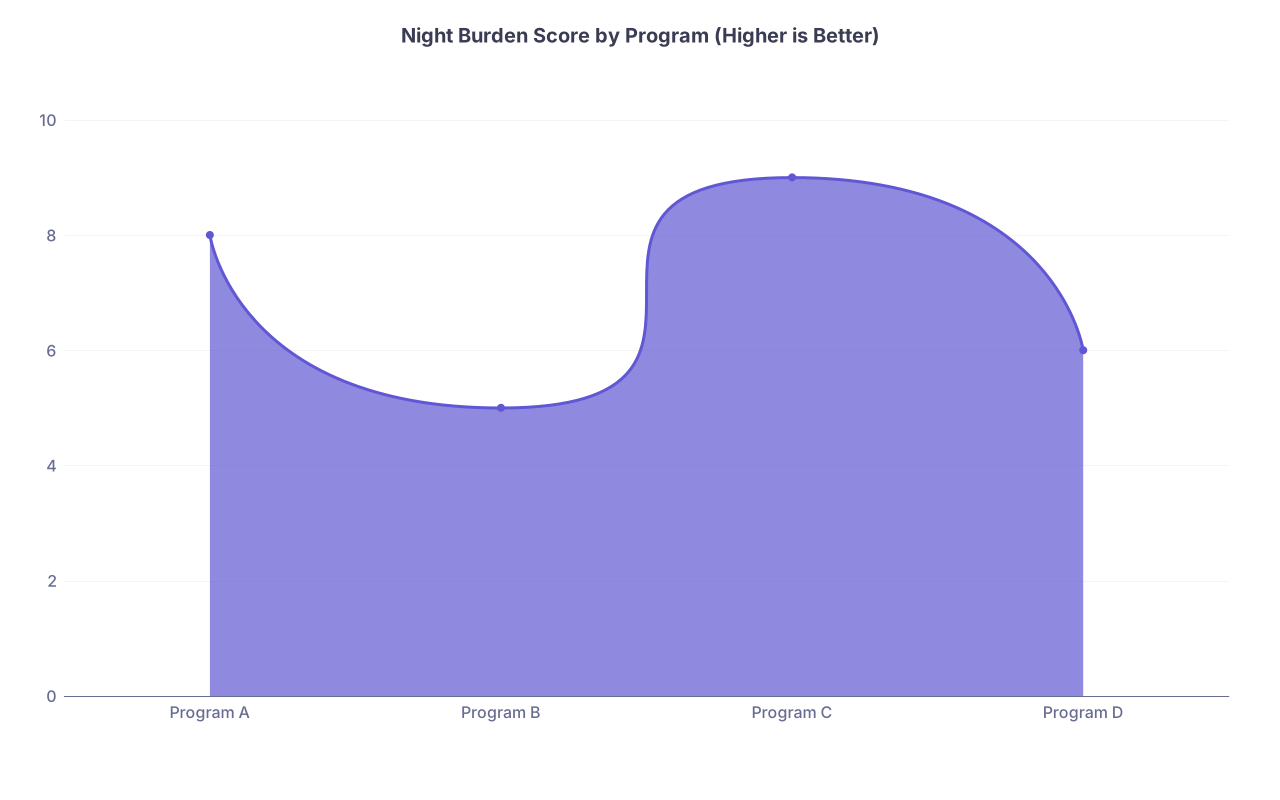
| Category | Value |
|---|---|
| Program A | 8 |
| Program B | 5 |
| Program C | 9 |
| Program D | 6 |
This makes it very obvious who is punishing you with nights.
Step 10: Sanity-Check Against Your Future Self
Last piece.
Imagine yourself:
- Six months into intern year.
- Running on less sleep than you think is possible.
- Still learning basics while holding real responsibility.
Now ask:
- Would I thank my past self for choosing a lighter call program?
- Or would I feel okay having traded those hours for a more intense program?
That hypothetical future self carries more weight than current you, who is still in student mode and may underestimate how much chronic sleep deprivation changes everything—mood, relationships, learning, mistakes.
Do not pick a schedule you “think you can survive.” Pick one you can live with.
Two Key Takeaways
- Stop asking, “Is the call reasonable?” and start asking for numbers: night weeks, call nights, weekend burden, and realistic weekly hours. Then standardize everything into a simple scoring system across programs.
- Combine that call burden score with honest resident feedback and your own priorities. The right program is not just where you match—it is where you can still function as a human being while becoming the physician you want to be.