
The way most applicants look at alumni outcomes is lazy and almost useless. You can do much better—and it will absolutely change how you rank residency programs.
You are not trying to predict “average” here. You are trying to predict your career trajectory, given your goals, if you choose that program. That requires structure, not vibes.
Here is the system I give residents and MS4s who actually want to use alumni outcomes as a decision-making weapon instead of brochure filler.
Step 1: Define a Specific, Testable Career Trajectory
If your goal is fuzzy, alumni data will be meaningless. “I want to keep doors open” is how people end up in programs that are fine on paper and terrible for their actual future.
You need a concrete trajectory that can be checked against alumni outcomes. Something like:
- “Academic cardiology at a research-heavy institution”
- “Community EM in the Southeast with reasonable night schedule”
- “Private practice ortho in a large metro, high volume, high income”
- “Physician-scientist with R01-level funding”
- “Hospitalist with strong QI/administrative opportunities”
Write your primary trajectory in one sentence. Then list 1–2 acceptable alternatives if Plan A fails. For example:
- Plan A: Academic GI at university hospital, 50/50 clinical–research
- Plan B: Community GI in mid-sized city
- Plan C: Hospitalist with strong procedures and teaching
Now you have something you can literally score programs against.
Step 2: Translate Your Goals Into Measurable Alumni Endpoints
You are going to be ruthless here. No abstract talk about “strong mentorship” or “lots of opportunities” until you see outputs.
Ask yourself: “If this program is good for my trajectory, what should I see in their alumni 3–10 years out?”
Break it into 4–6 measurable endpoints. For example:
Example: Academic Subspecialty Trajectory
You might care about:
- Fellowship match rate into your target field
- Fellowship quality (top 20? highly academic? major city?)
- Alumni in faculty positions at academic centers
- Alumni with publications, grants, or leadership roles
Example: Community-Focused / Lifestyle Trajectory
You might care about:
- Alumni in community jobs versus academic
- Geographic distribution (same region you want?)
- Reported work–life balance (from alumni you talk to)
- Procedural volume and autonomy reflected in first jobs
You are not comparing programs in general. You are checking: “Do their graduates end up where I want to be?”
Step 3: Build a Simple Alumni Outcomes Scorecard
If you do not put this in a structured format, your brain will get hijacked by brand names and interview-day charm offensives.
Use a very simple scorecard. Spreadsheet, Notion, handwritten table—does not matter.
| Outcome Category | Weight (1–5) | Program A | Program B | Program C |
|---|---|---|---|---|
| Match into target fellowship | 5 | |||
| Strength of fellowship destinations | 4 | |||
| Alumni in desired geography | 3 | |||
| Alumni in academic vs community mix | 3 | |||
| Graduates in leadership roles | 2 |
Weights: 1 = nice to have, 5 = career-critical. Force yourself to pick.
You will fill these program columns later out of 5 (or 10) based on actual data, not feelings.
Step 4: Where to Find Real Alumni Data (Not Marketing Fluff)
Programs rarely hand you the full picture, and some are frankly deceptive by omission. You will have to pull from multiple sources. This is how to do it efficiently.
1. Program Website (But Read It Skeptically)
Look for:
- “Where our graduates go” pages
- Fellowship match lists (last 3–5 years minimum)
- Alumni spotlight profiles
Red flags:
- Only showcasing one graduating year
- “Sample destinations” instead of full lists
- No update in the last 3+ years
2. LinkedIn Deep Dive
LinkedIn is your best unofficial alumni database.
Search by:
- Program name + specialty
- Hospital name + “resident” or “fellow”
- Filter by year of graduation if possible
What to record:
- Current role (fellowship / attending)
- Type of practice (academic / community / private)
- City and region
- Titles (assistant professor, medical director, etc.)
Do this for at least 10–20 alumni per program if you can.
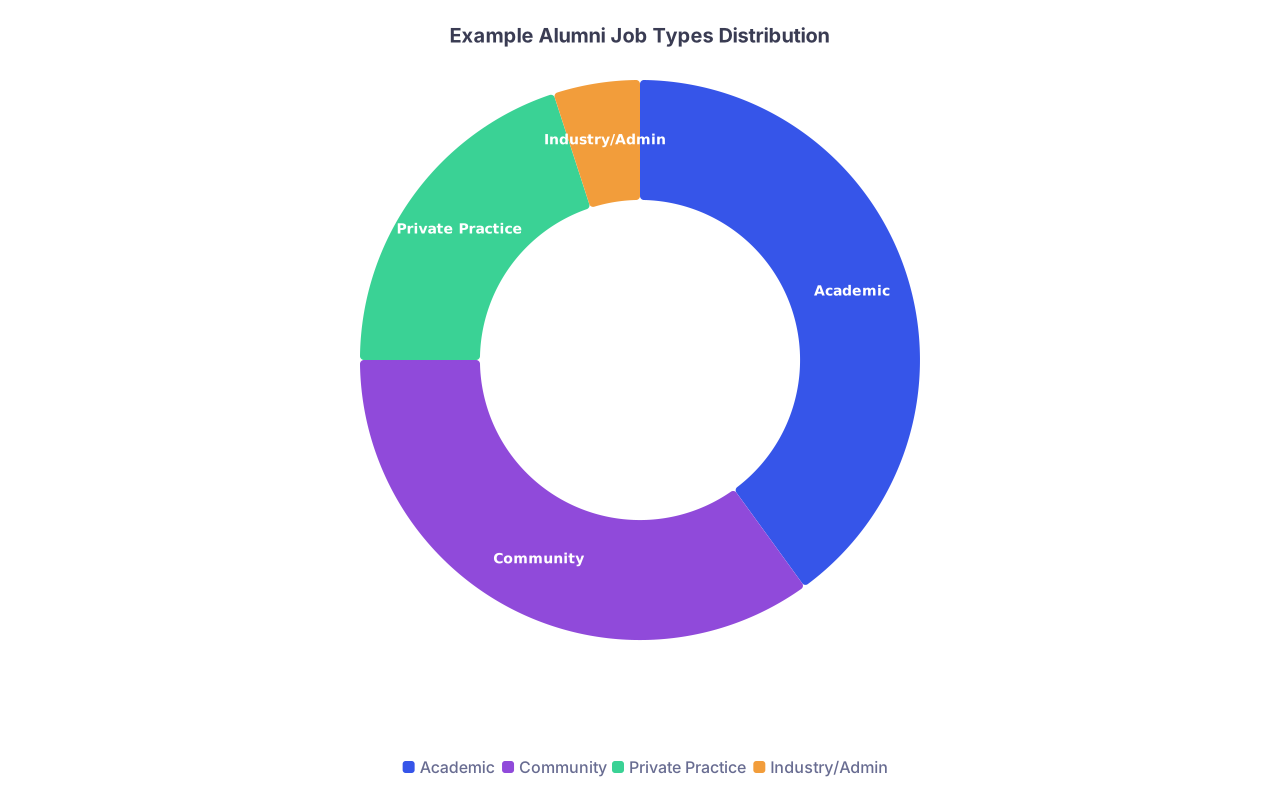
| Category | Value |
|---|---|
| Academic | 40 |
| Community | 35 |
| Private Practice | 20 |
| Industry/Admin | 5 |
3. Doximity and Program Reputation Lists
Doximity and similar rankings are flawed, but they give broad reputational signals and sometimes hints about alumni networks and fellowship placements.
Use them for:
- Quick sense of whether the program feeds into academic vs community jobs
- Relative fellowship placement reputation in your field of interest
Do not overinterpret one rank difference. Patterns matter, not single numbers.
4. PubMed for Research-Oriented Trajectories
If you care about research or academics, search:
- “Lastname FirstInitial” + residency program institution
- Filter by last 5–10 years
See how many resident names you recognize from program rosters. That gives you:
- Number of alumni who publish
- Type of work (case reports vs major trials)
- Whether graduates stay active in research after training
5. Cold Outreach to Alumni
This is where serious applicants separate themselves.
You send short emails or LinkedIn messages to alumni 3–8 years out:
- Who trained at your target program
- Who are now in roles you want (or do not want)
Sample outreach:
“Hi Dr. X,
I am a [MS4 / applicant] applying to [Program] and very interested in [field / career type]. I noticed you trained there and are now doing [role]. I am trying to understand what graduates actually end up doing after residency. Would you be open to a 10–15 minute call sometime this month to share your experience? Totally understand if your schedule is tight.”
You will get fewer responses than you like. That is fine. A few honest conversations beat all the glossy PDFs.
Step 5: Ask Alumni the Right, Uncomfortable Questions
Do not waste alumni time asking, “Did you like the program?” That gives you nothing.
You are trying to map input (training environment) to output (career outcome). Ask targeted, outcome-focused questions.
Core Questions to Ask
For each alumnus:
Where did most of your co-residents end up 3–5 years after graduation?
- Fellowships? Which fields?
- Community vs academic?
- Big cities vs smaller communities?
For residents who wanted [your goal], how many actually got it?
- “Of the people who wanted academic GI, how many are in academic roles now?”
- “How many wanted to stay in the region and actually did?”
Did the program help or hinder people reaching those goals?
- Specific fellowship pipeline mentors?
- PD / faculty advocacy or indifference?
- Any politics you noticed?
If someone like me wants [your trajectory], would you choose this program again?
- Why or why not, in one sentence?
What surprised you about alumni paths after you left?
- More people burning out?
- People switching career goals because of the culture or workload?
Take notes immediately after each conversation. Do not trust your memory.
Step 6: Map Alumni Paths to Your Trajectory (Not Their Average)
Now you turn raw data into prediction.
Classify Alumni Relative to Your Goal
For each program, look at 10–30 alumni 3–10 years out and mark them:
- Direct hit: Doing essentially what you want
- Near miss: Close enough you would be OK with that job
- Off path: Nowhere near what you want
Count them.
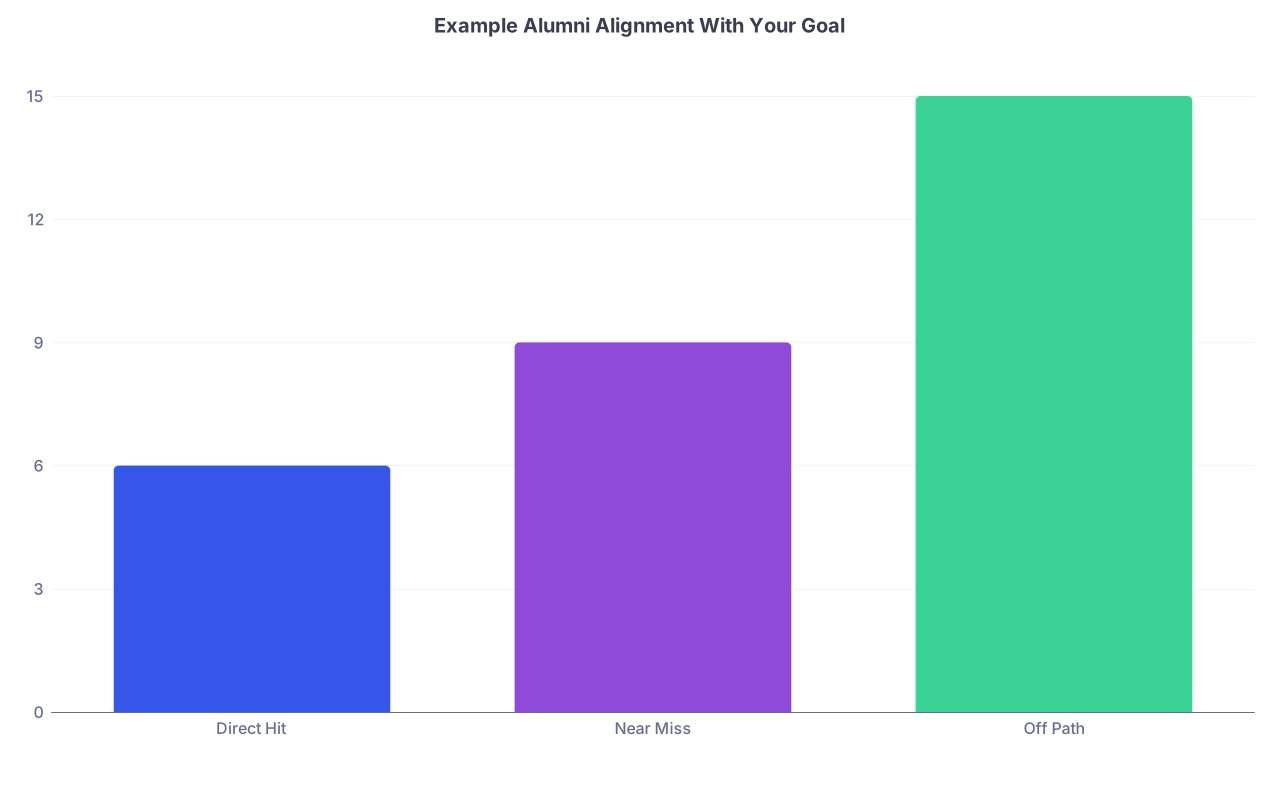
| Category | Value |
|---|---|
| Direct Hit | 6 |
| Near Miss | 9 |
| Off Path | 15 |
This is crude but far better than nothing.
Ask:
- Are “direct hits” rare unicorns or regular occurrences?
- Are there specific subgroups (e.g., research track residents) who get where you want to go?
- Do people with your background (IMG vs AMG, DO vs MD, nontraditional) succeed there?
Look for Repeatable Patterns, Not Exceptions
One star graduate who landed a dream job tells you almost nothing.
What matters:
- Repeated matches at strong fellowships in your field
- Repeated alumni in the same type of role you want
- Evidence that ordinary residents (not just superstars) succeed in your direction
If a program PD brags about “We had someone match MGH cardiology last year,” ask: “How many in the last 10 years?”
Step 7: Score Each Program Objectively
Now you go back to your scorecard and fill it in.
For each category (e.g., “match into target fellowship”), rate 1–5:
- 5 – Consistently strong outcomes directly in line with your goals
- 4 – Good outcomes with occasional misses
- 3 – Mixed; some good, some clearly off
- 2 – Rare hits; most do not align with your plans
- 1 – Almost no one ends up where you want
Multiply by your weight. Sum for each program.
Example:
| Category | Weight | Program A | Program B |
|---|---|---|---|
| Target fellowship match rate | 5 | 4 (20) | 2 (10) |
| Fellowship destination strength | 4 | 5 (20) | 3 (12) |
| Alumni in desired geography | 3 | 2 (6) | 5 (15) |
| Academic vs community alignment | 3 | 5 (15) | 2 (6) |
| Leadership / research roles | 2 | 4 (8) | 1 (2) |
| **Total** | — | **69** | **45** |
Now you have a quantitative reflection of alumni outcomes against your personal path. Much harder for recency bias from interviews to override.
Step 8: Combine Alumni Outcomes With Time Lag Reality
Here is the uncomfortable truth: you are using past data to guess about a future 3–10 years away. Programs change.
You need to adjust for:
- New leadership (recent PD turnover—good or bad?)
- Major changes in hospital system, funding, or merger
- New fellowship programs opening or closing locally
If a program has stellar alumni outcomes but the fellowship pipeline was driven by a single senior faculty member who just retired, you discount that.
Conversely, if a historically average program now has:
- New research infrastructure
- Aggressive recruitment of high-caliber faculty
- Evidence of improving match lists over the last 3–5 years
You bump it slightly above what alumni data alone would say.
Timeline perspective helps:
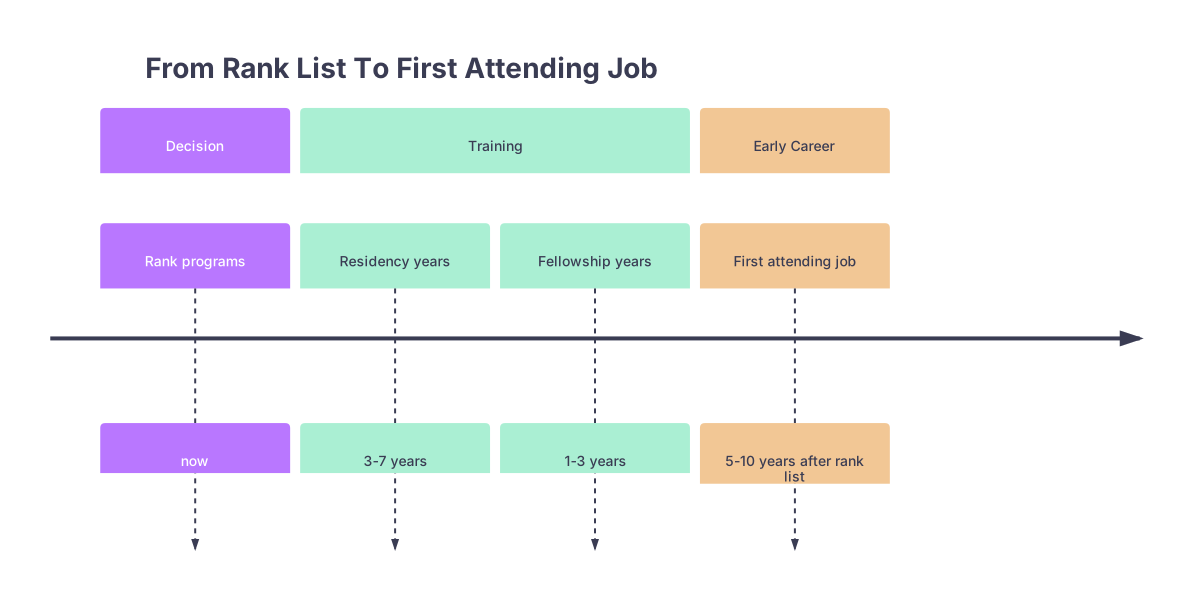
| Period | Event |
|---|---|
| Decision - Rank programs | now |
| Training - Residency years | 3-7 years |
| Training - Fellowship years | 1-3 years |
| Early Career - First attending job | 5-10 years after rank list |
You are asking: “Given where this program has been for the last 5–10 years and where it seems to be going, what is the most likely set of outcomes for someone like me?”
Step 9: Adjust for Your Own Profile Honestly
This part stings, but skipping it is delusional.
Programs do not produce identical outcomes for everyone. Alumni trajectories differ by:
- Academic profile (research background, scores, class rank)
- Visa status / IMG vs AMG / DO vs MD
- Personality and ambition
- Niche interests (global health, industry, informatics)
You must ask: “Among alumni who look like me on paper, what happened?”
When you talk to alumni, specifically ask:
- “How did IMGs from your program do for [goal]?”
- “Were there DO grads in your class interested in [subspecialty]? What happened to them?”
- “Did residents without heavy research backgrounds still land good academic roles?”
If your profile matches the group that repeatedly achieves what you want, you can lean harder on their trajectory as predictive.
If your profile does not match them, you need to be more cautious.
Step 10: Use Alumni Outcomes to Break Ties on Your Rank List
By this point, you will have:
- A weighted scorecard of alumni outcomes for each program
- Qualitative notes from alumni conversations
- A rough sense of which programs repeatedly generate your desired outcomes
Now use this data surgically.
Tie-break scenarios where alumni outcomes should dominate:
Two programs feel equally good culturally and location-wise.
- Rank higher the one whose alumni repeatedly land in your target jobs.
Big-name program vs smaller but outcome-aligned program.
- If the smaller program actually produces your desired trajectory more consistently, ignore the prestige siren song.
Local comfort vs long-term ambition.
- If you are truly serious about a competitive subspecialty or academic career, favor the places with real alumni evidence, not wishful thinking.
When alumni data should not overrule everything:
- When the culture seems toxic or malignant despite good outcomes. Burnout is a career outcome, too.
- When your life constraints (family, partner job, kids) make some locations impossible.
- When your goals are genuinely uncertain and you need broad, flexible training instead of hyper-specific pipelines.
Use alumni outcomes as a strong but not absolute signal. If everything else is equal, let this data decide.
Common Pitfalls You Need to Avoid
I have watched applicants blow excellent data by making the same predictable mistakes.
Mistake 1: Confusing Program Prestige With Alumni Outcomes
Name recognition helps, but it does not guarantee that:
- Ordinary residents (not superstars) land where you want
- The program invests in your niche field
- The alumni network is active and accessible
Look at where graduates go, not just where the program sits on a brand hierarchy.
Mistake 2: Overweighting Individual Anecdotes
The super ambitious alum who matched the single top program in your specialty from a community hospital. The bitter graduate who complains about everything from 10 years ago.
Listen. Then put each anecdote in context of:
- Year of graduation
- Leadership at the time
- Whether they are representative of majority outcomes
You want patterns, not stories.
Mistake 3: Not Tracking Data Systematically
Reading random alumni bios and saying “seems pretty good” is worthless. You will forget details and remember only extremes.
If you are not writing it down and scoring it, you are not really using alumni outcomes.
Sample Workflow: One Week of Serious Alumni Recon
If you want a concrete, time-bound protocol, here is one.
| Period | Event |
|---|---|
| Decision - Rank programs | now |
| Training - Residency years | 3-7 years |
| Training - Fellowship years | 1-3 years |
| Early Career - First attending job | 5-10 years after rank list |
That is it. One focused week and you have more clarity than 90% of applicants.
Quick Reality Check: What Alumni Outcomes Can and Cannot Do
Alumni outcomes can:
- Show you whether your dream path from that program is rare or routine
- Reveal hidden strengths and weaknesses in training
- Help separate marketing from reality
- Sharpen your rank list beyond vague impressions
Alumni outcomes cannot:
- Guarantee your personal success
- Fully account for future changes in healthcare or training
- Replace your own work ethic, adaptability, and choices in residency
You are stacking the deck in your favor. Not buying certainty.
FAQ (Exactly 4 Questions)
1. How many alumni do I need to look at per program for this to be meaningful?
Aim for at least 10–20 alumni 3–10 years out. Less than that and you are looking at noise. If you are targeting a very niche trajectory (like physician–scientist with heavy bench research), you may have fewer direct comparables, so expand to “near miss” roles (clinical researchers, QI leaders) to estimate the program’s support for non-clinical careers.
2. What if a program refuses to share detailed alumni or fellowship match lists?
That is usually a bad sign. Strong programs are proud of their outcomes and publish them. If a program is evasive, you should assume variability or mediocrity until proven otherwise. Rely more heavily on LinkedIn, PubMed, and alumni outreach. And be cautious about ranking that program highly if outcomes are critical for your goals.
3. I am genuinely undecided about my long-term career path. How should I use alumni data then?
In that case, do not lock onto a single trajectory. Instead, define 3–4 “probable futures” you might want (e.g., academic subspecialty, community generalist, hospitalist with leadership). Look for programs with diverse strong alumni outcomes across those paths. Avoid places where almost everyone ends up in just one type of job that you might not want.
4. Should I ever rank a lower-outcome program higher for personal or family reasons?
Yes. You are a person, not a machine. If child care, partner career, elder care, or your own mental health will be significantly better at one location, that can justify ranking it over a program with marginally better alumni outcomes. Just be honest with yourself: you are trading some career probability for life stability. Sometimes that is the right call. But do it consciously, not by accident.
Key points:
- Define a specific career trajectory, then translate it into 4–6 measurable alumni endpoints.
- Collect real data (websites, LinkedIn, PubMed, alumni calls) and score programs against your personal goals, not general prestige.
- Use those alumni patterns as a serious tie-breaker on your rank list, adjusting for your own profile and the program’s recent changes.