Balancing research and clinical training is not a philosophical question. It is a logistics problem disguised as a career decision. Solve the logistics, and the “right” residency program becomes obvious.
Most applicants do this backwards. They stare at program websites, read vague lines like “strong research opportunities” and “robust clinical training,” then guess. That is how you end up in a “research powerhouse” where you cannot get time off service, or a “busy clinical program” where everyone talks about research but no one actually publishes.
You need a checklist. Not a cute reflective exercise. A hard, practical, residency selection checklist you can use to interrogate programs and decide if they can realistically support the career you say you want.
Below is that checklist, broken into concrete questions, red flags, and action steps.
Step 1: Decide Your Research–Clinical Profile (Before You Touch ERAS)
If you do not define what you want, programs will define it for you. And they will usually be wrong.
You need to place yourself in one of four buckets. Be honest.
Clinician-Only (Minimal Research)
- Goal: Practice-focused career (e.g., community hospitalist, private practice surgeon, outpatient pediatrics).
- Research: Optional. Maybe a small QI project or case report.
- What you need from residency:
- Heavy clinical volume.
- Efficient systems, strong teaching.
- Minimal mandatory research requirements and no pressure to “be academic” if you don’t want it.
Clinician with Scholarly Activity (Some Research, Some QI)
- Goal: Mostly clinical, but want:
- A few publications or abstracts.
- Strong CV for fellowship or academic-leaning job.
- Research: 1–3 projects, often QI, retrospective chart reviews, educational projects.
- What you need:
- Protected time or light, doable projects with real mentorship.
- Track record of residents with similar goals getting outputs (posters, papers).
- Goal: Mostly clinical, but want:
Clinician–Scientist Path (Research is a Major Pillar)
- Goal: Academic career with regular publications, maybe eventual K award, some bench or translational work.
- Research: Continuous involvement. Multi-year projects, possibly basic/bench or clinical trials.
- What you need:
- Real protected time (not “academic half-days” that always get cancelled).
- Embedded research infrastructure.
- Faculty who publish with residents, not just by themselves.
Physician–Scientist / Heavy Research (MD/PhD-style trajectory)
- Goal: 30–70%+ research career; grants, lab, PI.
- Research: High-level, long-term work. Need continuity over multiple years.
- What you need:
- Dedicated research tracks or ABIM research pathways (for IM and some others).
- Extended training with built-in research years or blocks.
- Guaranteed, not theoretical, protected time.
If you cannot cleanly identify your bucket, you will fall into whatever culture dominates the program you match into. That is how people get pushed into research they do not care about or, on the flip side, get clinically overrun and publish nothing.
Action: Write down your bucket on a sheet of paper. Literally. You will use it in every step that follows.
Step 2: Translate Your Profile into Non-Negotiables
Your bucket should drive your non-negotiables. This is where most people skip straight to “top 20 vs not” and miss the point.
Here is what typically matters for each profile:
| Profile Type | Top Priority | Research Time Needed | Program Type Fit |
|---|---|---|---|
| Clinician-Only | Clinical volume | Minimal | Community-heavy, hybrid |
| Clinician + Scholarly | Balanced training | Limited but real | University-affiliated |
| Clinician–Scientist | Structured research | Significant | Large academic center |
| Physician–Scientist | Protected research | Extensive, formal | Dedicated research track |
Now turn this into constraints:
Clinician-Only:
- Hard requirements:
- High patient volume.
- Strong board pass rate.
- No mandatory, high-stakes research milestones for promotion.
- Soft preferences:
- Some QI support for residency completion requirement.
- Optional access to research if you change your mind.
- Hard requirements:
Clinician + Scholarly:
- Hard requirements:
- Residents actually presenting posters, case reports, or QI annually.
- At least some structured scholarly time (electives, “research blocks,” or protected afternoons) that people actually use.
- Soft preferences:
- Faculty with a track record of resident-coauthored papers.
- Hard requirements:
Clinician–Scientist:
- Hard requirements:
- Multiple faculty mentors in your interest area.
- Documented resident research output (not just “we support research”).
- Clear, scheduled research blocks or longitudinal time.
- Soft preferences:
- Internal fellowships or research awards.
- Statistical or data support (biostats core, REDCap, IRB office that actually responds).
- Hard requirements:
Physician–Scientist:
- Hard requirements:
- Formal research tracks (e.g., ABIM Research Pathway, PSTP, R38, T32).
- Guaranteed protected research time in writing.
- Clear examples of recent residents with K awards, postdoc research years, or major grants downstream.
- Soft preferences:
- Integration with PhD-level scientists and labs.
- Access to robust core facilities (omics, imaging, etc.)
- Hard requirements:
Action: For your bucket, write down 3–5 non-negotiables. If a program cannot meet them, it is off your rank list no matter how shiny the name.
Step 3: Use a Checklist to Audit Programs (Not Their Branding)
Program websites lie by omission. Nearly every one claims:
- “Strong research opportunities.”
- “Robust clinical training.”
- “Scholarly activity encouraged.”
You need to cut through the fluff with a functional checklist. Here is one you can literally use line by line.
A. Clinical Training Checklist
Ask these questions and write down the answers:
Patient Volume and Breadth
- How many admissions does a typical intern carry on:
- Ward months?
- ICU rotations?
- How many weekly clinic sessions per half-day block?
- What is the diversity of pathology (only bread-and-butter vs complex tertiary referrals)?
- How many admissions does a typical intern carry on:
Autonomy and Supervision
- Are residents the primary decision makers on the team, or scribes for fellows?
- Are there “resident-run” services?
- Any sites with limited fellow presence where residents manage independently?
Procedural Volume (if your field needs this)
- For surgical/operative fields: Average cases per year, per resident.
- For IM, EM, anesthesia: Typical numbers for intubations, central lines, LPs, etc.
Board Pass Rates and Outcomes
- Last 5 years’ board pass rates.
- Where graduates go:
- Fellowship match list (for academic-leaning folks).
- Jobs (community vs academic).
Red flags:
- Residents describing themselves as “note-writing machines.”
- Board pass rate below national average without a compelling plan for improvement.
- Graduates routinely struggling to get fellowships in your desired specialty.
B. Research Infrastructure Checklist
Now the research side. These are not “nice to know” questions. They determine whether your research actually happens or just lives on a slide deck.
Protected Time – Real or Fictional
- Is there:
- Dedicated research block(s)? (How long? PGY level?)
- Longitudinal research time (e.g., half-day per week)?
- Ask residents:
- “Does your protected research time ever get pulled for service coverage?”
- “In your last research block, how many days did you actually spend on research?”
- Is there:
Mentorship and Faculty Buy-in
- How many faculty in your area of interest?
- Do they have:
- Ongoing projects?
- History of resident coauthorship?
- Ask:
- “Name 2–3 faculty who are good with resident mentees.” If they struggle to name names, that tells you a lot.
Resident Output – Numbers, Not Stories
- How many abstracts/posters/papers did residents produce last year?
- Are there annual resident research days with awards?
- Can they show recent posters or publications with resident first-authors?
Research Support Infrastructure
- Access to:
- Biostatistics support.
- IRB office that responds in weeks, not half a year.
- Data warehouses, registries, or clinical databases.
- Is there training on:
- Study design?
- Basic statistics?
- Grant or abstract writing?
- Access to:
Formal Tracks and Pathways
- Is there:
- Research track.
- Physician–Scientist track (PSTP).
- Funded time (e.g., T32, R38 spots).
- Are those positions competitive, and do residents actually get them?
- Is there:
Red flags:
- “You can always do research on nights and weekends” as the default answer.
- Only QI posters at internal hospital day, no external presentations or publications.
- One “star” researcher but no wider culture of supporting resident projects.
Step 4: Map Time – Your True Limiting Resource
You are not choosing between research and clinical training in theory. You are choosing how your time will be divided in real life.
Let’s lay out a simple picture. Say you are in a 3-year residency.
- Clinical-heavy program: 95% clinical, 5% research.
- Balanced program: 80% clinical, 20% research.
- Research-heavy track: 60% clinical, 40% research (or even less clinical in formal pathways).
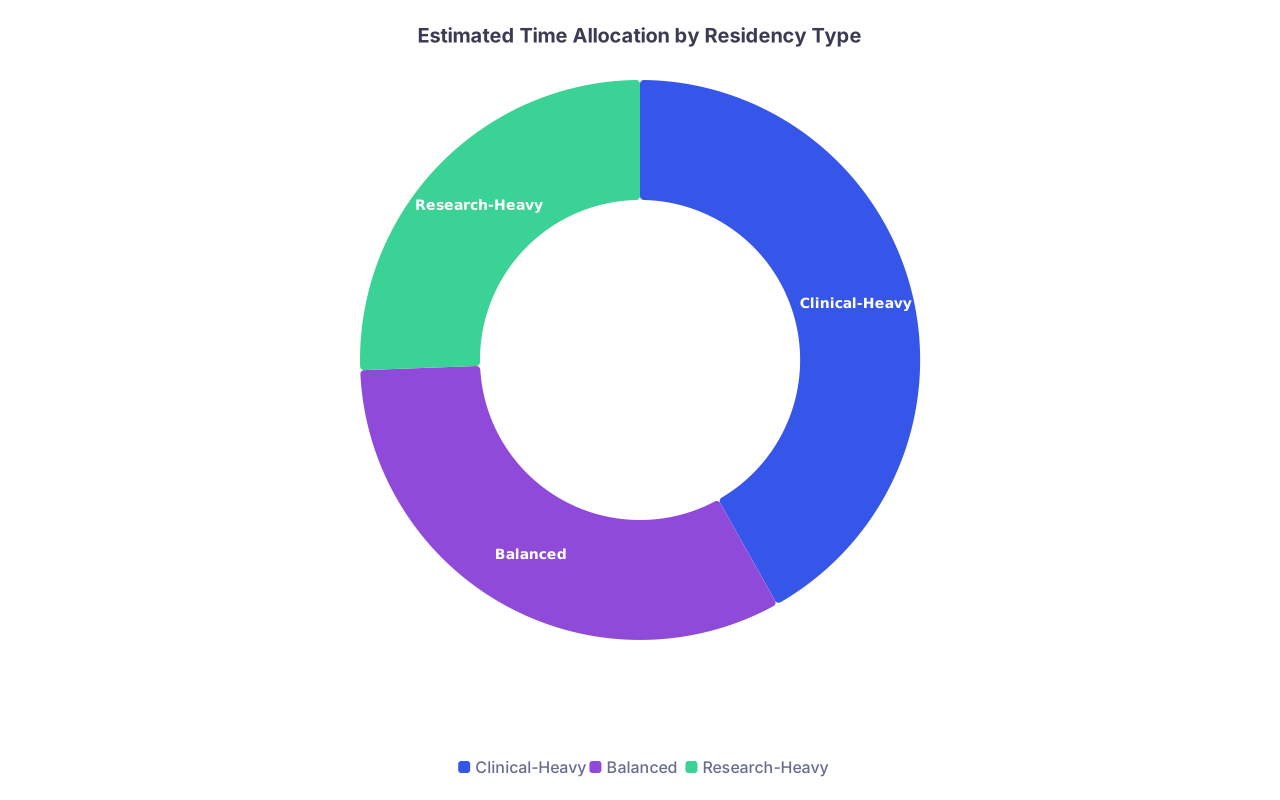
| Category | Value |
|---|---|
| Clinical-Heavy | 90 |
| Balanced | 70 |
| Research-Heavy | 55 |
Those numbers are not precise, but here is the takeaway:
- If you are clinician-only or clinician + small scholarly output, 90–95% clinical time is fine or even ideal.
- If you want to be a real clinician–scientist, 95% clinical time will strangle your research.
The key questions:
What percentage of your residency months are off-service electives?
- Can any be converted into research blocks?
- Do residents actually do that or is it theoretical?
Is there longitudinal time?
- An afternoon per week for 6–12 months is worth more than a single 2-week “research elective” that gets cancelled.
What does a typical PGY-2 or PGY-3 schedule look like for someone doing research?
- Ask for a sample schedule of a research-engaged senior resident.
Once you see their time layout, you will know quickly if your goals fit.
Step 5: Interrogate Programs on Interview Day (Without Sounding Clueless)
You cannot just ask, “Is there good research here?” They will always say yes.
You need sharper, operational questions. Here is a script you can adapt.
Questions for Residents
- “How many people in your class are actually involved in research right now?”
- “How many of them have presented at a regional or national meeting?”
- “Can you tell me about the last time someone had to give up protected research time to cover service?”
- “If I started a project PGY-1, what are the realistic chances I could get a poster or publication by PGY-3?”
Questions for Program Leadership
- “Do you track resident scholarly output? What were the numbers last year?”
- “Do you have a formal system for helping residents find research mentors?”
- “For residents in the research track (or heavily involved in research), how is their schedule adjusted to make that sustainable?”
- “Can you give specific examples of residents who recently matched into X fellowship and the kind of scholarly work they completed here?”
Questions for Faculty (especially potential mentors)
- “How many residents are you mentoring right now?”
- “In the last 2–3 years, how many resident first-authored projects have you had?”
- “If I joined your group as a PGY-1, what kind of project would you realistically start me on?”
Listen for vague answers. You want numbers, specifics, and names.
Red flag phrases:
- “We encourage residents to pursue whatever they are passionate about” with no structure described.
- “I have not had a resident working with me recently, but I am very open to it.”
- “We are building our research infrastructure” (translation: not ready yet).
Step 6: Evaluate Culture – The Invisible Force That Will Decide For You
You can have perfect infrastructure on paper and still never finish a project because the culture is wrong.
Watch for this during interview day:
What do residents brag about?
If they talk about:
- Operative cases.
- Busy nights.
- Sick patients.
- “We work hard but we are prepared.” Then you are in a clinical-first culture.
If they talk about:
- Presentations at national meetings.
- Lab meetings.
- Mentors, grant submissions. Then you have a more research-centered culture.
How do they talk about research?
- Positive culture:
- “Our PD fights to protect our research time.”
- “Almost everyone has at least one project.”
- Negative culture:
- “You can do research, but you have to really push for it.”
- “You can do it if you do not mind using your vacation.”
- Positive culture:
Attitude toward clinically heavy rotations
- If everyone looks burned out and bitter, there is a good chance you will not add research on top.
- A program can be busy and still functional, but if all residents say, “Honestly, nobody has gas left for research,” believe them.
Step 7: Compare Programs Side-by-Side with a Simple Grid
Your brain will get fuzzy after 5–10 interviews. Write things down in a structured way.
Here is a basic comparison grid you can build in a spreadsheet and fill using the checklist above.
| Program | Clinical Volume | Real Protected Time | Resident Publications | Research Track | Culture Fit (1–5) |
|---|---|---|---|---|---|
| A | High | Yes, 2–3 months | 10–15 per year | Yes | 4 |
| B | Moderate | Limited | 3–5 per year | No | 3 |
| C | Very High | None | 1–2 per year | No | 2 |
You can refine the columns:
- For your profile, weight certain factors higher:
- Clinician-only: Heavily weight clinical volume, board pass, autonomy.
- Physician–scientist: Heavily weight protected time, output, formal tracks.
Rank programs only after this exercise. Do not let “brand name” override a bad fit.
Step 8: Adjust for Specialty-Specific Realities
Different specialties have different baselines. Expect that.
Internal Medicine / Pediatrics / Neurology / Psychiatry
- Plenty of viable clinician–scientist and physician–scientist paths.
- Many large academic centers with:
- ABIM Research Pathways (IM).
- T32 or R38 slots.
- If you want research-heavy careers in these, programs must show:
- Real protected time.
- Documented research cultures.
Surgery and Surgical Subspecialties
- Culture is more clinically and operatively intense.
- True research often happens in:
- Dedicated research years between PGY-2 and PGY-3.
- If the program does not have an established “lab years” structure and you want a surgeon–scientist track, you will have a harder road.
Emergency Medicine, Anesthesia, Radiology
- Research cultures are more variable by program.
- Need to look particularly hard at:
- Presence of active faculty in your niche.
- Whether schedules reasonably allow research (e.g., batch shifts, academic days).
Step 9: Have a Plan for Each Path – What Success Looks Like
Too many residents say, “I want to do research,” with no definition of success. That is how they end up with three half-finished projects and nothing to show on paper.
Anchor yourself now.
If You Are Clinician-Only
Success = finishing residency clinically strong with minimal burnout and good outcomes.
- Confirm:
- Strong clinical evaluations.
- Solid board prep support.
- Reasonable schedule and wellness support.
Your main decision: Avoid overly research-pressured programs that will add stress without benefit.
If You Want Limited Scholarly Activity
Success = 1–3 tangible scholarly products by graduation.
Examples:
- PGY-1: Join or start a simple QI project → Internal presentation.
- PGY-2: Convert QI or chart review into poster at a regional/national meeting.
- PGY-3: 1 manuscript submitted (even if not accepted yet).
You need:
- One reliable mentor.
- One or two protected blocks or light rotations with time to write.
If You Want Clinician–Scientist Status
Success = sustained portfolio of work, not just a single poster.
- By graduation:
- 2–4 peer-reviewed publications, at least one first-author.
- Multiple regional/national oral or poster presentations.
- Clear research niche you can describe in 1–2 sentences.
If You Are Aiming at Physician–Scientist
Success = launch pad for a research career.
- By graduation or end of research pathway:
- First-author manuscripts in solid journals.
- Evidence of grant-writing exposure (or early career award submissions).
- Clear plan and mentorship for next-stage (fellowship, K award trajectory).
You cannot achieve that in a program where research time is optional, fragile, or ad hoc.
Step 10: Use a Simple Flow to Decide
If you want a visual way to check your decision logic, here is a stripped-down flow:

| Step | Description |
|---|---|
| Step 1 | Define your profile |
| Step 2 | Prioritize clinical volume and outcomes |
| Step 3 | Need real but limited research time |
| Step 4 | Require structured blocks and mentors |
| Step 5 | Physician scientist path |
| Step 6 | Need formal research tracks |
| Step 7 | Exclude programs with heavy research pressure |
| Step 8 | Check resident outputs and QI structure |
| Step 9 | Compare protected time and mentor depth |
| Step 10 | Rank only programs with proven pathways |
| Step 11 | Clinician only? |
| Step 12 | Want some scholarly work? |
| Step 13 | Aim for clinician scientist? |
Follow that tree for each program you are considering. If a program fails at the requirement for your path, stop trying to rationalize it.
Your Next Move: Build and Use Your Checklist Today
Do not wait until interview season chaos to sort this out.
Here is what you should do today:
- Write your profile at the top of a page: Clinician-only, clinician + scholarly, clinician–scientist, or physician–scientist.
- List 3–5 non-negotiables for research vs clinical balance based on that profile.
- Build a 1-page checklist with:
- Clinical volume and autonomy questions.
- Research infrastructure and culture questions.
- Take one program you are already considering and run it through your checklist using their website, current residents’ contacts, and public data.
If, after that exercise, you cannot explain in two sentences why that program fits your research–clinical balance, do not rank it highly. Open your spreadsheet or notebook right now and start that grid. One program, ten minutes. That is how you stop guessing and start choosing.