
The worst problem in residency applications is not having no options. It is having too many “good” ones and no clear way to rank them.
You are not confused because you are indecisive. You are confused because you are trying to compare apples to MRI scanners using vibes and hearsay. That does not work.
Here is the fix: turn your rank list into a structured decision problem, run it through a stepwise framework, and force programs to compete on your terms, not theirs.
Step 1 – Stop Asking “Which Is Best?” and Define “Best For You”
Most applicants stall right here. They say:
- “Program A is higher ranked but Program B felt friendlier.”
- “This one has better research, but that one is closer to family.”
- “I liked all of them.”
That is not analysis. That is noise.
You need non‑negotiables and prioritized preferences. Write them down. Literally.
1.1 Lock in Your Non‑Negotiables (Hard Filters)
These are yes/no items. If a program fails any of these, it should drop far down or off your list entirely, no matter how “prestigious” it is.
Common non‑negotiables (adapt these, do not just copy):
- Geographic requirements
- Must be within X hours of partner/children/parents
- Cannot tolerate extreme weather / cost of living in certain cities
- Program structure
- Categorical spot vs advanced with weak prelim year
- Must have strong training in X (eg, trauma exposure, OB numbers)
- Dealbreakers
- Known malignant culture (from multiple trusted sources)
- Chronic under‑staffing or violation of duty hour rules
- Chaos-level disorganization (no schedule, frequent last‑minute changes)
Action:
Make a simple checklist and run every program through it.
Example:
- Within 3 hours of partner?
- No credible reports of malignant culture?
- Strong exposure to my intended fellowship / practice style?
- Reasonable cost of living?
If a program fails 2–3 of your non‑negotiables, you are trying to talk yourself into it. Put it near the bottom.
1.2 Turn “Preferences” into Ranked Categories
Non‑negotiables separate acceptable from unacceptable.
Preferences separate good from ideal.
Build 6–8 categories that actually matter to your career and sanity. Do not go beyond 10 or you will overfit and stall out.
Example category list for Internal Medicine:
- Clinical training strength
- Fellowship opportunities
- Resident culture / wellness
- Location & lifestyle
- Mentorship and teaching quality
- Schedule and workload (call, nights, rotation structure)
- Reputation for my goals (academics vs community)
- Support systems (family nearby, partner job market, child care)
You are going to score each program in each category. But first, you decide how much each category counts.
Step 2 – Assign Weights: Force Yourself to Choose What Actually Matters
Most people say “everything is important.” That is how you end up stuck in analysis paralysis.
You need weights. You are deciding how much impact each category has on your happiness + career outcome equation.
2.1 Create Your Weighting System
Use a simple 0–10 importance scale and then normalize.
Example for a student who cares a lot about fellowship and culture, less about location:
- Clinical training: 9
- Fellowship outcomes: 10
- Resident culture: 9
- Mentorship / teaching: 8
- Location / lifestyle: 5
- Schedule / workload: 6
- Reputation for academics: 7
- Support systems (family, partner): 6
Total = 60
Now convert to percentages:
| Category | Raw Weight | Percent |
|---|---|---|
| Clinical training | 9 | 15% |
| Fellowship outcomes | 10 | 17% |
| Resident culture | 9 | 15% |
| Mentorship/teaching | 8 | 13% |
| Location/lifestyle | 5 | 8% |
| Schedule/workload | 6 | 10% |
| Reputation | 7 | 12% |
| Support systems | 6 | 10% |
You could keep using the raw numbers instead of percentages, but the point is the same: you have to decide. Culture and training might matter more than zip code. Or the opposite, if your spouse’s job depends on one city.
2.2 Check for Internal Honesty
Ask yourself two blunt questions:
- If Program A has much better fellowship placement but is two states away from family, which would I pick today if I had to sign a contract?
- Would I really trade a supportive, non‑toxic culture for a tiny prestige bump?
Adjust your weights until they match your actual answers, not what you think you “should” value.
Step 3 – Score Each Program Systematically (and Fast)
Now you turn all those fuzzy impressions from interview day into numbers you can compare.
3.1 Use a 1–5 or 1–7 Rating Scale Per Category
Do not overcomplicate. I like 1–5:
- 1 – Very weak / red flag
- 2 – Below average
- 3 – Solid / acceptable
- 4 – Strong
- 5 – Outstanding / best‑in‑class
You are comparing relative to other places you interviewed, not the entire country.
Example for three IM programs you liked (A, B, C):
| Category | Weight | Program A | Program B | Program C |
|---|---|---|---|---|
| Clinical training | 9 | 5 | 4 | 4 |
| Fellowship outcomes | 10 | 5 | 3 | 4 |
| Resident culture | 9 | 3 | 5 | 4 |
| Mentorship | 8 | 4 | 4 | 3 |
| Location | 5 | 2 | 4 | 5 |
| Schedule/workload | 6 | 3 | 4 | 3 |
| Reputation | 7 | 5 | 4 | 3 |
| Support systems | 6 | 2 | 4 | 5 |
You are capturing your gut sense but with structure.
3.2 Convert to Weighted Scores
Multiply each category score by its weight, then sum.
Program A – Weighted sum example:
- Clinical training: 5 × 9 = 45
- Fellowship: 5 × 10 = 50
- Culture: 3 × 9 = 27
- Mentorship: 4 × 8 = 32
- Location: 2 × 5 = 10
- Schedule: 3 × 6 = 18
- Reputation: 5 × 7 = 35
- Support: 2 × 6 = 12
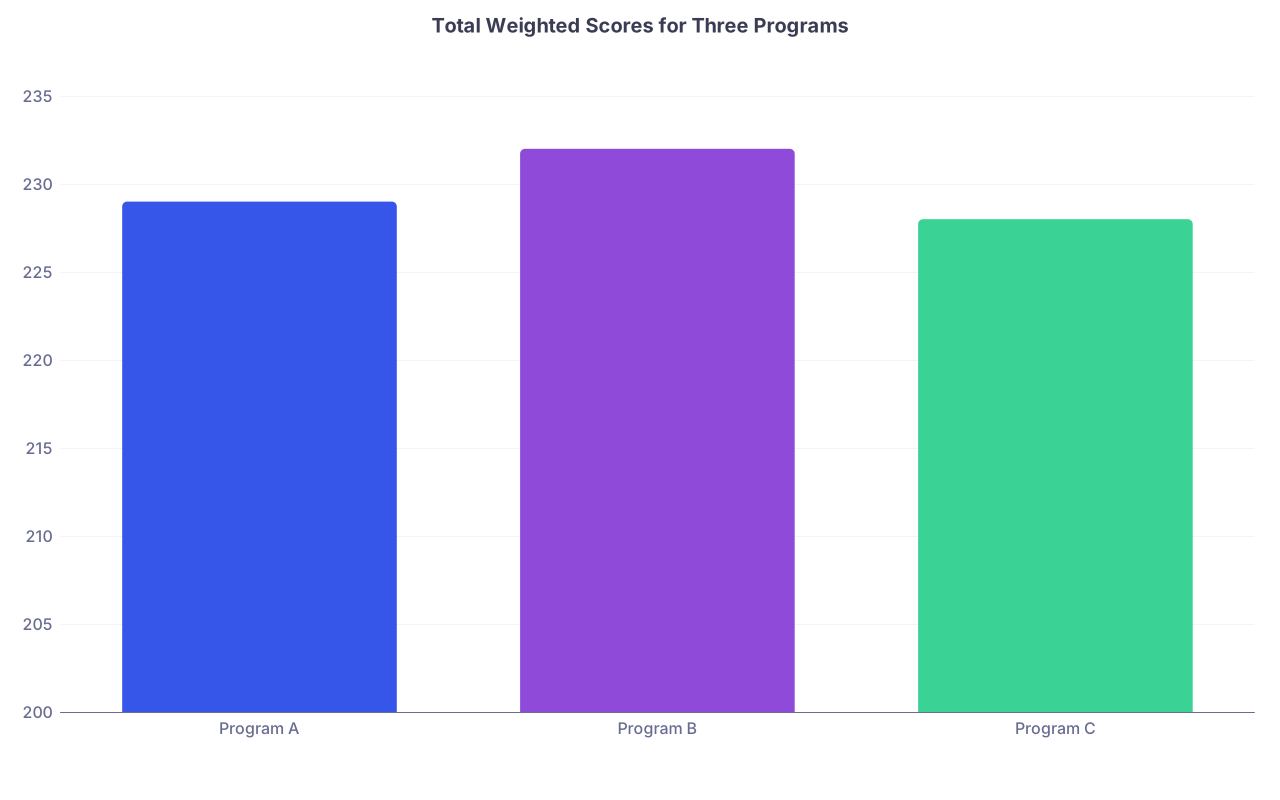
Total = 229
You do the same for B and C.
Let me show you this as a final comparison:
| Category | Value |
|---|---|
| Program A | 229 |
| Program B | 232 |
| Program C | 228 |
You might be surprised when the “famous” or “shiniest” program loses once your actual priorities are applied.
If your scores are very close (like the example above), that is where the next steps come in.
Step 4 – Run the Two Crucial Reality Checks
Numbers are powerful. But they can also hide lies you are telling yourself. So you stress‑test your ranking with two filters: Regret Test and Future You Test.
4.1 The Regret Test (Thought Experiment That Works)
For any tight pair (say Program A vs B):
- Assume you ranked A above B. You match at A.
- Ask: “If my friend then matched at B and loved it, would I feel:”
- Mostly relieved I am at A?
- Genuinely jealous and second‑guessing?
If you feel a gut punch imagining yourself at A while they are at B, you secretly prefer B. Fix your list.
I have watched plenty of people ignore that feeling, then complain for years afterward.
4.2 The “PGY‑3 Looking Back” Test
Fast‑forward three years. You are a PGY‑3 or about to finish residency. You are exhausted, more jaded, and a lot more realistic.
Ask Future You one specific question:
“What about this program would I most thank my past self for choosing? What would I curse them for ignoring?”
Then look at your categories:
- If Future You is trying to match GI, you will care a lot less that the program was in a “fun city” and a lot more that you had strong research and letters.
- If Future You carried a newborn through residency, you will care a lot more about call burden, child care, and support than you think right now.
Rerun your weights if this test reveals a mismatch.
Step 5 – Face the Two Biggest Hidden Variables: Culture and Pain
You can survive almost anything for three to seven years if the people and environment are decent.
You can burn out in 12 months in a “prestigious” program with malignant leadership.
5.1 Culture: Stop Guessing from One Interview Day
Everyone says, “Residents seem happy.” Of course they did. They got selected to talk to you.
You want converging evidence, not one polished Zoom session.
Concrete ways to probe culture:
- Look for patterns in resident answers
- When asked about weaknesses, do they all give the same canned line?
- Anyone openly mention things like “leadership was responsive when…”, “we had some issues with X but it improved”? That is a good sign.
- Ask former or current residents you know privately
- “What would make you leave if you could?”
- “Would you send your little sibling here?”
- Watch how faculty talk about residents
- Respectful and specific? Or dismissive and vague?
If you have two programs with similar numbers, use culture as a major tiebreaker. The daily grind matters more than prestige.
5.2 Pain Budget: How Much Misery Can You Tolerate for a Goal?
Some programs are clearly harder:
- More call, more nights
- Tougher patient population, fewer resources
- High expectations for research output
Sometimes that is worth it. Sometimes not.
You need a rough personal “pain budget”:
- For a shot at a hyper‑competitive fellowship? Maybe you tolerate more.
- For primary care in a community setting? You probably do not need a soul‑crushing three years to be excellent.
Ask honestly:
“If this program gives me better doors but makes the next three years 30–40% more painful, am I still in?”
If the answer is no, rank accordingly. You are not weak. You are planning for sustainability.
Step 6 – Use Context: Career Goals, Specialty Nuances, and Life Realities
Your framework needs some specialty‑specific and life‑specific tuning. Not all factors carry the same weight in every context.
6.1 How Your Career Goal Changes the Equation
Wants elite fellowship / academic career
- Heavier weight to: clinical rigor, fellowship match history, research infrastructure, faculty names
- You may accept: tougher schedules, less “sexy” locations
Wants community practice / primary care
- Heavier weight to: broad hands‑on experience, autonomy, community ties, procedural exposure
- Prestige matters less. Quality of life can matter more.
Undecided
- Aim for: balanced programs with exposure to subspecialties, advising that is actually functional, and reasonable flexibility to pivot.
6.2 Specialty‑Specific Examples
Surgery
- Case volume, operative autonomy, and fellowship outcomes matter a lot.
- Culture around feedback and hierarchy can make or break your sanity.
Psychiatry
- Quality of psychotherapy training, addiction exposure, and call burden at psych vs ED differ widely.
- Burnout risk is high; culture and supervision are critical.
Emergency Medicine
- ED volume, acuity, and off‑service rotations; flight/EMS exposure if you care; shift scheduling patterns matter.
Tweak your categories and weights with these realities in mind.
6.3 Life Logistics Are Not “Soft Factors”
Residents wreck themselves pretending life does not matter.
Reality check:
- Partner job market and visa issues
- Support with kids (child care, grandparents nearby, school systems)
- Personal health needs, ongoing medical care
- Financial pressure (cost of living vs salary)
These are not secondary. They will directly influence whether you show up functional or depleted.
Treat them as real categories with real weights.
Step 7 – Apply a Simple, Repeatable Ranking Workflow
Let us turn this into a concrete protocol you can execute in a weekend.
7.1 One‑Page Per Program Summary
For each program, create a single page (digital or paper) with:
- Quick stats (class size, location, program type)
- Your scores for each category
- 3 bullets: “What excited me most”
- 3 bullets: “What worried me most”
- Any red/yellow flags
This prevents you from relying on the fuzzy memory of one “fun dinner.”
7.2 Score, Then Sort
- Plug each program’s scores into your weighted system.
- Calculate total scores.
- Sort from highest to lowest.
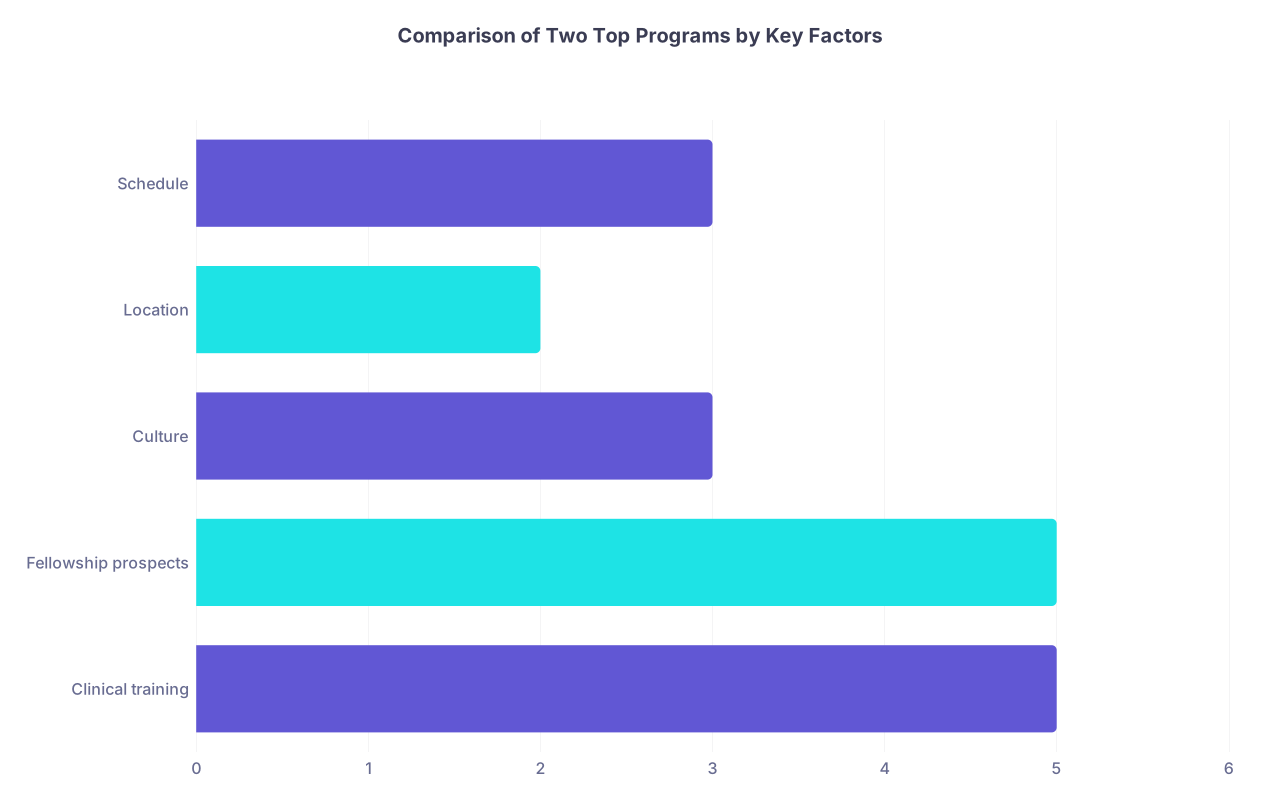
If you like, visually compare top programs and how they differ by category:
| Category | Value |
|---|---|
| Clinical training | 5 |
| Fellowship prospects | 5 |
| Culture | 3 |
| Location | 2 |
| Schedule | 3 |
(Example: Program A’s relative scores)
You can build similar for your second program and see the tradeoffs clearly instead of hand‑waving them.
7.3 Only Then Bring in Your Gut
Once you have a preliminary numeric order, ask:
- “Does any program feel clearly too low or too high?”
- If so, why exactly? Which category score or weight was wrong?
You are allowed to override the numbers, but if you do, document the reason. That protects you from last‑minute panic reshuffling based on random gossip.
7.4 Use a Decision Flow When You Still Feel Stuck
If two or three programs are basically tied and you keep spinning, use a simple decision tree:

| Step | Description |
|---|---|
| Step 1 | Programs tied by score |
| Step 2 | Rank red flag program lower |
| Step 3 | Rank better culture higher |
| Step 4 | Rank better logistics higher |
| Step 5 | Follow gut, document reason |
| Step 6 | Treat as interchangeable |
| Step 7 | Any clear red flags? |
| Step 8 | Culture meaningfully different? |
| Step 9 | Life logistics clearly better? |
| Step 10 | Strong gut preference? |
If you get to “treat as interchangeable,” then stop overthinking. The Match algorithm already favors your preferences. Let them tie.
Step 8 – Sanity Checks Before You Certify Your Rank List
Before you hit submit, do three quick passes.
8.1 The “Would I Rather Go Unmatched?” Filter
For any program in your lower half, ask:
“Would I genuinely prefer to go unmatched (or SOAP into something else) than train here?”
If yes, move that program below any options you would accept via SOAP or leave it off. Do not rank programs you absolutely would not attend.
(Obvious exception: hyper‑competitive specialties where reapplying is your plan. But be honest about that strategy.)
8.2 The “Partner/Family Reads It” Check
If you have a partner or close family deeply affected by this choice:
- Show them your category list, weights, and top 5 rankings, not just the final order.
- Ask: “Does this reflect what we have been saying matters for the last year?”
You will catch mismatches, especially around location and support.
8.3 Time‑Delay Confirmation
Do this:
- Finish your list.
- Do not touch it for 48 hours.
- Re‑open it and see if anything feels obviously wrong after some distance.
If you are still comfortable, certify it and walk away.
Example: Two “Great” Programs, One Clear Answer
You interviewed at:
- Program X – Big‑name, urban, famous fellowship pipeline, rougher culture, high cost of living.
- Program Y – Mid‑tier academic, strong but not elite, very supportive, lower cost, closer to family.
You want a cardiology fellowship, but you also care a lot about mental health and having a child during residency.
When you run the framework:
- Training and fellowship: X slightly higher than Y.
- Culture: Y clearly higher.
- Support systems, location, cost: Y much higher.
- Schedule: Y modestly better.
Weighted totals come out close, but when you apply:
- Regret Test – You imagine matching at Y and a friend at X. You feel a tiny twinge of prestige envy but mostly relief you will not be crushed by a toxic department.
- Future You Test – As a PGY‑3 applying for cards with a 2‑year‑old at home, you know you will care more about letters and productivity than whether the name is “top 10.” Both can get you there if you perform.
You rank Y above X. Ten years from now, that will likely look like a very smart decision.
Common Mistakes That Wreck Rank Lists
You can avoid most of the classic errors with one read‑through.
- Overvaluing anonymous online opinions
- Student Doctor Network horror stories from 2016 are not a reliable data source.
- Chasing clout over fit
- Matching at the “best” program means nothing if you are miserable or underperform because of misfit.
- Making the list in one frantic sitting
- Rushed rank lists track anxiety, not values.
- Ignoring your own red flags because “maybe it will be fine”
- If 3 residents independently hinted at leadership problems, believe them.
- Letting someone else’s priorities quietly override yours
- Attending: “You should rank BigName U first.” They are not living your life.
Your framework is how you protect yourself from this noise.
Quick Reference: Minimalist Framework If You Are Short on Time
If you are late in the game and do not have the energy for full spreadsheets, do the stripped‑down version:
Define 4 critical categories
- Training quality
- Culture
- Career alignment (fellowship or practice type)
- Life logistics (location/support/cost)
Assign rough priority
- Label them 1 (highest) to 4 (lowest) importance.
Rank each program by each category verbally
- “For training quality: 1) A, 2) C, 3) B…”
- Repeat for each category.
Score by placements
- Each #1 rank gets 3 points, #2 gets 2, #3 gets 1, etc.
- Sum across categories but double‑count your top priority category.
Apply regret and future tests to any ties.
Even that abbreviated process beats “I dunno, I just liked them all.”