
It is late November. ERAS is sent, interview invitations are trickling in, and your partner just got the email: their company will not approve a transfer outside three specific cities. None of those cities match your current top residency programs.
You are staring at a spreadsheet with:
- Programs you love that are nowhere near your partner’s job hubs
- A few “OK but not exciting” programs in the right cities
- A sinking feeling that you might have to choose between your career and your relationship
You do not. But you do need a strategy. A serious one. Not the hand-wavy “we’ll figure it out” that people say on group chats and then regret in March.
I am going to walk you step by step through how to handle this when your partner’s job is boxing in your residency options.
Step 1: Get Concrete About Your Constraints (Not Vibes)
Most couples stay vague way too long.
“I’d prefer to stay near Boston.”
“We really want the West Coast.”
That is how you end up in February realizing Silicon Valley “West Coast” does not actually line up with “smallish community program in Eastern Washington.”
You need hard, non-negotiable parameters. Right now.
A. Pin down your partner’s actual job constraints
Have your partner answer, in writing if needed:
Where can they reasonably work from July 1 of your intern year?
- Cities where they already have an office or client base
- Locations their company has explicitly approved (not “maybe”)
- Fully remote? Then clarify time zone and travel expectations
What is their timeline flexibility?
- Can they stay put for PGY-1 and move PGY-2?
- Can they leave their job if needed and search in a new market?
- Are there promotion or vesting cliffs (e.g., bonus, equity) that matter?
What is their minimum acceptable scenario?
- “I can change jobs as long as we are in [metro areas].”
- “I must stay with this company until X date, and they only allow me in [cities].”
If they have not talked to their manager/HR, that conversation needs to happen this week. “Probably can move” is useless. You want “I spoke to my manager, and they said X is possible, Y is not.”
B. Define your residency boundaries
On your side:
Where can you realistically train?
- Which states do you absolutely refuse because of licensing, proximity to family, or personal reasons? Be honest.
- Any geographic dealbreakers (e.g., must be within 2–3 hours of aging parents or shared custody situations)?
What is truly non-negotiable career-wise?
- You want cardiology vs. you want academic cardiology vs. you want top-tier research in advanced heart failure. Those are different search spaces.
- Some regions simply do not have the ecosystem you need for hyper-competitive fellowships.
Rank your priority for the next 3–7 years:
- Career prestige/training
- Relationship stability/location
- Lifestyle/cost of living
- Support system (family/friends/childcare)
You cannot maximize all 4. Pick 1–2 that drive decisions. Explicitly.
Step 2: Build a Real Overlap Map (Not Just a Mental Guess)
Now you combine both sets of constraints into something you can see.
A. Create an overlap grid
- Columns: Major metro areas your partner can work in
- Rows: Specialty-friendly residency regions/program clusters you would consider
Then mark:
- “Strong Fit” – realistic programs that match your training and city constraints
- “Acceptable” – less ideal but still solid training
- “Avoid” – only if absolute emergency
Here is how that might look in practice:
| City/Region | Partner Job Feasible | Residency Density | Overall Coupled Fit |
|---|---|---|---|
| Boston | Yes | High (multiple academic IM, neuro, surg) | Strong Fit |
| NYC/NJ | Yes | Very High | Strong Fit |
| Chicago | Yes | High | Strong Fit |
| Seattle | Maybe (new role needed) | Moderate | Acceptable |
| Smaller Midwest | No | Variable | Not Feasible |
Do this for your specific situation, not hypotheticals.
B. Use actual program data, not rumors
Stop going by “I heard that program is malignant” from a third-year who rotated there in 2016.
For each overlapping city:
- Pull a list of all residency programs in your specialty within a 60–90 minute commute radius.
- For each program, look at:
- Board pass rates
- Fellowship match list (or for non-fellowship specialties, job placement)
- Call schedule and culture (talk to current residents, not just the website)
- Whether they have couples match experience (ask directly)
You will quickly see that some “second tier” programs in good cities are significantly better training environments than “big name” programs in miserable locations. I have seen people much happier at “no-name” academic affiliates in Chicago than flagship programs in isolated towns.
Step 3: Decide Your Relationship Strategy Early (Not in February)
This is the talk people avoid. Then they end up in panicked meltdown mode two weeks before rank list certification.
You need to choose which model you are operating under:
- Same city, same home
- Same city, two homes temporarily
- Commuter (e.g., weekly travel)
- Long-distance with a plan for reunification by PGY-2/3
A. Ask each other the hard questions
Sit down and answer, each on your own first:
Are we willing to do:
- 1 year long-distance?
- 3 years long-distance?
- Never long-distance?
What is worse for us:
- You in a significantly weaker program but same city
- You in a strong program, but we live apart for part of training
Where do kids / fertility / family care fit into this timeline?
- For some couples in their mid-thirties, staying in the same city matters more than getting the “perfect” program because of future constraints.
- For others, especially earlier in training, temporarily splitting locations is survivable.
You are not choosing what sounds most romantic. You are choosing what is least likely to blow up your relationship or your career three years from now.
Step 4: Adjust Your Application Strategy Like an Adult
Most people never update their application plan after the job constraint appears. They just “hope it works out.”
You are going to fix that.
A. Re-balance your program list
You want something like this:
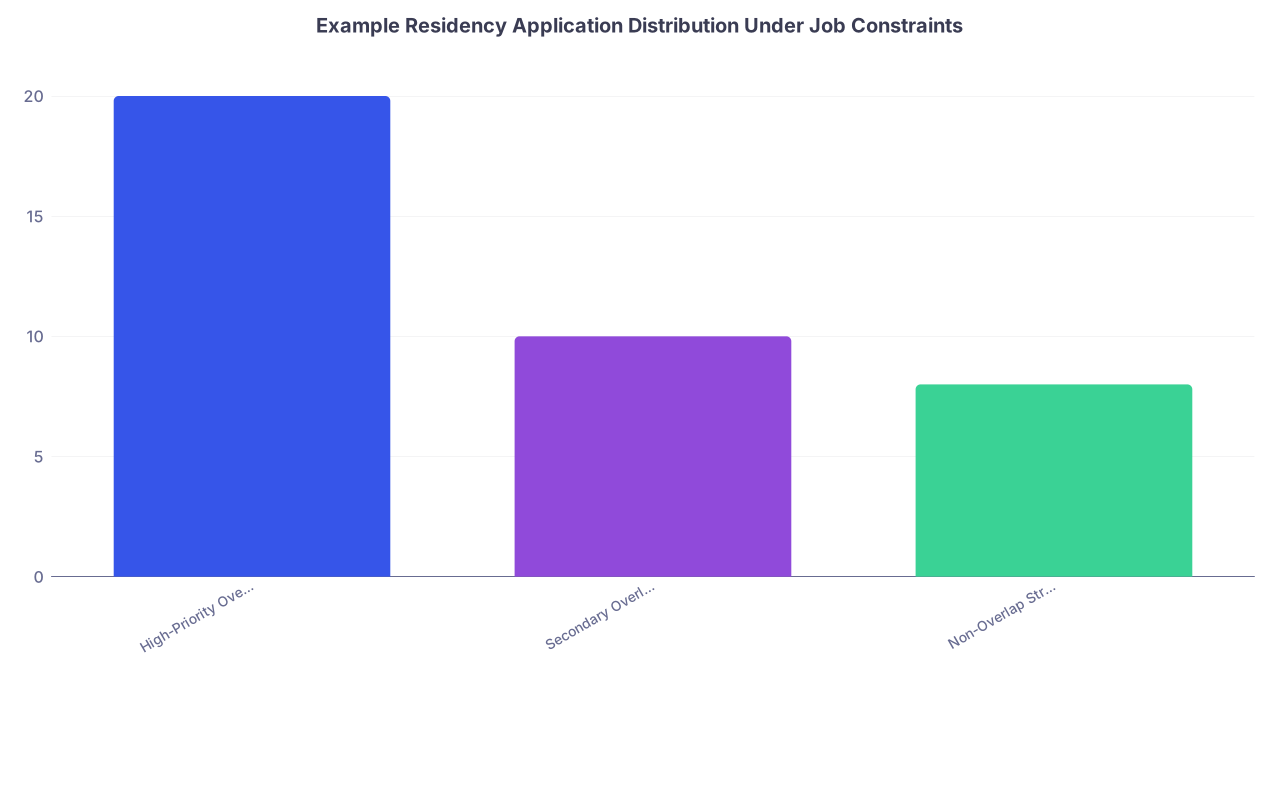
| Category | Value |
|---|---|
| High-Priority Overlap Cities | 20 |
| Secondary Overlap Cities | 10 |
| Non-Overlap Strong Programs | 8 |
Example for an internal medicine applicant:
- 20 programs in 2–3 cities where your partner definitely can work
- 8–10 programs in “stretch” cities where they might be able to transfer
- A small number (5–8) of top-tier dream programs outside all constraints, only if they are truly career-defining
If your partner’s job constraint is hard (e.g., must be in NYC or Boston), then 70–80% of your applications should be there. Not scattered across the country.
B. Use couples match intelligently (even if only one of you is matching)
If both of you are in ERAS:
Use NRMP couples match and aggressively pair combinations in your overlap cities. You will rank long “chains” of combinations within the same metro area (Program A + Program X, Program A + Program Y, etc.) before you ever rank cross-country combos.
If only you are in ERAS and your partner is working:
You are still acting like a couples match, just outside the algorithm. Your “pairing” is: Program + Realistic Job Market.
So your rank list essentially becomes:
1–10: Programs in City A (where partner is locked in / best options)
11–18: Programs in City B (backup market for partner)
19+: Only if both of you agree they are long-shot but acceptable options
Be explicit: “We will not rank programs in cities where you cannot work longer than 6 months.”
Step 5: Triage Programs by Training Quality vs. Location
Now the real tension: mediocre program in a great city with your partner vs. strong program somewhere your partner’s job cannot easily follow.
You need a framework. Otherwise you chase names or chase comfort, and both can be bad.
A. Rough tiers to think in
| Tier | Program Quality | Location Fit with Partner Job | What It Means |
|---|---|---|---|
| 1 | Excellent | Strong | Ideal |
| 2 | Excellent | Weak/None | Career-first, relationship strain |
| 3 | Good | Strong | Balanced, usually best compromise |
| 4 | Marginal | Strong | High relationship, career risk |
| 5 | Marginal | Weak/None | Avoid unless absolute emergency |
You want to maximize Tier 1 first, then Tier 3. Tier 2 can be worth it for ultra-competitive paths. Tier 4 is where people burn out and regret it.
B. Questions to interrogate a “mediocre” program in a good city
Before writing off a “less prestigious” program in your partner’s job city:
- Do they routinely match graduates into your desired fellowships or jobs?
- Are graduates board-certified and employable in the regions you care about long term?
- Is the culture humane enough that your relationship does not disintegrate?
If the answers are yes, yes, and yes, that program might be a much better real-world choice than the big fancy name in a city where your partner is miserable or unemployed.
Step 6: Use Interview Season to Pressure Test Reality
Interviews are not just about selling yourself. They are where you force the details.
A. What you should ask programs (directly but professionally)
On interview day or during resident socials:
- “How common is it for residents to have partners working in X industry in this city?”
- “Do people often live in [specific suburb] and commute? Is that realistic with call?”
- “Have you had couples where one partner had a non-medical job constraint? How did that work?”
With the program director or APD (when appropriate):
- “My partner’s job will likely anchor us to [city/metro]. Long-term, I am interested in [fellowship/job type]. Have your residents planning to stay local had success achieving that from here?”
If they look confused or dismissive about dual-career issues, that is data.
B. What your partner should do during interview season
They are not a passive passenger in this.
Your partner needs to:
- Reach out to recruiters or managers in each metro area where you have interviews.
- Ask bluntly:
- “If we relocate to [city] in July, how likely am I to find a role at my level in [industry] within 3–6 months?”
- “Does your company have a footprint in [City A, B, C]?”
- Track:
- Number of viable job options per city
- Salary ranges
- Time-to-hire expectations
That way, by the time you are building your rank list, you both know which cities are realistic for two careers, not just one.
Step 7: Build a Joint Rank List Strategy (Not Just Yours + Their Opinion)
The rank list is where couples implode if they are not aligned. I have seen it more than once.
A. Work backwards from your worst acceptable outcome
Start with this sentence:
“The worst outcome we would still stay together and accept is:
You at [tier of program] in [type of city], me in [job scenario].”
If you cannot complete that sentence, you should not be ranking programs beyond your overlap zones.
Then, your process:
-
- Tier A: Strong job options + good programs
- Tier B: One of you compromised significantly but still feasible
- Tier C: Only in case of catastrophe
Within each city, tier programs by training quality
- A1, A2, A3… for top programs and so on
Create an ordered list where city tiers and program tiers are both respected
- Example:
- Rank all Tier A city + strong program combos first
- Then Tier B city + strong program
- Then Tier A city + acceptable program
- Only then consider Tier C or marginal program scenarios
- Example:
This forces you to think like a unit, not two independent people.
Step 8: If You End Up Long-Distance, Make It Structured, Not “We’ll See”
Sometimes the match just does not line up. Or your partner’s company refuses to move them. Or you get into a dream program far from any viable job market.
If you choose long-distance, you treat it like a project plan, not a vague hope.
A. Define the time box
You need a clear, mutually agreed time horizon:
- “We will do long-distance for PGY-1 only and re-evaluate in January of PGY-1 for transition by PGY-2.”
- Or “We accept 2 years max of long-distance if and only if:
- My program is giving me tangible career benefits
- You are working on moving or changing jobs.”
Put dates to it. Mark them in a shared calendar.
B. Make the commute and costs explicit
Long-distance without a plan drains money and energy fast.
Sit down and list:
- Expected travel frequency (every week, every 2 weeks, monthly)
- Average flight/train costs
- Time off realities (interns do not get many free weekends early on)
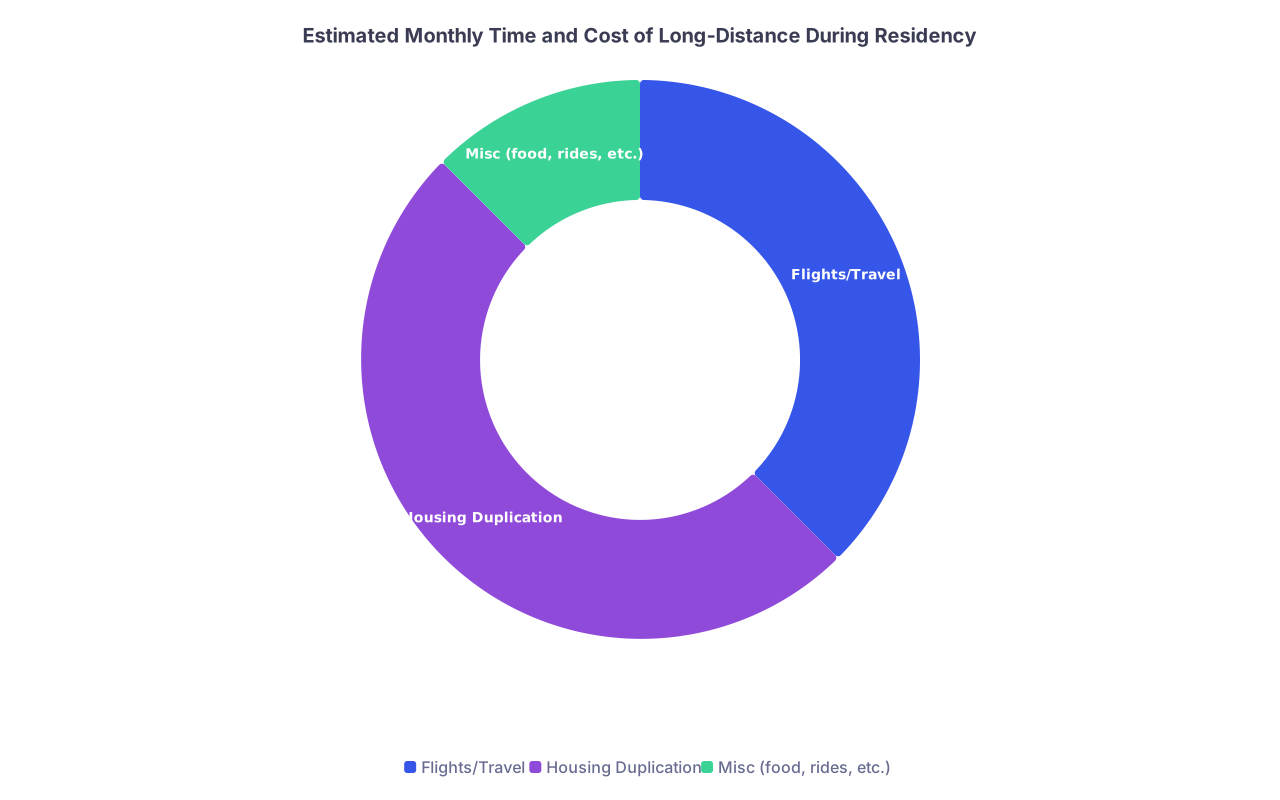
| Category | Value |
|---|---|
| Flights/Travel | 600 |
| Housing Duplication | 800 |
| Misc (food, rides, etc.) | 200 |
Once you see numbers like that, some couples rethink the “it will be fine” assumption.
Step 9: Protect Your Relationship During Residency (Regardless of Where You Match)
Even if you match in the same city, residency is rough on relationships.
You are going to be:
- Sleep-deprived
- Emotionally drained
- Frequently feeling guilty (either about work or home)
You need a basic operating plan.
A. Set a realistic baseline for connection
Examples that actually survive residency:
- One 30–45 minute protected “no phones” conversation per week (video if apart)
- One “non-medical” time together weekly (walk, dinner, Netflix episode)
- A quick daily check-in text or 5-minute call on bad days
Not grand gestures. Just consistent, low-friction habits.
B. Get ahead of resentment
This part is ugly but real.
Resentment creeps in when:
- One partner feels like their career “took the hit”
- The other feels permanently guilty but also helpless
You both need to say out loud:
- “We are making this choice together for the next 3–7 years.”
- “Later, when it is your turn for a career move or promotion, I will adjust my choices too.”
If one of you is compromising more now, you plan when the pendulum will swing. Medical careers are long. There is room for both of you to win, but not always simultaneously.
Step 10: If the Job Constraint is Truly Incompatible, Name That Too
Sometimes the honest answer is:
Your partner’s job is completely incompatible with your training path in any sustainable way.
Examples:
- They refuse to consider any relocation or job change, and their current city has zero programs in your specialty.
- They demand you only apply to 1–2 programs that are unrealistic for your competitiveness.
- They will not even discuss options or timelines.
You then face a tougher decision:
Is this a temporary logistics problem or a fundamental misalignment in life priorities?
I have seen residents try to force it. They end up:
- In the wrong specialty
- In bad programs
- Or in a long-distance relationship that is effectively dead within a year
You owe it to yourself and to them to be honest early. Not after you have matched into a three-year commitment.
Quick Visual: The Overall Decision Flow

| Step | Description |
|---|---|
| Step 1 | List partner job cities |
| Step 2 | List viable residency regions |
| Step 3 | Find overlap cities |
| Step 4 | Prioritize applications in overlap cities |
| Step 5 | Apply broadly, plan time limited distance |
| Step 6 | Reassess partner job flexibility or specialty/plan |
| Step 7 | Interview and validate job markets |
| Step 8 | Jointly build ranked tiers of cities and programs |
| Step 9 | Create rank list honoring both careers |
| Step 10 | Any strong overlap? |
| Step 11 | Willing to do long-distance? |
Final Reality Check
You are not choosing a fantasy scenario. You are choosing which tradeoffs you can live with.
Three key points to keep in your head:
- Get specific early. Vague “we’ll figure it out” conversations lead to panicked, bad decisions when rank lists are due.
- Optimize for strong enough training in a city where both of you can realistically work and live, not just for the flashiest program name.
- Whatever compromise you make, make it explicit, time-limited, and mutual—so neither of you ends up quietly resentful halfway through PGY-2.
Do this like adults, and you really can protect both your career and your relationship. Not perfectly. But well enough.