
The way most applicants “feel out” residency programs is broken. You do not need more vibes. You need a system.
You can build that system—a residency fit rubric tailored to you—in under 60 minutes. And it will be better than any ranking list, Reddit thread, or “my friend said this program was chill” story you have heard this year.
Let me walk you through it step by step.
Step 1: Set a 60-Minute Timer and Define the Goal (5 minutes)
Do not “plan to work on it this weekend.” That is how this kind of thing never happens.
- Pick a 60-minute block. Today.
- Put your phone in another room.
- Open:
- A blank Google Sheet or Excel file
- A simple notes app or paper
Your goal for the next hour is not to perfectly evaluate every program.
Your goal is:
Build a simple, repeatable scoring system that lets you compare residency programs quickly, consistently, and with far less emotional noise.
This is a decision-support tool. Not a prison. You can override it. But you will override it with intent, not because the residents seemed nice on Zoom.
Step 2: Brain-Dump What Actually Matters to You (10 minutes)
If you skip this and just copy someone else’s rubric, you will end up training for a life you do not want.
For 10 minutes, answer these prompts in a notes doc. No editing. Short phrases. Fast.
1. Life outside the hospital
- Where do you realistically want to live for 3–7 years?
- Who else is in your life? Partner, kids, parents, support system?
- What do you absolutely hate in a city? (Heat, cold, driving, isolation, cost?)
- Do you care more about:
- Proximity to family
- Cost of living
- Fun / culture / outdoors
2. Training style and workload
- Do you want high-volume “sink or swim” or more protected teaching?
- How many call nights per month are you willing to tolerate?
- Are you okay with older-school culture (“we worked 120 hours, so you can do 80”)?
- How much do you care about Wellness™ vs just not being abused?
3. Career goals
- Fellowship or straight-to-practice?
- Academics vs community vs private practice?
- Research expectations: Hate it, tolerate it, or love it?
- Do you want a sub-specialty that only certain programs can realistically feed?
4. Program culture
- What behaviors are hard no’s for you? (Yelling, shaming, hidden malignant attendings, blatant disregard of rules)
- Do you prefer tight-knit small classes or anonymity in a bigger group?
- Diversity: how much does representation of residents/faculty and inclusion efforts matter to you?
5. Personal health and sanity
- Sleep: do you break on chronic night float?
- Mental health: have you burned out before? What triggered it?
- Support: do you need real vacation, therapy access, or flexible sick policies to stay functional?
Once you are done, scan what you wrote. Circle or bold phrases that show up repeatedly. That repetition = priority.
You just created the raw material for your rubric.
Step 3: Translate Priorities into 8–12 Scoring Categories (10 minutes)
This is where most people overcomplicate it. You do not need 25 categories.
You need 8–12 high-yield domains that cover your dealbreakers and big goals.
Open your spreadsheet. Row 1 will be your header. Each column (after the program name) is one category.
Start with this template and adjust:
- Program name
- Location & cost of living
- Program culture / resident happiness
- Workload & schedule (hours, call, nights)
- Clinical volume & complexity
- Teaching & education quality
- Fellowship / job placement
- Research & academic support
- Support for wellness & mental health
- Diversity, equity, inclusion climate
- Family/partner friendliness (if relevant)
- Gut feel / overall fit
You may not need all of these. For example:
- If you absolutely hate research and do not plan fellowship → drop “Research” or just weight it low.
- If you have a spouse whose career is critical → split “Location” into:
- Location: general
- Partner career opportunities
The rule:
If two categories always move together for you, merge them.
Example: You always care about “teaching” and “academic reputation” together → combine into “Academic environment.”
You want 8–12 columns after the program name. Not 20. Not 5.
Step 4: Choose a Simple Scoring Scale and Weights (10–15 minutes)
4.1 Set the scoring scale
Use a 1–5 scale. Anything more granular is fake precision.
- 1 = Terrible / unacceptable
- 2 = Below average / concerning
- 3 = Average / fine but not special
- 4 = Good / strong
- 5 = Excellent / ideal
You will score each category for each program from 1 to 5.
4.2 Assign weights to each category
Not all categories are equal. Pretending they are is how people end up in cities they hate just because the ICU was “strong.”
Decide the relative importance of each category. Use weights that sum to 100.
Example weighting:
| Category | Weight (%) |
|---|---|
| Location & cost of living | 15 |
| Program culture / happiness | 20 |
| Workload & schedule | 10 |
| Clinical volume & complexity | 15 |
| Teaching & education | 10 |
| Fellowship / job placement | 10 |
| Research & academic support | 5 |
| Wellness & mental health support | 5 |
| Diversity & inclusion climate | 5 |
| Family/partner friendliness | 5 |
How to assign your own:
- Start with the categories you circled repeatedly earlier.
- Give your top 2–3 categories 15–20 each.
- Middle importance: 5–10.
- Things you really do not care about: 0–5.
Quick sanity check:
- If you would never choose a program far from your aging parents, “Location” is at least 20.
- If you would happily live anywhere for elite training, “Clinical volume” and “Fellowship placement” are heavy.
You can tweak these weights later, but lock in a first version now.
Step 5: Build the Spreadsheet Skeleton (10 minutes)
Now put structure around this before your time evaporates.
In your sheet:
Row 1: Headers
- A1: Program
- B1 onward: Your category names
- Last few columns:
- Total score
- Rank (optional)
Row 2 onward: Programs
- List a few programs you are serious about or interviewing at.
Create a weight row
- Put the weights in Row 2 or in a separate tab. Example:
- In B2, C2, D2… put 0.15, 0.20, etc.
- Or keep a separate “Weights” row at the top (Row 2) and start programs at Row 4.
- Put the weights in Row 2 or in a separate tab. Example:
Add a total score formula
Assume:
- Program names in column A
- Categories in columns B–K
- Weights for B–K are in row 2
- First program is row 4
In L4 (Total score), put something like:
=SUMPRODUCT($B4:$K4, $B$2:$K$2)
Copy this formula down for all programs.
Now each row gives you a weighted total score from 1 to 5 (or 0 to 5 if you allow zeros). You can multiply by 20 later if you want a 0–100 scale, but do not waste time on format now.
Step 6: Define Clear Scoring Rules for Each Category (10–15 minutes)
Here is where your rubric becomes powerful.
Most people say “culture” and mean 10 different things. You need concrete scoring rules so you are not grading based on the last resident who made you laugh.
Pick 3–5 of your highest-weight categories and quickly define what 1, 3, and 5 look like. 2 and 4 will be in-between.
Example: Program Culture / Resident Happiness
5 – Excellent
- Multiple residents (different years) independently say they feel supported.
- Low gossip about “that one toxic attending.”
- Chief residents speak candidly about improvements made and leadership actually responding.
- You hear phrases like “I feel like they really have our backs” without prompting.
3 – Average
- Mixed reviews: some like it, some just “get through it.”
- Occasional stories of harsh interactions, but not a dominant theme.
- Residents are not miserable, but not glowing either.
- Some friction with administration, but no major red flags.
1 – Terrible
- Multiple residents caution you about morale unprompted.
- Clear examples of retaliation, favoritism, or chronic disrespect.
- High attrition or reports of transfers.
- People say “we do not really talk about that” when you ask about wellness or conflict.
Example: Workload & Schedule
5 – Excellent
- Reasonable hours on most rotations, rare violations.
- Night float structured, with recovery time.
- Clear backup policies when people are sick.
- PGY-2+ say they have time for life (family, hobbies, basic sleep).
3 – Average
- Busy but manageable.
- Some stretches of rough call, but people feel prepared and not constantly drowning.
- Occasional schedule issues, but not systemic.
1 – Terrible
- Chronic violation flirting, residents “just do what it takes.”
- People joke about living at the hospital and not seeing family.
- No clear strategy for improving workload or staffing.
Do the same for 2–3 more categories that matter most to you: Location, Clinical exposure, Fellowship placement, Wellness support, etc.
You do not need essays. Just bullet notes so that Future You, exhausted after a string of interviews, can remember what you meant by a “4” vs “5.”
Step 7: Practice on 3 Programs to Test the Rubric (10 minutes)
Before you scale this to 20+ programs, you need to see if it behaves like your brain.
Pick three programs:
- One you are pretty sure is a top choice.
- One “middle of the road” program.
- One you have doubts about.
Score each category from 1 to 5 quickly. Do not overthink.
- Use whatever information you have now:
- Your interview impressions
- Current residents’ comments
- PD / faculty attitudes
- Official website (mainly for structure, not the marketing fluff)
- Word of mouth from trusted mentors
Once you enter the numbers, look at the total scores.
Does your “top choice” come out on top?
Does your “iffy” program come out lower?
If something feels off:
- Maybe you over-weighted a category that does not truly drive your decision.
- Maybe you are subconsciously giving top programs 5s across the board. That is lazy scoring. Fix it.
Adjustments you can make now:
- Tighten scale use: Force yourself to use 2s and 4s. Not everything is average or perfect.
- Adjust weights: If Location is sinking a program that you would still rank high for training, lower its weight.
- Split a category: If “Teaching & research” is masking differences, break them apart.
Spend 10 minutes making small tweaks until those 3 sample programs rank in the order that feels roughly right based on your overall thinking.
The goal is not perfection. The goal is alignment.
Step 8: Use the Rubric During and After Interviews
A rubric has zero value if you do not use it consistently.
Here is the protocol that actually works:
Before each interview
- Print a one-page version of your rubric or keep it in a simple notes app (categories + 1–5 scale).
- Add 1–2 targeted questions per category you struggle to assess.
Examples:
- Culture: “What happens here when a resident is struggling personally or academically?”
- Workload: “On your worst rotation, what does a typical week look like in terms of hours and call?”
- Fellowship placement: “Where have your recent grads gone, and how supported do they feel in that process?”
- Wellness: “Can you tell me about a time leadership changed something based on resident feedback?”
During the interview day
Right after resident-only sessions and at the end of the day:
- Open your rubric.
- For each category, jot very quick notes:
- “Residents emphasized support; two mentioned easy access to PD.”
- “Fellowships: 3 GI, 2 Heme/Onc in last 3 years, many stay local.”
- Do provisional scores (1–5) while impressions are fresh.
This takes 5–7 minutes per program. Less time than scrolling social media in the Uber back.
Within 24–48 hours after the interview
- Revisit your provisional scores.
- Adjust up or down by 1 point if needed after reflection.
- Lock them in.
- Let the spreadsheet calculate the total.
Now this program is “baked” into your system. You move on.
Step 9: Sanity-Check Your Final Rankings Against Reality
Eventually you will have 10–20 programs scored. Sort by Total score.
You will get a ranked list of fit based on your own priorities.
Now the mature step: challenge it.
- Look at your top 3–5.
- Does anything feel wildly off?
- Ask yourself: “If this program is scoring lower, which category is dragging it down, and do I really care that much?”
- Look at the bottom 3.
- Are you keeping any of these purely out of fear?
- Do you actually want to train there if you match?
This is where I have seen applicants realize:
- They are over-weighting prestige and under-weighting mental health.
- They are clinging to a coastal city dream that no longer fits their married life.
- They are pretending they are okay with heavy research expectations when they are already burned out.
Make one more pass adjusting weights only (not raw scores) if needed.
Once you change weights, glance again at the order. If your gut and the numbers start to agree, you are in a good spot.
Do not endlessly tweak. Give yourself one or two editing sessions, then call it.
Step 10: Know When to Override the Rubric (Rarely, and Deliberately)
A rubric is not your boss. It is your advisor.
There are legitimate reasons to override it:
- A program is a little lower-scoring but places extremely well into the exact fellowship you want.
- Your partner has a once-in-a-career opportunity in one city.
- You have a serious health condition, and one city/program has clearly superior access to needed care or support.
- You discovered late, game-changing information (like a leadership shakeup or loss of accreditation risk).
When you override, do it consciously:
Write down:
“I am ranking Program X above Program Y even though its total score is lower, because [specific reason]. I accept the tradeoff in [these categories].”
If you cannot articulate that in one or two sentences, you are probably just getting swayed by something superficial—fancy facilities, free merch, or that one very charismatic chief resident.
Quick Example: How Three Programs Might Compare
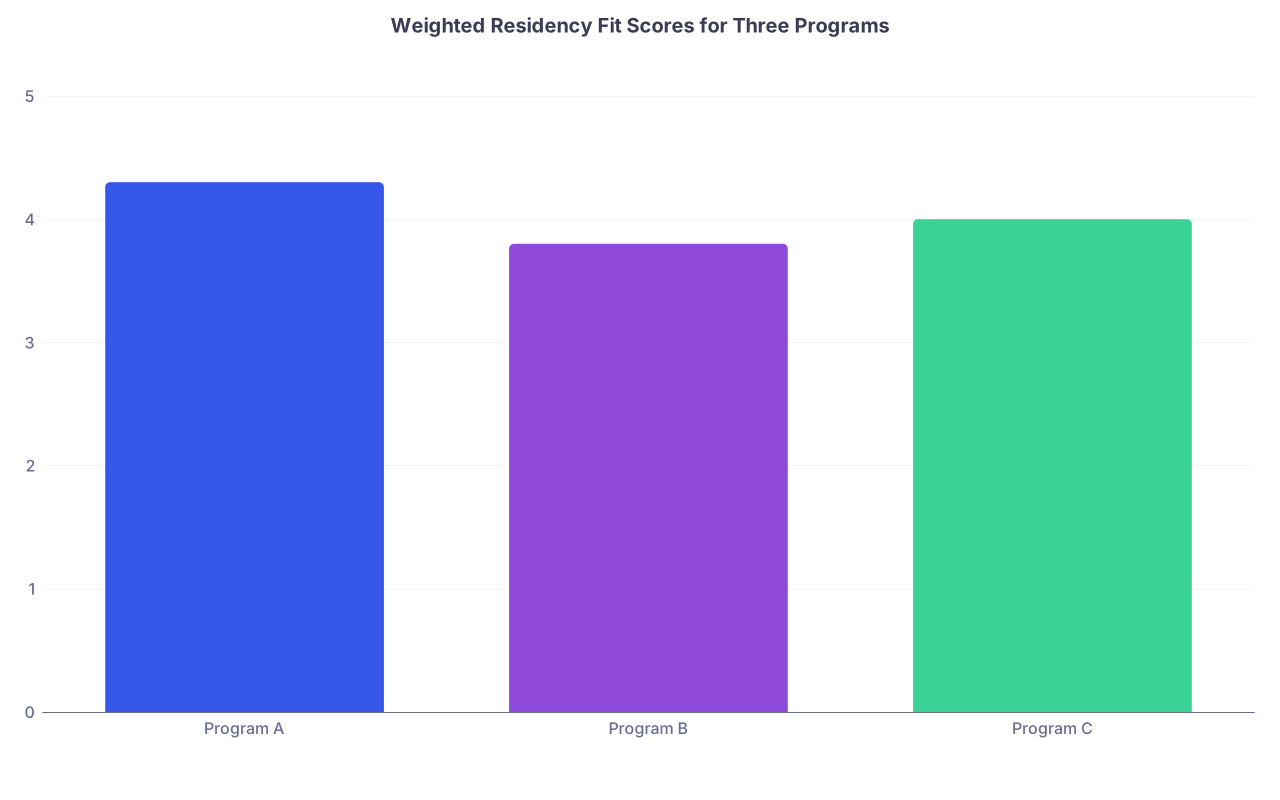
Here is a snapshot of how your rubric could highlight differences that your memory will absolutely blur in February.
| Category | Value |
|---|---|
| Program A | 4.3 |
| Program B | 3.8 |
| Program C | 4 |
- Program A (4.3/5)
- Excellent culture and teaching
- Strong but not insane workload
- Good fellowship opportunities
- Medium cost of living
- Program B (3.8/5)
- Big-name prestige
- Brutal call, weaker wellness
- City you do not actually want to live in
- Program C (4.0/5)
- Fantastic location for family
- Slightly less research, but good clinical training
Most applicants, left to gut instinct, would chase the name (Program B). Your rubric will expose the hidden cost of that decision relative to your own values.
Advanced Tweaks (If You Want to Go Beyond the First 60 Minutes)
After you build and use the basic version, you can refine:
1. Add a “Confidence” column
For each program, rate how confident you are in your scores (1–5).
- 1 = Based on website and one rushed Zoom
- 5 = In-depth interview, honest resident talks, mentor confirmation
You can use this to:
- Flag programs where you should follow up with residents or mentors.
- Avoid over-trusting a high score based on flimsy data.
2. Track hard red flags separately
Create a simple “Red flag?” column (Yes/No, or 0/1):
- Examples: ACGME citations, chronic duty hour violations, openly malignant behavior, unsafe staffing.
If “Yes,” you can:
- Automatically cap the total score (e.g., multiply by 0.8 in your formula).
- Or mark them as Do not rank if the issue is serious enough.
3. Use notes for context
In a “Notes” column:
- Add 1–2 short bullets:
- “Residents seemed exhausted but still positive.”
- “PD dodged question about remediation.”
- “ICU months heavy but incredible teaching.”
These short memory anchors will be gold in rank list season.
Visualizing Your Priorities Over Time
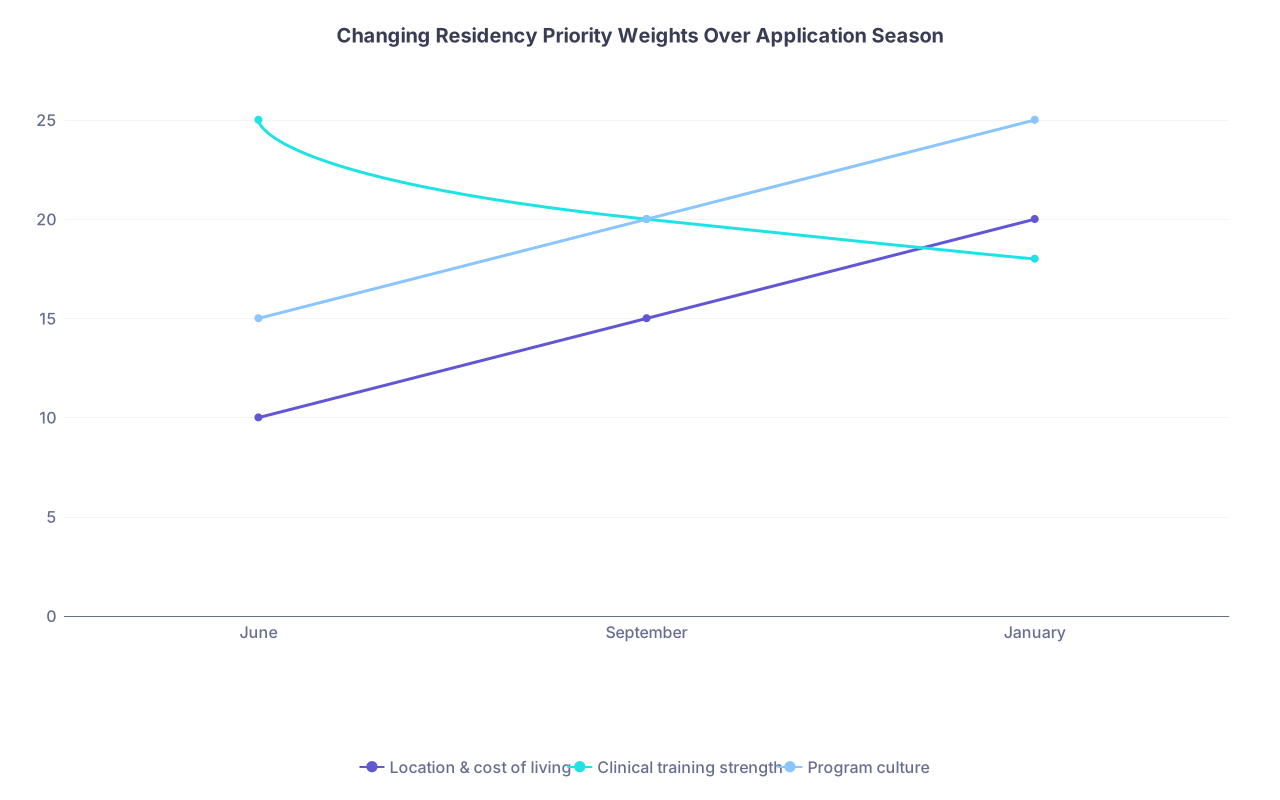
Sometimes you discover that what you thought mattered in MS3 is not what matters in January.
You can track how your view of priorities shifts.
| Category | Location & cost of living | Clinical training strength | Program culture |
|---|---|---|---|
| June | 10 | 25 | 15 |
| September | 15 | 20 | 20 |
| January | 20 | 18 | 25 |
This is normal:
- Early on, everyone overvalues training intensity and prestige.
- After a few sub-Is and seeing real burnout, people start caring more about culture and location.
Your rubric can evolve with you. Just do not change categories daily.
Putting It All Together: A 60-Minute Blueprint
If you like checklists, here is your one-hour build broken down:

| Step | Description |
|---|---|
| Step 1 | Start 60 min timer |
| Step 2 | Brain dump priorities 10 min |
| Step 3 | Select 8-12 categories 10 min |
| Step 4 | Assign 1-5 scale and weights 10 min |
| Step 5 | Build spreadsheet skeleton 10 min |
| Step 6 | Define scoring rules for top categories 10 min |
| Step 7 | Test on 3 programs and tweak 10 min |
| Step 8 | Use during interviews and lock scores |
That is it. One focused hour gives you a tool you can actually use, not another vague intention.
Your Next Step (Do This Today)
Do not bookmark this and move on.
Right now:
- Open a blank spreadsheet.
- Create columns for:
- Program
- Location
- Culture
- Workload
- Clinical volume
- Teaching
- Fellowship placement
- Wellness
- Diversity
- Total score
- Pick weights that sum to 100.
- Enter three programs you already know something about and score them.
If you do those four things today, you will already be making better residency decisions than most of your peers who are still “just going with their gut.”