
The fastest way to expose a dysfunctional residency program is to ask the right questions and refuse vague answers.
Most applicants do not do this. They ask soft questions, get rehearsed responses, and only realize the truth halfway through PGY-1 when they are drowning in scut and gaslit about “being a team player.”
You are not doing that.
This is a structured, targeted question list you can walk into any interview with and use to pressure-test how transparent a program really is. You are not just “getting a feel” for the culture. You are auditing it.
Below is the playbook: what to ask, why you are asking, and what good vs bad answers actually sound like.
Ground Rules: How to Use This Question List
Do not shotgun all of these in one sitting. That will feel like an interrogation and put people on the defensive. You are going to be strategic.
Use this framework across:
- Pre-interview Zoom / open houses
- Interview day (faculty + PD + APDs)
- Resident-only Q&A
- Follow-up emails after interview if needed
Your goals with these questions
Test transparency.
Not just content of answers. How willing are they to give specifics, numbers, and examples?Cross-check consistency.
Ask versions of the same question to:- Program Director (PD)
- Chief residents
- Random residents at different PGY levels
Compare. Inconsistency is a red flag.
Force concrete details.
Avoid letting them off with “We value wellness” or “We’re very supportive.” You are aiming for:- Numbers
- Policies
- Examples from the last 12–24 months
The Core Domains You Must Probe
You are really testing transparency in five areas:
- Workload and schedule reality
- Education vs service balance
- Resident support and mistreatment response
- Outcomes: board pass, fellowship, attrition
- Program honesty about weaknesses and change
Let’s build questions around each.
1. Workload and Schedule: “Show me the receipts”
This is where programs lie by omission. “We’re compliant with duty hours” means nothing. You need specifics.
Ask these to residents first, then confirm with leadership.
Questions to ask residents
“What does your worst month of the year look like, in terms of hours and stress?”
- Good answer: Specific rotation, clear ballpark hours, some nuance.
- “July in the MICU as a PGY-2 is rough. I’m usually there 70–80 hours, Q4 call. You feel it, but the attending coverage is strong and you still get a real day off.”
- Red flag: “It depends,” “It’s variable,” nervous laughter, or obvious minimizing.
- Good answer: Specific rotation, clear ballpark hours, some nuance.
“How often do you log over 80 hours in a week, and what actually happens when you report it?”
- Good: “A few times a year on heavy rotations. The chief emails you and the PD adjusts the schedule. We have had rotations restructured because of repeated violations.”
- Red flag: “We always stay under 80.” (Nobody always does.) Or: “We just fix our hours before submitting.”
“Who writes the schedule and how responsive are they to change requests?”
- Good: “Chiefs build it. If you have a major issue, PD backs you up. Last month someone had a family emergency and we rearranged shifts within a day.”
- Red flag: “The hospital sets it,” “It is what it is,” or obvious fear around asking for changes.
“On wards/ICU, average number of patients per resident on a typical day?”
You want hard numbers.- Good: “On medicine wards, census 10–14 per intern, with an upper cap of 16. Seniors cap around 18–20.”
- Red flag: “We’re busy but it is fine,” or “It varies so much I can’t give a number.” They can. They just do not want to.
“What actually happens when someone calls in sick post-call or on a busy shift?”
- Good: Real examples. “We have a jeopardy resident. I used it last month; no one gave me grief.”
- Red flag: “We try not to use sick days,” “We usually just push through” = toxic.
Questions to ask PD/leadership
“In the last year, how many ACGME duty-hour citations or internal reviews have you had?”
- Good: “We had some issues on night float two years ago; we restructured the schedule and haven’t had citations since.”
- Red flag: evasiveness, no numbers, or “We have never had any concerns, ever.”
“What specific changes have you made to the schedule in the last 2–3 years based on resident feedback?”
- Good: “We cut 24-hour calls on OB, created a night float system for ICU, and added a protected post-call day.”
- Red flag: “We constantly reevaluate,” with zero actual examples.
“Can you walk me through a representative call schedule for PGY-1 on wards and ICU?”
You are checking if the PD knows their own schedule or just throws “we follow ACGME rules” at you.
2. Education vs Service: “Am I cheap labor or a trainee?”
Every program calls itself “balanced.” That means nothing until you ask:
Questions to ask residents
“How many hours of truly protected didactics do you get per week, and are you actually protected?”
- Good: “Four hours Wednesday morning. Pagers go to a jeopardy system; attendings expect you to be there. You get pulled maybe 1–2 times a month on ICU for emergencies.”
- Red flag: “We technically have five hours, but we often have to step out to take pages or admit patients.” Translation: not protected.
“Do you consistently have attending-led teaching on rounds, or is it mostly just trying to get work done?”
- Good: “Depends on attending, but most will take 10–15 minutes per patient for teaching, plus a short chalk talk a few times a week.”
- Red flag: “Rounds are fast. We mostly preround and present. Teaching is… variable.”
“How often do you scrub into procedures / get hands-on experience versus just writing notes and placing orders?”
- Good: “By mid PGY-2, we are doing central lines independently with supervision nearby. Interns get procedural exposure early.”
- Red flag: “Fellows do most procedures; residents watch.”
“What are the scut tasks that residents still have to do that you think should be done by someone else?”
Pay attention to tone. Honest programs will admit some flaws.- Good: “We still do some transporting and chasing labs on nights. Chiefs have been pushing for more phlebotomy coverage.”
- Red flag: “We don’t really have scut.” Everyone has scut. This is dishonest or naïve.
Questions to ask PD/leadership
“How do you monitor the balance between service and education in your program?”
- Good: “Semiannual anonymous surveys, CCC reviews, rotation evaluations, resident town halls, and we have changed X and Y rotations when we saw service creep.”
- Red flag: “We have open-door policies. Residents will tell us.” Spoiler: they will not, if the culture is punitive.
“What is your policy on pulling residents from didactics for clinical duties?”
- Good: Clear rules. “Only for codes or true emergencies. Otherwise that is a systems problem, not a resident problem.”
- Red flag: “Patient care comes first,” with no nuance. That phrase is often used to justify endless interruptions of protected time.
3. Resident Support, Wellness, and Mistreatment: “What happens when things go bad?”
A program’s honesty is clearest when you ask about conflict and failure. Do not skip this.
Questions to ask residents (resident-only session)
“Has anyone actually used the program’s wellness or mental health resources? How did it go?”
- Good: “Yes, several of us. Confidential, easy to access, no one from the program is notified.”
- Red flag: long pause, then: “They exist, but I don’t know anyone who has used them.”
“What happens if you make a serious mistake here?”
You are testing for shame-based vs learning culture.- Good: “It is discussed in M&M, but names are removed. You talk one-on-one with faculty and focus on systems and learning, not blame.”
- Red flag: “You just try not to let it happen,” or stories about residents getting publicly humiliated.
“Have you seen or experienced mistreatment from attendings, nurses, or staff? How did the program respond?”
- Good: “Yes, there were a few incidents. Residents reported them, and the PD addressed them; one attending no longer works here.”
- Red flag: “We have not had any mistreatment at all.” That is fantasy. Or: “We try to handle it ourselves.”
“When residents struggle academically or clinically, what actually happens?”
- Good: “They get a remediation plan, assigned mentor, concrete goals, and follow-up. We have had residents go through this and succeed.”
- Red flag: “We only rank people we know will do well,” or “We have never had anyone struggle.” Both are nonsense.
Questions to ask PD/leadership
“In the last 3 years, how many residents have been on formal remediation or probation, and what proportion successfully graduated?”
You are not asking for names. Just data.- Good: “We have had 2–3 per year on focused remediation, most completed successfully. One separated from the program after not meeting milestones.”
- Red flag: “We cannot comment on that,” or “None. Ever.” That means they bury problems or push people out quietly.
“How can residents safely report mistreatment without fear of retaliation? Give me an example of when that happened and what changed.”
- Good: Mentions:
- Anonymous ACGME surveys
- Direct reporting lines outside PD (GME office / ombudsperson)
- Real example of action taken
- Red flag: Only “Come talk to me directly.” That is not protection.
- Good: Mentions:
“How do you track and respond to feedback from the annual ACGME resident survey?”
- Good: “We share aggregate results with residents, identify problem areas, and create an action plan. Last year, we improved X based on low scores.”
- Red flag: “We usually score very high, so there is not much to do.” Everyone has weaknesses.
4. Outcomes: Boards, Fellowship, Jobs, and Attrition
Transparency without data is just storytelling. You want numbers and patterns.
Ask PD/leadership for hard numbers
Phrase it directly:
“Could you share your last 3–5 years of outcomes in these areas?”
- Board pass rates (first-time and ultimate)
- Fellowship match by specialty
- Percentage going into hospitalist / general practice by choice vs default
- Attrition: residents who left, transferred, or were dismissed
Then clarify with residents:
“Do these numbers feel accurate based on what you’ve seen?”
| Metric Type | Minimum Data You Want |
|---|---|
| Board Pass Rate | 3–5 years, first-time rate |
| Fellowship Match | 3–5 years, by specialty |
| Job Placement | % in desired practice type |
| Attrition | # leaving per 5 years |
| Remediation | # per year, success rate |
Specific questions to ask
“What is your 5-year first-time board pass rate, and what have you changed when scores dipped?”
- Good: “We average 95–100 percent. One year dropped to 88; we responded with mandatory board review sessions and improved didactics.”
- Red flag: “Our residents usually pass,” with no numbers.
“For residents who want competitive fellowships, what is your track record and specific support?”
- Good: “In the last 5 years, 80–90 percent applying to cards / GI matched. We help with faculty mentors, research, and structured letters.”
- Red flag: “People match where they want,” or handwaving about “our name carries weight” with no data.
“In the last 5 years, how many residents have left the program early or been dismissed?”
- Good: Honest numbers plus high-level explanation.
- Red flag: Refusal to answer, or claiming zero.
“What percentage of graduates end up in the practice setting they initially wanted (academic vs community vs rural)?”
This tests whether the program can actually support divergent goals, not just one pipeline.
Cross-check with residents
On resident Q&A, ask:
- “How many people in the last couple of years did not match their first-choice fellowship or job?”
- “Are there residents who stayed on as faculty? Why did they choose to stay?”
You want to see whether residents and PD tell the same story.
5. Program Weaknesses, Change, and Honest Self-Assessment
This is the heart of transparency. A program that cannot admit weaknesses will not improve. And will not protect you when the system fails.
Ask these to everyone (PD, faculty, residents)
“What is one thing about this program that you are actively trying to fix right now?”
- Good: Specific, time-bound, with clear ownership.
- “We have struggled with continuity clinic volume. We are restructuring clinic assignments next year and piloting a new EMR template workload.”
- Red flag: “We are always improving,” or “There is nothing major right now.”
- Good: Specific, time-bound, with clear ownership.
“What type of resident tends to be unhappy here?”
- Good: Honest pattern:
- “People who want low-volume, low-acuity or do not like autonomy are usually not a good fit.”
- Red flag: “Everyone is happy here.” No, they are not.
- Good: Honest pattern:
“If I ask your interns what the biggest pain point is right now, what will they say?”
- Good: PD answers, then you verify with interns.
- Red flag: “They will say everything is great.”
“Over the past 3–5 years, what are the three biggest changes you have made based on resident feedback?”
You are looking for:- Concrete examples
- Timeline
- Clear sense that resident voice matters
“What do your least satisfied residents usually complain about?”
The answer itself matters less than whether they will admit that not everyone is thrilled.
6. How to Organize and Deploy Your Questions
You cannot carry all this in your head. Build a structure.
Step 1: Create a one-page question sheet per program
Before each interview, build a quick grid.
| Domain | Question Example | Ask Whom |
|---|---|---|
| Workload | Worst month details | PGY-2 residents |
| Education | Protected didactics reality | PD + interns |
| Support | Mistreatment response example | Chiefs |
| Outcomes | 5-year board pass data | PD |
| Weaknesses | Biggest current pain point | Everyone |
Do not read off this sheet like a robot. Glance, pick 2–3 per session, adapt language to the situation.
Step 2: Spread questions across the day
Example distribution:
PD interview:
- Duty-hour citations and schedule changes
- Board pass and attrition data
- One big current weakness and fix
Faculty interview:
- Education vs service expectations
- How they respond to errors
- How they advocate for residents
Resident-only Q&A:
- Real workload numbers
- Sick call reality
- Mistreatment stories and response
- True pain points and scut work
Step 3: Document answers immediately after
Do not trust your memory. Programs will blur together.
Right after the interview day, write down:
- Exact phrases used (e.g., “we just fix our hours before submitting”)
- Any visible discomfort when answering
- Conflicting answers between PD and residents
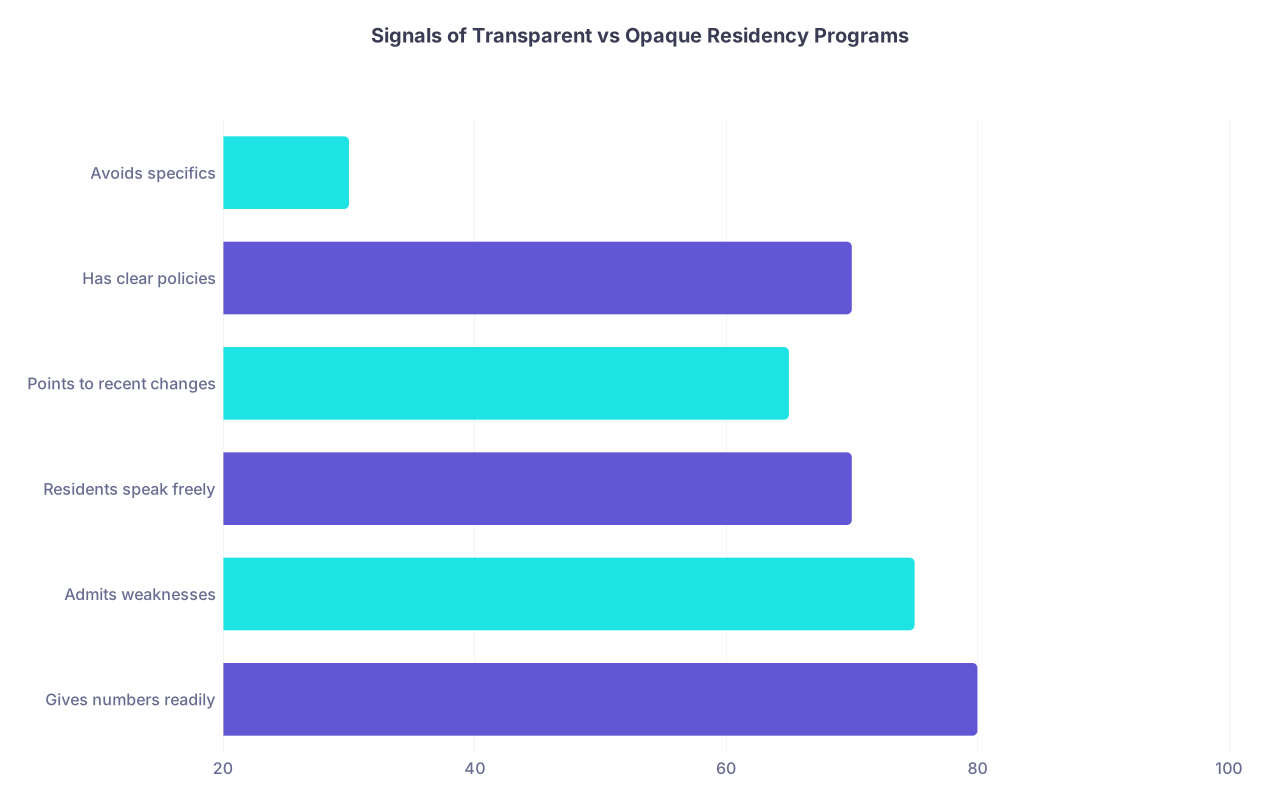
7. Reading Between the Lines: What Transparent vs Opaque Looks Like
You are not just listening to content. You are watching behavior.
| Category | Value |
|---|---|
| Gives numbers readily | 80 |
| Admits weaknesses | 75 |
| Residents speak freely | 70 |
| Points to recent changes | 65 |
| Has clear policies | 70 |
| Avoids specifics | 30 |
Signs of a transparent program
- They give numbers without you begging.
- They admit at least one real problem, with a plan in motion.
- Different PGY levels give similar answers on core issues.
- Residents speak without glancing at faculty or looking guarded.
- PD knows the schedule, duty-hour situation, and ACGME feedback details.
- They do not trash other programs or former residents.
Signs of a program hiding something
- Every answer is a slogan (“We’re a family,” “We work hard, play hard”).
- No one gives numbers. Everything is “busy but manageable.”
- No clear examples of recent changes based on resident feedback.
- PD claims “we have no problems with X,” while residents hedge or go quiet.
- Residents seem anxious when asked about mistreatment or workload.
- They drown you in amenities talk (free food, gym access, new building) instead of structure and culture.
8. Example: Applying the List to Two Hypothetical Programs
To make this concrete, let me show you how this plays out.
You ask both programs:
“What is your worst month like in terms of hours and stress?”
Program A resident:
“Probably January ICU. I am usually there 70–80 hours, Q4 call, 10–12 patients. It is intense, but attendings and fellows are present, chiefs monitor our hours, and if we hit 80 they adjust. Last year they added a night float to help with overflow.”Program B resident:
“It depends. ICU is busy but you learn a ton. We are technically under 80 hours. I mean, everyone works hard.” (Looks at faculty, nervous smile.)
You ask:
“What changes have you made in the schedule due to duty-hour concerns?”
Program A PD:
“Three years ago we were getting frequent violations on OB nights. We created a night float system and capped admissions after midnight. Since then, violations dropped by ~70 percent. We still monitor it every quarter.”Program B PD:
“We have always been compliant with duty hours. We do not really have issues there.”
Program A is honest about pain and fixes. Program B hides behind rules and vagueness. You do not need a spreadsheet to rank these.
9. Quick Prep: Build Your Own Personalized Question Set
Take 10 minutes and do this now:
Pick your top 3 non-negotiables. Examples:
- Reasonable workload
- Strong fellowship placement
- Healthy culture / no malignant attendings
For each non-negotiable, choose 2–3 questions from this article.
Example for “culture and support”:
- “Has anyone actually used the mental health resources?”
- “Tell me about a time someone reported mistreatment and what changed.”
- “What type of resident tends to be unhappy here?”
Rewrite them in your own words so they sound natural coming from you.
Print or save a one-page cheat sheet for each interview day.
10. Final Tactic: The One Question That Forces Honesty
If you only remember one question, use this:
“If your own child or sibling wanted to go into this specialty, would you be comfortable having them train here? Why or why not?”
Watch their face. Not just their answer.
- A transparent person may say:
“Yes, because they would get excellent training and support. They would work hard, but I trust the environment.” - Or:
“Honestly, if they wanted something less intense or in a different region, I might steer them elsewhere.”
The dishonest version usually sounds like a brochure.
Take one concrete step now:
Open a blank document and write down 10 questions from this list that matter most to you. Then cut it to your top 6. Those 6 become your standard set for every program. If a program cannot answer them clearly and consistently, they have told you everything you need to know—without meaning to.