Sign-out is one of the most underrated tests of intern readiness in American medicine. Not rounds. Not polished case presentations. Not even how smoothly someone answers pimp questions. Sign-out. That is where you see whether an IMG can actually function in a U.S. hospital the way an intern must function: prioritize risk, communicate clearly, transfer responsibility safely, and think ahead before something goes wrong at 2 a.m.
Let me be specific. In the U.S. clinical workflow, sign-out is the handoff between teams or providers that includes the active problems, current patient status, pending tasks, anticipated overnight issues, contingency plans, and the exact point at which responsibility shifts to the covering clinician. It is not clerical. It is not a script. It is compressed clinical judgment under time pressure.
For IMGs, this matters even more. A strong sign-out shows that you have adapted to U.S. team-based care, that you understand how nurses, residents, seniors, and attendings expect information to flow, and that you grasp the patient-safety culture that drives inpatient medicine here. I have seen applicants with excellent knowledge look unready the moment they describe handoffs vaguely. I have also seen IMGs win instant credibility because they could explain exactly how they prioritized a cross-cover list, what they warned the night team about, and when they escalated.
This article breaks down seven concrete ways U.S. sign-out experience proves intern readiness. Not vague "confidence." Observable competence. The kind programs trust.
1) It Shows You Can Prioritize Like a U.S. Intern, Not Just Present Like a Student
Medical students often learn to present everything. Interns learn to sort everything. Those are not the same skill.
A good U.S. sign-out starts with the sickest patient, the most unstable issue, or the task most likely to hurt someone if missed overnight. That alone reveals a lot. If you sign out the patient with a possible GI bleed after the stable cellulitis patient because you are following bed order or room number, you are thinking like a list manager, not a doctor. Bad habit. Dangerous too.
The intern mindset is simple: what can crash, what must be done, what can wait till morning?
That prioritization usually follows a pattern:
- Unstable or high-risk patients first
- Time-sensitive tasks second
- Likely overnight events next
- Routine updates last
When IMGs have real sign-out exposure, they begin speaking in that hierarchy naturally. They stop giving a generic summary and start saying things like:
- "She is stable right now, but the potassium is trending down and the repeat BMP at 10 p.m. matters."
- "He is comfortable at the moment, but if the blood pressure drops again, the night team should reassess for ongoing bleeding."
- "This task can wait until morning unless the nurse reports worsening pain or new fever."
That is clinical maturity. Not because it sounds sophisticated, but because it reflects triage thinking under actual constraints.
Here is what I listen for in interviews. Not whether you participated in sign-out. Everybody says that. I want to hear your prioritization logic. Which patient did you mention first and why? Which task did you push to cross-cover and which did you finish before leaving? What red flag made you worry? The candidates who answer those questions cleanly almost always look more intern-ready than the ones who talk only about watching residents or memorizing formats.
Because internship is not an oral exam. It is a sequence of competing demands. Sign-out is where that reality becomes visible.
2) It Demonstrates Safe Handoff Communication, Which Is Core to U.S. Patient Safety
A weak sign-out is one of the fastest ways to create preventable harm. Everyone in hospital medicine knows this, even if people pretend the problem is just "miscommunication." Usually it is worse than that. It is unclear thinking delivered in unclear language.
A solid sign-out has structure. At minimum, it should cover:
- who the patient is and why they are here
- current clinical status
- what specifically needs to be done overnight
- what might happen
- when to escalate and to whom
The exact format varies by hospital, but the safety principle does not. The night team needs enough information to act fast without having to reconstruct the case from scratch.
That is why IMGs who can give or describe a strong handoff stand out. You are not merely proving English fluency. You are proving that you can communicate in a way that reduces error. Big difference.
The behaviors that signal real readiness are very specific:
- concise summaries instead of wandering mini-presentations
- direct action language: "repeat lactate at midnight," not "just keep an eye on things"
- closed-loop communication: confirming the receiver understood the key tasks
- clear contingency thresholds: "call senior if O2 need rises above 4 liters" is good; "let us know if worse" is useless
- staying organized despite interruptions, which absolutely happen in real sign-out
I have watched handoffs where one intern says, "He is kind of sick, but okay for now, maybe just monitor." That is not sign-out. That is a liability. Compare it with: "COPD exacerbation on 2 liters, improved after nebs, no ICU needs right now. If respiratory rate climbs or oxygen requirement increases, reassess at bedside and page senior." That is useful. That protects patients.
For IMGs, this is also where adaptation to U.S. teamwork becomes visible. American inpatient care depends heavily on horizontal communication across shifts. Nurses page. Cross-cover interns respond. Seniors expect escalation, not heroic silence. A clear sign-out tells programs you understand that supervision is part of safe care, not evidence of weakness.

3) It Proves You Understand Anticipatory Thinking, Not Just Reaction-Based Care
The best sign-out is not a recap of what happened all day. It is a forecast.
Anticipatory guidance is the heart of that forecast. You are telling the covering team what could go wrong overnight and what to do first if it does. That skill is pure intern medicine. You cannot survive internship by reacting after the chart, the nurse, and the vital signs all force the issue. You have to think one step ahead.
This shows up constantly in routine inpatient care:
- Fever overnight? Decide whether the patient needs cultures, a chest x-ray, acetaminophen, broader antibiotics, or simply observation based on the actual context.
- Pain uncontrolled? Clarify whether PRNs are enough, whether there is a post-op concern, or whether the night team should examine the patient if pain suddenly escalates.
- Abnormal labs? Specify which ones matter enough to trigger action before morning.
- Post-op patient? Mention urine output, bleeding, respiratory risk, ileus, delirium, and thresholds for calling surgery.
- Borderline decompensation? State the trigger points. Hypotension. Rising oxygen need. New confusion. Decreased urine output.
This is where I see a huge gap between superficial and meaningful clinical exposure. If you tell me, "I participated in handoffs," that says almost nothing. If you tell me, "For a patient with evolving sepsis, I signed out that if the lactate rose or MAP remained low after fluids, the covering resident should reassess immediately and escalate," now I know you understand contingency planning.
That kind of description also plays beautifully in interviews because it demonstrates systems thinking and judgment at the same time. Not heroics. Preparation. Programs trust that.
4) It Reflects Familiarity with Multidisciplinary U.S. Workflow and Escalation Norms
Sign-out does not happen in isolation. It sits inside the real machinery of a U.S. hospital: nurses calling with concerns, consultants leaving recommendations, seniors supervising, attendings expecting updates, respiratory therapists flagging changes, pharmacists clarifying orders, and cross-cover interns fielding the entire mess after hours.
If you have meaningful sign-out exposure, you start understanding where your role begins and where it must widen fast.
Intern readiness means knowing three things:
- what you can handle independently
- what you should confirm or reassess
- what requires immediate escalation
That sounds obvious. It is not. Many learners either escalate nothing because they want to look capable, or escalate everything because they are lost. Both are bad. The ready intern recognizes patterns.
Real workflow examples make this clear:
- A nurse pages about mild nausea on a stable patient. You manage appropriately, review the chart, and document.
- A cross-cover page comes for new tachycardia and borderline hypotension in a post-op patient. You go bedside, reassess, and loop in the senior early.
- A consultant recommended repeat labs overnight. You make sure that instruction survives the handoff rather than dying quietly in the chart.
- A patient becomes more confused, pulls off oxygen, and is no longer following commands. That is not a "morning team" problem.
IMGs who have seen U.S. sign-out up close are usually much better at understanding this hierarchy of response. They know that accountability is shared but not blurred. They know that safety escalation is expected, documented, and respected. That familiarity makes the transition into residency smoother and safer. No small thing.
5) It Gives Concrete Evidence of Ownership, Reliability, and Accountability
Programs say they want "hardworking team players." Fine. Generic. What they actually want is an intern who owns the list, tracks tasks, updates changes, and does not vanish behind excuses when something was missed.
Sign-out exposes that immediately.
Ownership in this setting means you know what happened to your patients, what still needs to happen, and what the next person must know so the patient does not get dropped between shifts. Reliability means your list is current, your tasks are accurate, and your handoff reflects reality rather than the version from six hours ago. Accountability means you state plainly what you did, what you could not complete, and what needs reassessment. No spinning. No defensiveness.
I have much more respect for the trainee who says, "The CT has not been done yet, I called radiology, the patient is stable, and the night team should follow up because the result may change management," than the one who buries the incomplete task in a vague sign-out and hopes nobody notices.
That is the point. Sign-out turns professionalism into something observable.
Reliable interns tend to do the same things well:
- arrive to handoff prepared
- maintain a current patient list
- update medication changes and pending studies promptly
- close loops with nursing and seniors
- make unresolved issues visible, not hidden
For IMGs, this can become powerful evidence of readiness because it mirrors exactly what an intern on call is expected to do. Not just know medicine. Carry responsibility cleanly.
6) It Helps IMGs Translate Clinical Experience into Residency Language
This is where many strong IMGs undersell themselves.
They often have substantial clinical experience, sometimes more hands-on than U.S. graduates in certain settings, but they describe it in language that sounds passive or non-specific to residency selection committees. That is a framing problem, not a competence problem.
Sign-out experience helps fix that because it gives you a very U.S.-recognizable way to explain your value.
Instead of saying:
- "I observed inpatient management."
- "I followed the team during rounds."
- "I learned how the system works."
You can say:
- "I participated in structured handoffs and learned to communicate pending tasks and escalation thresholds clearly."
- "I tracked cross-cover issues, reassessed changes in patient status, and understood when concerns required senior input."
- "I developed experience with anticipatory guidance for overnight events such as fever, abnormal labs, worsening pain, and respiratory decline."
That language lands because it maps directly to what residency programs care about: patient safety, communication, supervision, and clinical judgment.
It also prepares you for common interview questions. And these questions come up constantly:
- Tell me about a difficult patient situation.
- Describe a time you recognized a safety concern.
- Give an example of when you had to escalate care.
- Tell me about a challenging handoff.
- Describe a time you balanced multiple clinical demands.
If you have thought carefully about sign-out, you can answer these with real structure:
- Briefly define the patient and the problem.
- Explain what made the situation risky.
- State what information you communicated.
- Describe the plan and the contingency plan.
- Show how you reassessed or escalated.
- End with the result and what you learned.
That is far stronger than a loose story with no decision points.
This framework also helps with written application materials. In a personal statement, sign-out can illustrate your transition from observer to responsible clinician. In interviews, it can show maturity under pressure. In letters of recommendation, supervisors can comment on your organization, communication, and reliability during handoffs. That is gold because it is concrete.
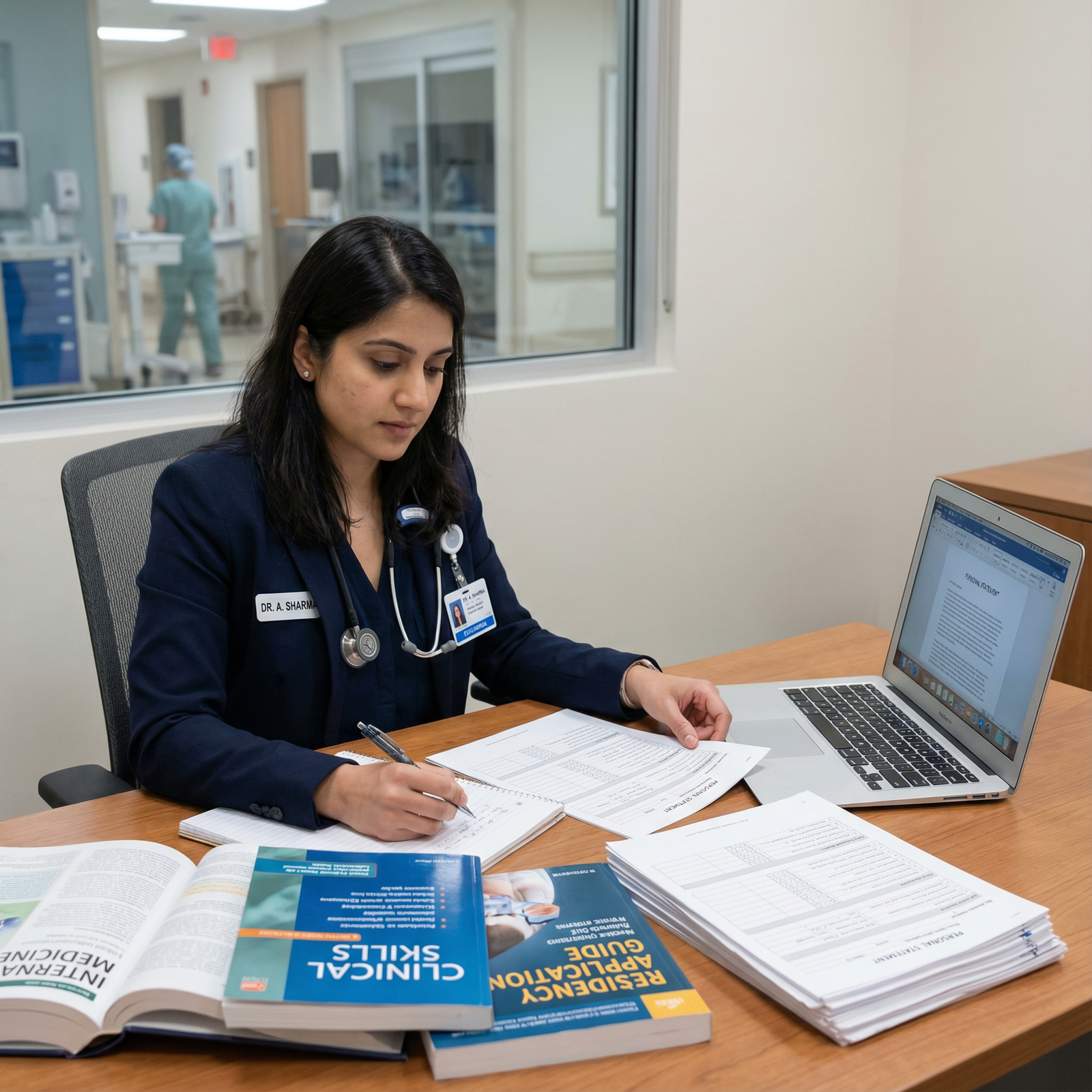
If you are an IMG, do not waste this experience by describing it vaguely. Translate it into residency language. Handoff quality. Escalation judgment. Closed-loop communication. Ownership. Reassessment. Those are the words of readiness.
7) It Shows You Are Ready for the Real Tempo of Internship
Internship is fast. Messy. Interruption-heavy. Full of partial information and competing responsibilities. Anybody who tells you otherwise has either forgotten intern year or is romanticizing it badly.
Sign-out is one of the clearest previews of that tempo.
You are dealing with multiple patients at once. The list is changing. A nurse asks a question during handoff. A lab result returns late. Someone still needs pain control. Someone else may need to be seen right now. The covering team wants the essentials, not a speech. That environment trains exactly the capacities interns need:
- stamina across long shifts
- situational awareness across many patients
- judgment despite incomplete data
- comfort switching between tasks without losing the thread
- resilience when plans change quickly
This is also where the psychological transition happens. You stop acting only as a supervised learner collecting information and start acting as an accountable team member protecting continuity of care. That shift matters. A lot.
For IMGs, exposure to this pace in the U.S. system is especially valuable because tempo is cultural as well as clinical. The expectations around responsiveness, escalation, documentation, and cross-cover efficiency are very specific. Sign-out teaches those expectations in real time.
And that is why it is such a credible marker of readiness. It touches everything that matters: clinical judgment, communication, teamwork, patient safety, and endurance.
Closing: How to Use Sign-Out Experience as Proof of IMG Intern Readiness
U.S. sign-out experience proves intern readiness because it reveals the skills residency actually runs on. Prioritization. Safe handoff communication. Anticipatory thinking. Familiarity with multidisciplinary workflow. Accountability. The ability to describe your work in residency language. Adaptation to the speed and pressure of internship.
That is why I do not treat sign-out as "extra exposure." It is a real readiness marker. A good handoff shows that you can think clinically, communicate safely, and function inside the U.S. inpatient system the way a program needs an intern to function from day one.
If you are an IMG, use this well. Document what you did. Reflect on specific handoff scenarios. Keep examples of when you identified risk, clarified a task, anticipated a problem, or escalated appropriately. Then describe those experiences directly in your application, your interviews, and your conversations with mentors writing letters.
Do that, and sign-out stops being a background task on your CV. It becomes what it truly is: proof that you are ready to carry patients, not just discuss them.
Key takeaways
- U.S. sign-out experience is one of the clearest demonstrations that an IMG can function like a ready intern, not just a knowledgeable learner.
- The strongest evidence comes from showing real competencies: prioritization, safe handoff communication, escalation judgment, accountability, and adaptation to U.S. workflow.