

The obsession with “US clinical experience” is wildly overstated—and it’s probably scaring you more than it should.
Let me guess where your brain is right now:
“They all have US electives. I have a couple of observerships and some home-country rotations. I’m dead. Programs will toss my application in 2 seconds. I’m going to end up unmatched, stuck, and regretting everything.”
Yeah. I know that spiral. I’ve watched people with way less US experience match solidly while others with beautiful US CVs panic on Match Day. So clearly, this isn’t as simple as: “More US experience = guaranteed match.”
Let’s be brutally honest, but strategic.
What “US clinical experience” actually means (and what it doesn’t)
Programs are not sitting there with a ruler measuring your US weeks like:
“Ah, you have 8 weeks, but your friend has 12. Rejected.”
They use US experience as a proxy for a few things:
- Can you function in the US health system without melting down?
- Do you understand documentation, EMR, team hierarchy, communication norms?
- Has anyone in the US clinically seen you work and vouched for you in a letter?
- Are you a huge cultural / systems learning curve risk for July 1?
That’s it. They’re not giving out medals for “number of weeks” just because.
Here’s the part that nobody says out loud: there’s a point where “more” stops mattering. The first 4–8 weeks of solid, hands-on US clinical experience do a lot of heavy lifting. The jump from 0 to something is huge. The jump from 4 to 12? Much smaller. The jump from 12 to 24? Mostly ego.
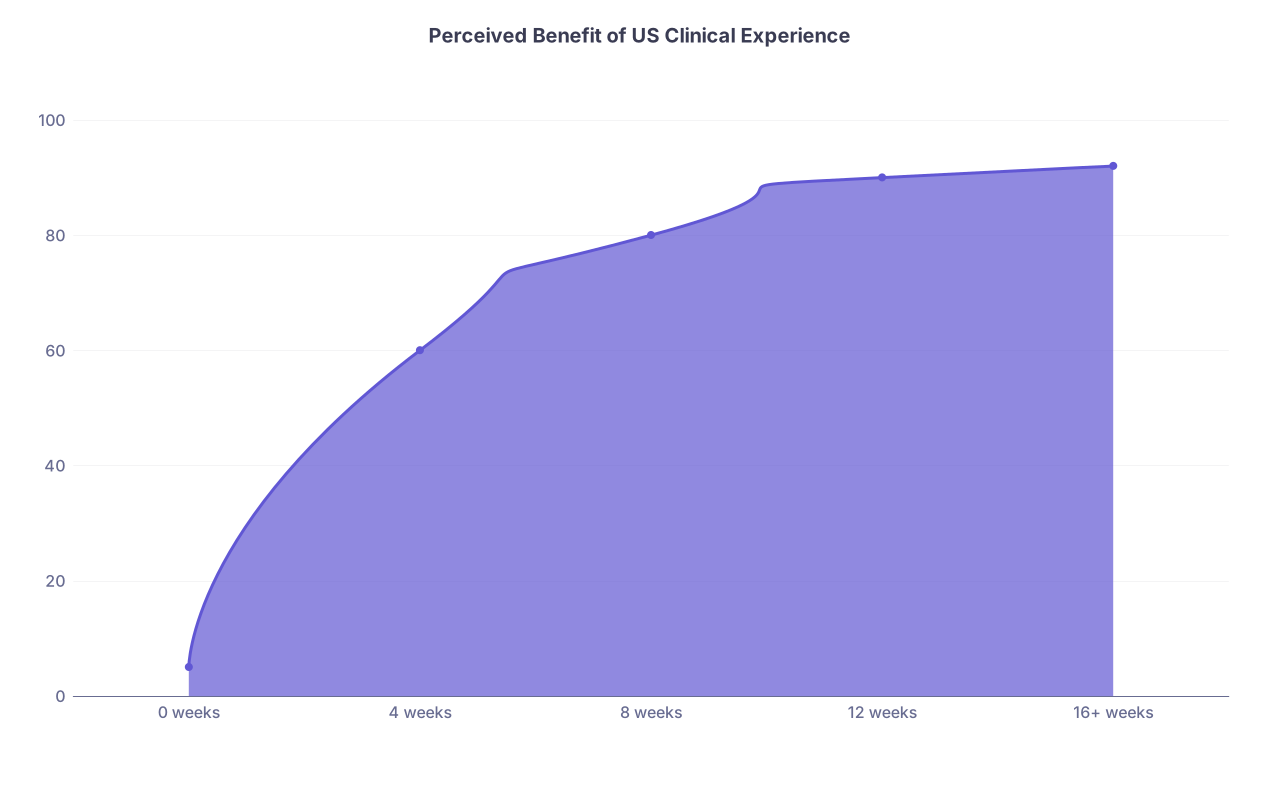
| Category | Value |
|---|---|
| 0 weeks | 5 |
| 4 weeks | 60 |
| 8 weeks | 80 |
| 12 weeks | 90 |
| 16+ weeks | 92 |
If you’re at or near zero, yeah, that’s rough. Programs get nervous. But if you’ve got a few observerships, an externship, or a structured hands-on experience, you’re not automatically “behind”—you’re just not maximally padded.
And no, your friend who did 3 shiny away rotations at big-name university hospitals doesn’t automatically win. I’ve seen people with a single strong US letter and rock-solid home clinical narrative beat out those CV monsters.
The ugly truth: there are more important red flags than “less USCE”
Let’s stop pretending US experience exists in a vacuum. Programs look at your entire profile. You’re freaking out about one variable.
Here’s the harsh hierarchy I’ve seen (especially for IMGs):
| Factor | Rough Impact Tier |
|---|---|
| Step scores / exam performance | Critical |
| Visa status | Critical |
| YOG / gaps | High |
| US clinical experience | High–Medium |
| Letters of recommendation | High–Medium |
| Research / extras | Medium |
If your anxiety is:
“I only have 4 weeks USCE, my peers have 12,”
but your Step scores are strong, graduation is recent, and you don’t have long unexplained gaps—you're not doomed.
If your situation is more like:
- Older YOG (5+ years out)
- Step failures or low scores
- Need visa sponsorship
- And minimal USCE
Then yeah, US experience becomes more important because it’s one of the few things you can still change. But it’s still part of a bigger picture, not the entire picture.
Let me be very blunt: there are IMGs who matched with:
- 4 weeks of observerships + 1 strong US letter
- No US electives at all but excellent scores and stellar home letters
- A single community hospital externship plus a compelling personal story
And there are IMGs who did 6–12 months of USCE and still didn’t match because of Step failures, weak interviews, or no coherent narrative.
Types of US experience: what actually helps you compete
You’re probably obsessing over the labels: “observership” vs “externship” vs “elective.” Programs are more interested in: what did you actually do and who’s willing to vouch for you?
Very roughly:
- Hospital elective as a student (hands-on, school-affiliated): gold standard
- Formal externship (hands-on, usually for grads): solid
- Inpatient observership with good integration (rounding, case discussions): useful
- Outpatient-only shadowing where you mostly stood in a corner: thin but not nothing
Where IMGs get into trouble is when their experience is:
- Extremely brief (1–2 weeks total)
- All in low-structure “shadowing” with no meaningful role
- No strong US letter comes out of it
- Or it’s unrelated to their intended specialty with no explanation
You don’t need to “match” your peers week-for-week. You need enough substantial experience to cover three things in the eyes of a PD:
- You’ve seen US inpatient / outpatient care up close.
- Someone here has observed your clinical thinking or work ethic.
- You can talk about US cases like you actually lived them, not like you read them.
The right 4–8 weeks can do that.
“But they have better US letters than I do…”
Yeah, this is the one that stings.
Everyone brags: “My attending is a PD at [Big Name Hospital]. My letter is amazing. He said I’m in the ‘top 1%’ of students he’s ever worked with.”
You hear that and automatically downgrade your own:
“Mine’s from a community hospital attending I barely knew for 4 weeks. It’s over.”
No. Stop. I’ve read actual letters. Most are generic fluff. “Hardworking, pleasant, shows promise.” That famous PD letter might be one line away from a template.
What matters more than the letterhead is whether your letter:
- Sounds like the writer really knows you
- Includes specific examples of you thinking, working, caring
- Mentions initiative, reliability, communication, and teachability
A great letter from a mid-tier community hospital that says:
“On week 2, she identified early sepsis in a patient and called the team appropriately. She stayed late multiple times voluntarily for complex discharges.”
is more powerful than “top 1%” with zero specifics.
If your US experience is limited, your job isn’t to magically create more months. It’s to squeeze maximum depth out of what you already have:
- Ask for mid-rotation feedback and adapt. Then your letter-writer sees growth, not just a static 4 weeks.
- Volunteer for presentations, QI, or teaching med students during your short time there.
- Make your letter request very specific: remind them of cases, projects, or moments where you stood out.
How to compete when your US experience is “less” on paper
Alright, here’s the part your anxious brain keeps asking: “What do I actually do now?”
You cannot go back in time and suddenly stack 6 US electives. So you focus on leverage, not volume.
1. Make your limited US experience look deliberate, not accidental
Programs hate randomness. They want a story.
Instead of:
“I did a few random observerships because that’s all I could get.”
You frame it as:
“I specifically sought out [community hospital / safety-net clinic / academic center] to better understand [X aspect] of US healthcare related to [your specialty].”
In your ERAS experiences and personal statement:
- Emphasize what you learned about US systems, team dynamics, EHR, patient expectations.
- Mention particular patient cases that show you weren’t just a passive observer.
- Connect each USCE experience to your chosen specialty or your growth as a clinician.
You’re competing not on quantity. On clarity.
2. Outperform them somewhere else
If you can’t win the “USCE amount” game, win a different game.
For example:
- Study until your Step 2 is clean and clearly above average for IMGs in your specialty.
- Fix gaps in your timeline with actual, structured clinical or academic work (even home-country).
- Convert your home clinical experience into something that sounds real and rigorous, not like an afterthought.
Your peers may have more USCE, but if you:
- Interview better
- Understand your own story better
- Sound more mature about your career choices
you absolutely can beat them.

3. Align your application with the programs that actually want you
Another thing no one likes to say out loud: some programs pretty much only rank US grads and top-tier IMGs. If your peers with more USCE are gunning for those, let them.
You should be:
- Targeting community programs, IMG-friendly programs, and hospitals in regions known to value hardworking IMGs with real-world experience
- Not wasting half your list on super-academic, hyper-competitive university programs that will filter you out before even reading your file
A lot of anxiety comes from comparing yourself to peers applying to completely different tiers of programs. Different fight. Different ring.
Fixing the “I only have observerships” problem (without magic)
If your entire USCE is non–hands-on observerships, yeah, that hurts. Programs worry you haven’t touched patients in a US setting or written a note.
But here’s what you can still do:
Be insanely detailed about your role in those observerships.
Did you pre-round (even unofficially)? Present cases? Attend teaching sessions? That matters.If you’re still pre-application, try to add even one structured hands-on experience:
An externship, a clerkship through a school-affiliated program, or a robust community hospital rotation.Show you’re clinically active now, even if it’s back home.
A current home-country hospital job, teaching, or clinic work beats “sitting and waiting for match” by a mile.
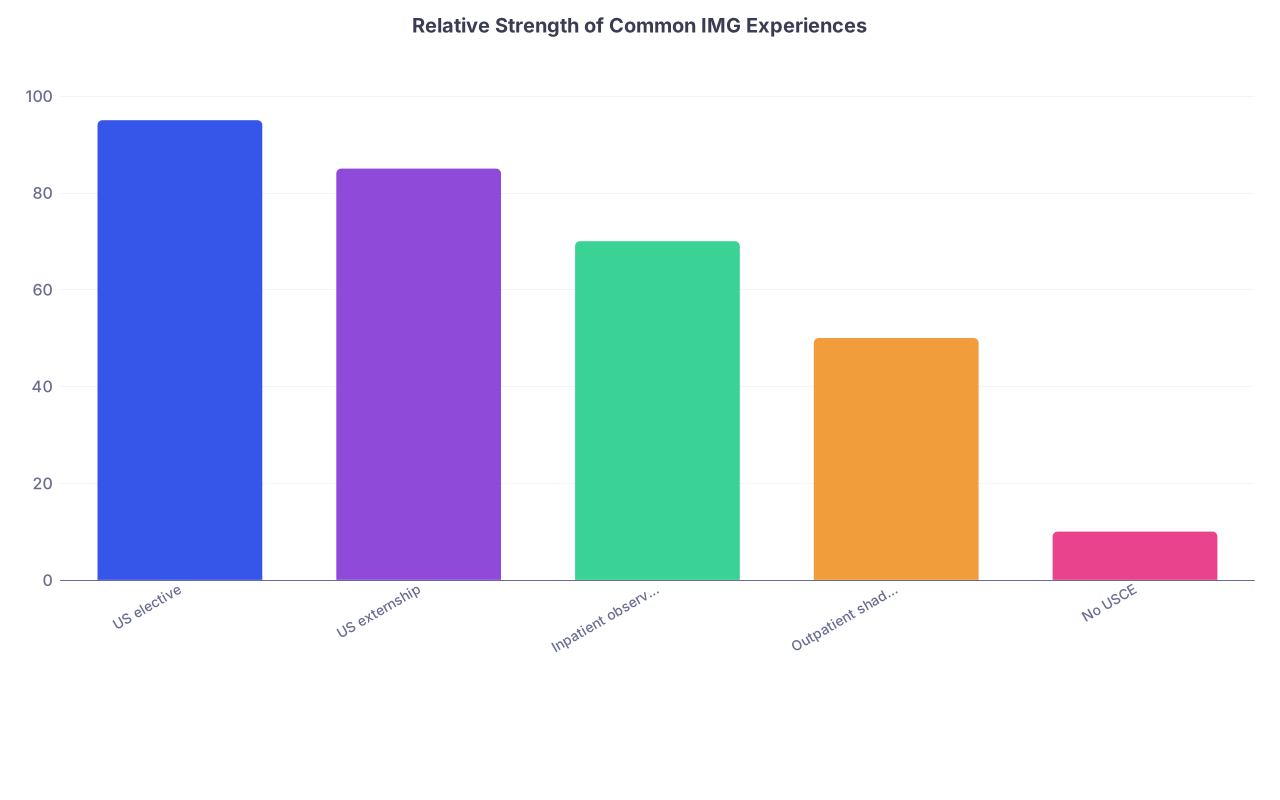
| Category | Value |
|---|---|
| US elective | 95 |
| US externship | 85 |
| Inpatient observership | 70 |
| Outpatient shadowing | 50 |
| No USCE | 10 |
Your goal: avoid the “no USCE at all” box and the “stagnant, not clinically active” box. You don’t need perfection. You need to clear the threshold of reasonable reassurance.
The comparison trap: why your peers’ USCE looks better than it really is
Let me be slightly cynical here: people exaggerate.
Your friend saying, “I worked really closely with the PD” might mean “I was on a team where the PD rounded once a week and said hi to me twice.”
“Hands-on” sometimes means: touched the computer once.
“Research” might be: entered data into Excel for a summer.
You only see the headline of their experience. Not the content. Not the depth. Not how well they’ll interview or explain it.
You also have zero idea what their hidden weaknesses are:
A Step 1 fail. A mediocre MSPE. A weird professionalism comment. A past failed match attempt.
You’re comparing your real, messy story to their polished, braggy version. Of course you feel behind.
Stop assuming “more USCE” = “better candidate.” Sometimes it just means “better connected” or “richer” or “started planning earlier.”
You can’t fix the past. You can absolutely fix how solid, focused, and grown-up your application looks now.
What you can realistically do this week
Let’s stop spiraling and actually move one step forward.
Here’s a concrete action you can take today:
Open your ERAS (or your planning document) and write a 3–5 sentence explanation of your US clinical experience story as if you were answering an interview question:
“Tell me about your US clinical experience.”
Force yourself to:
- Name where you rotated
- Describe what your actual role was
- Mention 1–2 specific things you learned about the US system
- Tie it to your specialty interest or growth
If, as you write that, you realize it sounds paper-thin or vague, then you have clarity: you need to either (1) add one more meaningful experience, or (2) deepen how you describe what you already did.
Do that answer today. Right now.
If you can’t convince yourself in those 3–5 sentences, no amount of extra weeks on a CV will save you. But if you can write something honest, specific, and grounded? You’re already competing better than half the people who are just counting weeks.


