

It’s late. You’re staring at your ERAS “Experiences” section for the tenth time. Every single US clinical thing you’ve done—observership, externship, research, volunteer work—is at the exact same hospital. Same address. Same system. Same damn logo.
And your brain goes straight to: “This looks desperate. Or lazy. Or like nobody else wanted me. Programs are going to see this and immediately toss my application, right?”
Let’s walk through this like two people who both overthink everything.
First: Is One-Hospital US Experience Automatically Bad?
No. It’s not automatically bad. But it can raise questions if you don’t frame it right.
Programs don’t sit there saying, “Reject everyone who only has one hospital on their CV.” That’s not a real rule. What they do is look at patterns and ask themselves:
- Does this person understand US clinical culture?
- Has anyone we trust actually seen them work?
- Is their experience recent and relevant?
- Does anything about this application feel off?
One hospital for everything isn’t a death sentence. I’ve seen people match with:
- One 4-week US rotation at a single community hospital
- A single year of research at one academic center with no other US stuff
- Purely telehealth/remote research from one US institution
The bigger problems are:
- No clinical exposure at all
- Old experience (4–5 years ago, never updated)
- Completely non-clinical stuff only (random non-med jobs with no patient contact)
- Bad or generic letters from that single hospital
You having all your experience in one place? That’s not in the “automatic no” category. It’s in the “needs to be explained and used well” category.
What Programs Actually Think When They See One-Hospital Experience
Let me be brutally honest about the thoughts that might cross a PD’s or faculty reviewer’s mind.
Possible negative thoughts
They might wonder:
- “Could they not get into any other hospitals? Why?”
- “Do they only know one specific system? Are they flexible?”
- “Is this just a family/friend connection and they stayed in that bubble?”
- “Do they really understand the variety of US practice if they’ve only seen one setting?”
That’s the paranoid side of your brain, and, annoyingly, it’s not completely made up. Some reviewers do think like that.
But here’s the part your anxiety tends to ignore.
Possible neutral or positive thoughts
They might also think:
- “Nice, they clearly impressed people enough to stay on or be invited back.”
- “Continuity. They had time to build relationships. Their letters might be strong.”
- “They probably understand this system deeply. That’s actually useful.”
- “If this is our hospital or our affiliate, this is a plus.”
Programs care way more about:
- Strength and specificity of your LORs
- What your evaluators say about you
- How recent the experience is
- Whether the setting matches their style (community vs academic, specialty, etc.)
If your entire US story is in one hospital, your job is to turn that from “defensive” to “intentional.”
How Risky Is This Really? (Let’s Be Rational for 30 Seconds)
To give your anxiety something concrete:
, Old US experience only, One hospital only, Mixed hospitals](https://cdn.residencyadvisor.com/images/articles_svg/chart-relative-residency-application-concerns-for-imgs-1310.svg "Relative Residency Application Concerns for IMGs")
| Category | Value |
|---|---|
| [No US experience](https://residencyadvisor.com/resources/clinical-experience-imgs/i-have-zero-us-clinical-experience-as-an-imgis-match-still-possible) | 90 |
| Old US experience only | 70 |
| One hospital only | 40 |
| Mixed hospitals | 20 |
Rough translation (not exact numbers, obviously, but in line with what PDs care about):
- No US experience: huge red flag, especially in competitive specialties.
- Old experience only: moderate concern—people wonder if your skills are current.
- All in one hospital: mild concern, solvable with explanation and good letters.
- Multiple hospitals: easiest to explain, but not magic either.
If you’re catastrophizing that “one hospital” is the end of the world—it’s not. It’s not even close to the top of the list of things that hurt IMG applications.
When One-Hospital Experience Actually Makes Sense
You know what programs don’t hate? A coherent story.
If you can give a believable reason why all your US experience is in one place, you’ve already diffused a lot of suspicion.
Some legit explanations that don’t sound desperate:
- Visa or travel constraints kept you in one city or region
- Financial limits—you couldn’t afford to bounce around unpaid rotations across the country
- You built a strong relationship with a mentor there and stayed for research + additional rotations
- The hospital invited you back because they liked you (this is a positive, by the way)
- Pandemic-era restrictions—many places weren’t open to outside rotators
If this is your reality, say so. Not in an apologetic, groveling way. Just clear and factual.
Something like:
“Due to financial and visa limitations, I focused my US clinical training at [Hospital Name], where I completed multiple rotations and ongoing research in internal medicine. This allowed me to build continuity with mentors who observed me over time and provided detailed evaluation of my growth.”
That sounds intentional. Stable. Adult. Not desperate.
The Real Leverage: Your LORs from That One Hospital
If your entire US life is at one place, your recommendations from there become everything.
Bad scenario (and this is where the “desperate” look actually kicks in):
- Three LORs, all from the same department, all generic
- “To whom it may concern, I worked with Dr. X for 4 weeks and they were punctual and professional.”
- No specifics, no stories, no clear sense that they actually know you
That does look weak. Not because it’s one hospital—but because nobody is going to bat for you.
Good scenario:
- Two strong letters from different attendings who watched you over time
- Maybe one research/mentor letter if you did scholarly work there
- Letters clearly reflect longitudinal observation: “I’ve worked with them across 3 rotations over 8 months”
- Specific comments: complex patients, independence, communication with nurses, follow-up, etc.
That doesn’t look desperate. That looks like: “This person embedded deeply in one system and earned our trust.”
If you’re still there or in touch with them, and your letters are vague, fix that now. Ask for:
- Letters that describe time frame clearly
- Specific examples of your clinical reasoning, work ethic, communication
- Mention of how you progressed over time
Don’t just quietly accept a mediocre letter because you feel grateful they let you rotate there. That hurts you more than one-hospital experience ever will.
How to Explain One-Hospital Experience in Your Application
You don’t need a huge monologue about it, but you do need to make the pattern make sense.
Personal statement
You can slip in a line or short paragraph:
“My US clinical experiences have been centered at [Hospital], a [community/academic] institution where I was able to work closely with the same core faculty across multiple rotations. This continuity allowed me to take on progressive responsibility, receive consistent feedback, and demonstrate growth over time.”
Short. Calm. You’re not apologizing. You’re framing.
ERAS “Experience” descriptions
Don’t just list the same hospital 4 times with vague roles and hope no one notices.
Be specific about:
- Department
- Setting (inpatient, outpatient, ICU, clinic)
- Level of involvement (observership vs hands-on externship vs research)
So instead of four identical “Clinical observer – Hospital X,” do:
- Clinical Extern – Internal Medicine Inpatient – Hospital X
- Clinical Observer – Cardiology Clinic – Hospital X
- Research Assistant – Quality Improvement – Hospital X
- Volunteer – Patient Education Program – Hospital X
Same building. Very different flavors. That shows breadth within your limitation.
When You Actually Should Try to Add Another Site
If you’re still early enough in your timeline and can possibly arrange something else, I’d be stupidly honest: yes, having at least two different settings is better.
Situations where I’d seriously consider hustling for another site:
- You have zero inpatient experience in the US
- All your work is observerships only, no hands-on or at least active participation
- The only hospital you’ve got is a very small, unknown clinic and no one there writes strong letters
- You still have 6–12 months before applying and some money/time flexibility
If you can only afford one extra rotation, be strategic. For example:
| Current Site Type | Helpful Second Site Type |
|---|---|
| Community IM | Academic IM |
| Academic IM | Community IM |
| Outpatient only | Inpatient rotation |
| Research heavy | Hands-on clinical site |
| Single specialty | Broader internal medicine |
One extra 4-week block in a different system can neutralize a lot of your anxiety. But if you truly can’t do it—visa, money, family, whatever—then stop torturing yourself. Focus on strengthening what you do have.
How to Talk About It in Interviews (Without Sounding Pathetic)
Worst fear: interviewer says, “I see all your US experience is at Hospital X. Why only there?”
Wrong answer: Nervous laugh + “Yeah… I guess I just couldn’t get anything else.”
Better answer:
“That’s right. I initially joined Hospital X for a 4-week observership in internal medicine. I was fortunate to build strong relationships there, which led to additional rotations and research with the same mentors. Practicing in one system over a longer period gave me the chance to understand workflow, follow up patients longitudinally, and get consistent feedback. If I could have added a second site, I would have, but I’m grateful I was able to develop depth where I was.”
And if there were real constraints:
“I was limited to that geographic area because of visa and financial constraints, so I committed fully to the opportunities available there instead of doing multiple short, scattered rotations I couldn’t sustain.”
That doesn’t sound desperate. That sounds like someone who made the best possible use of a constrained situation. Programs get that.
Reality Check: What Hurts More Than “One Hospital Only”
If you’re going to worry, at least worry about the right things.
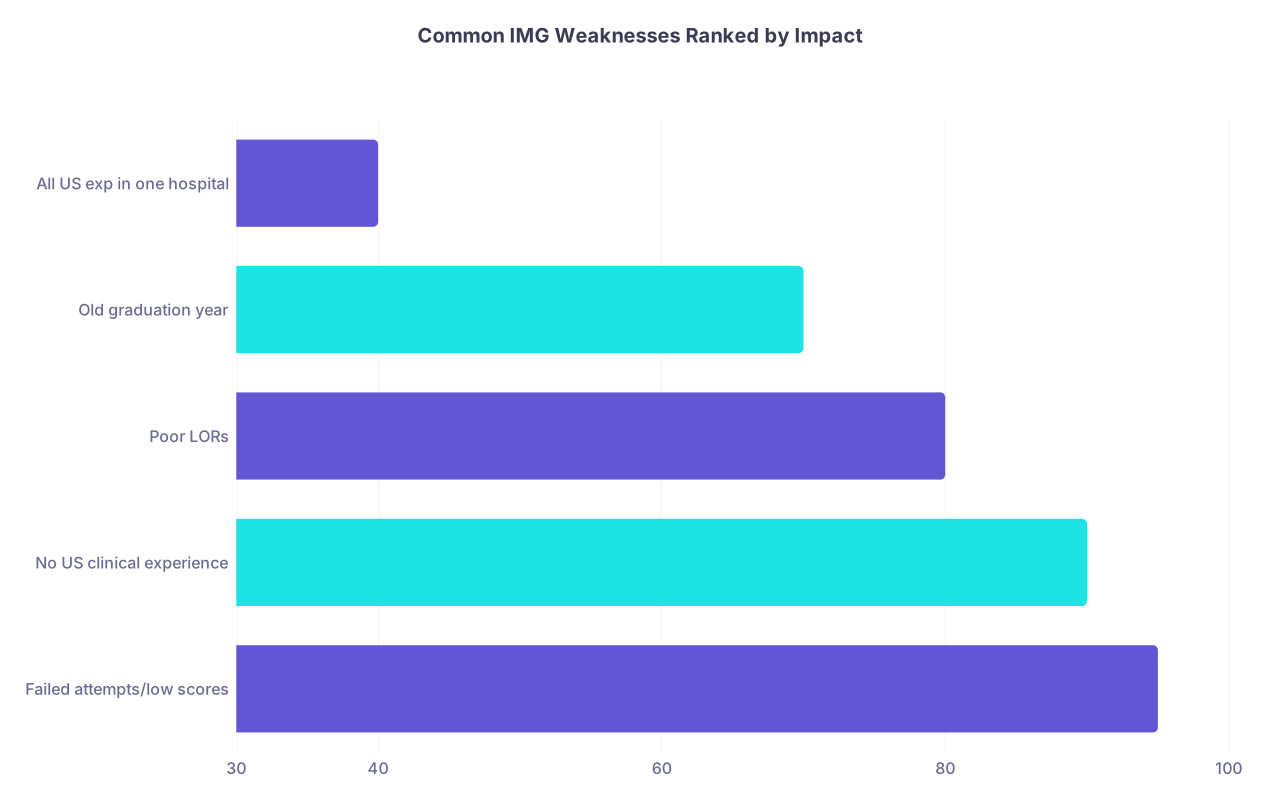
| Category | Value |
|---|---|
| Failed attempts/low scores | 95 |
| No US clinical experience | 90 |
| Poor LORs | 80 |
| Old graduation year | 70 |
| All US exp in one hospital | 40 |
Stuff that typically bothers PDs way more than “one-hospital”:
- Multiple exam failures or very low scores
- No US clinical exposure at all
- Weak or clearly template LORs
- Long gap since graduation with no meaningful clinical activity
If your biggest “issue” is that you worked your butt off in one hospital instead of three? That is not in the catastrophic tier.
Concrete Things You Can Do Right Now
If you're stuck in the “one hospital only” box, your action list is basically this:
- Make sure your US experience is recent (ideally within 1–3 years of applying).
- Get at least 2 strong, specific LORs from different faculty there.
- Diversify within the hospital if possible:
- Inpatient + outpatient
- General IM + subspecialty
- Clinical + maybe a small QI/research project
- Frame it in your PS and ERAS entries as intentional continuity, not “I had no options.”
- If you still have time/means, consider adding one more rotation elsewhere, but don’t panic if you can’t.
Is it perfect? No. But it’s enough to be taken seriously.
Quick Mental Reframe (Before You Spiral Again Tonight)
Instead of:
“I only had one hospital. Everyone else rotated all over the country. I look like no one wanted me.”
Try:
“I committed deeply to one system, built long-term relationships, and left with people who are willing to vouch for me in detail.”
Programs don’t match a spreadsheet. They match a story plus proof. You can make a one-hospital story work if the proof (LORs, specifics, timeline) is solid.


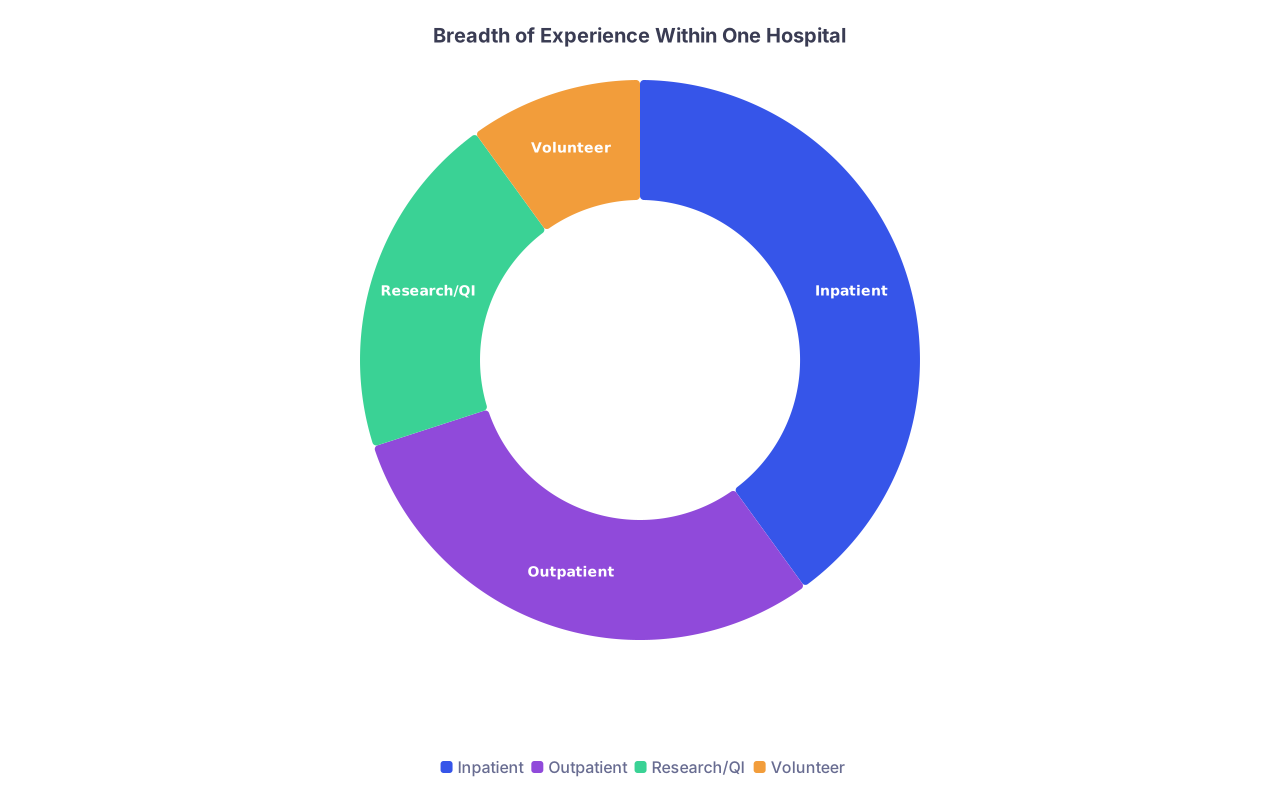
| Category | Value |
|---|---|
| Inpatient | 40 |
| Outpatient | 30 |
| Research/QI | 20 |
| Volunteer | 10 |

| Step | Description |
|---|---|
| Step 1 | See all US exp at one hospital |
| Step 2 | Major concern |
| Step 3 | Weak application |
| Step 4 | Moderate concern |
| Step 5 | Acceptable pattern |
| Step 6 | Any US experience at all |
| Step 7 | Strong letters |
| Step 8 | Recent and relevant |

FAQ (You’re Not the Only One Thinking These)
1. Is it better to have one strong hospital with good letters or many hospitals with average letters?
One strong hospital with excellent letters beats three hospitals with “they were fine, I guess.” People drastically underestimate how much LOR quality matters. If your attendings actually know you, mention specific cases, and describe your growth, that is more persuasive than a shopping list of random sites where nobody really remembers you.
2. Does having all my US experience in one hospital hurt me for programs in other states?
Not automatically. Programs don’t expect you to have rotated in their exact geographic region. It can be a bonus if you’ve worked nearby, but it’s not a requirement. What they care about is that you can function in the US system somewhere. If you’re worried, mention your genuine interest in relocating and your reasons (family, long-term goals, etc.) in your PS or supplemental questions, instead of fixating on your single-hospital history.
3. Will programs think I had no other offers if everything is in one hospital?
Some might briefly wonder why you stayed in one place, but most won’t build an entire rejection narrative from that alone. Lots of IMGs stay put because of money, visas, or simply because that hospital actually invested in them. If your story is consistent and your LORs are strong, this doesn’t scream “no one wanted me.” It looks more like, “I found a place willing to train me over time and I committed to it.”
4. If I can only afford one more rotation, should I go back to the same hospital or pick a new one?
If your current hospital writes fantastic letters and values you, but you have only one short block there, extending there might deepen your letters and continuity—that’s good. But if you already have multiple months and solid LORs from that site, I’d lean toward adding a different hospital to show you’re adaptable to a new environment. One more data point in a different setting can help your confidence and give programs one more angle from which to see you.
Key points:
- One-hospital US experience isn’t a dealbreaker; weak or generic output from that hospital is.
- Your job is to frame the continuity as a strength and back it up with specific, strong LORs.
- If you can add another site, great; if you can’t, maximize depth and clarity where you already are, instead of beating yourself up for what’s not possible.


