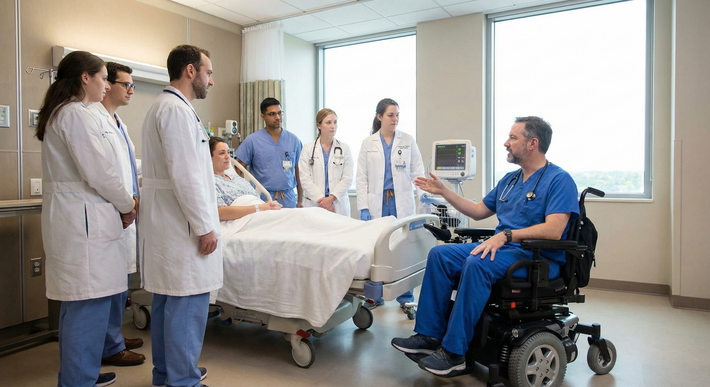
When the Flight Seems Impossible: Facing Interview Travel with a Disability
What if I just... can't get there?
That thought has been looping in your head for weeks, hasn't it? You're staring at an interview invite from your dream program, the one you worked so hard for, and instead of excitement, your stomach drops. It's in Chicago. In January. You'd need a 6 a.m. flight, a layover, a shuttle to a hotel that may not be accessible, then eight hours of interviews on hard chairs, no guaranteed place to rest, no place to take your meds privately. And you have three more next week.
I get it. The fear feels so visceral. Like your body is going to fail you at the exact moment your career needs you most. Everyone else seems to be booking Southwest flights and posting their interview trail photos. And you're quietly panicking about whether your wheelchair will fit in the overhead bin, whether airport security will confiscate your injectables, whether you'll have a flare and miss the whole thing.
You are not alone in this. Not even close. So many of us have sat exactly where you are, refreshing that inbox, loving medicine, and feeling like the logistics of getting into residency were designed for someone else's body.
Here's the promise I can make you: practical strategies exist. Real, tested, legal protections exist. And you deserve an equitable shot at matching. Period. Yes, interview scores matter. Programs rank on fit and performance. But your health and your access? That's non-negotiable. You cannot interview well if you're in crisis. Protecting your body isn't being "difficult." It's being strategic.
Your Legal Rights: What You're Actually Entitled To
Okay, let's talk about the scary part first, the part that keeps you up at night. "If I ask for help, will they blacklist me?"
No. They legally can't. And I know your anxiety says "but what if they do it secretly anyway," so let's get concrete.
You are protected under the Americans with Disabilities Act (ADA) and Section 504 of the Rehabilitation Act. Because residency programs receive federal funding, Medicare money counts, they have to provide reasonable accommodations that give you equal access to their interview process. That's not a favor. That's the law.
What does "reasonable" actually mean? It means a program cannot penalize you for requesting accommodations. It means they have to engage in an interactive process with you. It means if travel is a significant barrier due to your disability, asking for a virtual interview, an adjusted schedule, an accessible hotel room, or extra breaks is not just okay, it's expected.
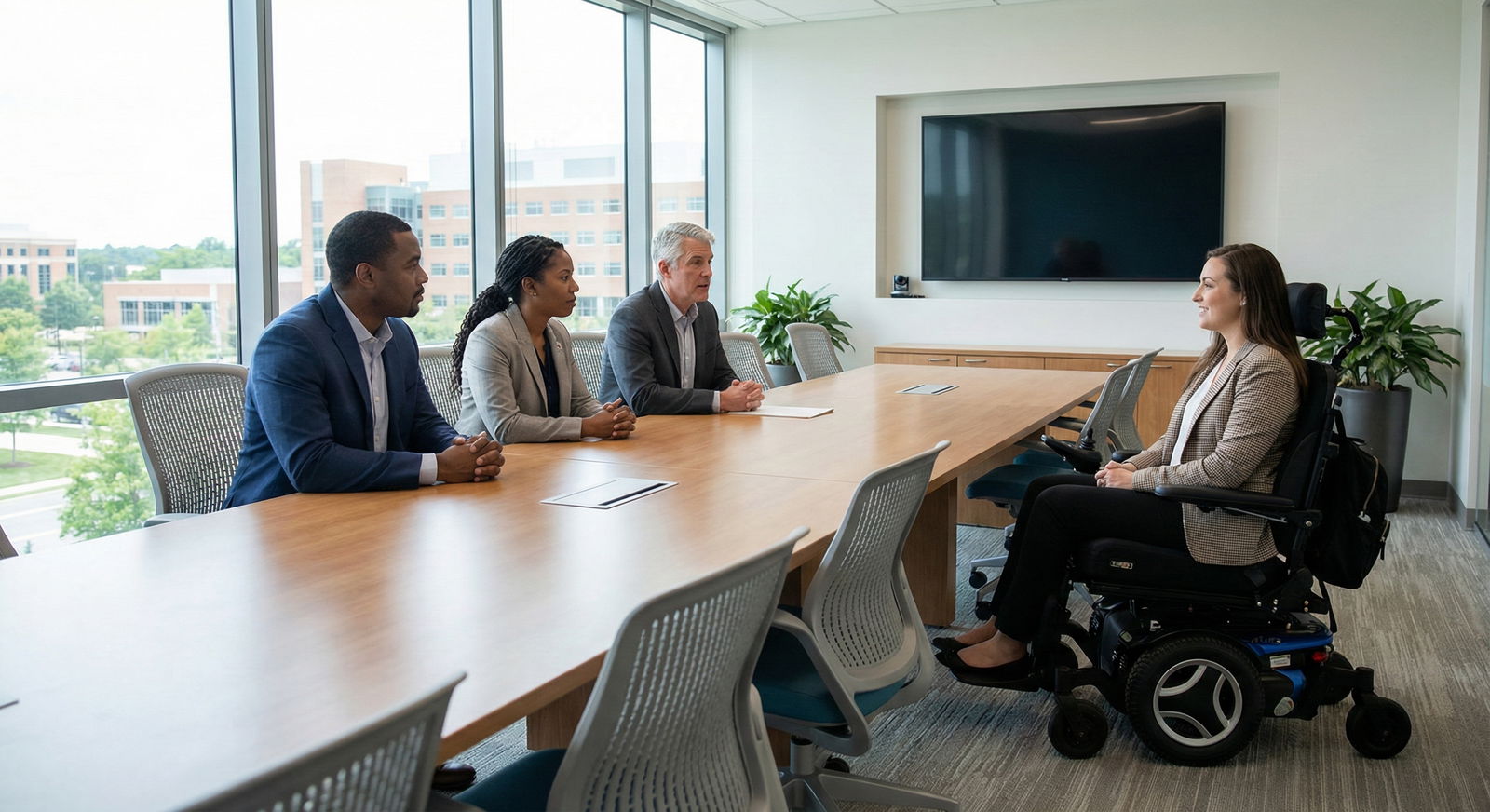
Since 2020, everything shifted. Virtual interviews went from "we've never done that" to standard operating procedure. Most programs now have the tech. Most have done it. So when you ask, you're not asking them to invent something. You're asking them to use a tool they already have.
I know that fear of being labeled "high maintenance" feels huge. I felt it too. But think about it this way: programs manage dietary restrictions, childcare emergencies, pregnancy accommodations every year. Your accommodation request goes through HR or the GME office, not the program director's personal judgment file. And any program that would actually punish you for a legal request? That's a program that would punish you for being sick during residency. You don't want to match there. Trust me.
You are not a burden. You are a qualified applicant requesting equal access to show your talent.
Practical Strategies: Making Travel Work for Your Body
Alright, let's get into what you can actually DO. Because spiraling helps no one, and a plan helps everyone.
1. How to ask. Timing and script matter.
Don't wait until 48 hours before your interview. Once that invite lands, give yourself a day to freak out, then research that program's accommodation policy, it's often buried on their GME website. Then email. 2-3 weeks before is the sweet spot.
You do not need to disclose your entire medical history. You need to be specific about functional need.
Try this template, I've seen this exact language work:
Subject: Interview on [Date] - Request for Reasonable Accommodation
Dear [Program Coordinator/GME Office],
Thank you so much for the invitation to interview on [Date]. I am very excited to learn more about [Program Name].
I am writing to request a reasonable accommodation under the ADA. Due to a disability-related need, prolonged air travel and [specific barrier, e.g., extended standing/walking without rest] would significantly impact my ability to participate fully.
Would it be possible to arrange [specific ask: e.g., a virtual interview option, an accessible hotel room within the hospital complex, a scheduled rest break between interviews, wheelchair assistance]?
I am happy to provide documentation from my medical school's disability services office if needed and to discuss what would be feasible. Thank you for your consideration.
Best, [Your Name], AAMC ID: [Number]
Short. Professional. Functional. No apology.
2. Virtual as equal access.
Ask plainly: "Does your program offer a virtual interview option as an accommodation?" If they say no, ask who to contact in the GME office or Disability Resources office. Sometimes the coordinator says no because they don't know they can say yes. Escalate gently, not aggressively.
3. If you do travel: brutal logistics planning.
This is where your anxiety is actually useful, because you think of everything.
Pack your carry-on like it's your survival kit: meds in original bottles with letters, chargers, compression devices, snacks, emergency contacts printed out. Call the airline's disability line 48 hours ahead, not the regular line, and confirm mobility assistance. Request TSA Cares screening if you need it. Build a rest schedule into your itinerary and actually block it, like "4-6 p.m. horizontal, do-not-disturb." Your body needs recovery time. Budget it like you budget flights.
4. Money.
This is real. Disability travel costs more. Accessible hotels cost more. Last-minute changes cost more. First, email your med school's student affairs and disability office, many have hidden interview travel funds they don't advertise. Then look at organizations like the National Association of Medical Students with Disabilities, state medical societies, and even your specialty's diversity scholarships. Some programs reimburse mileage or provide resident hosting. Ask. The worst they say is no.
Building Your Support System: You Don't Have to Do This Alone
I tried to do this alone my first cycle. Bad idea. I told no one, white-knuckled every flight, crashed after every interview. Don't be me.
You need layers.
Strategic disclosure: You get to choose. You do NOT need to disclose your disability in your personal statement unless you want to. For interview accommodations, you disclose to the coordinator / GME / disability office, not necessarily the individual faculty interviewers. You can say "I have a medical condition that requires X accommodation" and leave it there. Detail is your choice. My rule: disclose need, not diagnosis, unless you want to share more.
Your med school disability office is your attack dog. Use them. That's literally their job. They can write the official letter, they can call the program on your behalf, they have language that programs recognize as "this is formal, we need to comply." If your school's office is weak, find your Title IX/504 coordinator. Go up the chain.
Find your people. There are residents and attendings with your exact disability who matched. I've seen a resident with a chronic pain condition who did 12 virtual interviews and matched at her top 3. I've seen a Deaf applicant who requested CART captioning and got it. Reach out through #DocsWithDisabilities on X/Twitter, through your specialty's disability group, through the AAMC's resources. One 20-minute chat with someone who did it will cut your anxiety in half.
And emotional support? Not optional. Your school therapist might not get the Match. Try to find a therapist who understands medical training pressure, or at minimum a peer support group. The anxiety spiral of "what if they think I'm faking, what if I fail", that's not weakness. That's this process being hard.
Protecting Your Mental Health: Managing the Anxiety spiral
Let's be honest. This whole thing feels unfair.
You did everything right. You studied, you rotated while exhausted, you proved you can be an excellent doctor. And now you're forced to solve an access problem that your non-disabled peers don't even think about. Of course you're anxious. Of course you're angry. That's a normal reaction to an inequitable system. Not a character flaw.
So what do we do with the 3 a.m. thoughts?
Name it. This is anxiety talking, not prophecy. "I'm having the thought that I'll be forced to travel and will end up in the ER and ruin all my interviews." That's a thought. Not a fact.
Contain it. My anxiety coach taught me "worry time." Sounds dumb. Works. Schedule 15 minutes at 5 p.m. That's your official freak-out window. You can catastrophize all you want then. Outside that window? You write the worry down for later. Your brain starts to trust that it will be heard, so it shouts less at midnight.
Breathe like you mean it. Not the vague "take deep breaths." Try box breathing before you send that accommodation email: 4 seconds in, 4 hold, 4 out, 4 hold. Do it four times. Your nervous system needs a signal that you're safe to advocate.
And reframe, not toxic positivity, but truth. Most programs WANT diverse trainees. I mean genuinely want them. Disability is diversity. The program that sees your creative problem-solving, your empathy from lived experience, your resilience? That's a good program. They are out there. A lot of them.
You belong in medicine exactly as you are. Not when you're "fixed." Not when travel is easier. Now. Exactly like this.
Your Next Steps: Taking Action Today
Okay. Deep breath together. You don't have to fix everything tonight. You just have to do one small thing today.
First: pull up your school's disability services site. Email them. Even if it's just "Hi, I'm an MS4 interviewing for residency and I need to discuss travel accommodations. Can we meet this week?" Send it.
Second: make a simple sheet. List every program you applied to. Quick Google: "[Program] GME accommodations" and "[Program] interview travel policy." Note what you find. Takes an hour. Saves you weeks of panic later.
Start the conversation early. Do not wait until you have 10 invites and are overwhelmed. Programs actually respond better when you give them lead time. It reads as organized and professional, which you are.
Your disability is part of your story. It's shaped how you doctor, how you listen, how you persevere. That's not a barrier to your success. That's evidence of it.
You are worthy of a training environment that supports your access needs. You are worthy of a program that says, "Great, let's figure out how to make this work so we can see how brilliant you are."
You've got this. And if it feels impossible today? You're allowed to feel that. Then you send the email anyway.