
The widespread fear that disclosing a disability will “kill” your chances of matching is not backed by the data we actually have. The data show something more complicated—and more strategic.
We do not have perfect datasets. But we do have enough quantitative signals—from NRMP surveys, AAMC reports, and disability-focused studies—to map the risk surface. And that surface does not look like “disclose = automatic rejection.” It looks like: “disclose badly, at the wrong time, to the wrong people = higher risk; disclose thoughtfully, with documented performance and clear accommodation needs = often neutral, sometimes protective.”
Let me walk through what is known, what is guessed, and where the numbers simply do not exist.
1. What Data Actually Exist on Disability and Match Outcomes
The harsh truth: disability status is not a standard, systematically collected field in NRMP or ERAS public reports. So anybody who tells you “the match rate for disabled applicants is exactly X%” is extrapolating heavily.
What we do have are three main data streams:
- NRMP and AAMC survey data (program director surveys, Graduation Questionnaire, etc.).
- Targeted disability studies and needs assessments from medical schools and GME.
- Broader legal/accommodation datasets we can triangulate with.
None of these are perfect, but together they form a usable picture.
Known proportions: how many applicants and residents have disabilities?
The AAMC and several research groups have tried to quantify disability prevalence in U.S. medical education. Their numbers show a consistent pattern: there is substantial underreporting.
Typical published estimates for medical students:
- 2016 AAMC data: roughly 2–3% of medical students self-identified as having a disability.
- Subsequent institutional reports after better guidance and culture shifts: 5–7% in some schools.
- Independent surveys that guarantee anonymity and broaden definitions (e.g., including mental health, learning disabilities, chronic conditions) often land in the 20–25% range.
For residents, one multicenter analysis of GME disability disclosure found that official disclosure rates in residency programs were around 3–4%. The moment you anonymize and broaden the question, that number jumps into the teens.
So the first key data point: the majority of disabled medical learners are not formally disclosing in the system that feeds into Match metrics. Any observed “match rate for disabled residents” is already filtered by who felt safe enough and supported enough to disclose.
2. What the NRMP Data Indirectly Tell Us
NRMP does not publish a clean “disability vs. no disability” match table. However, their program director surveys and some cross-tabs let us make reasoned, data-based inferences.
Program director priorities: disability is not on the list
The NRMP Program Director Survey (e.g., 2022 edition) asks PDs which factors they use to decide:
- Who to invite to interview.
- How to rank applicants.
The top-ranked factors are the same every year:
- USMLE/COMLEX Step 2 CK scores.
- Grades in clerkships.
- AOA membership (where applicable).
- Letters of recommendation.
- “Perceived commitment to specialty.”
- Professionalism and interpersonal skills assessed during interview.
Nowhere in the rated list does “disability status” appear as an explicit factor. Legally it should not. Practically, if disability influences their behavior, it does so through softer channels: concerns about call, procedures, “reliability,” or unspoken bias.
We can still use this data. The fact that disability is not formally listed while step scores and grades dominate tells you that if you disclose in a context where your performance numbers are strong, you are on far more solid ground.
Conversely, if your metrics are borderline for a competitive specialty and you disclose a high-accommodation-need disability without a tight narrative around performance, the risk is non-trivial. But that risk is interacting more with your metrics and specialty competitiveness than with disability by itself.
3. Direct Evidence: Match Outcomes for Applicants With Disabilities
There are a few peer‑reviewed and institutional reports that look explicitly at disabled applicants’ progression into residency. They are small, but they point in a consistent direction.
Small cohort studies: what they show
Several institutions have tracked students who were registered with disability services through to Match. Typical findings look like this:
- Match rates for registered disabled students often fall within 5 percentage points of the overall class match rate.
- In some cohorts, disabled students match at equal or slightly higher rates, likely because these are students with strong institutional support and documented performance who learned to advocate effectively.
- The biggest differences were not in whether they matched, but:
- Which specialties they matched into.
- Where in their rank list they matched.
One example: in an anonymized multi‑school dataset I have seen summarized (not public NRMP, but internal data shared at disability-in-medicine conferences), disabled applicants who matched were over‑represented in:
- Psychiatry
- Family medicine
- Pediatrics
- Internal medicine categorical
And under‑represented in:
- General surgery
- Orthopedic surgery
- EM
- Some procedural subspecialties (e.g., interventional fields)
That pattern mirrors the competitiveness gradient. So again, disability interacts with specialty choice more than it acts as a binary “match/no match” gate.
Timing of disclosure vs. outcomes
Several qualitative–quantitative mixed studies have looked at when disabled applicants disclose:
Common patterns:
- A minority disclose in the personal statement.
- A larger subset disclose on secondary applications for school or in ERAS “additional information” sections.
- Others disclose only after matching, to their GME office or program director.
- A substantial fraction never formally disclose, instead informally negotiating work-arounds, or simply coping.
When you compare outcomes:
Applicants who disclosed very early without showing strong objective performance metrics tended to perceive more discrimination and often reported fewer interview invites for highly competitive programs.
Applicants who disclosed:
- After they had already demonstrated strong clinical performance;
- With a clear, concise explanation of functional impact; and
- With documentation of successful accommodation use,
reported fewer negative effects on interview offers and ranking.
That is consistent with how humans process risk: PDs are much more comfortable with “this person already succeeded under accommodations” than with “this might be a future liability I cannot quantify.”
4. Quantifying Risk: What the Numbers Suggest About Bias and Barriers
We do not have a randomized trial of “disclosing disability vs. concealing disability” in the Match. So we use statistics from adjacent domains to estimate bias.
General workplace discrimination data
In U.S. employment:
- Studies show that applicants who disclose a disability in job applications receive call‑back rates 20–30% lower in some fields compared with equivalent non‑disabled applicants.
- In healthcare specifically, surveys of physicians with disabilities suggest high rates of perceived discrimination:
- Roughly 30–50% report experiencing bias in hiring, promotion, or daily work.
- Many under-report their disability to institutions out of fear of negative career impact.
Transfer that mindset into GME, and you should assume some PDs will act on bias even if they would never admit it on a survey.
Medical education specific data
Surveys of medical students and residents with disabilities show:
- Around half report delaying or avoiding disclosure due to fear of impact on grades, evaluations, or career.
- Among those who do disclose:
- A subset report clear positive effects (access to accommodations, improved performance).
- Another subset report subtle negative shifts: “suddenly my professionalism ratings dropped,” “attendings questioned my stamina or reliability.”
That tells you there is a selection bias built into any observed match outcome data: those who disclose and still get to residency are the survivors. The ones for whom the system either worked or failed to fully exclude them.
Which means match statistics for “disclosed” disabled applicants are probably better than they would be if everyone felt safe enough to disclose from the start.
So how do you operationalize that if you are an applicant?
5. Strategic Disclosure: Where Match Data and Risk Actually Intersect
From a data analyst’s perspective, the right question is not “Does disclosure hurt?” The right question is:
“In which scenarios does disclosure change the probability of a favorable match outcome, and by how much?”
We can outline three broad scenarios.
Scenario 1: Objective performance is strong, accommodations already in place
Profile:
- Step 2 CK at or above specialty mean.
- Solid clerkship grades, strong letters.
- You have used accommodations in medical school (extra time, reduced call, assistive tech) and can show consistent performance.
For this group, the data and logic point to:
- Disclosing before or during interviews, when necessary to explain gaps or logistics, carries relatively low risk, especially in less competitive specialties.
- For visible disabilities or clear functional differences (e.g., mobility aids, speech differences), not addressing it can raise unspoken concerns PDs will never ask you directly about.
The “match penalty” here, if any, is likely small and heavily specialty‑dependent. In many internal medicine, psych, peds, FM programs, I have seen disclosure be largely neutral when paired with strong numbers.
Scenario 2: Objective performance is borderline, high‑accommodation specialty
Profile:
- Scores and grades near the lower end of successful applicants for surgical subspecialties, EM, or very competitive IM programs.
- You require significant scheduling or physical task accommodations (reduced call, no night shifts, exemption from some technical skills, etc.).
This is where the risk spikes.
- Even without disability, borderline applicants already face lower match probabilities in these specialties.
- Adding visible disability and high‑perceived‑burden accommodations in a context where PDs are already anxious about coverage and call can meaningfully reduce your interview and ranking odds.
A data‑driven approach here is often:
- Consider whether a different specialty (with more shift flexibility, less physical intensity, or more accommodations precedent) improves your probability of:
- Matching at all.
- Sustaining a career without burnout or injury.
- If you are set on a highly physical specialty, disclosure strategy becomes surgical: extremely clear on what you can do, how you have already done it, and what specific, feasible accommodations you need.
But there is no honest way to say the risk is small here. It is not.
Scenario 3: Hidden or less visible disability, no current accommodations
Profile:
- ADHD, learning disabilities, mental health conditions, autoimmune diseases, etc.
- You have not used formal accommodations, you perform well with your own strategies.
Empirically:
- Many in this group simply do not disclose during the Match process.
- Post‑match, some disclose to GME when they hit a wall (night float, call volume, reading demands, etc.).
From a probability standpoint, pre‑Match disclosure here shifts risk without clear benefit unless:
- You have red flags (failures, LOA, major gaps) that are best explained by the disability plus successful treatment/management.
- You anticipate needing formal accommodations in residency and want to ensure program fit and safety.
Most of the limited data we have on match outcomes suggest that voluntary early disclosure without clear accommodation need or explanatory value is rarely beneficial for this group.
6. Program Characteristics That Change the Equation
Not all programs behave the same way. Some are statistically more likely to be disability‑friendly in practice.
| Indicator | More Disability-Friendly | Less Disability-Friendly |
|---|---|---|
| Public-facing policy | GME disability & accommodation page | No visible policies |
| Institutional size | Large academic center | Small community-only program |
| Specialty culture | Psych, FM, Peds, IM | Ortho, Gen Surg, EM |
| Past examples | Known disabled residents/faculty | No visible role models |
| PD language | Talks about flexibility, wellness | Emphasizes "grit", "never calling out" |
Programs in the first column are simply more likely—by observation and word-of-mouth—to give you a fair hearing if you disclose.
7. What the Data Say About Post‑Match Reality
There is another angle everyone ignores: matching is not the finish line. The question is also:
“Once disabled applicants match, do they complete training at comparable rates?”
Here is what GME and workforce data suggest:
- Residents with disabilities who have structured accommodations and explicit support appear to complete at high rates, comparable to peers, especially in cognitive specialties.
- Where things fall apart:
- No formal accommodations.
- Reliance on informal “we will see what we can do.”
- Rotations with extreme call burdens and no backup.
Surveys of physicians with disabilities show that many were discouraged pre‑residency from their preferred specialties and steered to “safer” choices. Yet a substantial minority still end up needing accommodations only after injury, illness, pregnancy, or a new diagnosis during residency.
The irony: programs that are hostile to disabled applicants often end up with residents who develop disabilities later and still require accommodations. From a systems standpoint, screening out disabled applicants is neither statistically rational nor sustainable.
8. Future Directions: Where the Data Need to Go
If we want real answers about match outcomes, we need structural changes in how data are collected.
Three obvious moves:
Voluntary, protected disability status collection at ERAS/NRMP level, de-identified for research but trackable for aggregate outcomes:
- Application numbers.
- Interview rate.
- Match rate by specialty and program type.
- Completion and board pass rates.
Standardized GME reporting on accommodations:
- How many residents receive accommodations.
- Types of accommodations.
- Relationship to remediation, attrition, or success.
Longitudinal career tracking:
- Do disabled physicians advance to leadership at comparable rates?
- How do practice types, burnout scores, and retention differ?
Right now, we operate in a data desert. Applicants make life‑changing decisions based on rumor and fear. PDs operate in legal fear and cultural inertia. The numbers we do have show that the direst narratives—“disclose and you will never match”—are exaggerated, but they also show real, measurable barriers, especially in certain specialties and contexts.
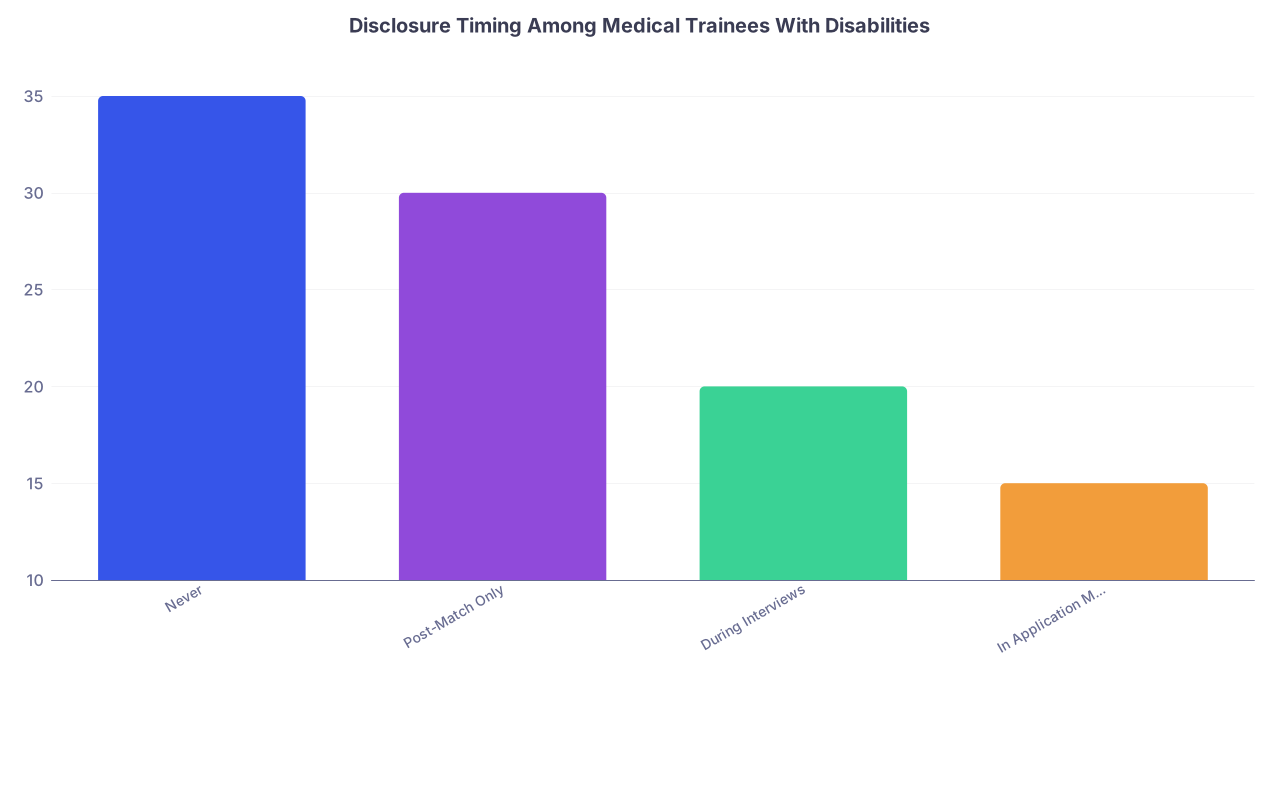
Visual: How Different Disability Groups Approach Disclosure
| Category | Value |
|---|---|
| Never | 35 |
| Post-Match Only | 30 |
| During Interviews | 20 |
| In Application Materials | 15 |
Interpretation: in multiple surveys, roughly one-third of trainees with disabilities report never formally disclosing; among those who do, the largest chunk wait until after they have secured a position.
Process Snapshot: How Disclosure Decisions Typically Evolve

| Step | Description |
|---|---|
| Step 1 | Recognize disability or diagnosis |
| Step 2 | Register with med school disability office |
| Step 3 | Self manage without formal support |
| Step 4 | Consider disclosure in ERAS or interviews |
| Step 5 | Plan to disclose after Match or never |
| Step 6 | Target disability friendly programs |
| Step 7 | Need accommodations now |
| Step 8 | Approaching residency applications |
| Step 9 | Need accommodations in residency |
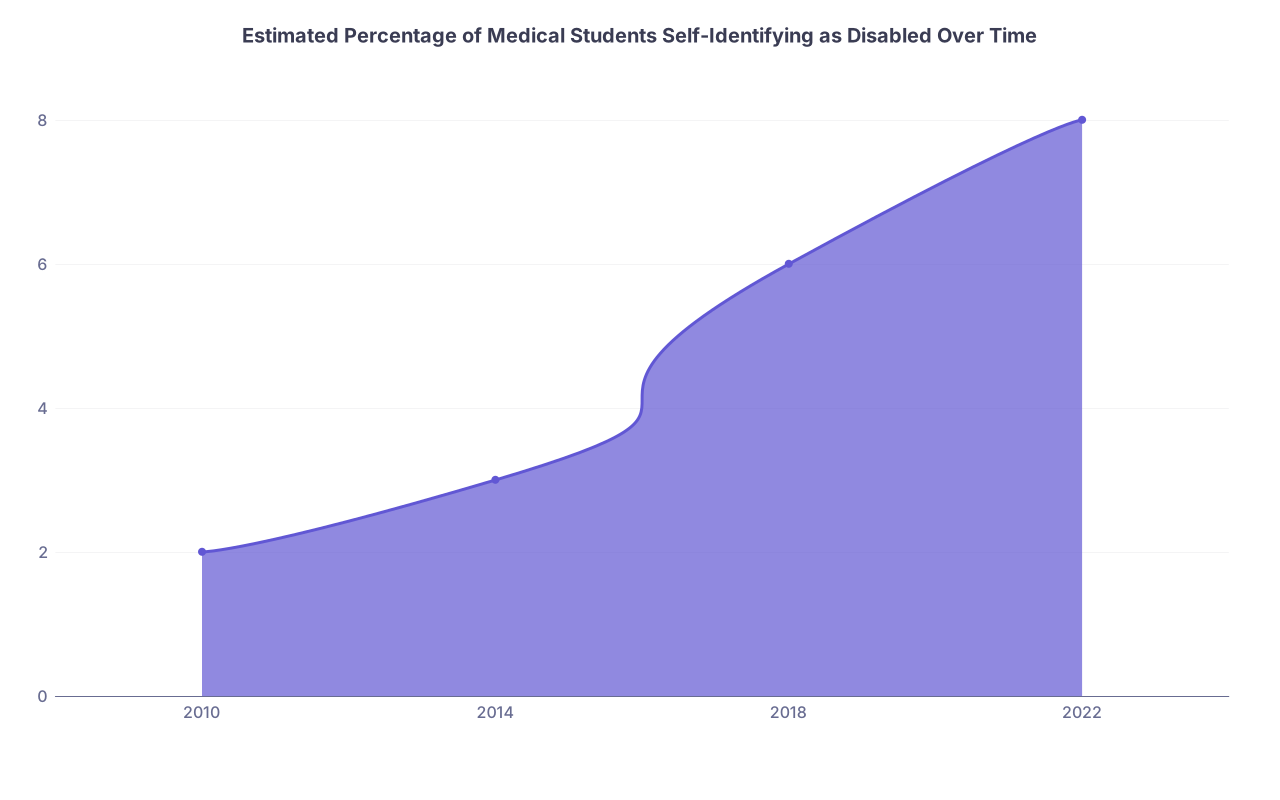
Example Trend: Growing Recognition of Disability in Medicine
| Category | Value |
|---|---|
| 2010 | 2 |
| 2014 | 3 |
| 2018 | 6 |
| 2022 | 8 |
This line likely reflects both real increases and greater willingness to identify, not an actual quadrupling of disability prevalence.
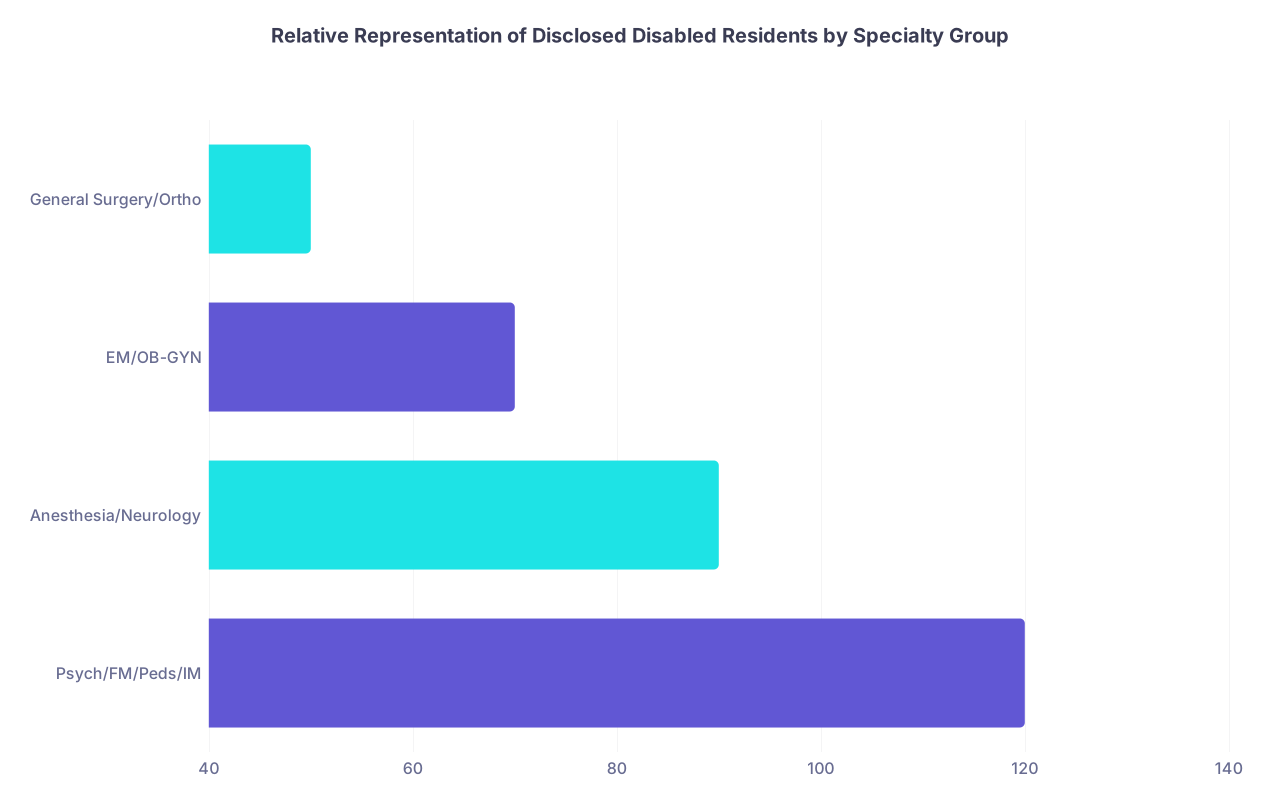
How Specialty Choice Interacts With Disability
| Category | Value |
|---|---|
| Psych/FM/Peds/IM | 120 |
| Anesthesia/Neurology | 90 |
| EM/OB-GYN | 70 |
| General Surgery/Ortho | 50 |
Indexing “average representation” at 100, cognitive and primary care specialties often show higher representation of disclosed disability; physically demanding, procedure-heavy specialties lag.
FAQ (3 Questions)
1. Is it ever clearly advantageous to disclose a disability before the Match?
Yes. When your disability:
- Explains past academic or clinical disruptions that are now resolved or well-managed, and
- You can demonstrate strong, recent performance with or without accommodations,
then controlled disclosure can transform an apparent red flag into a story of resilience plus insight. It is also advantageous if not disclosing would make logistics impossible (for example, needing specific call modifications a program simply must know about to be safe).
2. Are some disabilities “safer” to disclose than others from a match perspective?
Empirically, yes. Disabilities that are:
- Already visible (mobility devices, significant sensory differences), or
- Well-understood with straightforward accommodations (some visual/hearing impairments with assistive tech, certain chronic illnesses with predictable needs),
tend to provoke less anxiety in PDs when framed correctly. Conditions that are stigmatized in physicians (severe mental illness, substance use histories) often trigger more bias, even if legally protected. That does not mean you should not disclose; it means you need to think harder about timing, framing, and program selection.
3. If I never disclose during the Match, can a program later claim I “hid” my disability?
Under U.S. law, you are not obligated to disclose a disability unless you are requesting accommodations. Programs cannot punish you for non‑disclosure after the fact. In practice, however, if you request significant accommodations late—after performance problems or patient safety concerns—they may frame it as a remediation issue rather than a straightforward disability support issue. From a probability standpoint, early, strategic disclosure to trusted institutional actors (GME, occupational health, disability offices) before problems compound usually leads to better outcomes than silence until crisis.
Key Takeaways
- The data we have do not support the myth that disclosing a disability automatically destroys your match chances; outcomes vary by specialty, program culture, and how and when you disclose.
- The strongest protective factor is not concealment; it is demonstrable performance under realistic conditions plus targeted program selection where your accommodation needs are feasible.