
Are you burning thousands of dollars on ERAS tokens just to feed the vanity of academic medical centers that throw your application straight into the digital trash bin?
I see it every single match cycle. Hardworking osteopathic medical students get cornered by well-meaning but hopelessly out-of-touch faculty advisors. The advice is almost always the same: "Apply broadly to university programs. You need that academic name on your CV if you want a real career."
Nonsense. Pure, unadulterated folklore.
The AOA-ACGME single accreditation pathway merger was finalized back in 2020. Yet, five years later, DO applicants are still falling into the same prestige trap. They apply heavily to ivory-tower university programs where their applications get auto-filtered into oblivion, while ignoring top-tier community hospital systems that would jump at the chance to train them.
Let me break down the actual data. If you want to maximize your match probability, secure elite procedural training, and avoid burning cash on dead-end applications, you need to abandon the prestige myth and look at how the National Resident Matching Program (NRMP) really works.
The Conventional Wisdom Trap: Why Everything You Know About University vs. Community Programs is Wrong
The medical education establishment loves a neat hierarchy. University programs sit at the top, community-based programs rest at the bottom, and university-affiliated community sites float somewhere in between.
This ranking might make for great cocktail party chatter, but it misrepresents how application screening works post-merger.
The Ghost of the Dual Match
Before single accreditation, DO applicants had their own dedicated match (the AOA match). When the systems unified under the ACGME banner, many osteopathic students assumed it created a completely level playing field.
It didn't.
What it actually did was allow legacy ACGME university programs, many of which had zero history of taking DO graduates, to set automated ERAS filters that filter out COMLEX scores or mandate astronomically high USMLE Step 2 CK cutoffs.
Outdated Advice: "Apply university-first, community as a safety."
Data Reality: University programs auto-filter DOs at 3x the rate of community programs.
I've reviewed application strategy sheets from hundreds of DO seniors. A terrifying number of them spend 70% of their program applications on major university health systems, despite having no research publication history and only a COMLEX score.
The result? Massive application waste.
When you look at actual NRMP match outcomes, the volume of DOs matching into pure university settings remains heavily clustered in specific, historically friendly institutions. Meanwhile, community health systems absorb the vast majority of successful osteopathic applicants, not because community programs are "settling," but because their selection criteria align far better with what osteopathic training actually produces: high-performing clinical generalists.
The Match Rate Reality: Where Do DOs Actually Secure Positions?
Let's look at the numbers. The NRMP Charting Outcomes in the Match report provides clear, unequivocal data regarding where DO seniors actually end up.
Across every single specialty, from broad-scope primary care to competitive surgical fields, the match rate for DO applicants is dramatically higher in community-based settings than in university medical centers.
Look at General Surgery. A DO applicant targeting community surgical residencies achieves a match rate approaching 62%. That same pool of applicants targeting university surgical programs sees that rate plummet to 24%.
Why the massive gap? It comes down to what program directors value during application screening.
University vs. Community Filter Criteria
University program directors are driven by academic metrics that boost institutional reputation:
- Heavy NIH grant funding
- Peer-reviewed first-author publications
- High USMLE Step 2 CK score cutoffs (often 245-250+)
- Feeder-school prestige (legacy MD ties)
Community program directors operate on entirely different priorities:
- Immediate clinical competency and work ethic
- High procedural volume readiness
- Team culture fit and low resident burnout risk
- Strong regional retention (will this resident stay and practice locally?)
When a university program receives 5,000 applications for 10 spots, they use software filters to slash that stack down to 300. If you don't have a USMLE score or a heavy research track record, your application is discarded before a human ever reads your personal statement.
Community programs, by contrast, are far more likely to evaluate COMLEX scores alongside USMLE, read your letters of recommendation, and assess your actual clinical capability.
Clinical Training Quality: High-Volume Community Sites vs. Tertiary Care Ivory Towers
Now let's tackle the biggest myth of all: "If I match at a community program, my clinical training will be inferior."
This is completely backward.
If your goal is to become an exceptional bedside clinician who can run a code, place a central line blindfolded, or operate independently on day one of attendinghood, a high-volume community site frequently beats a university center.
The Fellow Problem
At a massive tertiary university hospital, who gets the rarest, most complex procedures?
- The Cardiology fellow gets the complex structural heart cases.
- The Pulmonary/Critical Care fellow gets the difficult airways and bedside ultrasounds.
- The Surgical Oncology fellow gets the complex resections.
Where does that leave the categorical resident? Sitting in front of a computer workstation, entering orders, writing discharge summaries, and coordinating social work consults. You become a glorified administrative coordinator for subspecialty fellows.
In a strong community health system, there are no fellows.
You are the first call. You are the one putting in the chest tube at 2:00 AM. You are the one running the ICU team as a PGY-2. You get high procedural autonomy early in your training, not during the final six months of your senior year.
What About Fellowships?
"But Myth Buster, won't a community program kill my chances of getting a fellowship?"
No. Outdated thinking.
If you want an elite, hyper-competitive academic GI fellowship at Johns Hopkins, yes, coming from a non-research community program makes that an uphill battle. But if your goal is matching into Cardiology, Nephrology, Pulmonary/Critical Care, or Rheumatology at a solid regional program, strong community programs match residents into fellowships every single year.
The key is looking for community programs with internal fellowships. A community hospital that sponsors its own Cardiology or Hematology/Oncology fellowship offers the absolute best of both worlds: high resident autonomy during core residency, followed by a direct internal pipeline into subspecialty training.
Strategic Application Execution: Separating Data-Driven Fact from Faculty Folklore
So how do you actually use this data to build an intelligent, cost-effective ERAS strategy? You stop applying based on program names and start applying based on empirical filters.
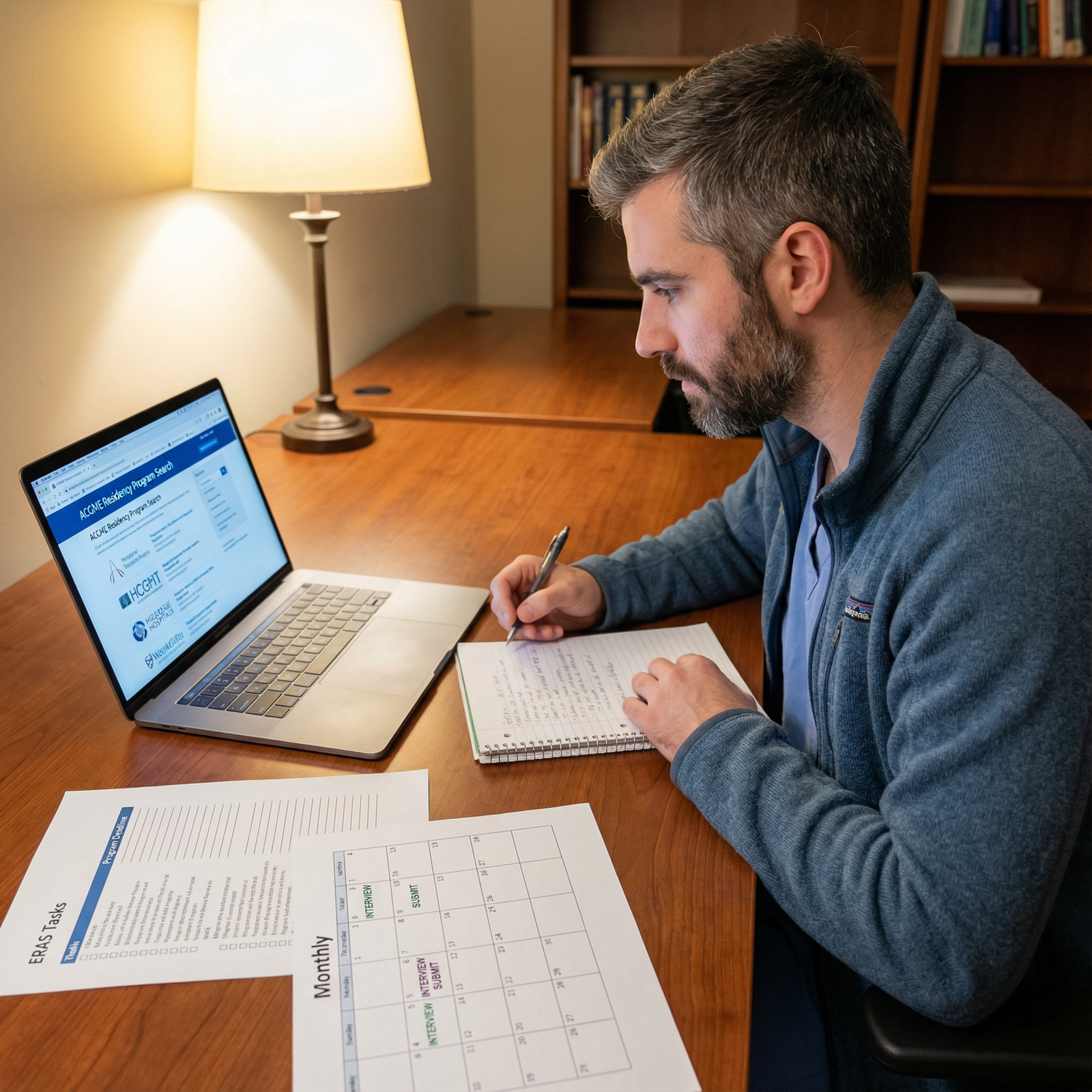
1. Board Score Triage: Know Where You Stand
- If your Step 2 CK is below 240 and you lack significant research, applying to top-20 university programs is effectively burning money.
- Focus your tokens on university-affiliated community programs and independent community health systems where your score sits well above their historical match medians.
If you took COMLEX only, double down on community programs, specifically those with Osteopathic Recognition (OR) or a long, documented track record of matching DOs. Do not waste precious application signals on university programs that state on their website: "USMLE required for all applicants."
2. Leverage Geographic Targeting over Brand Names
Community programs exhibit strong regional bias. They want residents who will stick around, staff their regional clinics, and build local networks.
If you grew up in the Midwest, went to school in the Midwest, and apply to community programs in the Midwest, your interview yield will skyrocket compared to sending cold applications to university programs across the country. Use your ERAS geographic preferences deliberately on community targets.
3. Build a Data-Backed Rank List
When it comes time to rank, turn off the prestige noise in your head. Stop listening to student forum threads ranking programs by "clout."
Evaluate programs using an objective scoring matrix:
- Procedural Autonomy: Are residents performing procedures themselves, or sitting back while fellows take over?
- DO Representation: What percentage of current residents are DOs? (If it's 30%+, the culture is already proven).
- EMR & Ancillary Support: Will you spend your day taking care of patients or doing phlebotomy and transport work?
- Fellowship Placement Rates: Where did the last 3 graduating classes actually land?
Key Takeaways
- The Prestige Myth is Expensive: University-affiliated ACGME programs filter out DO applicants at significantly higher rates than community-based programs, leading to lower match yields for score-focused applications.
- Community Programs Offer Superior Clinical Autonomy: Without fellows competing for procedures, residents at community hospital systems achieve higher procedural volume and earlier clinical independence.
- Fellowship Pipelines Exist in Community Settings: DO applicants seeking subspecialty training should target robust community health systems with internal fellowship programs rather than low-yield university ivory towers.
- Strategy Beats Pride: Tailor your ERAS tokens based on hard board metrics, geographic preferences, and historical DO intake rather than institutional branding.
Summary
Matching well as a DO isn't about chasing the biggest brand name on a hospital building. It's about matching at a program that actually wants you, will train you to be a confident clinician, and won't hide you behind a wall of fellows. Stop letting outdated academic prestige guide your application budget. Look at the match data, apply strategically to high-volume community and university-affiliated sites, and focus your energy where your odds of success are highest.