Will applying with COMLEX only quietly wreck your interview chances?
That's the question people ask in polite language, but the panic underneath it is usually harsher: did I just make myself easier to filter out than the classmate who took USMLE too? Did I hand programs an excuse to skip me without ever really reading my application?
I get why this fear sticks. Interview season already feels arbitrary and a little cruel. You can do well in school, build a solid application, rotate at the right places, and still end up staring at your inbox wondering whether one missing exam score became the invisible reason you got passed over.
Here's the honest answer: COMLEX-only is not an automatic disaster, but it absolutely can change interview odds at some programs. More in some specialties than others. More at some MD-heavy academic programs than at residencies that have trained DOs for years. And that distinction matters, because applicants often hear the soothing version, "we accept COMLEX", when what they really need is the blunt version: "accept" does not always mean "evaluate equally."
This article sticks to the evidence we actually have, while being honest about what the data can't prove. Because spiraling helps no one. But pretending there's zero disadvantage? That's not honest either.
Are COMLEX-only applicants actually at a disadvantage for DO vs MD interviews?
Yes, sometimes. Not universally. But enough that you should take it seriously.
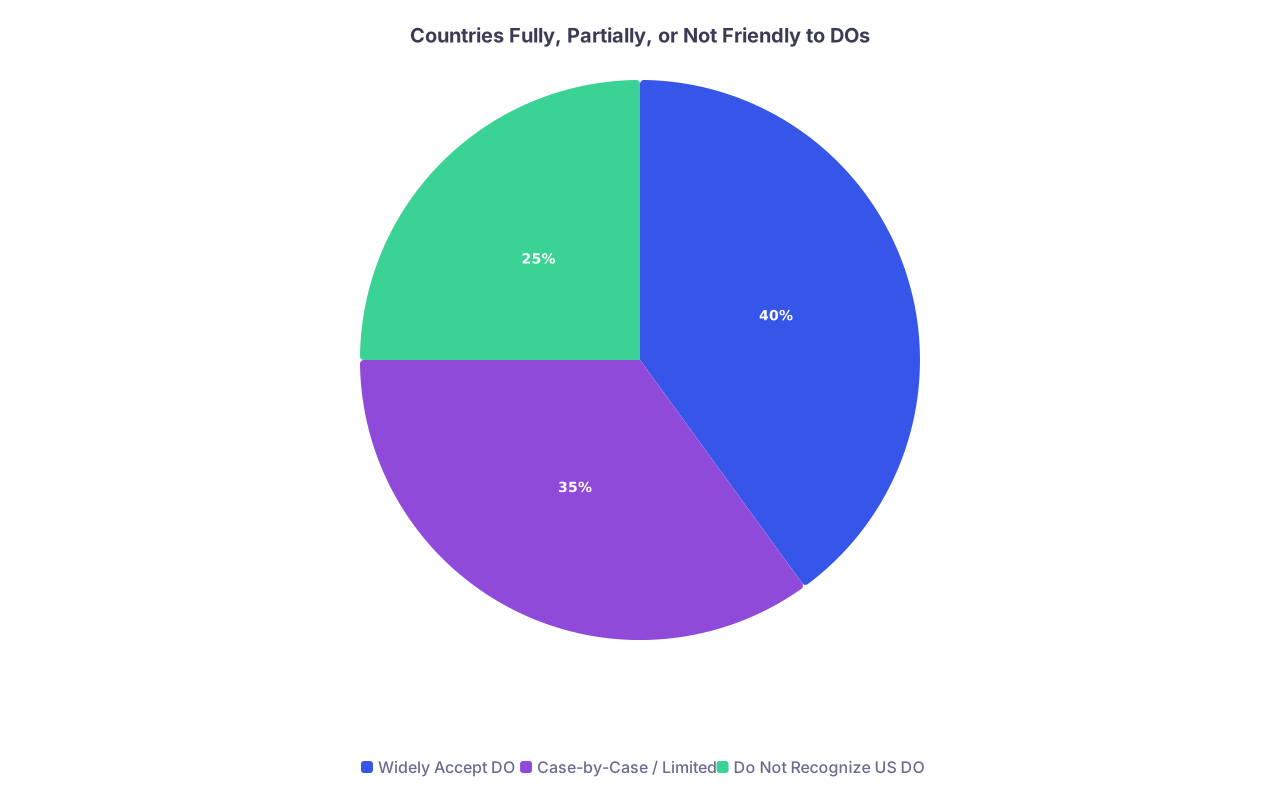
The first thing to separate is osteopathic versus allopathic interview culture. Many DO-friendly programs, especially community programs and residencies with a visible history of training osteopathic residents, are comfortable using COMLEX as a primary score. They know what it means. They've seen applicants succeed with it. There's less hand-wringing, less awkward score conversion nonsense, less "how do we compare this applicant to everyone else?"
A chunk of MD-heavy programs operate differently. Not always because they're anti-DO. Sometimes it's simpler and dumber than that. They use USMLE because it's familiar, easy to benchmark, and built into how they screen thousands of applications. If a program director or coordinator is used to seeing Step scores, a COMLEX-only file may require extra interpretation. And extra work is not your friend during mass screening.
That's the central problem. Not that COMLEX is invalid. It isn't. It's a real licensing exam. The problem is that residency selection is full of shortcuts, and USMLE often functions as one.
So when we ask whether COMLEX-only applicants are "at a disadvantage," the better question is: at which programs, in which specialties, and at which stage of review? That's where the data gets more useful, and more frustrating.
What the available data actually shows about interview odds
The frustrating truth is that interview-level data is much thinner than match-level data. We have decent information on outcomes, applicant characteristics, specialty competitiveness, and broad program patterns. We have far less clean public data showing exactly how often COMLEX-only applicants were offered interviews compared with similar applicants who also had USMLE scores.
Still, the available evidence points in a pretty consistent direction. Programs that regularly train DO residents tend to be more comfortable interviewing COMLEX-only applicants. Programs that are more competitive, more university-based, or more rigid in their screening habits are more likely to prefer USMLE, even when they technically accept COMLEX. That preference can translate into fewer interviews for COMLEX-only applicants in certain settings.
NRMP-style reports, specialty advising data, and program behavior all suggest the same practical reality: exam interpretation matters most when a program is trying to cut a giant pile of applications into a smaller interview list. If a program knows how to read COMLEX and has a history of doing so, the disadvantage shrinks. If it doesn't, the absence of USMLE can become a quiet liability.
But the data has real limits. Big ones.
First, a lot of reports don't separate interview offers neatly by DO status and exam strategy. Second, specialty differences are enormous. Family medicine is not dermatology. Internal medicine at a community hospital is not orthopedic surgery at a research-heavy academic center. Third, self-selection muddies everything. Applicants who skip USMLE often apply differently, to different specialties, different regions, and different program mixes. That makes direct apples-to-apples comparison messy.
And then there's the issue no one likes to say aloud: some programs say one thing publicly and do another privately. Their website may say COMLEX accepted. Their actual interview list may tell a more selective story.
So no, we can't produce one magical percentage and call it settled. But we can say this with confidence: interview odds for COMLEX-only applicants vary sharply by specialty, region, and program culture, and programs with established osteopathic recruiting patterns are usually much safer bets.
Why some programs say they accept COMLEX, but still seem to favor USMLE
This is the part that makes applicants feel crazy. Because on paper, a program looks open to you. In real life, the results can feel colder.
A residency can honestly state that it accepts COMLEX and still end up favoring applicants with USMLE. That's not a contradiction. It's how screening works when people are overloaded, risk-averse, and lazy in very institutional ways.
A lot of programs rely on filters before a physician ever seriously reviews your file. Sometimes that filter is a hard requirement. Sometimes it's a "preferred" benchmark that functions almost the same way. Sometimes it's just the simple fact that coordinators and faculty are more comfortable comparing Step scores because they've used them for years. COMLEX may be accepted, but if nobody feels fluent in it, your application can become the one that requires extra explanation. That's dangerous.
I've seen this dynamic play out in advising conversations over and over. A student has strong rotations, solid letters, no glaring red flags, and a respectable COMLEX score. They apply to a slate of programs that all say they accept COMLEX. Then the interview pattern comes back weirdly thin at the more academic places. Why? Often because "accepted" is not the same as "preferred," and "preferred" is not the same as "needed to survive the first screen." Programs don't always spell out which one they mean.
And yes, that's stressful in the worst possible way. Because a missing USMLE score can feel like a silent filter you'll never get to appeal. No rejection says, "we didn't know how to compare your score." Your file just disappears into the pile of people who were easier to process.
That's why applicants obsess over this. They're not being dramatic. They're reacting to a system that really does reward familiarity over nuance.
Where COMLEX-only applicants may be least and most competitive
If you want the blunt version, here it is: COMLEX-only tends to be least problematic where programs already know and trust DO trainees, and most problematic where USMLE has become the default language of comparison.
That usually means primary care fields, many community-based programs, and residencies with a long track record of interviewing and matching DO applicants are more forgiving territory. Family medicine, many internal medicine programs, pediatrics in the right settings, and some community psychiatry programs often fall into this category. Not always. But often enough that it matters.
The harder landscape is usually highly competitive specialties and more research-heavy academic programs, especially those that receive a flood of applications and use score-based shortcuts to triage them. There, COMLEX-only may not make you unqualified. It just makes you easier to deprioritize. Harsh, but true.
Region matters too. Programs in areas with stronger osteopathic training presence are often more comfortable with COMLEX. Programs that rarely see DO applicants may be more skeptical or simply less practiced in evaluating them. Again, not fair. Also very real.
So where are you "competitive"? You're most competitive where your exam format isn't treated like an inconvenience. That sounds obvious, but applicants ignore it all the time because they fall in love with program prestige or assume every listed policy is equally sincere.
Don't do that to yourself.
COMLEX-only is not disqualifying. Plenty of applicants match successfully every year without USMLE. But it can narrow your interview pool, especially if your list leans heavily toward places that say the right things while quietly screening the wrong way.

How to improve interview odds if you applied COMLEX only
If you already applied COMLEX only, don't waste the next three weeks doom-scrolling forums written by people who confuse confidence with accuracy. Focus on leverage.
First, target programs that have actually interviewed and matched DO residents before. Not vaguely. Actually. Look at resident rosters. Look at recent classes. If a program hasn't trained osteopathic residents in years, don't act shocked if it's a tougher sell.
Second, use geographic ties aggressively. Programs care about retention and fit more than applicants want to believe. If you trained nearby, grew up nearby, have family nearby, or can make a credible case for that region, say it clearly. Don't assume they'll infer it.
Third, your letters matter even more when your application needs context. Strong specialty-specific letters can offset uncertainty better than generic praise ever will. A bland "pleasant student, worked hard" letter is wallpaper. You need "I would recruit this applicant into our residency" energy.
Fourth, tailor your application to mission fit. Community service, underserved care, rural interest, academic curiosity, procedural drive, whatever the program actually values, connect your story to it. This is one of the few ways to force someone to see you as more than a score format problem.
If you haven't submitted yet and you're aiming for highly competitive specialties or USMLE-heavy programs, taking USMLE may be worth serious thought. Not because COMLEX isn't enough in principle, but because residency selection is not a philosophy seminar. It's a bottleneck. You need to survive the bottleneck.
If you already submitted, though, don't panic and assume the cycle is over. It's not. Plenty of programs will still review you fairly. Your job now is to apply smartly, communicate fit, and stop treating the absence of USMLE as universal rejection. It isn't.
Bottom line: what anxious applicants should remember before hitting submit
Here's the part I want you to remember when your brain starts doing that late-night thing where every uncertainty becomes a catastrophe.
COMLEX-only can reduce interview odds at some programs. That's real. But it is not a universal deal-breaker, and it does not mean your cycle is doomed. A lot of DO applicants match successfully with COMLEX alone, especially when they apply to programs that are genuinely comfortable evaluating osteopathic candidates.
The real question isn't "is COMLEX-only bad?" That's too blunt to be useful. The real question is where it matters most. Competitive specialties, academic environments, and programs using USMLE as a shortcut? Higher risk. DO-friendly, community-based, osteopathic-familiar programs? Often much less concerning.
So do the boring, effective thing. Review resident rosters. Study program histories. Ask your advisors which places actually interview DO applicants. Build a list around evidence, not panic. Worst-case thinking feels productive. It isn't. Smart targeting is.