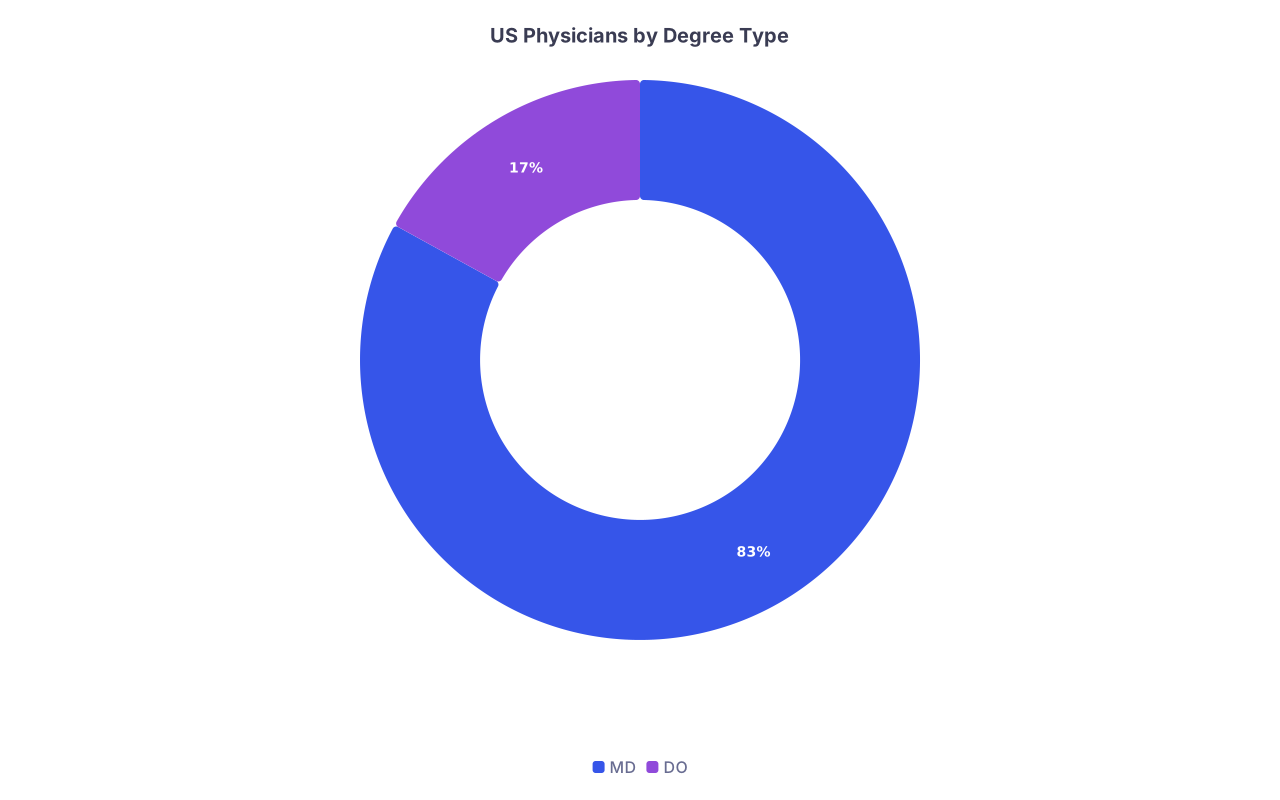
| Category | Value |
|---|---|
| MD | 83 |
| DO | 17 |
The fantasy that you’ll “start DO and later convert to MD” is mostly false.
You’re not upgrading an airline ticket. You’re choosing a full training pathway.
Let me walk through what’s actually possible, what’s basically fantasy, and how to make a smart decision before you lock yourself into 4+ years.
1. The blunt truth: there is no simple DO → MD conversion
Here’s the bottom line: there is no legal, formal, or commonly used “bridge” that turns a DO into an MD in the United States.
Once you:
- Matriculate at an osteopathic medical school,
- Complete a DO curriculum, and
- Graduate and get licensed
…your professional degree is Doctor of Osteopathic Medicine. Forever. You will sign your name with “DO,” not “MD.”
You can’t:
- Pay a fee to “convert” your degree
- Do a 1-year “MD top‑off” program
- Take a test that swaps your initials
Those programs don’t exist in any mainstream, accredited way in the U.S.
If you’re thinking, “I’ll go DO now and fix it later,” understand: there is no standard fix later.
So why do people keep talking about “converting”?
Because there are some narrow, painful, and often unrealistic paths where someone who started as a DO student eventually ends up with an MD. They’re the exception, not the plan.
2. The three real (but limited) “pathways” people mean by “convert”
When people ask about converting DO to MD, they’re usually talking about one of three things:
- Transferring from a DO school to an MD school as a student
- Dropping out and reapplying to MD from scratch
- Getting some sort of extra MD credential later (usually outside the U.S.)
Let’s be specific.
Pathway 1: Transferring from DO to MD during school
Does it happen? Rarely. Is there a clean, formal DO→MD transfer pipeline? No.
MD schools that accept any transfer students already have strict rules:
- They usually only consider transfers into 2nd or sometimes 3rd year
- You must be in “good standing”
- There has to be a curricular match (block systems vs traditional, etc.)
- They prioritize LCME-accredited MD students whose schools lost accreditation or closed
Now add this: most MD schools simply don’t want to deal with cross‑accreditation transfer from a DO school. The curricula, exam sequences, and accreditation bodies are different.
You’d need:
- Stellar performance at your DO school (top of your class, strong COMLEX/USMLE if taken)
- A very compelling reason (school closure, personal hardship, geographic crisis, etc.)
- An MD school that a) accepts transfers at all and b) is willing to consider a DO transfer
I’ve seen this work a handful of times in conversations over years. It’s a unicorn scenario, not something you should count on.
If you start DO, assume you’re finishing DO. If a transfer appears, great. But don’t bank your career happiness on a 0.1% event.
Pathway 2: Withdraw from DO school and reapply to MD
This is the “scorched earth and restart” path.
What it actually involves:
- You leave your DO school (often with significant debt and no degree)
- You try to explain this in a new MD application
- You compete again against a fresh applicant pool
Med schools will ask:
- Why did you start DO in the first place if you “always wanted MD”?
- Why did you leave? Academic problems? Professionalism issues?
- Are you going to bail on our program if it gets hard?
You’d need:
- Strong original stats (GPA, MCAT) that are competitive for MD
- Ideally, you left your DO program in good academic standing
- A story that isn’t just “I realized DO is beneath me” (which will kill your app)
Does it ever work? Occasionally. But it’s extremely risky. And it wastes years and money.
I’d only even consider this if:
- You’re early (first year),
- You’re genuinely miserable or misaligned, and
- Your MD application profile is already very strong or you’re willing to improve it significantly.
If your stats were marginal for MD the first time and you only got DO acceptances, reapplying after dropping out of DO is usually harder, not easier.
Pathway 3: “Extra” MD degree later (usually abroad)
You’ll sometimes hear about DOs who later get an MD from a foreign university or a short “bridge” program.
The reality:
- These are usually non‑US MD programs
- They’re not necessary for US practice or residency
- They may look strange or even raise eyebrows with credentialing bodies
- Many are basically vanity degrees
Will they change your U.S. license status? No. You’re still a DO licensed physician. You just now hold an additional MD credential, often with limited impact.
In other words: this doesn’t change your life in the way students imagine. You still trained as a DO. You still match as a DO. You still generally use your DO degree for practice in the U.S.
For 99% of people, this is a giant waste of time and money.
3. What does “starting DO” actually mean for your career?
Now let’s step out of fantasy-land and talk realities.
MD and DO are functionally equivalent for U.S. licensure
If you:
- Graduate from an accredited DO school
- Pass COMLEX (and often USMLE if you choose)
- Complete an ACGME residency
…you can practice medicine in all 50 states, bill insurance, get hospital privileges, prescribe medications. Same as MDs.
Your license says “physician,” not “junior physician” or “lesser physician.”
The real differences that actually matter
They’re not mystical “MD vs DO” status. They’re practical:
Residency competitiveness in certain specialties
Some ultra-competitive fields (derm, plastics, neurosurgery, ENT, ortho, some academic IM) still favor MD grads, especially from highly ranked schools.Research-heavy academic careers
Top academic centers (Harvard/BWH, Hopkins, UCSF, etc.) lean MD, especially for physician‑scientist tracks. DOs can absolutely get there, but it’s harder and you’ll be the exception.Prestige perception among older physicians and some international settings
In some hospitals and older groups, MD is still viewed as the “default” physician. DO is well-accepted in many places but misunderstood in some.International practice
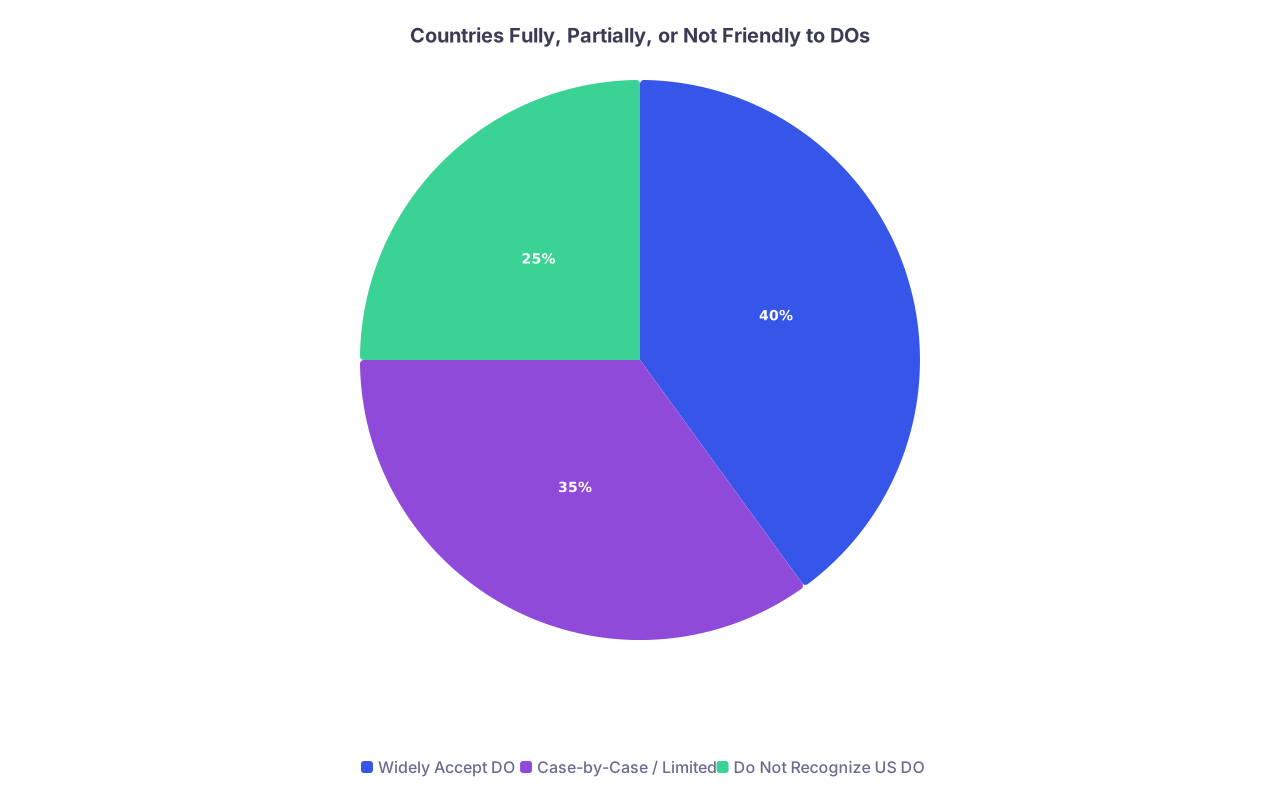
Some countries don’t fully recognize the DO degree, or only partially. If you know you want to practice long‑term in Europe, Asia, or the Middle East, you must research this carefully.
That’s it. That’s the real impact. Not “you’ll be stuck in urgent care forever” or “you’ll never be respected.” Those are internet myths.
4. Should you hold out for MD or take a DO seat now?
This is the actual decision you’re trying to make.
Here’s a clean way to think about it.
Scenario A: You’re DO‑only because your stats aren’t MD‑competitive
Example:
- GPA: 3.4
- MCAT: 505
- Limited research, decent clinical work
You applied broadly MD + DO and only got DO interviews/acceptances.
Ask yourself:
- Are you willing to take 1–2 more years to rework your entire app (post‑bacc, SMP, retake MCAT, more research, stronger clinicals)?
- Is your goal specialty realistically compatible with DO (FM, IM, peds, EM, psych, anesthesia, etc.)?
- Are you okay with being a DO for life, not as a “temporary” label?
If you want a solid clinical career in a mainstream specialty in the U.S., and you’re not obsessed with ultra‑elite programs, taking a DO seat now is often the smart move.
What’s dumb is taking a DO seat while secretly believing you’re going to magically become MD later. That mindset will poison your whole experience.
Scenario B: You have MD‑level stats but only DO offers (or are unsure)
Example:
- GPA: 3.8+
- MCAT: 515+
- Good research, leadership, etc.
- Maybe you applied late, applied too narrowly, or had weak essays/LORs
In this case, I’d seriously consider:
- Taking a gap year
- Rewriting your app strategically
- Reapplying MD (and DO as backup if you’d truly be okay with that outcome)
If you clearly have the numbers and experiences to be competitive for MD, and you know you’ll always resent not trying, waiting a cycle may be the better play.
Just don’t fake it. If you reapply, you need to actually fix your weaknesses: late timing, school list, essays, interviews. Not just hit “submit” again and pray.
5. What about residency – do programs care DO vs MD?
They care less about your initials and more about:
- Your board scores (COMLEX and/or USMLE)
- Clinical performance + letters of recommendation
- Research for competitive specialties
- How well you fit the program
But yes, DO grads still face some friction, especially in ultra-competitive spots.
Look at match data (NRMP + AACOM reports). You’ll see:
- DOs match extremely well into: FM, IM (community), peds, psych, EM (variable), anesthesia (variable but decent), PM&R
- Harder but doable with strong stats: radiology, competitive IM programs, some surgical subspecialties
- Really tough as DO: derm, neurosurg, plastics, ENT, ortho at top programs, integrated vascular, etc.
Can it be done? Yes. I’ve seen DOs in derm, ortho, neurosurg. They usually had:
- Top-tier board scores (e.g., 250+ Step 2 / strong COMLEX)
- Research in the field
- Away rotations with glowing letters
But again: they’re exceptions. If your absolute dream life is Harvard derm and you’d “rather not be a doctor” than anything else, then yeah, you should be fighting tooth and nail for MD.
6. A realistic decision framework
Strip away the noise and ask yourself these questions:
Do I want to practice in the U.S. long‑term?
- Yes → DO and MD are both viable
- No / maybe → investigate DO recognition in your target country, MD may be safer
Is my dream specialty ultra‑competitive, and am I honestly willing to grind like crazy for it?
- If yes and you’re already borderline competitive: lean MD
- If you’re fine with core specialties: DO is usually perfectly fine
Why do I want MD instead of DO?
- If your answer is basically “status” or “my parents/friends think MD is better,” that’s not a great reason to lose years of your life.
- If your answer is “I want maximal flexibility for research-heavy academic medicine and international work,” that’s more legitimate.
Would I be okay being a DO for life, assuming I get the specialty I want?
- If your honest answer is no, think hard about going DO at all.

| Step | Description |
|---|---|
| Step 1 | Considering DO Acceptance |
| Step 2 | Research International DO Limits |
| Step 3 | Accept DO or Weigh Against Gap Year |
| Step 4 | Consider Gap Year & Reapply MD |
| Step 5 | If Limited, Prioritize MD |
| Step 6 | Commit Fully to DO Path |
| Step 7 | Want US Clinical Career? |
| Step 8 | OK Being DO for Life? |
7. What you should not do
A few patterns I’ve seen that end badly:
- Starting DO with a secret plan to transfer to MD
- Constantly talking down your own degree in school (“I’m basically MD anyway”)
- Treating DO as a backup identity you’ll eventually shed
- Ignoring your actual performance (grades, boards, clinical skills) because you’re obsessed with labels
Programs don’t want insecure, bitter residents. Patients don’t care about your letters; they care if you listen and fix their problem. Colleagues respect competence, not degree snobbery.
If you’re going DO, go DO all the way. Crush COMLEX/USMLE. Get great letters. Match well. Build a good life. That’s the conversion that actually matters.
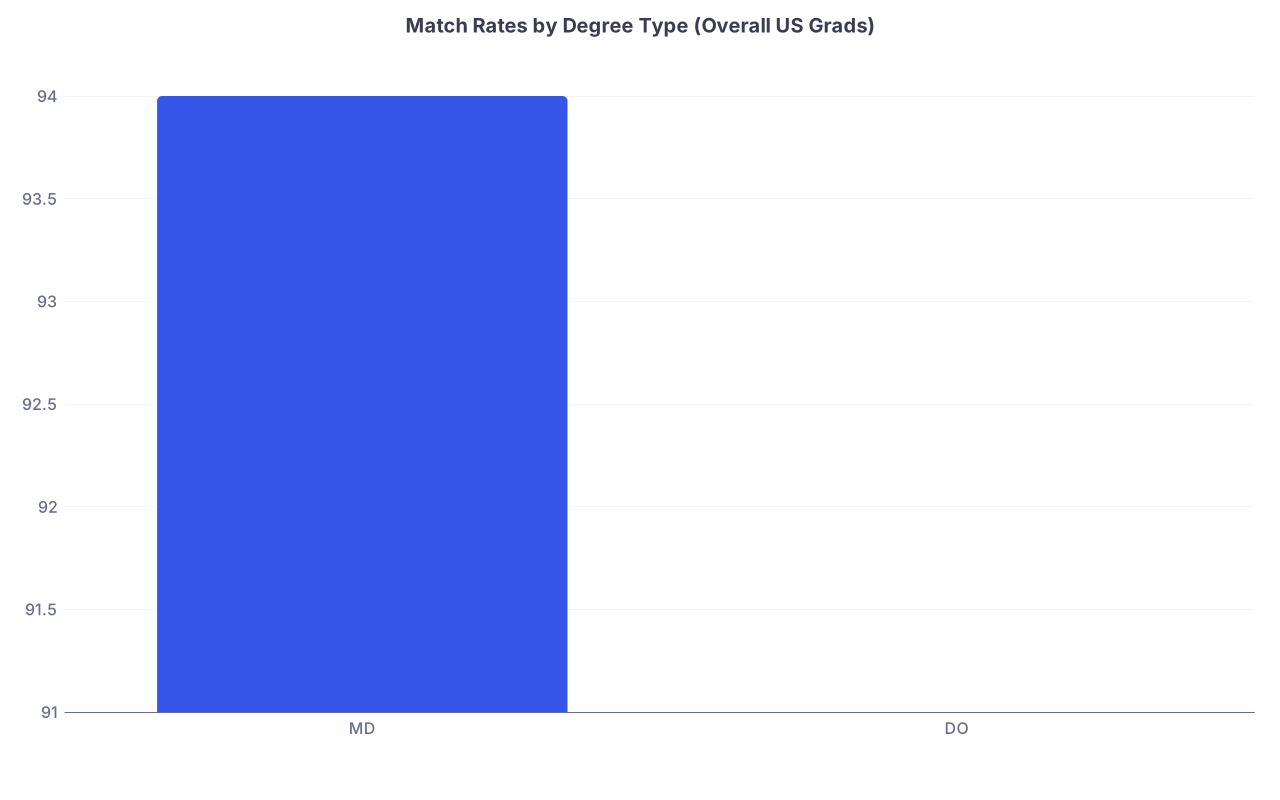
| Category | Value |
|---|---|
| MD | 94 |
| DO | 91 |
8. Practical next steps if you’re on the fence
If you’re staring at a DO acceptance and wondering what to do:
Talk to actual DOs in the specialties you’re considering.
Ask where they trained, what walls they hit (if any), and whether they’d do DO again.Look at the match lists of specific DO schools.
Some DO schools consistently place grads into competitive residencies; others are more primary‑care heavy. That matters more than internet comments.Be honest about your academic ceiling.
If you barely scraped a 500 MCAT after 3 tries, “I’ll just be top 1% and match derm as a DO” is fantasy.Decide whether you’re willing to lose 1–2 years to pursue MD.
That’s a real cost. For some people, it’s justified. For others, it’s pure ego tax.

FAQ (6 questions)
Can a practicing DO in the U.S. ever officially change their degree to MD?
No. Your primary degree (DO) doesn’t change. You can’t retroactively become an MD via some U.S. “conversion” process. You might earn an additional MD abroad or in a special program, but that doesn’t rewrite your original DO degree or training.Are there any legitimate DO-to-MD bridge programs in the U.S.?
Not in the mainstream, accredited, widely-recognized sense. You’ll find occasional foreign or niche programs offering an MD to already‑licensed physicians (including DOs), but U.S. boards, employers, and hospitals still focus on your original degree and residency training.How often do students transfer from a DO school to an MD school?
Extremely rarely. Most MD schools don’t accept many transfers at all, and among those that do, transfers are usually from other LCME‑accredited MD schools facing closure or major disruption. A DO→MD transfer is a unicorn situation and should never be your primary plan.Does being a DO hurt my chances of matching into a competitive specialty?
It can make things harder, especially for derm, plastics, neurosurgery, ENT, and top‑tier academic programs. Not impossible, but you’ll be competing in a smaller number of programs that regularly take DOs, and you’ll usually need stronger metrics (board scores, research, letters) to stand out.If I know I want to practice outside the U.S., should I avoid DO?
Maybe. Some countries fully recognize U.S. DOs, some partially recognize them, and some don’t at all. If international practice is a serious goal, you need to research your target country’s rules before committing. In many cases MD is the cleaner, simpler path abroad.If I accept a DO seat now, can I still apply to MD schools in a future cycle?
You technically can, but it’s messy. You’d almost certainly need to withdraw from the DO program, explain that decision in your MD applications, and show you left in good standing. Admissions committees will scrutinize your judgment and commitment. It’s possible but risky—and absolutely not something to bank on as a “backup plan.”
Key takeaways:
- There is no straightforward DO→MD conversion. Once you start DO, assume you’ll finish DO.
- DO and MD are both fully capable paths to being a U.S. physician; the big differences show up in ultra‑competitive specialties, academia, and some international settings.
- Make your decision now based on your real goals and stats—not on a fantasy that you’ll quietly “switch letters” later.