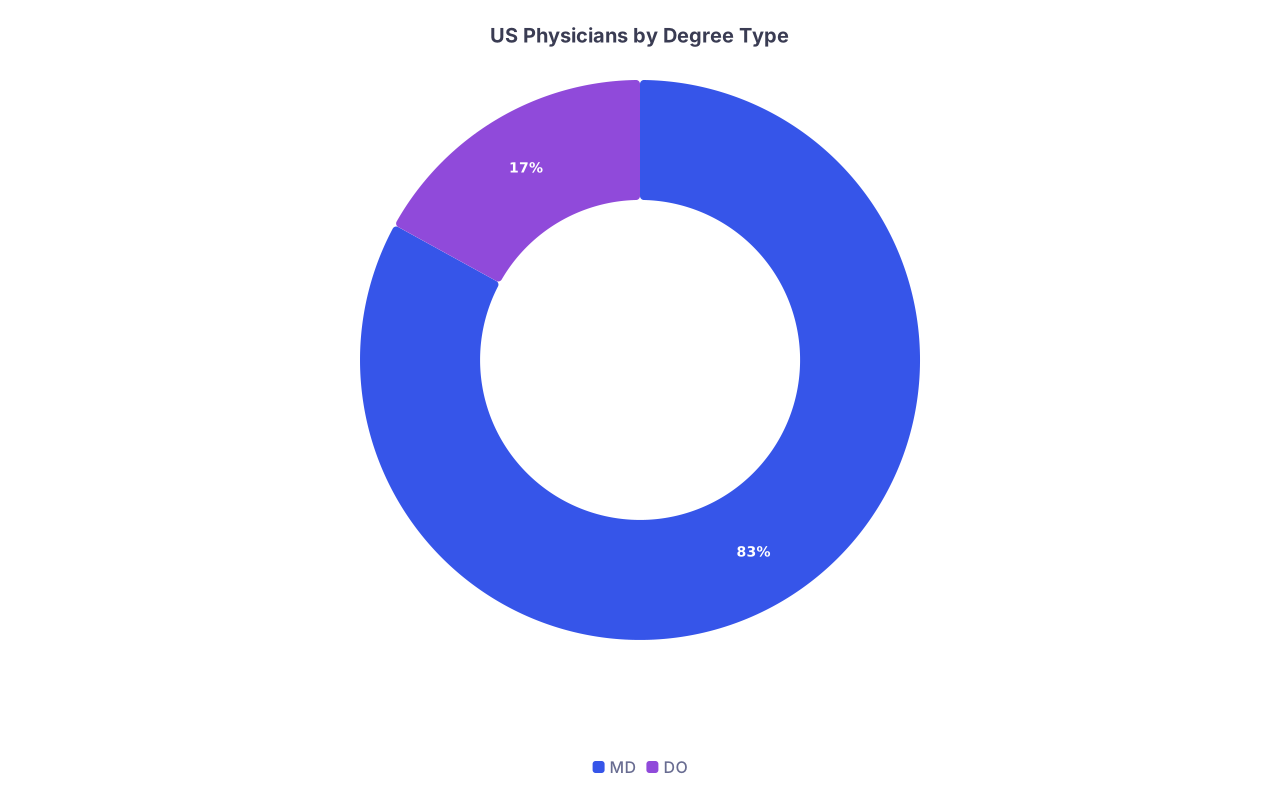
Here is the direct answer: residency screeners do not usually sit down and read every file like a novel. They triage. Fast. The data shows that in many programs, especially those receiving 1,000 to 5,000 applications for a handful of positions, the first job is not to identify the perfect future resident. It is to reduce volume to a manageable interview pool with the least risk and the least time.
That reality shapes everything.
The first pass is usually built around standardized filters: visa status, graduation year, whether required board exams are present and passed, obvious academic trouble, clerkship performance, letters of recommendation, geographic ties, and any red flags that could create downstream headaches. Screeners are often faculty, chief residents, coordinators, or program directors working inside brutal time constraints. I have seen files get less than two minutes on the first review. Sometimes less than 30 seconds if the program is drowning in applications. That is not ideal. It is just true.
Where DO versus MD differences appear is not usually in a clean, explicit rule saying "reject DO" or "prefer MD." It is more structural than that. Programs respond to what they know, what they can benchmark, and what has historically worked for them. If a department has trained mostly MD graduates from a familiar group of schools, that history becomes a proxy for safety. If they understand USMLE distributions better than COMLEX distributions, USMLE becomes easier to screen around. If a specialty is intensely competitive, uncertainty gets punished.
That is the real mechanism. Process, not mythology.
So yes, DO and MD files can be filtered differently. But the degree alone is rarely the whole story. The data shows the sorting behavior is driven by three things: institutional preference, specialty competitiveness, and the availability of familiar comparison points. A strong DO file absolutely can outperform a weaker MD file. I have seen it happen repeatedly. But at the margin, when files are average and time is short, screeners often lean on familiar signals. That is where bias lives. Quietly. Efficiently. And very predictably.
The First Pass: What Data Gets Flagged Before a Human Reads the Narrative
The first pass is a risk-reduction exercise dressed up as application review. The data shows the highest-volume filters are usually the simplest ones:
- Exam completion status
- Pass/fail outcomes
- Graduation year
- Unexplained gaps
- Failed courses or board attempts
- Disciplinary actions
- Incomplete letters or missing documents
- Visa requirements
- Obvious misalignment with the specialty
These are not subtle filters. They are blunt instruments, and programs use them because blunt instruments are fast.
In practice, many screening workflows start with an automated sort in ERAS or an internal spreadsheet. Files may be tagged before a physician reviewer even opens them. Incomplete application. No Step 2. COMLEX only. Graduation more than three years ago. Need visa sponsorship. Prior failure. Hold. Reject. Maybe. That is the first battlefield.
For DO and MD applicants, the asymmetry often shows up in what I would call "familiarity proxies." A screener may know exactly how to interpret an applicant from a regional MD school that sends graduates there every year. They know the grading system. They know the surgery chair. They trust the sub-I comments. A DO school with less historical presence may not get that benefit, even if the student is excellent.
That is not fair. It is common.
School reputation, core rotation networks, and feeder-school history matter more than programs like to admit. The data shows screening behavior tends to reward known pipelines. If a program has interviewed ten students from School A and six became strong residents, School A becomes safer. If they have little experience with School B, uncertainty rises. In a high-volume process, uncertainty is costly.
This is why applicants get bad advice when people say, "They review everyone holistically." No. Not at scale. Not in the first pass. Holistic review is often what happens after the file survives the basic filters. The screen exists to narrow the pile, and the data shows efficiency usually beats fairness in that phase.
DO vs MD in Practice: Where the Difference Really Appears
The difference between DO and MD files becomes most visible when programs are competitive, benchmark-driven, and culturally conservative in how they define "fit."
At many community programs, screening can be surprisingly practical. Did you pass your boards? Are your clerkship evaluations strong? Do your letters sound trustworthy? Do you have ties to the region? Can they picture you functioning on day one? In these settings, a strong DO applicant often does very well. The file is judged more on usable signal than prestige theater.
University programs, especially in competitive specialties, are different. Historical match patterns skew MD-heavy. Faculty networks skew MD-heavy. Research expectations skew MD-heavy. And when screeners have 2,000 files and 120 interview spots, they default to what they know. That often means known MD schools, known mentors, known research shops, and USMLE scores they can instantly benchmark.
The COMLEX-versus-USMLE issue is central here. It is not just about whether COMLEX is "accepted." On paper, it often is. In practice, the data shows many screeners are more comfortable interpreting USMLE because the benchmark is cleaner. They know what a Step 2 score means in relation to prior residents, board passage, and specialty norms. COMLEX introduces conversion uncertainty, and uncertainty hurts applicants in crowded pools.
This is why COMLEX-only can be enough at some programs and a handicap at others. Not because the applicant is weaker. Because the screener has less confidence in the comparison model.
That difference matters most in the middle of the distribution. A truly outstanding DO applicant with high board performance, excellent clinical grades, and strong specialty-specific letters can absolutely outperform a weaker MD file. I have watched that happen in internal medicine, anesthesiology, psychiatry, and even some surgical prelim screens. Strong signal cuts through noise.
But average files are where bias shows itself. An average MD applicant from a familiar school may get the benefit of the doubt. An average DO applicant may need extra proof. Better boards. Better letters. Better rotation performance. More obvious specialty commitment. More signal density.
That is the phrase I use because it fits the data: signal density.
If your degree introduces uncertainty for a program, the rest of the file has to remove that uncertainty. Not with one shiny metric. With a cluster of them.
This chart is illustrative, not empirical, but it captures the pattern I have seen. Board scores remain heavily weighted for both groups. The difference is usually not that DO applicants are judged less on performance. It is that some programs ask the rest of the file to work harder to establish comparability.
Brutal, yes. But measurable in behavior.
What Screeners Value Most When the File Is Close
When two files are close, screeners stop looking for reasons to reject and start looking for reasons to believe. That is where tie-breakers matter.
The most important late-stage screening variables are usually:
- Away rotation or sub-internship performance
- Letters from faculty the program knows or trusts
- Specialty-specific clinical comments
- Research aligned with the department's interests
- Evidence of geographic or personal fit
- Clear, competent communication in the personal statement and experiences
I have seen an away rotation rescue a borderline file. I have also seen a vague letter sink an otherwise solid applicant. People underestimate how much known faculty influence the process. A generic "hard-working student" letter is weak signal. A letter from a respected attending saying, "I would recruit this student into our residency without hesitation" moves the needle.
For DO applicants, this can matter even more. If a program has less familiarity with the school, they will often look for external validators. That can mean a sub-I at the institution, a letter from a nationally recognized physician, strong USMLE performance if taken, or rotation comments from settings the program recognizes. More proof. More comparability. More trust.
That does not mean every DO student needs to overbuild the file to absurd levels. But the data shows that in programs where osteopathic graduates are less common, stronger signal density improves the odds materially.
And this is where applicants make a common mistake: they obsess over one weakness as if it is fatal. It usually is not. One weaker preclinical mark. One less impressive volunteer item. One decent-but-not-spectacular research entry. Those things rarely kill a file alone.
Compounding kills files.
One board failure plus average letters plus no geographic ties plus unclear specialty commitment. That stack is dangerous. An average board score plus excellent sub-I comments plus respected letters plus local ties. That stack survives.
Screeners work cumulatively. They are not always saying yes to excellence. Often they are saying no to aggregated uncertainty.
That is the lens you should use. Not "Is this one thing bad?" Ask instead: "What total picture does this file create in a 60-second review?"
How to Build a File That Survives Screening Bias
If you want to survive screening, build for the first pass first. Not for your ego. Not for internet bragging rights. For the actual filter.
The highest-yield moves are boring. That is why people avoid them.
Start here:
- Pass required exams as early and cleanly as possible
- Submit a complete application on time
- Secure strong specialty-specific letters
- Show clear commitment to the specialty
- Apply broadly with realistic program selection
- Target programs that historically interview applicants like you
- Build geographic and institutional fit where possible
For DO applicants specifically, board strategy deserves blunt discussion. If you are targeting specialties or programs that commonly rely on USMLE benchmarks, taking USMLE can improve comparability. Not always necessary. Sometimes very necessary. The data shows the utility rises with specialty competitiveness and with program unfamiliarity around COMLEX interpretation.
That is not a moral statement. It is a market statement.
The next major lever is program targeting. Applicants waste applications every year on places that have never meaningfully interviewed osteopathic graduates, or do so only once every few cycles. Historical behavior matters. A program's public language about holistic review means little if the roster data says otherwise. Follow what programs do, not what they claim.
Away rotations are another high-yield tactic, especially if your school is not part of the program's normal pipeline. A strong in-person month can replace uncertainty with direct evidence. That is gold in screening. Show up prepared, easy to work with, clinically sharp, and humble. Not fake humble. Real humble. Programs remember the student who made intern life easier.
Finally, build the full file, not a single talking point. The data shows the degree alone is not the strongest predictor of getting past the filter. The combination matters more:
- Objective board performance
- Clinical grades
- Recognizable letters
- Specialty alignment
- Geographic fit
- Lack of red flags

That is the formula. Not magic. Not fairness. Just better odds.
What the Data Suggests About Fairness, Bias, and Program Strategy
The data shows screening differences between DO and MD applicants are structural before they are personal. Programs have limited review time. They rely on proxy signals. They repeat historical recruitment patterns because those patterns feel safe. Safe is efficient, and efficient dominates the first-pass process.
That means program behavior often reflects specialty competitiveness and institutional culture more than applicant merit in isolation. A file can be strong and still miss at a program that values familiar pedigree over transferable evidence. That is bad process, but it is common process.
I do not think applicants should romanticize this system. It is imperfect. It is often lazy. Sometimes it is openly risk-averse to the point of being intellectually weak. Still, you have to deal with the system that exists, not the one people pretend exists.
The useful takeaway is practical: screening bias is rarely one giant barrier. Usually it is a series of smaller penalties attached to uncertainty. Remove enough uncertainty, and the odds improve. Strong boards, strong letters, strong rotations, smart targeting, clear specialty fit. That stack works.
The summary is simple. Residency screeners filter for efficiency and risk. DO versus MD differences usually emerge through proxies such as school familiarity, exam comparability, and historical recruiting patterns. A strong file can overcome a lot, but average files are where bias bites hardest. Build dense, credible signal. Make the first-pass decision easy. That is how you survive the screen.