It's 2 a.m. again. You should be sleeping, but you're not. You're staring at a blurred salary chart on your laptop, replaying the moment your needle driver slipped, the knot came apart, or the attending just sighed and took the instruments from your hand. Somewhere on Instagram, a resident is posting a perfect running subcuticular closure. You're holding a burnt banana and a growing sense of doom.
The 2 A.M. Thought: What If My Hands Are Not Good Enough?
This thought doesn't arrive politely. It ambushes you after a bad day in the skills lab or a silent OR where you felt like a clumsy giant. You watch a surgeon tie a surgeon's knot in three seconds using two fingers and what seems like magic. Then you try it. The suture slips. The needle drops. Your hands shake as if they belong to someone else. The voice in your head delivers its verdict: you are manually incompetent, and you should quit before humiliating yourself further.
Let me say this plainly. You are not the only one thinking this. Almost every applicant aiming for a surgical field has a version of this spiral. The fear gets louder when the stakes are high, and the top-paid surgical fields, neurosurgery, orthopedic surgery, plastic surgery, cardiothoracic surgery, urology, and ENT, feel like glass castles. One wobble of your hand and the whole dream shatters. Except that's anxiety talking, not evidence. This article will do what no 2 a.m. panic spiral does: separate fear from fact, tell you what "good hands" actually means, give you a worst-case plan that isn't surrender, and push you toward evidence instead of self-rejection.
Disclaimer: Compensation figures discussed are for educational purposes only, not financial advice. Figures vary by practice setting, region, and market conditions. Consult a qualified professional regarding career and financial decisions.

Top-Paid Surgical Fields: The Fear Is Loud, But the Money Is Not the Judge
Let's get the numbers on the table so we can stop letting them scare you. The highest-paid surgical specialties consistently appear near the top of physician compensation surveys, and they include neurosurgery, orthopedic surgery, plastic surgery, cardiothoracic surgery, urology, and ENT. Average annual compensation can range roughly from $500,000 to over $760,000 depending on specialty, call burden, and practice model. That's real money. And that's part of why the pressure feels existential. You think, If I'm not a natural with my hands, I'm locked out of the highest echelon of earning potential.
But the money is not the judge of your hands. Compensation in these fields reflects training length, liability risk, demand, lifestyle strain, and reimbursement structures. It does not reflect a hidden hand-gene that you either have or don't. The people earning these incomes were not born holding a scalpel. Most of them struggled with tremor, tension, and bad knots in medical school. I've watched future neurosurgeons drop needles and future plastic surgeons tie knots that fell apart. They weren't defective. They were novices.
Typical novice struggles include tremor with fine instruments, poor knot tension, suturing that takes five minutes and still looks messy, awkward instrument handling, and freezing the moment someone watches. Those are training problems. They are not character flaws. You need to hear that because anxiety will try to convince you otherwise.
When should you worry? Persistent safety concerns despite coaching, no improvement after structured deliberate practice, a tremor that affects daily fine-motor tasks like writing or eating, or severe avoidance that makes you skip simulation sessions entirely, those deserve mentor feedback and possibly medical evaluation. A bad day in the skills lab does not. A single Reddit thread where someone claims they "knew they had bad hands" does not. And YouTube videos of expert surgeons are essentially highlight reels. Stop comparing your behind-the-scenes to someone else's final product.
What Good Hands Really Means and Why It Is More Trainable Than You Fear
"Good hands" is a phrase that gets tossed around like a sacred verdict. You need to break it apart before you let it break you. Good hands are not a single magical trait. They are a bundle of components: steadiness under load, hand-eye coordination, proprioception, spatial reasoning, instrument familiarity, error recovery speed, and something people forget, communication and judgment while using those hands. A surgeon who cuts beautifully but cannot adapt when something goes wrong does not have good hands. They have a party trick.
Surgical residency programs expect medical students to arrive as novices. You are not supposed to be fast or polished. You are supposed to be safe, coachable, and able to learn. Technique is taught through repetition, simulation, gradual responsibility, and feedback. I have seen students go from dropping every instrument to tying reliable one-handed knots in eight weeks. Not because they unlocked some secret talent. Because they practiced deliberately.
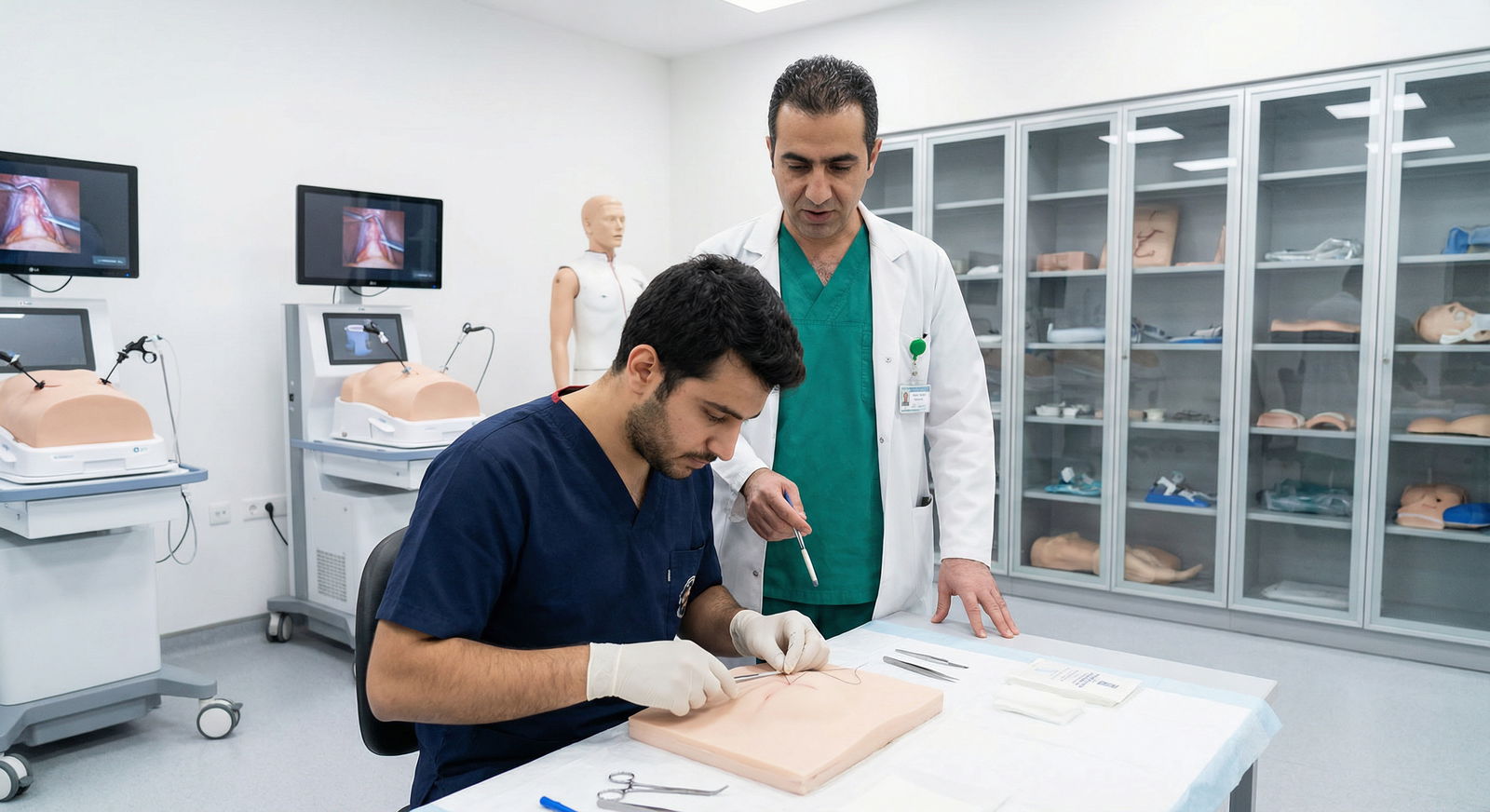
Deliberate practice means more than just repeating a motion. It means practicing correct technique, getting immediate feedback from someone who knows what they're doing, tracking your errors, and practicing again with specific adjustments. Suturing on a pad while watching Netflix doesn't count. Suturing while a resident critiques your spacing and tension, then doing it again until it's consistent, counts.
Let's talk about tremor honestly, because this is what keeps people up at night. Mild physiologic tremor is incredibly common. Caffeine makes it worse. So does sleep deprivation, performance anxiety, and hunger. Many medical students discover their hands shake only when they're terrified in the OR, not when they're relaxed at home. That is not a disease. That's adrenaline. Even a mild essential tremor is often manageable with ergonomic adjustments, techniques like resting a hand on a stable surface, and sometimes beta blockers under a physician's guidance. A tremor is not an automatic disqualifier. It is a reason to get evaluated, not to self-destruct.
Practical steps: get a basic suture pad. Watch technique videos from actual surgical educators, not influencers. Ask a resident or attending to watch you and give specific feedback, not "you'll get there," but "your bite spacing is uneven, try marking the pad first." Track your improvement over time. And treat your anxiety and sleep before you conclude your career is over. Catastrophizing is not diagnostic.
(See also: not feeling competitive enough for lucrative specialties for more.)
The Worst-Case Rehearsal: What If I Really Am Not Cut Out for the OR?
Anxiety loves worst-case thinking, so let's rehearse it properly. What if you genuinely are not cut out for the OR? Not because of one bad day, but because of persistent, observed difficulty that doesn't improve with coaching.
The truest worst case is not public humiliation. It is discovering a poor fit and refusing to adapt because of shame or sunk cost. Staying in a pathway that makes you miserable and risks patient safety is not loyalty to a dream. It's avoidance of a hard decision.
If difficulty persists, remediate before you despair. A concrete plan looks like this: increase simulation hours with direct observation, ask mentors for a focused technique assessment, and if tremor is significant, get a medical evaluation, occupational therapy or neurology, not a WebMD spiral. Set a time-limited practice plan with measurable goals: "by week eight, I will close a simulated laceration with consistent spacing under observation." If you meet it, great. If you don't, you have useful information, not a verdict on your worth.
Now, alternatives. Having a backup is not betrayal. It's strategy. Different surgical specialties have different manual demands. General surgery, OB/GYN, ophthalmology, or surgical subspecialties like breast surgery or trauma may feel different than microsurgery-heavy fields. Procedural but non-surgical fields like interventional radiology, interventional cardiology, gastroenterology, or anesthesiology involve hands-on work without the same kind of open operative pressure. And nonoperative paths, radiology, pathology, consulting, research, are not failures. They are different ways to use a medical degree without forcing yourself into a role that doesn't fit.
Identity and money fears complicate this. You may think, If I can't do orthopedic surgery, I'm nothing. Or I need the top salary to justify the loans. Top pay is not worth unsafe practice. Period. A backup plan protects you from panic-based decisions. It gives you a clear-eyed way to pivot if the evidence says surgery isn't a fit, without burning down your entire medical career on one anxious night.
Decision rule: do not quit after one bad day. That's self-sabotage. But do not ignore repeated, observed safety concerns raised by multiple mentors over time. There is a difference between impostor syndrome and a real mismatch. You owe it to yourself, and your future patients, to learn that difference.
Your Reassurance Plan and CTA: Trade Panic for Evidence, Then Act
Reassurance that feels good for five minutes and then fades is not what you need. You need a plan that turns "what if" into "what now." Here it is.
Step 1: get objective feedback. Ask two or three mentors, attendings, senior residents, or clerkship directors, to watch you perform a specific skill and answer directly: Is there a safety concern here? What do you see in my technique? What would you want to see improve in the next four weeks? Vague reassurance like "you'll be fine" is not feedback. Push gently for specifics. And if you have a tremor, ask them if they notice it and whether it interferes. You might be imagining a problem that no one else sees.
Step 2: build an 8-12 week deliberate practice plan. Cover suturing, knot-tying, and simulator tasks relevant to your target field. Include sleep, caffeine reduction, and anxiety management in the plan. Anxiety is a performance variable. If you are vibrating with panic every time you enter the skills lab, your hands will be worse, and you'll misinterpret the cause. Treat the anxiety, then reassess the dexterity.
Step 3: reassess with a written checklist. Note specific metrics: knot security, spacing, speed, steadiness under observation, error recovery. If you are improving over weeks, you have evidence that you are trainable. Keep pursuing the field with a backup plan in your back pocket, not as a jinx, but as a mature, evidence-based hedge. If repeated safety concerns persist despite coaching and remediation, adjust before application deadlines. That is not failure. That is clarity.
Your CTA is simple and immediate. Do not let one anxious thought make a career decision. Book an advising appointment this week. Start a skills log today. Talk to a trusted surgeon and be honest about what you're feeling. If your anxiety is paralyzing or feels unmanageable, contact a counselor or physician. Catastrophic thinking can mimic incompetence, and you don't need to suffer silently while it eats your confidence.
Key Takeaways
- Fear of having "bad hands" is common, especially when you compare your novice skills to expert-level highlight reels.
- Manual dexterity is trainable through deliberate practice, feedback, and repetition, it is not a fixed moral verdict on your worth.
- Top pay does not require innate perfection; surgical programs care about safety, judgment, coachability, and communication just as much.
- Get objective mentor feedback to distinguish normal anxiety from real red flags like persistent safety concerns or tremor affecting daily tasks.
- Having a backup plan is not betrayal of your dream, it's a mature way to reduce panic and make clearer decisions.
- Do not self-reject after one bad day, but do not ignore repeated, observed concerns despite good coaching.