
It’s 10:30 p.m. You just finished another brutal call in a “nice” but underpaid specialty. You’re mid-40s, maybe early 50s. Your kids’ college costs are staring at you. Your back hurts. And you just got an email from a co-resident who did interventional radiology, now making double what you do with more control over their schedule.
You’re asking yourself the forbidden question:
“Is it completely insane to pivot into a higher-paid niche this late?”
You’re not a wide-eyed MS3. You’re a practicing doc with a mortgage, maybe partners, maybe kids, maybe aging parents. You cannot blow up your life chasing a dream fellowship like a 28-year-old with no attachments. You need safety. Predictability. And more money.
This is for you.
We’re going to walk through how to actually do a late-career switch into a higher-paid specialty or niche without torching your finances, family, or sanity.
Step 1: Get Honest About Your Starting Point
Before you fantasize about neurosurgery-level income, you need a clean, brutal inventory.
Ask yourself:
- What is your current board certification and residency background?
- How many years out of training are you?
- Any board or malpractice issues, employment terminations, or health limitations?
- How much financial runway do you have if your income drops for 1–3 years?
- Do you actually like procedures, night work, high acuity? Or are you just chasing a number?
You cannot skip this. The late-career pivots that blow up are the ones done on vibes and envy, not on clear-eyed assessment.
Know which paths are even realistic from where you stand
Certain late-career moves are relatively feasible if your base training is adjacent. Some are fantasy unless you’re willing to start over completely.
Here’s a reality snapshot:
| From (Current) | To (Target High-Pay Niche) | Feasibility (Late-Career) | Notes |
|---|---|---|---|
| IM / FM | Hospitalist (high-shift pay) | High | Often fastest pay boost |
| IM / FM | Outpatient cardiology (non-invasive) | Medium | Needs fellowship, competitive |
| IM / FM | Gastroenterology | Low | Fellowship + competitiveness |
| Anesthesia | Pain medicine | High | Classic late-career pivot |
| Radiology | Interventional radiology (IR) | Medium | Pathway-dependent, harder later |
| Psychiatry | Interventional psych (ECT/TMS/Ket) | High | Courses + experience-focused |
| EM | Urgent care / occ med (volume-based) | High | Pay bump possible regionally |
If you’re an FM doc dreaming of orthopedic surgery money at 45 with no surgical background—forget it. That’s a burn-it-all-down move. You’re not here for that.
You’re here for high-yield, realistic pivots.
Step 2: Know Which Specialties / Niches Actually Pay and Are Reachable
Stop thinking just in terms of “highest paid specialties” as if you’re starting at age 26. You’re not lining up for a fresh neurosurgery residency. You’re looking for high-paid, adjacent niches you can realistically enter from your base.
Use this lens:
- How much does it pay?
- How adjacent is it to my current training?
- What extra training is required, and is that even doable at my stage?
Let’s hit the big categories that are both high-comp and feasible late.
1. Pain Medicine (from Anesthesia, PM&R, Neurology, sometimes IM)
If you’re anesthesia / PM&R / neuro, this is the classic late-career switch.
- Compensation: $450k–$750k+ depending on region, procedures, and ownership.
- Training: ACGME pain fellowship (ideal) or, in some markets, skill-based + non-ACGME routes (getting tighter, though).
- Lifestyle: Procedure-heavy, clinic + interventions. Business pressures, prior auth headaches, but the money is real.
Who this works for:
Mid-career anesthesiologist sick of 4 a.m. starts and OR politics. PM&R doc wanting interventional work not just spine consult notes.
Who this doesn’t work for:
Someone who hates needles, hates procedures, and hates chronic pain patients. You will be miserable.
2. Interventional Psychiatry (ECT, TMS, Ketamine)
Psychiatry is exploding with higher-paid interventional options.
- Compensation: A good interventional psych setup can hit $400k–$600k+, especially with ownership or equity in a practice or center.
- Training: Short courses, ECT/TMS training, ketamine infusion protocols. Often does NOT require a new residency or fellowship.
- Lifestyle: Outpatient-heavy, some procedural feel, intellectually interesting, often private-practice focused.
This is one of the most realistic higher-paid late switches if you’re a psychiatrist.
If you’re not a psychiatrist, this route is basically closed, ignore the influencer clinics hiring “medical directors” from random specialties. That’s a compliance time bomb.
3. Hospitalist / Nocturnist (from IM / FM)
Not glamorous, but this is the fastest path to higher pay without retraining.
- Compensation:
- Day hospitalist: $280k–$400k+ depending on region, shifts, and RVUs.
- Nocturnist: $350k–$450k+ fairly common in high-need areas.
- Training: You already did it. You’re boarded in IM/FM.
- Lifestyle: 7-on/7-off, shift-based. Nights and weekends often.
If you’re an underpaid outpatient doc making $210k in a bloated health system, jumping to hospitalist work in a high-demand region can bump you $100k+ this year, not “after 3 years of fellowship.”
4. Procedural Primary Care / Specialty Hybrids
This is where a lot of mid-career docs quietly increase income without changing boards:
- FM/IM with:
- Aesthetic medicine (injectables, minor procedures)
- Office-based procedures (vasectomies, joint injections, skin procedures)
- Weight loss + metabolic clinics (cash-pay components)
- Occupational medicine with procedures and volume
Income here is more business-driven than code-driven. Top earners aren’t following a template; they’re building a niche practice.
Real numbers:
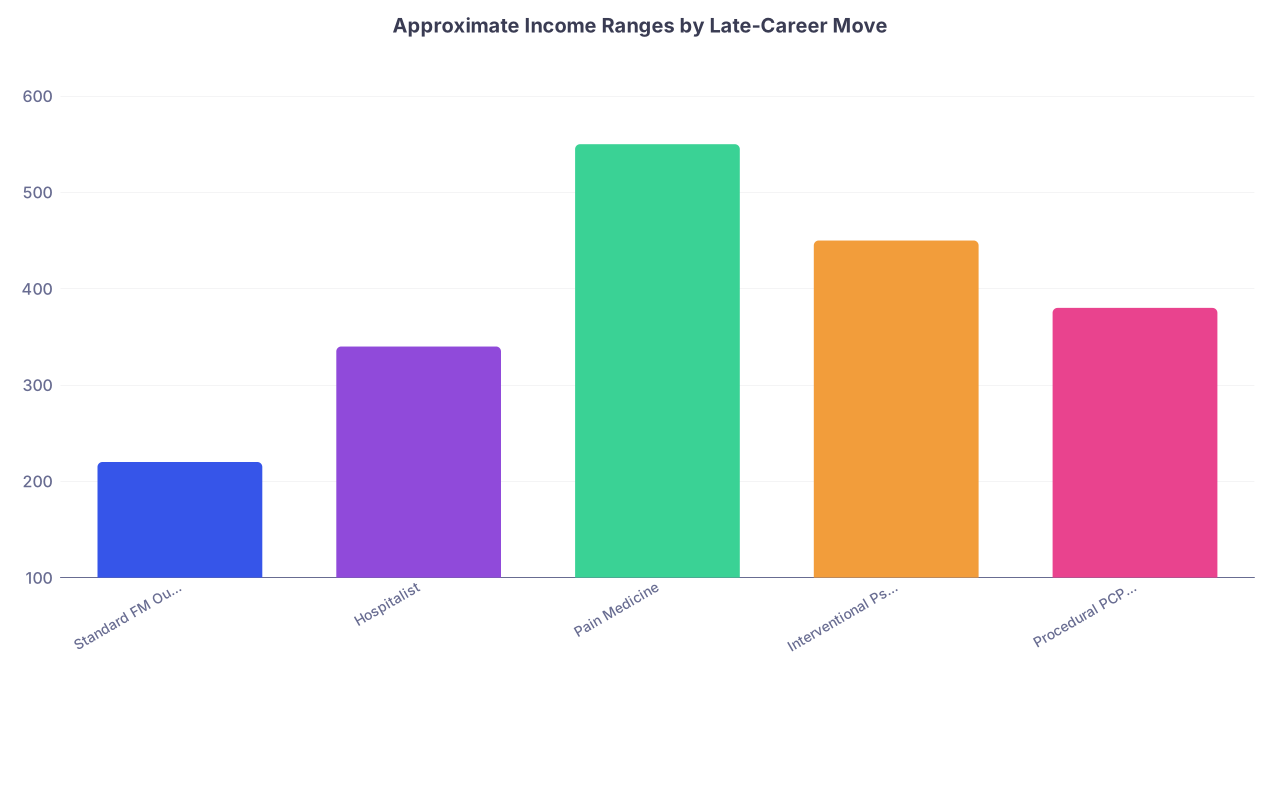
| Category | Value |
|---|---|
| Standard FM Outpatient | 220 |
| Hospitalist | 340 |
| Pain Medicine | 550 |
| Interventional Psych | 450 |
| Procedural PCP Hybrid | 380 |
If you like clinical variety, mild entrepreneurship, and some procedures but do not want to go back into formal training, this lane is underrated.
5. Radiology → IR or High-RVU Telerads
If you’re already a radiologist:
- Interventional Radiology from DR can be complex late-career. The training and credentialing bar is getting higher.
- But high-volume teleradiology, nights, weekends, and specific subspecialty reads can significantly bump income without new boards.
If you’re not radiology trained already, IR is not a realistic late pivot.
Step 3: Decide: Fellowship vs. High-Pay Pivot Inside Your Current Specialty
This is the fork in the road.
You have two broad strategies:
- New certification / fellowship track – Big move, bigger potential upside, bigger disruption.
- In-specialty high-comp pivot – No or minimal retraining, faster income bump, less risk.
When a late fellowship might make sense
You actually consider a late fellowship if:
- Your kids are older or out of the house.
- Your spouse/partner is on board with 1–3 years of lower income.
- You’re in a specialty with a dead-end ceiling you already hit (e.g., outpatient IM in a saturated, low-pay area).
- The fellowship leads to a clear, strong market demand in your region (e.g., pain in a region starved for it, not the 9th GI in a 3-mile radius).
You don’t do a late fellowship because you’re bored.
You do it because the numbers and the market justify it.
Step 4: Run the Math Like an Adult, Not a Resident
I’ve seen mid-career docs blow 2 years and $400k of opportunity cost on a fellowship that only increased annual income by $50k. That’s not a pivot. That’s a bad investment.
You need a crude but honest ROI check.
Compare three numbers
- Current income (CI): what you’re making now.
- Training income (TI): what you’d earn during fellowship or transition (often 50–70% of CI, sometimes less).
- Post-switch realistic income (PSI): what people with your background actually make in that new niche, in your region, not just what recruiters claim.
Then estimate:
- Years of training (Yt)
- Years to recoup lost income (Yr)
Let’s do a simplified example.
You’re an IM outpatient doc:
- CI: $230k
- Pain fellowship TI: $80k (fellow salary)
- PSI (pain in your region): $550k
You “lose” $150k per year for 1 year of fellowship ($230k – $80k). So cost of training year ≈ $150k + lifestyle hit.
Post fellowship, you’re up $320k per year ($550k – $230k).
So in about 6 months you’ve already recovered the lost year if you land a solid job.
That can be rational.
Now compare that with this disaster:
You’re an outpatient IM → non-invasive cardiology:
- CI: $230k
- TI for 3-year fellowship: $80k x 3
- PSI as a staff cardiologist in your oversaturated metro: $350k
You lose $150k/year for 3 years = $450k lost.
Post-fellowship bump is only $120k/year.
It’ll take you almost 4 years post-fellowship just to break even, assuming you land a job easily (not guaranteed). That’s almost a 7-year total window (3 training + 4 recoup) to get back to where you’d be if you’d just stayed put.
At 45? That’s dumb. You won’t get those years back.
If the breakeven is >5–7 years and you’re already mid-40s, you’d better love that field, not just its salary line.
Step 5: Protect Downside: Don’t Blow Up Your Life All at Once
The “safe” part of this is not just financial; it’s reputational and psychological.
Here’s how you don’t wreck yourself:
1. Test the niche before you commit
- Shadow someone in the niche regularly for 1–2 months, not just a one-day “cool clinic” visit.
- If possible, moonlight or take per-diem shifts adjacent to that work (e.g., you’re an IM doc taking extra hospitalist shifts before going full hospitalist).
- Attend a serious CME or mini-course, not some glossy, salesy weekend.
2. Keep your current revenue stream alive as long as possible
- Go 0.6–0.8 FTE in your current job while:
- you train in new skills,
- build network,
- or interview for niche positions.
- Do not resign and “trust the process.” The process does not pay your mortgage.
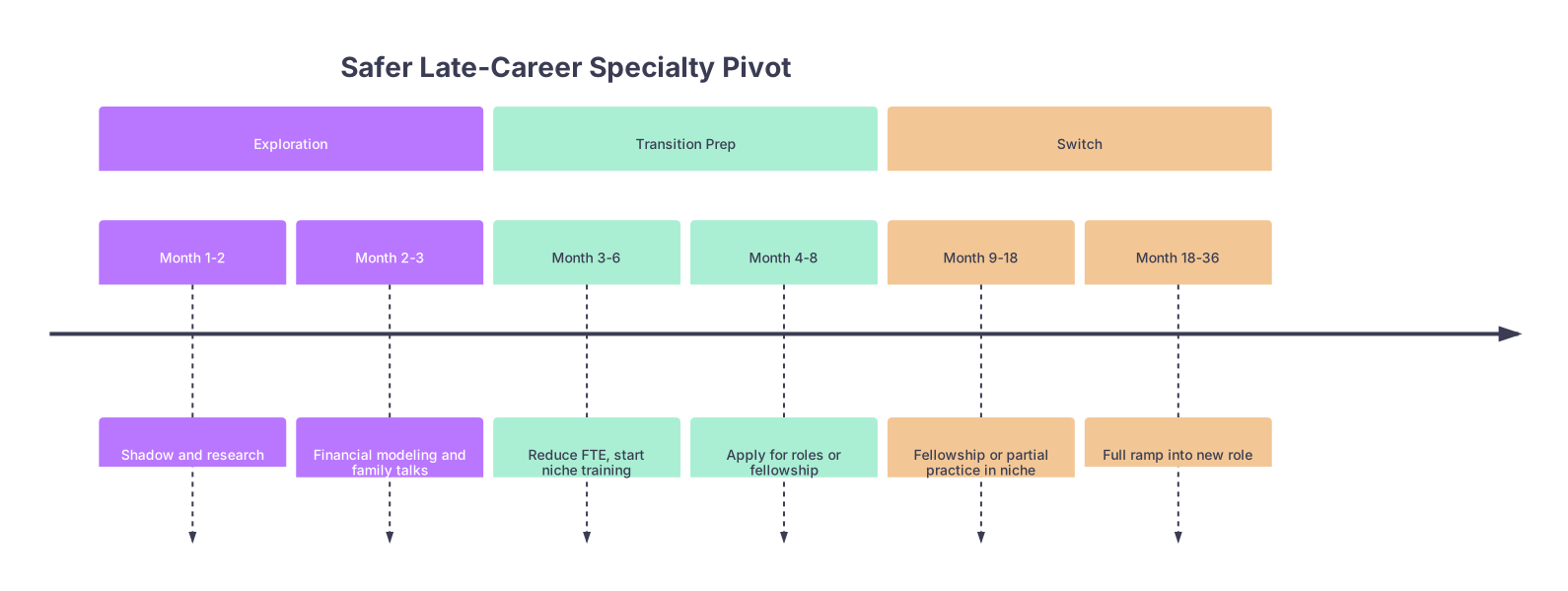
| Period | Event |
|---|---|
| Exploration - Month 1-2 | Shadow and research |
| Exploration - Month 2-3 | Financial modeling and family talks |
| Transition Prep - Month 3-6 | Reduce FTE, start niche training |
| Transition Prep - Month 4-8 | Apply for roles or fellowship |
| Switch - Month 9-18 | Fellowship or partial practice in niche |
| Switch - Month 18-36 | Full ramp into new role |
3. Get clear on credentialing and politics early
Late-career switches get kneecapped by:
- Hospitals refusing certain privileges (“You don’t have enough recent surgical/procedural volume.”)
- Groups skeptical of older newcomers, assuming you’re a problem recruit.
- Board certification timing and requirements you didn’t check in advance.
So you:
- Email or call the credentialing office at a hospital where you might work. Ask what they actually require for your intended role.
- Talk to two practicing physicians in that niche, ideally 5–10 years ahead of you, and ask bluntly:
- “Would you hire someone like me at 48 with this background?”
- “What would be the red flags for a group considering me?”
You’ll get more honest intel off the record than from any brochure.
Step 6: Managing Age, Ego, and Culture Shock
You will feel weird being the older person in a new lane. That’s normal.
You may be 47 sitting in an interview with a 38-year-old program director or a 33-year-old partner who’s evaluating your fit. You cannot show up defensive, bitter, or “too senior to learn.”
Two rules:
Own your age, don’t apologize for it.
“I spent 15 years in outpatient IM, got very good at complex chronic care. I realized I thrive with more procedural and acute work, so I’m intentionally making this shift. I’m committed for the long term.”Signal humility and adaptability.
Say it out loud: “I know I’m coming in later than most. I am very comfortable being in learner mode again, taking feedback, and proving myself by my work.”
If you walk in expecting deferential treatment because you’re “senior,” you will not get a good offer. Or any offer.
Step 7: Tactical Moves by Current Specialty
Let’s get concrete. You want practical moves? Here:
If you’re IM / FM
Most realistic higher-paid moves:
- Hospitalist / Nocturnist in higher-paying markets.
- Procedural-heavy primary care (vasectomies, skin, joints) with good payer mix.
- Obesity / metabolic / endocrine-lite program with cash-pay components.
- Administrative + clinical leadership with bonus structures at a growing system (CMO, service line lead).
Borderline but sometimes doable:
- Pain (if you can actually get a fellowship; competitive, but some mid-career candidates match).
- Critical care (if you’re still sharp in acute care and can handle actual ICU life).
Bad late bets for most IM/FM at 45+:
- GI, cardiology, heme/onc fellowships purely for money. Long training, high competition, questionable ROI that late unless you have a crystal-clear job waiting.
If you’re Anesthesia
Realistic higher-paid moves:
- Pain medicine (classic).
- High-intensity locums / critical access / high-call sites with serious premiums.
- Or anesthesia group ownership / partnership with profit sharing instead of just W2.
You don’t need to reinvent the wheel here. Anesthesiology already pays well; your issue might be structure, not specialty.
If you’re EM
Emergency medicine has gotten hammered in some markets, but:
- Move from saturated urban academic → rural community with sign-on, higher hourly.
- Urgent care + occ med setups with volume-based compensation and some business upside.
- Hospitalist conversion if you did IM and are dual-boarded or close enough to get credentialed.
The “late fellowship into something brand new” path from EM is tough unless you already did a combined or earlier pivot.
If you’re Psychiatry
You have one of the best late-pivot playgrounds:
- Interventional psychiatry (TMS, ECT, ketamine) with partial ownership.
- Concierge / boutique cash-pay practices with tight panels and high fees.
- Forensic psychiatry (in some regions), which has very strong hourly.
The money here is driven heavily by structure and payer mix, not just codes.
Step 8: Family and Life Constraints – Treat Them as Hard Data
You’re not 26. You can’t pretend your spouse, kids, and parents aren’t part of the equation.
Hard questions to actually talk through with them:
- “Can we sustain a 30–50% income drop for 1–2 years?”
- “Are we willing to move to where the niche pays best?”
- “What happens to childcare, elder care, schooling if I take more nights/weekends in the new role?”
If your partner is already maxed out, and you casually decide to do a 2-year fellowship with night call, don’t act surprised when your marriage fractures.
I’ve watched that movie more times than I’d like.
Step 9: Concrete Action Plan for the Next 90 Days
You’re either going to actually move on this or just doomscroll job boards.
Here’s a tight 3-month plan if you’re serious:
Weeks 1–2
- Pick one target niche. Not three. One.
- Talk to 2 docs doing exactly what you want in 5–10 years. Thirty minutes each, real questions.
Weeks 3–6
- Shadow or observe at least 3 full days in that niche.
- Ask for income ranges, partnership track, and lifestyle as they really are.
- Start a rough 5-year financial model: current vs switch.
Weeks 7–10
- Meet with a financial planner or run scenarios yourself:
- “What happens if I drop to 0.6 FTE next year and start transition?”
- “What’s our runway if income dips for 1–2 years?”
Weeks 11–13
- Decide: Fellowship route vs in-specialty high-pay pivot.
- If fellowship: start contacting programs early, ask how they view mid-career applicants.
- If pivot: start searching for:
- 0.6–0.8 FTE bridge roles,
- moonlighting or per-diem in your target style of practice.
Put dates in your calendar. If you don’t timebox this, you’ll still be griping about burnout 18 months from now with nothing changed.

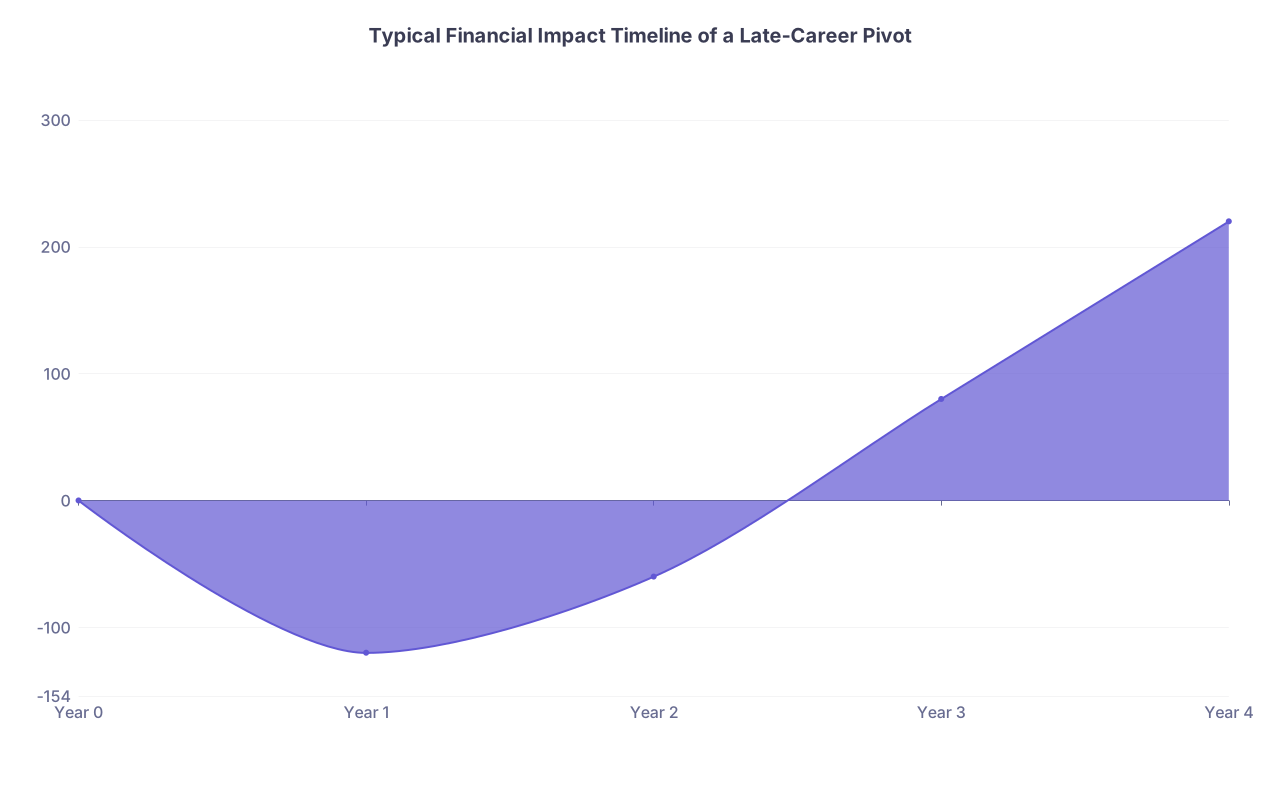
| Category | Value |
|---|---|
| Year 0 | 0 |
| Year 1 | -120 |
| Year 2 | -60 |
| Year 3 | 80 |
| Year 4 | 220 |


FAQ (Exactly 4 Questions)
1. Am I “too old” to switch into a higher-paid niche if I’m over 45?
No, you’re not too old; you’re just out of the “anything is possible” phase. You have to pick from realistic, adjacent options with a clear financial upside and manageable training time. Pain from anesthesia/PM&R, interventional psych from psychiatry, hospitalist/nocturnist from IM/FM, and procedural-heavy hybrids are all viable at 45–55 if you plan carefully. The key is ROI and fit, not ego.
2. Will programs or groups even take a mid-career applicant seriously?
Yes—if you present well. If you show up as bitter, entitled, or evasive about why you’re switching, you’ll get nowhere. But if you clearly articulate: “Here’s my background, here’s why I’m making a deliberate, long-term pivot, and here’s why I’m an asset,” many places will lean in. Mid-career stability and maturity are actually attractive when paired with humility and a strong work record.
3. What if my spouse or family is against me going back for more training?
Then a long fellowship is probably a bad move. For real. You can’t run a multi-year training gauntlet with an openly hostile home environment and expect things to go well. In that case, focus on within-specialty income upgrades: different region, different practice model, higher-acuity or procedural roles, partial ownership, or admin roles with bonuses. Plenty of doctors add $80k–$200k to their income without formal retraining by changing structure, not specialty.
4. How do I know if I’m chasing money versus making a smart strategic move?
Look at your behavior, not your story. If you’ve shadowed, done the math, talked to multiple practicing docs, checked credentialing, and built a 3–5-year plan with your family and finances in view—that’s strategy. If you’ve just compared salaries on Doximity and feel resentful, that’s money-chasing. The smart move usually feels more boring and spreadsheet-heavy than the fantasy version in your head.
Bottom Line: 3 Things to Remember
- Late-career switches are possible, but not all of them are smart. Start with what’s adjacent, in-demand, and realistically trainable from where you stand.
- Run the numbers like a grown-up. If the breakeven is 6–7+ years and you’re mid-40s, you’d better deeply want the work, not just the paycheck.
- Protect your downside: test the niche, keep income flowing during transition, and get your family fully on board before you jump.
You don’t need to suffer in a low-paid, draining setup until retirement. But you also don’t get to gamble like a resident. Plan it, pressure-test it, and then—if it holds up—commit.