
It’s 8:30 p.m. You just finished admitting your fourth CHF/COPD combo of the night. You glance at the attending’s name on the board. Hospitalist. You know roughly what they make. You also know your med school debt number. Those two numbers are not playing nicely together.
You’re in internal medicine residency, you do not hate medicine, but you’re looking at the highest paid specialties list and thinking: “Did I box myself out forever?” You’re not alone. I’ve seen this exact conversation on night float more times than I can count.
Let me walk you through what’s actually realistic from where you stand right now—and what is fantasy.
Step 1: Get Brutally Clear on Your Starting Point
You cannot plan a transition if you do not define your constraints. Take 10 minutes and answer these on paper, not in your head:
- What PGY level are you?
- What’s your visa status (if any)?
- What country and state are you in?
- Are you willing to:
- Move states?
- Restart residency?
- Add 1–3 extra years of training?
- How aggressive is your financial pressure really? (Debt amount, dependents, spouse income.)
Here’s the uncomfortable truth: the more flexible you are with geography, time, and ego (yes, restarting training hurts the ego), the more doors exist.
If you’re PGY-3, on a J-1, with two kids in school, not willing to move or restart… your path is narrower than a PGY-1 citizen willing to go anywhere and redo residency if needed.
Step 2: Understand the Real Money Levers After IM
Your baseline after internal medicine is not bad. General IM has multiple “pay knobs”:
- Specialty choice (hospitalist, primary care, academic vs private)
- Geography (rural vs major coastal city)
- Practice structure (W-2 employed vs partnership/ownership vs locums)
- Fellowship (cards, GI, etc.)
- Side income (telemedicine, nocturnist shifts, consulting)
But you asked specifically about highest paid specialties. Let’s anchor with some rough, realistic post-training annual income ranges in the U.S. (pre-tax, typical mid-career private practice or strong employed positions):
| Path | Typical Annual Range (USD) |
|---|---|
| Academic IM (general) | 210k–280k |
| Community outpatient IM | 250k–330k |
| Hospitalist (7-on/7-off) | 280k–380k |
| Nocturnist | 320k–450k |
| Cards (non-invasive) | 450k–700k+ |
| Interventional cardiology | 650k–900k+ |
| GI | 550k–900k+ |
| Pulm/CC (intense private group) | 450k–700k |
| Hem/Onc (strong RVU/PP model) | 450k–750k+ |
Those are ballpark, but they track with what I’ve seen in contracts and MGMA-esque data.
Notice something: very high pay is still reachable without ditching IM. For most IM residents, your highest realistic earning potential is still through IM-based fellowships, not trying to jump ship into derm or ortho at PGY-2.
Step 3: The “Stay in IM, Earn Like a Specialist” Routes
If you want higher pay and you’re already in an IM program, these are your most realistic “high yield” paths.
1. Cardiology (especially interventional)
Practical reality:
- Competitiveness: High, but doable from a solid IM program if you have:
- Strong Step/board scores
- Good in-program reputation
- At least some research or quality-improvement work
- Extra training:
- 3 years IM
- 3 years general cardiology
- +1–2 years for interventional or EP if you want the big money
Why it works for pay:
- High RVU specialty
- Constant procedural volume (caths, stents, TAVRs depending on training)
- Call can pay very well, especially in smaller markets
Who should actually consider it:
- You’re okay with catheter labs, middle-of-the-night STEMIs, and real acute care
- You can tolerate 6–8 extra years total from med school graduation to “real money”
If you’re PGY-2 and not totally burned out, applying cards this fall is your most straightforward “higher pay” play. Not glamorous. Very realistic.
2. Gastroenterology
You want scope-heavy, procedure-driven, big-RVU work. GI is your friend and your enemy.
Reality check:
- Competitiveness: One of the most competitive IM fellowships
- Extra training:
- 3 years IM
- 3 years GI
- Lifestyle:
- Endoscopy-heavy days
- Call with bleeds, foreign bodies, etc.
- Often intense but can be highly structured
Money side:
- High procedure volume = high RVUs
- Strong private practices, ASC ownership potential
- Rural/suburban groups can pay extremely well
The catch: You won’t waltz into a good GI spot with mediocre evaluations and zero scholarly output. If you’re serious, you start acting like a future GI fellow yesterday: GI electives, case reports, befriend the GI faculty, get your name on something.
3. Pulm/CC and Hem/Onc
These usually sit a notch below GI/cards in peak earning, but still significantly better than plain general IM, especially in private groups.
Pulm/CC:
- Training: 3 years IM + 3 years Pulm/CC (combined)
- Scope:
- ICUs, vents, procedures
- Outpatient lung clinics and sleep labs
- Pay sweet spot:
- Private groups that staff multiple ICUs and clinics
- Groups with sleep labs or pulmonary function labs
Hem/Onc:
- Training: 3 years IM + 3 years Hem/Onc
- Reality:
- Emotional load is high
- RVUs from chemotherapy management, infusions, long-term patients
- Money:
- Busy private practices can match or exceed general cards in some markets
- Academic heme/onc earns much less, be careful which offers you compare
If you’re early in residency and like critical care or oncology, these are very decent high-pay paths that don’t require burning IM to the ground.
4. High-Pay General IM: Hospitalist, Nocturnist, Locums
You do not have to fellowship to improve your income. You can hack the general IM path pretty hard if you’re willing to trade location and schedule.
Here’s what I’ve watched residents do:
- Become a rural hospitalist:
- 7-on/7-off, non-major metros
- 300k–400k realistic, sometimes higher with bonuses
- Move from days to nocturnist:
- Same 7-on/7-off but nights only
- 20–40% pay bump over day hospitalist
- Locums for 1–3 years:
- 300k–500k is absolutely possible, sometimes more
- Trade-off: constant travel, some sketchy systems, up-and-down census
- Very good for aggressive debt payoff
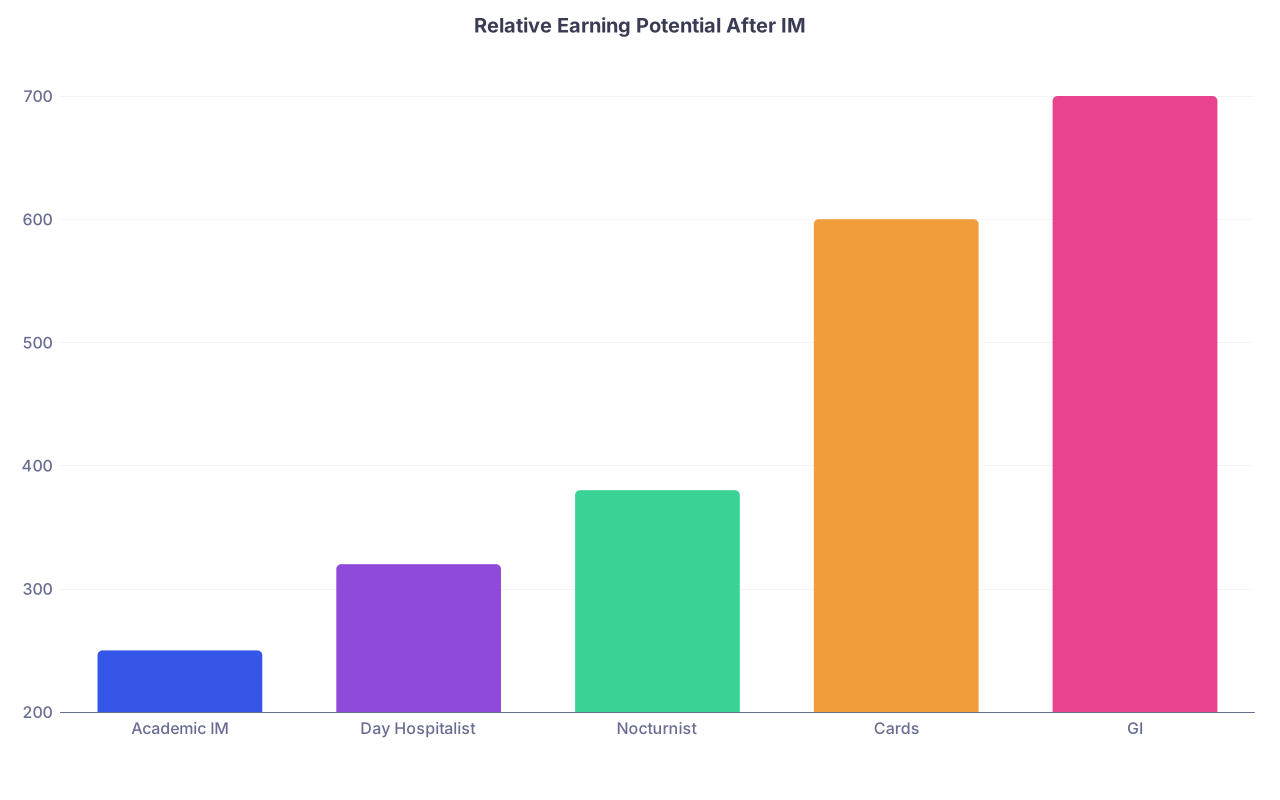
| Category | Value |
|---|---|
| Academic IM | 250 |
| Day Hospitalist | 320 |
| Nocturnist | 380 |
| Cards | 600 |
| GI | 700 |
If you’re PGY-3 and completely sick of training, this is probably your most direct path to “more money in 12 months.”
Step 4: The Fantasy Land Ideas (and When They’re Actually Possible)
Now to the stuff people whisper about in the workroom.
“I’ll just switch to derm/anesthesia/rads/something that pays more.”
For 90% of IM residents, these are long-shot or self-destructive moves. But there are a few edge cases where it’s not insane.
Switching Into Another Residency for Money
Specialties people eye for better pay or lifestyle:
- Anesthesia
- Radiology
- Dermatology
- PM&R (money is mixed, but lifestyle often better)
- EM (this one is currently trending the wrong way financially)
Harsh reality:
- You will almost always have to restart PGY-1 or PGY-2
- You delay your attending salary by 2–4 years
- You risk not matching at all if you apply half-heartedly
When it’s actually reasonable:
- You’re PGY-1 or early PGY-2
- You truly like that specialty’s work (you’ve shadowed, rotated, not just watched TikToks)
- Your exam scores and transcript support it (e.g., competitive for rads/anes/derm)
- You’re willing to move anywhere and start lower on the totem pole again
If you’re a PGY-3 staring down graduation, I would almost never recommend blowing up everything to reapply derm or rads just for money. The opportunity cost is brutal.
Pain Management: The “Crossroads” Option
Pain is one of the few higher-reimbursing areas that pulls from multiple cores (anesthesia, PM&R, neurology, sometimes IM via palliative/special paths depending on institution).
From IM, though, your path into true interventional pain is not straightforward everywhere. Many ACGME pain fellowships are tied to anesthesia or PM&R cores. Some private/regional fellowships are more flexible.
If you’re thinking “I’ll do pain and do lots of procedures and make bank”:
- Get very clear on:
- What fellowships even accept IM backgrounds
- Whether they’re ACGME-accredited
- What kind of practice their grads actually land in (procedural vs clinic-heavy meds, injections only, no implants, etc.)
This can be a good income bump, but it’s niche and program-dependent. You can’t just assume “IM → pain → 800k” like some spreadsheet.
Step 5: If You’re Already Locked In (PGY-3 or Finished) and Want Faster Money
Let’s say you’re PGY-3, you are not doing fellowship, you graduate in 6 months, and your main goal is “I don’t want to be broke.”
Here’s a very concrete playbook:
Decide now: inpatient vs outpatient
- Inpatient: Lean toward hospitalist/nocturnist/locums
- Outpatient: High-volume primary care or multi-specialty groups with productivity bonuses
Choose geography over glamour:
- Skip NYC, SF, Boston, LA if money is your top priority
- Target:
- Secondary/tertiary cities (Omaha, Tulsa, Raleigh, Columbus)
- Rural-ish but not-in-the-middle-of-nowhere communities
Be willing to do non-ideal schedules for 3–5 years:
- Nights
- Weekends
- Extra shifts for bonus pay
Optimize contracts, not vibes:
- Look for:
- Strong base salary
- Clear RVU or bonus structure
- Loan repayment
- Avoid:
- “Competitive compensation” with no numbers
- Long non-compete clauses that lock you into a low-paying market
- Look for:
I’ve seen residents jump right from IM residency to:
- Nocturnist in a mid-sized Southern city: 380k base, 7-on/7-off
- Hospitalist in the Midwest: 330k first year, 25k sign-on, 10k relocation
- Locums stringing contracts: ~450k their first full year out, absurd hours though
None of those required switching specialties. Just being flexible and a bit ruthless with job search.
Step 6: Choosing Between Fellowship vs High-Pay General IM
This is where a lot of people stall out: “Should I chase the fellowship money or just go work and earn right away?”
In simple terms:
You should seriously consider a high-paying IM fellowship (cards, GI, pulm/CC, heme/onc) if:
- You do not despise the subject matter
- You have at least neutral feelings about more training
- You’re not in full financial emergency mode
- You want a multi-decade career with very high earning ceiling
You should lean toward straight-to-work high-pay IM (hospitalist/nocturnist/locums) if:
- You’re burned out from training culture
- You need income now (family, debt, burnout)
- You don’t love any subspecialty enough to spend 3 more years in fellowship
- You’d rather use geography and schedule to hike pay than more credentials

| Step | Description |
|---|---|
| Step 1 | IM Resident PGY2-3 |
| Step 2 | Target high-pay hospitalist or locums jobs |
| Step 3 | Apply Cards, GI, PulmCC, HemOnc |
| Step 4 | Want 3 more years of training? |
| Step 5 | Like a high-pay subspecialty? |
You’re not choosing “money vs no money.” You’re choosing “money now vs more money later” and “what kind of medicine you’re willing to practice for decades.”
Step 7: How to Actually Execute a Transition (Concrete Moves in the Next 90 Days)
Let’s get granular. Here’s a 90-day game plan depending on where you are.
If you’re PGY-1 or early PGY-2 and want fellowship
Next 90 days:
- Pick 1–2 target fellowships: e.g., cardiology + pulm/CC
- Schedule those electives ASAP
- Identify 1–2 attendings in that field and tell them directly:
“I’m seriously considering [cards/GI/etc]. I’d like to build a competitive application—what should I prioritize this year?” - Get on at least one project:
- Case report
- QI project
- Retrospective chart review
- Clean up your ERAS CV and keep a running list of accomplishments
If you’re late PGY-2 or PGY-3 and want maximum pay after graduation
Next 90 days:
- Decide inpatient vs outpatient path (for the next 3–5 years, not forever)
- Start collecting intel:
- Talk to recent grads from your program:
- “Where did you go?”
- “What are your hours and pay actually?”
- Talk to recent grads from your program:
- Start casting a net:
- Recruiters (yes, they’re annoying, but you need data)
- Job boards for rural and mid-sized city hospitalist positions
- Learn the basic numbers of a good first contract for your region
Step 8: What You Should Not Do
Let me be blunt about a few traps:
Do not chase a specialty you dislike just for compensation. You’ll be miserable and probably still not top-earning, because the top earners are usually the ones who lean into the work, not avoid it.
Do not assume academics will magically pay well later. Academic IM and many academic subspecialties are perpetually underpaid relative to RVUs and skill. Good for some people, financially dumb if your main driver is income.
Do not stay in a saturated coastal metro and complain about salary. The math is brutal there. Supply is high, salaries are depressed. You can fix this by… leaving.
Do not ignore non-compete clauses. A beautiful 320k job with a 50-mile non-compete radius in a mid-size city can trap you badly when you want to move to a higher-paying group across town.
FAQs
1. I’m an IM resident with average scores and no research. Do I have any shot at cards or GI?
Yes, but you’re climbing uphill, not on flat ground. You’ll need:
- Very strong in-program reputation (people fight for you at fellowship rank meetings)
- At least some scholarly activity started now—case reports, QI project, whatever you can realistically finish
- Realistically, you might be more competitive for pulm/CC or heme/onc depending on your program’s strengths
Talk to your PD and a trusted subspecialist early. If they say your shot is slim for GI/cards, consider alternative fellowships with good incomes or lean hard into hospitalist/nocturnist/locums for pay.
2. Is locums right out of residency a bad idea?
Not inherently. But it’s not a game for the disorganized or clinically shaky. Locums can be very lucrative, but:
- You need to be clinically confident, because support can be variable
- Documentation and billing mistakes can eat your time and money
- Credentialing and travel logistics get old fast
If you’re relatively strong clinically, okay with uncertainty, and have a clear reason (like crushing debt fast), 1–3 years of locums can absolutely make financial sense.
3. I’m on a visa (J-1 or H-1B). Does that kill my options for higher-paying paths?
It constrains them but does not kill them. Realities:
- Fellowships: Some competitive fields are harder but not impossible as an IMG/visa holder (cards, GI). You’ll need strong support and a smart list of programs.
- Post-residency jobs: J-1 waiver positions often skew rural/underserved—which can be very high paying, especially for hospitalists.
- Switching fields (e.g., to rads/anes) is much riskier due to match uncertainty and visa complications.
Your move is usually:
- Maximize fellowship chances early, or
- Use a J-1 waiver hospitalist/nocturnist job in a rural-ish setting to earn well and build a strong CV, then re-evaluate later.
Open your notes app or a blank sheet of paper. Write three headings: “Fellowship Path,” “High-Pay IM Path,” and “Switch Specialty Path.” Under each, list one specific option you’d realistically pursue, with number of years of extra training and approximate earning potential. If any option feels vague, that’s your homework: make it specific within the next week.