
Visas and Sponsorship: Navigating High-Paid Specialties as an IMG
What do you actually do if you want orthopedics or dermatology… but the programs you like either do not sponsor visas or “prefer” green cards and citizens?
Let’s not pretend this is a level playing field. If you’re an IMG on a visa and aiming for the highest paid specialties in the US, you’re playing on hard mode. The rules are different for you. Some doors are closed. Some that look open are fake.
You do not need motivational quotes. You need a map and a strategy.
This is that.
1. The Real Visa Landscape for IMGs Aiming High-Paid Specialties
If you are chasing things like ortho, derm, radiology, gas, neurosurgery, plastics, ENT, urology, ophthalmology, you’re immediately in a different game than someone happy with internal medicine or family medicine.
Here’s the blunt reality:
- Many of the highest-paid specialties are among the least IMG-friendly
- Of the IMG-friendly ones, a bunch are J‑1 only, and H‑1B sponsorship is rare
- Some programs say “we accept IMGs” but:
- They don’t sponsor visas
- Or only rarely take IMGs
- Or only take US-IMGs (Caribbean schools, US citizens)
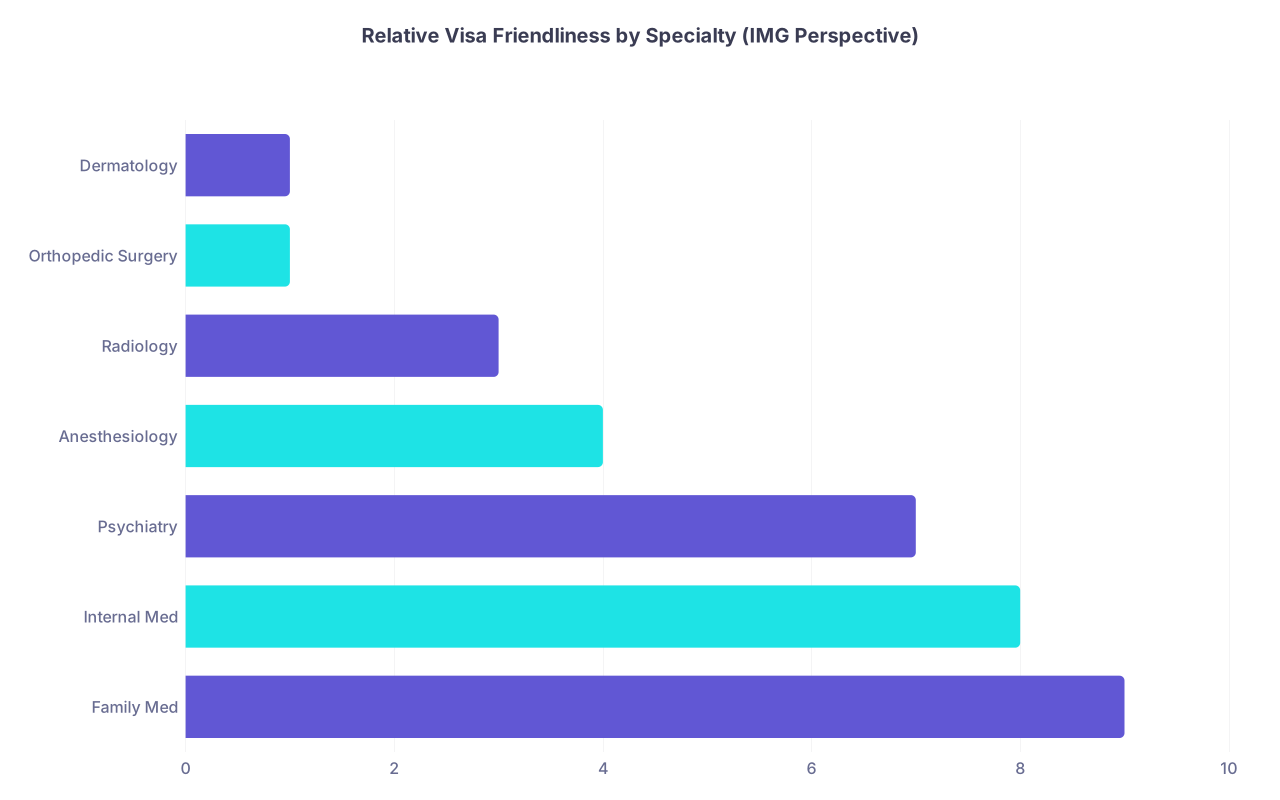
| Category | Value |
|---|---|
| Family Med | 9 |
| Internal Med | 8 |
| Psychiatry | 7 |
| Anesthesiology | 4 |
| Radiology | 3 |
| Orthopedic Surgery | 1 |
| Dermatology | 1 |
Scale is 1–10: higher = more IMG/visa friendly. This is directional, not exact, but you get the point.
So if you are:
- Non‑US citizen
- Need sponsorship
- Want a top-compensation specialty
…your first question is not “How do I strengthen my application?”
Your first question is: “Where is this even structurally possible?”
J‑1 vs H‑1B: How This Actually Affects Your Specialty Choice
You will see a lot of vague online chatter about J‑1 vs H‑1B. Here’s how it actually hits you in real life.
J‑1 (ECFMG sponsored):
- Easiest for programs administratively. Many competitive programs: J‑1 only
- You must return home for 2 years after training or do a J‑1 waiver (usually underserved area)
- J‑1 waivers are easier to find in:
- Primary care (FM, IM, peds)
- Hospitalist roles
- Some psych, some anesthesia, some radiology in rural areas
- Much harder in:
- Derm, ortho, plastics, ENT, ophtho, urology (very few waiver jobs)
H‑1B (employer sponsored):
- Programs must:
- Pay lawyer + filing fees
- Deal with a strict timeline
- Ensure USMLE Steps are fully completed (including Step 3) before start
- More common in:
- Internal medicine, FM, psych, some anesthesia, some radiology
- Rare to nonexistent in:
- Derm, ortho, neurosurg, plastics, ENT, ophtho, urology, many surgical subspecialties
Translation:
If your end game is a high-paying subspecialty that’s not IMG-friendly, relying on H‑1B at the residency level is usually fantasy. You’ll often be on J‑1 and then fighting for a waiver job in that niche. Some combinations are nearly impossible.
2. High‑Paid but Visa-Unfriendly vs High‑Paid and Realistic
Let’s separate dreams that are structurally possible from ones that are pretty much locked.
| Specialty | Pay (Relative) | IMG Friendly | Typical Visa Pattern |
|---|---|---|---|
| Ortho Surgery | Very High | Very Low | Rare J-1, almost no H-1B |
| Derm | Very High | Very Low | Extremely rare any visa |
| Radiology (DX) | High | Low | Mix J-1, some H-1B |
| Anesthesiology | High | Moderate | J-1 common, some H-1B |
| Cardiology (IM path) | Very High | Moderate | IM J-1/H-1B, cards J-1 |
| GI (IM path) | Very High | Moderate | IM J-1/H-1B, GI J-1 |
Strategy Question #1: Are You Willing to Take a Two-Step Path?
If you’re dead set on good compensation but not necessarily derm/ortho prestige, the most realistic visa-compatible high-income paths for IMGs are:
- Internal Medicine → Cardiology
- Internal Medicine → GI
- Anesthesiology
- Diagnostic Radiology
- Psychiatry → some interventional / niche roles
- Hospitalist IM in certain high-paying markets
The fully “sexy” competitive specialties (ortho, derm, plastics, neurosurg, ENT, ophtho, urology) are possible for IMGs without visa issues, but with visas, you’re in lottery-ticket territory. I’ve seen it, but it’s like “1 applicant out of 500” territory.
So if you’re in this situation:
“Non‑US IMG, Step 2: 245, needs visa, wants a high-paying future, open to a 2‑step route”
Then the rational play is:
- Target IM or anesthesia or radiology at programs that explicitly sponsor your visa type
- Build research and networking in the high-paid subspecialty you want
- Accept that you might top out at a very good, but not ultra-elite, niche—and that’s still financially excellent
3. How to Screen Programs When You Need Sponsorship
Here’s where most IMG applicants lose months: they apply blindly to 200+ programs and only afterwards realize half of them don’t sponsor any visa. That’s wasted money and emotional energy.
You need a more ruthless filter.
Step 1: Build a Personal Visa-Safe Program List
For each specialty you’re considering, create three columns:
- Programs that sponsor J‑1 only
- Programs that sponsor J‑1 + H‑1B
- Programs that don’t sponsor any visa
Then, split them again into:
- Historically IMG-friendly
- Historically no-IMG or token-IMG
How to get this data:
Program Websites
Look for:- “We sponsor J‑1 visa only”
- “We sponsor J‑1 and H‑1B visas”
- Or silence (silence is not good—usually means J‑1 only or nothing; you must verify)
FREIDA / Program Info Portals
They often list visa sponsorship types. Not always updated, but a starting point.Email the Coordinator (properly)
Subject that’s actually useful:
“Prospective IMG Applicant – Clarification on Visa Sponsorship (J‑1 / H‑1B)”Message (tight, professional):
Dear [Name],
I am an international medical graduate planning to apply to [Specialty] this cycle. I wanted to confirm your current policy on visa sponsorship for residents (J‑1 and/or H‑1B).
Thank you for your time,
[Your Full Name], [Medical School], [Grad Year]If they don’t reply for a week, move on or call. You cannot afford ambiguity.
Step 2: Align Your Specialty Choice to Reality, Not Fantasy
If your “visa-safe” list for derm or ortho is fewer than ~10 programs nationally, and your profile is not off-the-charts (top‑tier research, insane scores, US clinicals, connections), you’re basically buying Powerball tickets.
On the other hand, if for anesthesia you find:
- 40+ programs sponsoring J‑1
- 15+ sponsoring H‑1B
- Regular IMGs in their current residents
…this is a real option.
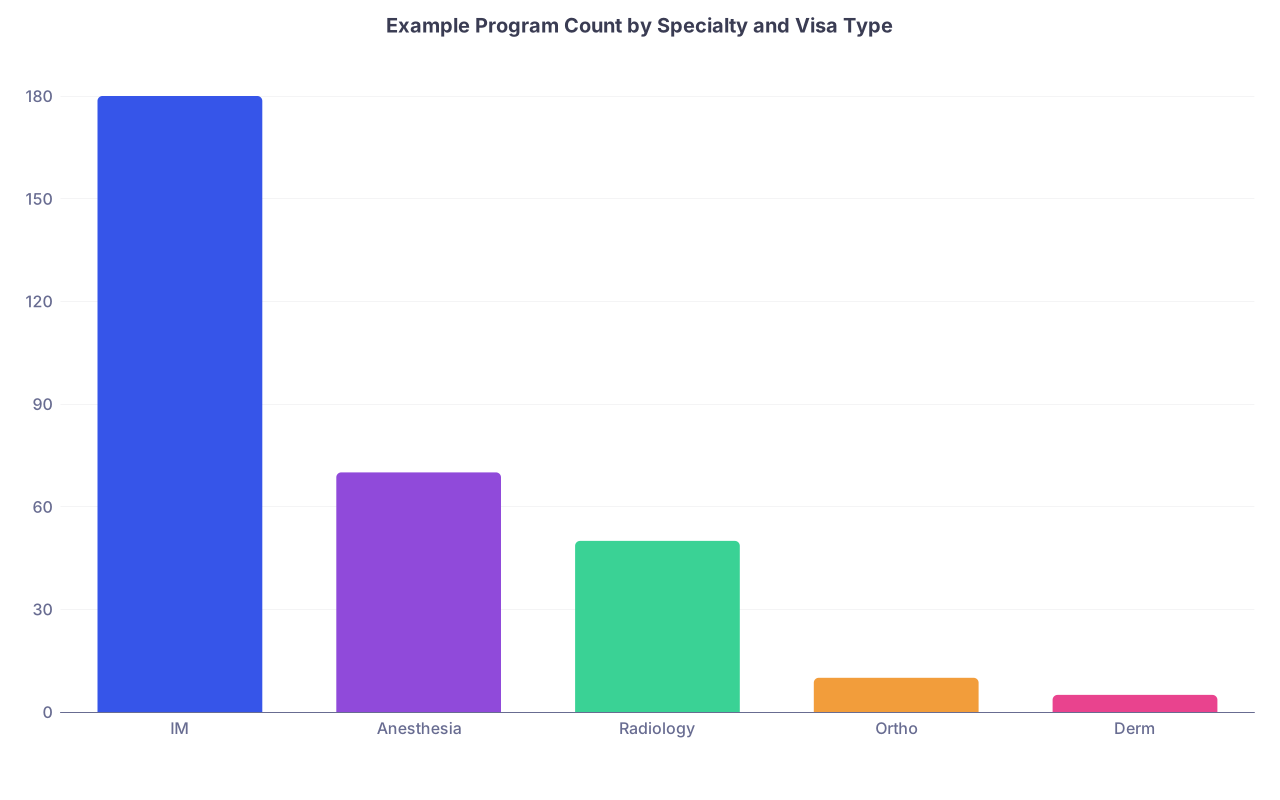
| Category | Value |
|---|---|
| IM | 180 |
| Anesthesia | 70 |
| Radiology | 50 |
| Ortho | 10 |
| Derm | 5 |
(Think of these as “approximate programs where an IMG with a visa has at least some shot,” not formal counts.)
4. Tactics If You Want High Pay + Need a Visa + Are Not a Unicorn
Let’s handle specific situations. Because your situation matters more than general advice.
Situation A: You’re an IMG Outside the US, Haven’t Matched Yet, Need Visa, Want High Income
Your priorities:
Secure any solid residency in a specialty that:
- Actually sponsors your visa
- Has a realistic path to good pay later
Honestly best bets:
- Internal Medicine (then aim for cardiology/GI/hospitalist)
- Anesthesiology
- Radiology (diagnostic)
- Occasionally EM (but EM’s job market is volatile)
Aggressively strengthen your profile in that direction:
- Research in that field, even if remote
- US clinical experience with letters from that specialty if possible
- Step scores ≥ competitive medians (you cannot be mediocre as a visa‑requiring IMG)
Apply broadly, but not blindly:
- 80–120+ IM programs if IM path
- 60–80+ if anesthesia/rads (assuming strong application)
- Filter out non‑sponsoring programs before you pay ERAS fees
Situation B: You’re an IMG Already in Residency on J‑1, Eyeing a High‑Paid Subspecialty
You’re in IM, anesthesia, or rads already. J‑1 sponsored. Now you want:
- Cards, GI, heme/onc, ICU, IR, interventional pain, etc.
Your key issue now is not just getting the fellowship, but what happens after.
Your actual questions:
- Will I be able to get a J‑1 waiver job in this subspecialty?
- Are there non-academic, high-paying jobs willing to hire J‑1 waiver physicians in this field?
You need to:
Talk to senior fellows / recent grads with your visa type.
Ask them:- Where did you get your waiver job?
- Was it in your exact subspecialty?
- Academic or community? Pay level?
Target fellowships in regions with more waiver jobs.
Midwest, South, rural-adjacent areas frequently have:- More willingness to do J‑1 waivers
- Higher salaries due to need
Stop thinking only “prestige fellowship.”
A name like “Cleveland Clinic” or “MGH” is great, but if the end result is:- No J‑1 waiver job in your niche
- Forced to return home with no plan
…that prestige doesn’t pay your future US mortgage.
Sometimes the smart play is:
- Solid but not top-5 fellowship program in a state that has:
- Multiple employer groups known to sponsor J‑1 waivers in your subfield
- Aggressive recruitment for underserved/rural coverage
Situation C: You’re Obsessed with Derm/Ortho/Plastics on a Visa
I’ve seen this. I’ve also seen people waste 5–6 years chasing it and end up with nothing.
If you insist, then:
You need numbers and CV way above average:
- Step 2: 255+ ideally
- Multiple US-based research projects, preferably 1st/2nd author
- US letters from leaders in that specialty
- Away rotations / observerships in those departments
You must be brutally honest about your plan B. Before you send a single application, ask:
- “If I do not match derm/ortho this cycle, what is my next move?”
- “Am I willing to:
- Do a research year or two?
- Pivot to IM/anesthesia/rads?
- Apply to my home country matching system instead?”
If the answer to all of these is “no,” you’re acting emotionally, not strategically.
Use a dual-application strategy only if your finances and time can handle it. Example:
- Apply derm (small list) + IM (broad list)
- Ortho (small) + anesthesia (broad)
But you must understand that some programs see dual-applicants as “not committed.”
5. Matching Visa Type to Long-Term Income Strategy
Everyone obsesses over “residency match.” The smarter question: What does the next 10 years look like on this visa path in this specialty?
J‑1 + High-Paid Field: What Happens After Training?
If you’re J‑1 in a high-paid field like:
- Cardiology
- GI
- Radiology
- Anesthesia
You often have one of three paths:
Waiver job in a less desirable location, very high pay.
Example:- Rural Midwest cardiology group
- $600–800k+ pay
- Heavy workload, limited city life, but fantastic debt payoff
Academic waiver position, moderate pay, good stability.
Example:- State university hospital
- $300–450k depending on specialty
- More teaching, less RVU grind, academic requirements
Struggle to find exact-niche job → accept more generalist role.
Example:- Interventional cardiology fellowship, but waiver job is mostly general cards with some interventions
If you’re picturing “Manhattan derm private practice on a J‑1 waiver,” that’s exactly the sort of fantasy that derails planning.
H‑1B Path: Pros and Traps
If you manage H‑1B residency + fellowship, the upside:
- No J‑1 two-year home requirement
- You can:
- Move directly into private practice (if they can also sponsor H‑1B/green card)
- Negotiate more aggressively since you’re not locked into waiver-only markets
Traps:
- Not all employers are comfortable with H‑1B.
- Delayed green card processing can limit mobility.
- If you ever have to switch jobs before permanent residency is stable, you re-enter visa negotiation hell.
So if you can engineer an H‑1B route in IM/anesthesia/rads → subspecialty → private practice, you’ve basically hacked the system. But expect resistance and limited options at each step.
6. Concrete Moves You Can Make This Year
Let’s bring this down to action level.
If You’re 1–2 Years Before Applying to Residency
Do this now:
Decide your priority stack:
- Working in the US at all,
- Specific specialty prestige,
- Maximum income.
You can have two. Rarely all three as a visa‑requiring IMG in a top-competitive field.
Start a spreadsheet:
- Columns: Program, City, IMG % residents, J‑1?, H‑1B?, Past IMG Matched?, Notes
- Rows: Every program in your target specialty
Push for:
- USCE in your desired realistic specialty (IM/anesthesia/rads, etc.)
- At least one strong US letter from that field
If you even remotely dream of H‑1B:
- Schedule Step 3 early enough that you’ll have results before residency start date
If You’re Applying This Coming Cycle
Do this in the next 1–2 weeks:
Finalize your short list of dream high-comp specialties (maybe 1 truly competitive + 1 more realistic high-paid)
Build two ERAS target lists:
- Small: your reach programs in the ultra-competitive field
- Large: your realistic programs in IM/anesthesia/rads with visa sponsorship
Email coordinators at any program where visa info is unclear. Fast, short, decisive.
Shape your personal statement and experiences toward a path that:
- Makes sense if you “only” match the realistic specialty
- Still leaves open the door to high-income subspecialties
For example, IM + strong interest in cardiology/critical care is completely coherent and believable. IM + “my true dream is derm” looks confused.
7. The Harsh But Useful Filter Question
When you’re staring at an application choice, ask yourself this, with your specific background and scores in mind:
“If this program only sponsors J‑1, and this specialty has almost no J‑1 waiver jobs in big cities, am I actually okay living in a rural or semi-rural area for 3–5+ years after training to pay off my debt and secure my future here?”
If your honest answer is no, that combination of visa + specialty probably does not serve you, no matter how shiny it looks on paper.
Open a blank document or spreadsheet right now and write three headings:
- “High-paid specialties I want”
- “Visa types I can realistically get”
- “Residency paths that intersect both”
Force yourself to list at least 5 concrete residency programs under that intersection column. If you cannot list 5 today, your plan is not a plan, it is a wish.