
Most residents are reading compensation reports wrong—and some are about to choose the wrong specialty because of it.
You think you’re researching “highest paid specialties.” In reality, you might be looking at a carefully averaged fantasy land that almost no real doctor actually lives in.
Let me be blunt: misreading compensation data is one of the quietest but most expensive mistakes residents make. It doesn’t hurt now. It hurts 8–10 years from now, when you realize the “average” in that Medscape or Doximity report had nothing to do with the way you actually practice, where you actually live, or how you actually feel about your job.
You’re not just picking a number. You’re picking a lifestyle, a call schedule, a malpractice risk profile, a burnout probability, and a geographic box. And if you only look at the averages, you will absolutely miss the landmines.
Let’s walk through the biggest traps so you do not get burned.
1. The “Average Salary” Trap: You’re Not Average, and Neither is the Data
The headline number in compensation surveys is the most misleading thing in the entire report.
You see something like: “Orthopedic surgery: $624,000.” Your brain quietly whispers, “Cool, that’s what I’ll make.” No. That’s what you might see on a survey if:
- You survive training
- You find a decent job
- You work at least as hard as the people who answered the survey
- You land in a reasonably paying market
- You do not get burned out and cut your hours
…and even then, you might still be way off.
The core mistake: residents see “average” as “expected.” It isn’t. It’s a statistical artifact built from a wildly mixed group of physicians:
- Academic vs private practice
- Rural vs urban
- High-volume proceduralists vs low-volume clinicians
- Owners vs employed docs
An “average” across those is like averaging a Tesla, a used Corolla, and a city bus, then concluding, “The average car has 5.3 seats and costs $47,000.” Technically true. Functionally useless when you walk into the dealership.
Mean vs Median vs Reality
Most reports publish mean (average) and sometimes median. The median is usually closer to what you might realistically see, but both hide the spread.
Here’s where residents get tricked:
- Means are pulled up by a small group of very high earners (big partners, huge volume, insane call, rural monopolies)
- Medians may still hide that the bottom 25–30% are making much less than you think
If you are risk-averse, have a family, want predictable hours, or know you won’t chase RVUs like a maniac, you’re not aiming for the right tail of the curve. You care more about the floor than the ceiling.
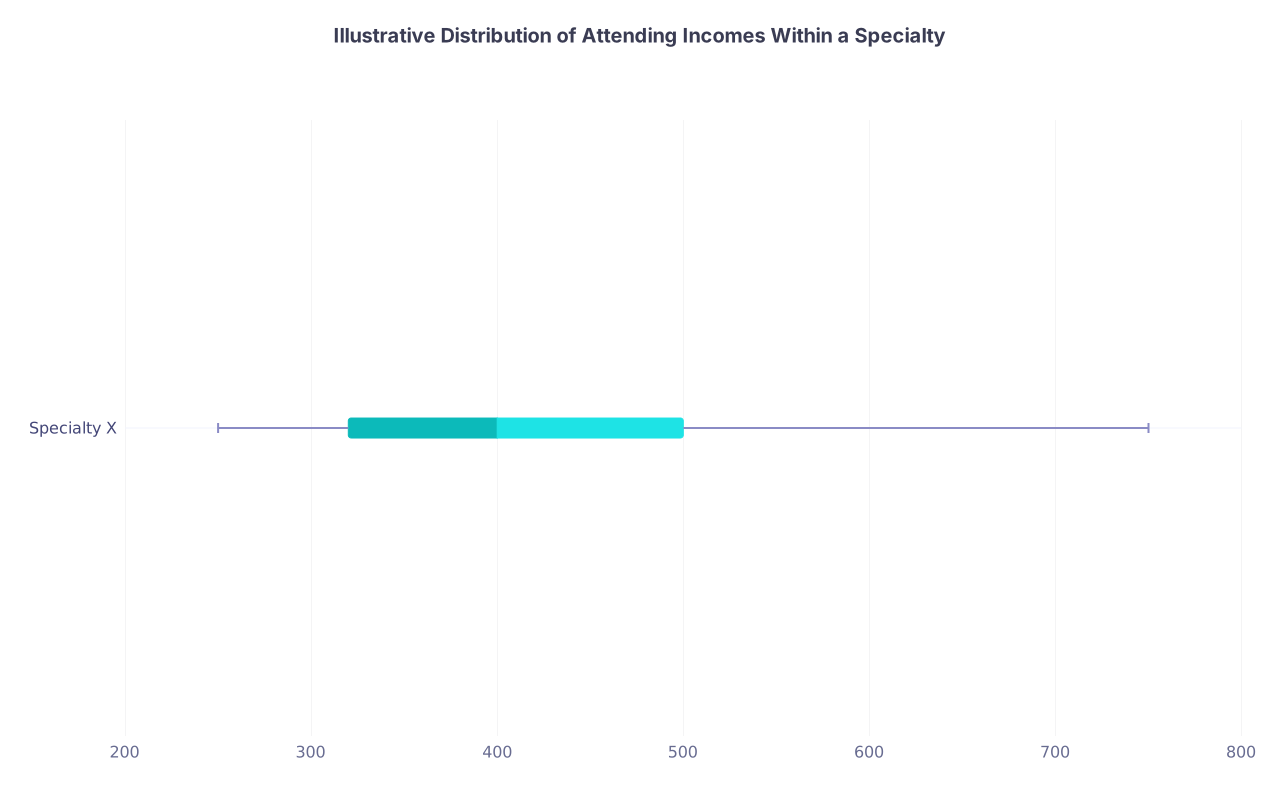
| Category | Min | Q1 | Median | Q3 | Max |
|---|---|---|---|---|---|
| Specialty X | 250 | 320 | 400 | 500 | 750 |
Notice how far that upper end goes. The survey tells you “average $400k.” The guy making $750k and the one making $260k are both part of that line. You have to ask: which end are you actually likely to live on?
2. Ignoring Setting: Academic vs Private vs Employed vs Ownership
One of the most painful errors I see: residents who love teaching, research, and complex cases… choosing a “high-paying” specialty because they saw a private-practice-heavy salary report, then taking an academic job that pays half of what they expected.
You cannot look at specialty-wide numbers without asking: what practice setting are these people in?
Common pattern:
- Academic jobs: usually lower base pay, stronger benefits, more teaching/research time
- Private practice employed: mid-range base, RVU or production bonuses, usually higher ceiling but more risk
- Physician-owned groups / partnership: potentially highest upside, also highest pressure and often longer hours
- Hospital-employed: predictable, stable, may cap your upside
If a survey mixes all of these and gives one tidy average, that number is noise.
| Practice Type | Typical Range (Illustrative) |
|---|---|
| Academic | $220k – $350k |
| Hospital-employed | $280k – $450k |
| Private employed group | $300k – $550k+ |
| Partner/owner | $400k – $800k+ |
If your heart is already in academic medicine, don’t fantasize about the partner track numbers.
Big red flag: any compensation report that doesn’t clearly break down pay by practice setting is basically an expensive horoscope.
3. Cost of Living: The Salary Mirage
Another huge blind spot: you see a $100k pay difference between two offers and think, “Obviously the higher one is better.”
Wrong. You forgot to divide by reality.
A $450k job in a low-COL Midwestern town can feel wealthier than a $600k job in San Francisco or Boston. Different residents, same specialty, radically different outcomes.
Common mistake: worshiping the nominal dollar amount without asking, “What does this buy me here?” Things that change the picture:
- Rent / mortgage
- Childcare
- Taxes
- Commute time (non-monetary but seriously affects your life)
- Student loan repayment strategy
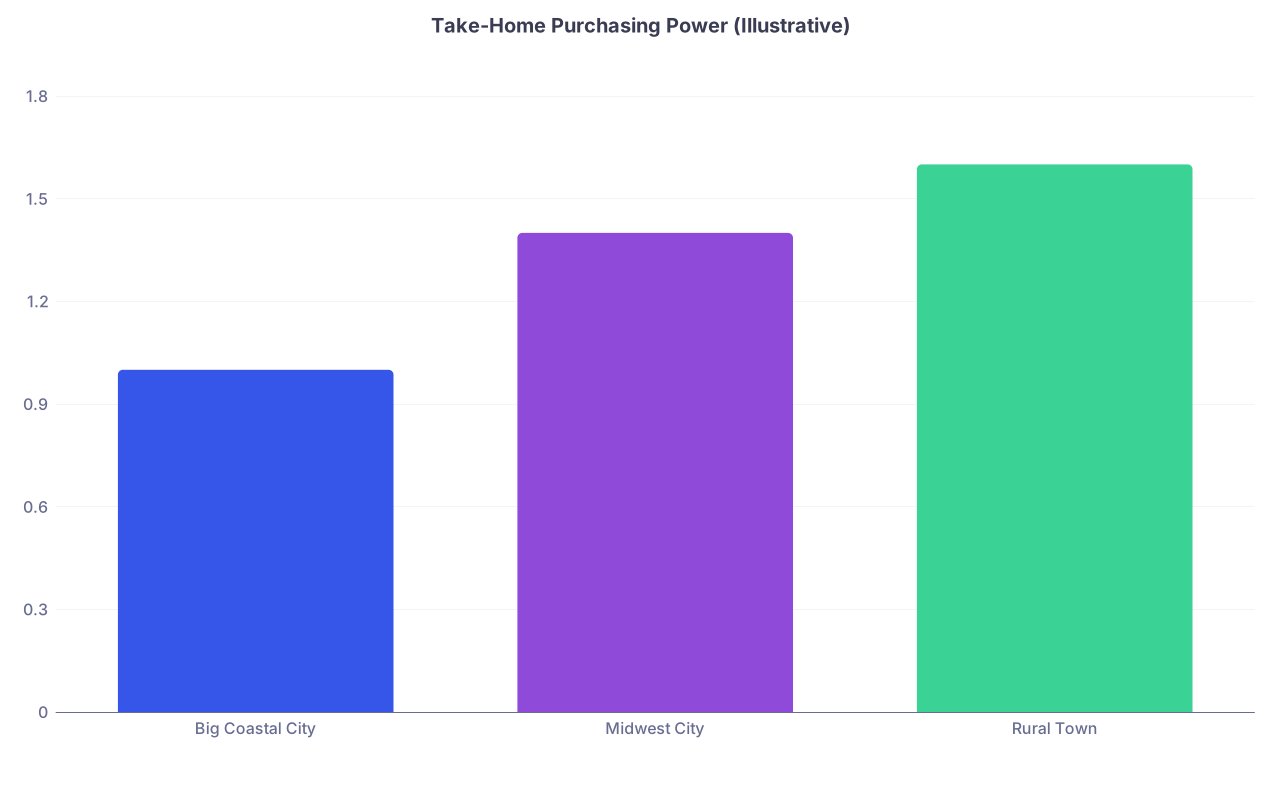
| Category | Value |
|---|---|
| Big Coastal City | 1 |
| Midwest City | 1.4 |
| Rural Town | 1.6 |
That’s a rough way of saying: the same nominal income stretches 40–60% further in certain markets. If your dream is a house, kids, and not stressing about every bill, chasing the “highest salary” in a brutal-cost city may be a bad move.
Residents get misled by national averages that don’t weight for location. Medscape will happily tell you “Specialty Y average = $420k.” That tells you nothing about whether you can afford a decent life in Seattle versus Des Moines.
4. Hours, Call, and RVUs: The Hidden Price of “High Pay”
There’s a cynical line I’ve heard from older attendings: “Any salary can look impressive if you divide it by zero hours of your life.”
The highest paid specialties—orthopedics, neurosurgery, cardiology, GI, radiology, anesthesiology—often come with:
- High call burdens
- Nights and weekends
- Pressure for high procedural volume
- High-stress situations and complication risk
Residents routinely misread compensation reports because they pretend those dollars are independent of the schedule.
Here’s the classic trap: comparing specialties or jobs by annual income, not by hourly or lifestyle cost. An overly simplified comparison:
| Job | Salary | Hours/Week | True Hourly (Before Taxes) |
|---|---|---|---|
| High-pay group | $600k | 70 | ~$165/hr |
| Moderate-pay job | $420k | 45 | ~$180/hr |
Residents see the $600k and stop reading. They don’t notice:
- 25 more hours a week
- More call
- Less vacation
- Higher burnout probability
And yes, this is before mental load, EMR misery, and administrative nonsense.
If you’re going into a high-paying specialty because of the numbers alone and you’re not thinking honestly about hours and call, you’re setting yourself up. The “highest paid” often means “highest extraction of your time and energy per year.”
5. Skimming Past Incentives, Bonuses, and Fine Print
Compensation reports often talk about:
- Average base salary
- Average bonus
- RVU thresholds
- Sign-on bonuses
Residents tend to see the top-line “total compensation” and ignore how fragile that total actually is.
Big red-flag errors:
Treating bonuses as guaranteed
“Average bonus $80,000” does not mean you’ll get $80,000. Many bonuses:- Depend on RVU production you may not hit for years
- Require staying a full year or more
- Are clawed back if you leave early
Ignoring ramp-up time
In some procedural specialties, you may need 1–3 years to build a patient base or referral network before you see full earning potential. Those rosy averages often come from fully ramped-up, established attendings. Not you on day one.Not understanding RVU math
I’ve watched residents sign contracts where the base looked fine but the RVU conversion rate or threshold was brutal. The comp report gave them false confidence: “My specialty average is $500k, so I’ll get there.” No, not if your group pays low per RVU and controls your schedule.
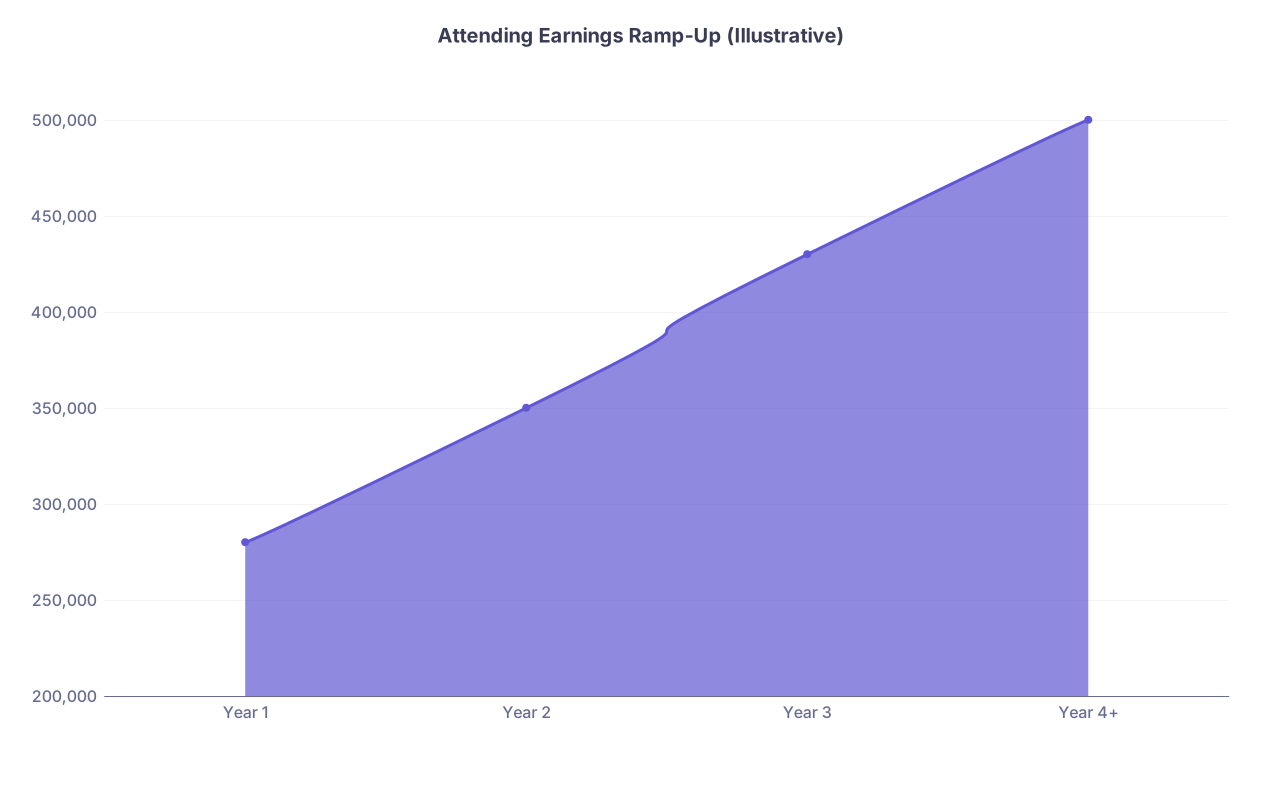
| Category | Value |
|---|---|
| Year 1 | 280000 |
| Year 2 | 350000 |
| Year 3 | 430000 |
| Year 4+ | 500000 |
If the compensation report you’re reading doesn’t show years in practice alongside income, you’re missing a crucial dimension.
6. Selection Bias: Who Actually Fills Out These Surveys?
Here’s an ugly secret almost no one mentions: most big compensation surveys are voluntary. That means they’re riddled with selection bias.
Who’s more likely to answer a compensation survey?
- Physicians proud of their income
- Those with something to prove
- Those heavily engaged with the platform (like Doximity users)
Who’s less likely?
- Burned-out docs too tired to click anything
- Underpaid physicians who are embarrassed or apathetic
- Older, semi-retired docs who don’t care about surveys
That doesn’t mean all numbers are fake. It means they’re skewed. Especially at the top.
I’ve seen residents obsess over a Doximity report that strongly reflects large coastal academic centers and high-brand-name institutions, then apply its numbers to some small-town private group job. Completely different world.
If you’re using a report:
- Look at how many respondents per specialty
- Check if they disclose practice setting, geography, years in practice
- Assume the data is optimistic, not conservative
If you treat the printed average as your expected floor, you’re setting yourself up for disappointment.
7. Confusing Potential With Probability
A sneaky psychological trap: you see the “top earners” in a specialty and quietly assume you’ll be one of them.
“I’ll be the ortho who owns a surgery center.”
“I’ll be the GI with massive endoscopy volume.”
“I’ll be the radiologist with telerad side gigs.”
Maybe. But not everyone is:
- Built for extreme volume
- Willing to work that many hours
- Comfortable with the business risk
- Lucky with timing and market dynamics
Compensation reports love to highlight the high end. Some even show “top 10% earning $800k+”. Residents read that and attach emotionally to those numbers, not the more realistic middle.
Be honest: are you the “max RVU at all costs” type, or are you working 60–70 hours a week in residency and already thinking, “I cannot do this forever”? If it’s the latter, basing your specialty choice on the upper-quartile compensation numbers is asking for regret.
8. Comparing Specialties Only by Money: A Fast Path to Misery
You’re reading this in a “highest paid specialties” context, so I’ll say the uncomfortable thing plainly: choosing between, say, derm, ortho, GI, rads, anesthesia, EM, or ENT based mostly on salary tables is a terrible idea.
Not because money doesn’t matter. It does. But because:
- The difference between $350k and $550k feels massive on paper and surprisingly small in real life once your basic life needs are met
- The difference between loving vs hating your day-to-day work is huge and permanent
- The risk of burnout skyrockets when you’re in a field you don’t enjoy, even if it pays well
Misreading compensation reports amplifies this bad decision-making. It pushes you toward what looks best “on average” without forcing you to confront:
- Do you actually like the patient population?
- Do you tolerate the procedures well?
- Are you okay with the malpractice environment?
- Can your body handle nights, call, lead aprons, or long cases?
I’ve watched residents chase “top-paying” fields they didn’t really like, rationalizing it with “I’ll just grind for 10 years then cut back.” Fast forward: many of them are stuck at 10 years, burned out, in golden handcuffs, still grinding.
Money can’t fix picking the wrong life.
9. How to Read Compensation Reports Without Getting Played
Enough doom. Here’s how to use these reports properly—without lying to yourself.

When you open a medscape, Doximity, or MGMA-style report:
Ignore the big, bold “average” at first.
Go straight to the breakdowns: setting, region, years in practice.Find the segment that matches the life you actually want.
If you love academics, focus on academic numbers. If you want part-time eventually, look for data on hours cut and associated pay.Look at regional spreads.
Don’t assume national numbers apply to your target city. High-paying rural surgery job ≠ big coastal academic surgery post.Ask about hours and call whenever you see a big number.
Either in the fine print or when talking to actual attendings. If no one knows the hours tied to the comp, the number is meaningless.Mentally downgrade the reported number by 10–20%.
As a sanity check for optimism and selection bias. If you’re still comfortable with the adjusted figure, you’re likely on safer ground.Cross-check with real people.
Residents make a major mistake here: trusting PDFs more than conversation. You need to talk to:- Recent grads from your program
- Attending mentors in the specialty
- Docs 3–7 years out (they remember the ramp-up phase)
Ask them what they make, what their partners make, and how many hours they work. That information will snap the compensation report back into perspective very quickly.
10. Smart Use for Residents Targeting High-Paying Specialties
If you’re specifically eyeing the “highest-paid specialties,” here’s how not to screw this up:

Use compensation reports to:
- Check that your field comfortably covers your financial obligations (loans, family, baseline lifestyle)
- Understand relative differences—e.g., ortho typically > general IM, GI typically > general surgery, etc.
- Learn which regions roughly pay more for your specialty
Do not use them to:
- Decide between two specialties you enjoy equally solely because “this one pays $60k more on average”
- Assume you will hit the reported top-decile incomes
- Justify a field you dislike because the salary looks seductive
And always anchor back to this: your career satisfaction will be driven mostly by:
- Fit with the work and patient population
- Culture of your group/hospital
- Schedule and autonomy
Compensation is critical, but it’s not a reliable tiebreaker unless you understand the fine print behind the numbers.
Visual Reality Check: Income vs Hours vs Happiness
Here’s the ugly triangle residents rarely see laid out clearly:

You can optimize for one corner aggressively, maybe two if you’re lucky. All three? Rare. Compensation reports overwhelmingly drag you toward the “Max Income” corner and quietly ignore what it cost those physicians to get there.
Do not let averages make that decision for you.

FAQs
1. How should I use compensation reports when choosing a specialty as a resident?
Use them as a rough, directional tool, not a promise. Focus on broad tiers (e.g., cognitive vs procedural vs surgical) rather than exact dollar values. Then filter by the lifestyle and practice setting you actually want: academic vs private vs employed vs ownership. Finally, confirm with real attendings in your target specialty and location to ground the numbers in reality.
2. Are certain compensation reports (Medscape, Doximity, MGMA) more reliable than others for residents?
They each have flaws. MGMA is often used by administrators and may be more granular but is frequently paywalled and can skew toward large groups. Medscape and Doximity are voluntary and carry selection bias. The mistake is treating any of them as gospel. The most reliable approach is to cross-reference at least two major reports and then validate with actual physicians in your desired setting and region.
3. How much weight should I give to “highest paid specialties” lists?
Very little on their own. Those lists are good for one thing: reminding you which specialties tend to be in the upper earning tier (ortho, neurosurg, GI, IR, radiology, anesthesia, etc.). They are terrible at describing what your life and income will look like in those fields, especially early in your career, in your chosen location, and with your desired schedule.
4. What’s the biggest financial mistake residents make when reading compensation data?
Assuming the average equals their future income and then building financial plans and expectations around that number. Residents overestimate early-career income, underestimate ramp-up time, and forget to adjust for call, hours, and cost of living. That combination leads to bad specialty choices, overborrowing, and lifestyle creep that feels justified because “my specialty average is $X.”
5. If I care a lot about money, what’s the safest way to think about specialty choice?
First, eliminate fields you know you would hate, even if they pay well—that’s non-negotiable. Among the remaining options you genuinely like, look at compensation reports by setting and region, sanity-check the numbers with attendings 3–10 years out, and mentally plan based on conservative (median-ish or slightly below) early-career figures, not maxed-out partner incomes. Protect your downside first; the upside will take care of itself if you’re good, reliable, and willing to work.