
It’s 3:40 a.m. You’re a PGY-3 in ortho, staring at a pager that will not shut up, charting on your seventh add-on case of the day. The intern is texting you X-rays from the ED. Your co-resident just bragged about their future spine salary, and you’re thinking, “I’m not sure that number is high enough to make this worth it.”
If you’re drifting toward ortho, neurosurgery, derm, plastics, ENT, IR, gas, or another top-earning specialty, you’re not just chasing a paycheck. You’re walking into a burnout minefield that looks nothing like primary care burnout. The traps are different. The psychology is different. And the fall can be brutal.
Let’s walk through the mistakes that chew people up in the highest paid specialties—and how you can sidestep them before you’re the attending sobbing in the call room at 2 a.m., Googling “non-clinical jobs for burned out surgeons.”
1. Confusing “High Income” With “High Control”
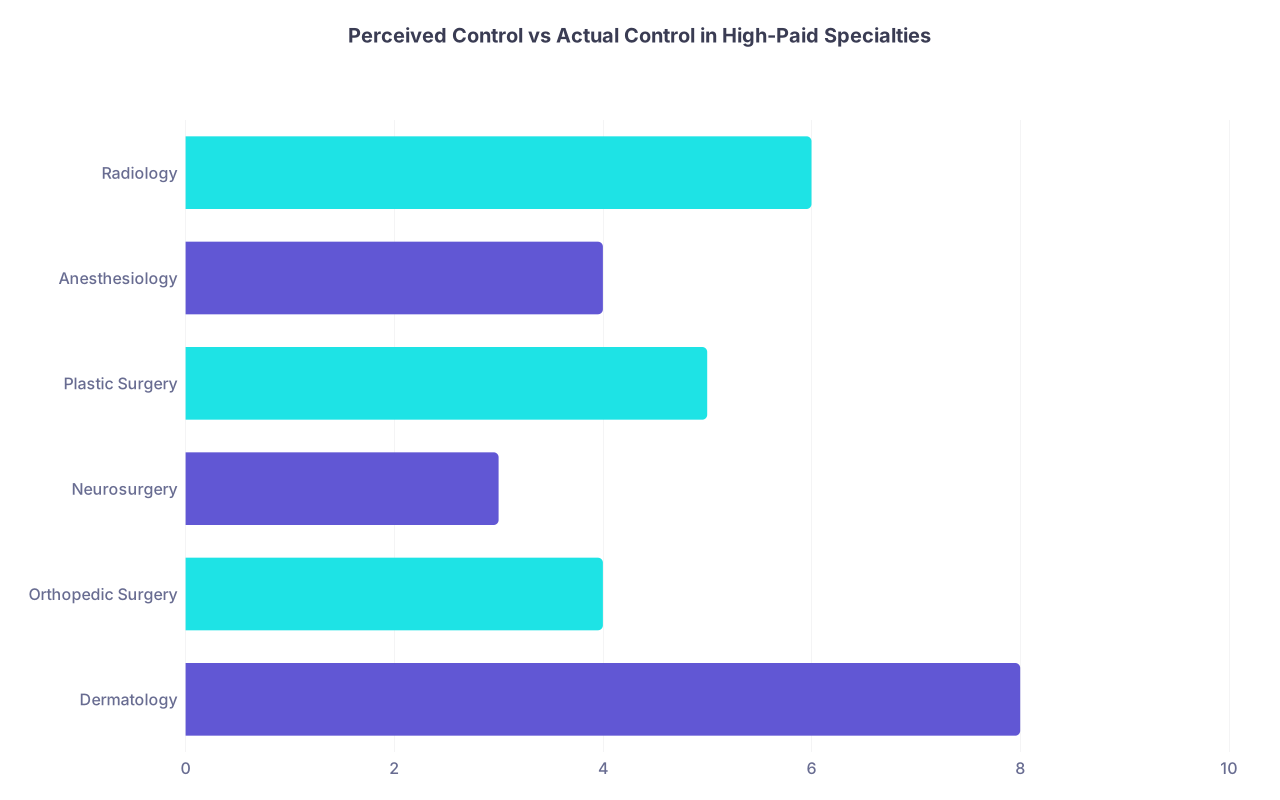
| Category | Value |
|---|---|
| Dermatology | 8 |
| Orthopedic Surgery | 4 |
| Neurosurgery | 3 |
| Plastic Surgery | 5 |
| Anesthesiology | 4 |
| Radiology | 6 |
Here’s the first big lie: “If I pick a high-paying specialty, I’ll have more control over my life.”
No. You’ll have more leverage eventually. But in the early and mid-career years, a lot of the highest paid fields are factories of low control, high responsibility, and high stakes.
Where this bites:
- Ortho/Neurosurg: Trauma pages run your life. Nights, weekends, holidays. Sick spine at 2 a.m. does not care that you planned a vacation.
- Anesthesia: Case start times, surgeon delays, emergency add-ons. You’re “needed” whenever the OR wheels something in.
- IR: “Stat” bleeds, middle-of-the-night thrombectomies, emergent lines. You’re the fire department.
- Derm/Plastics: Ironically, the “controllable lifestyle” ones are often jam-packed with insane clinic volumes, cosmetics schedules, and needy patients.
The mistake: assuming the high salary will automatically translate into freedom—and then feeling trapped when you realize your day is dictated by OR schedules, call pools, and the sickest patients in the hospital.
How to avoid it:
- During rotations, track your actual control:
- How often are days done anywhere near on time?
- How often do attendings have to cancel personal plans?
- How frequently does call genuinely blow up their lives?
- Ask blunt questions:
- “How often do you say no to an add-on case?”
- “When was the last time you canceled a family thing for work?”
- “What could you realistically change about your schedule if you wanted to?”
- Do not pick a specialty assuming future-you will magically have boundaries if current-you has none.
Control is a habit you build, not a gift the specialty hands you.
2. Chasing “Top of the Top” Subspecialties and Locking Yourself into Misery

In the high-paid world, the prestige trap is brutal:
- Ortho → spine, joints, sports
- Neurosurg → spine, skull base, functional
- Derm → cosmetics, Mohs
- Plastics → micro, aesthetics
- IR → neuroIR, complex interventions
Residents watch fellowship-trained attendings quote their RVU numbers and Ferrari payments and think, “If I don’t do that, I’m wasting my potential.”
The burnout trap: you commit early to the most intense, call-heavy, litigation-risky, or patient-demand-heavy niche because of money and status. Then one day you’re 42, on your 4th divorce, dreading the next complication review.
Common disasters I’ve seen:
- The ortho resident who hates the OR but forces themselves into joints “for the money,” then is miserable every single OR day.
- The derm resident who thrives in medical derm but feels like a failure if they’re not doing cosmetics 4 days a week—and burns out on demanding aesthetics patients they secretly resent.
- The plastics fellow who realizes they like bread-and-butter recon, not high-maintenance cosmetic clientele, but feels “locked in” by reputation.
How you avoid this:
- In residency, pay attention to your energy, not prestige:
- Which days go by fast?
- After which clinics/cases do you feel less dead?
- Which patients drain you vs. which are merely tiring?
- Do test drives:
- Electives with different subspecialists, not just the “rock stars.”
- Spend time in community settings, not only academic Ivy towers.
- Stop using “I’d be leaving money on the table” as an excuse. You will make plenty as a general ortho, general derm, bread-and-butter anesthesiologist. Burning out at 45 is the most expensive mistake.
3. Using Money to Justify Anything (Classic Golden Handcuffs)
You will hear versions of this constantly:
“It sucks now, but look at what I’ll be making.” “Once I’m an attending, I’ll work less.” “I can do anything for 5 years.”
That script is how people wake up one day:
- $900k in debt (loans + house + private school + lifestyle)
- Locked into a job they hate because the payment structure requires insane RVUs
- Terrified to cut back because the whole financial house of cards collapses
The highest paid specialties are uniquely vulnerable to golden handcuffs because:
- Recruiters dangle massive bonuses in exchange for abusive call.
- Private groups sell you on partnership that’s actually a lifetime of RVU grind.
- Your peer group normalizes absurd lifestyle inflation.
| Specialty | Trap Contract Feature |
|---|---|
| Orthopedics | Heavy trauma call for bonus |
| Neurosurgery | 1-in-2 or 1-in-3 call "temporarily" |
| Anesthesia | Guaranteed income tied to 1.3+ FTE workload |
| Dermatology | High-volume cosmetic quotas |
| IR | Unlimited call with “stipends” |
Mistakes that destroy you:
- Signing a first job where “guaranteed comp” is tied to unsustainable volume.
- Buying the expensive house/car in year 1 because “I deserve it.”
- Assuming you’ll just work more now and throttle down later. Later rarely comes.
What to do differently:
- In residency, build the habit of saying no somewhere. If you can’t say no as a resident to extra coverage, you’re unlikely to grow a spine suddenly when partnership is dangling in front of you.
- In contract talks, assume:
- Call will expand, not shrink.
- Volume expectations will creep up.
- Admin will not protect your time for free.
- Keep fixed expenses low for the first 3–5 years:
- Smaller house than you can “afford.”
- No luxury cars on day one.
- Actually pay down debt before inflating lifestyle.
It is far easier to avoid handcuffs than to saw them off later.
4. Underestimating the Emotional Load of High-Stakes Work
People think high-paid specialties are all procedures and no feelings. That’s not how it plays out.
You know what crushes people in these specialties?
- Orthopedics: The 24-year-old with a mangled limb you can’t fully fix.
- Neurosurg: The post-op bleed or devastating complication, even when you did everything “right.”
- Anesthesia: The one intra-op arrest you replay in your head for months.
- IR: The massive PE you couldn’t save at 3 a.m.
- Derm/Plastics: The body dysmorphia, the impossible cosmetic expectations, the patients who want you to fix their entire identity.
You’re not just doing procedures. You’re carrying:
- Catastrophic outcomes
- High litigation risk
- Intense patient expectations (“You’re the best, you have to fix this”)
The mistake is pretending you’re immune. Telling yourself you’re “not psych, so it’s fine.” Then becoming numb, cynical, or bitter when the cases start stacking up.
How to avoid that slide:
- Stop buying into the “I’m a proceduralist; I don’t do emotions” persona. You’re still human, even if your culture pretends otherwise.
- Create outlets early:
- A real therapist, not just complaining in the workroom.
- Peer debriefs after bad outcomes—scheduled and normalized.
- Watch your own red flags:
- You start rooting for cancellations more than you care to admit.
- You fantasize about quitting after every bad case.
- You catch yourself talking about patients as problems, not people.
You don’t get bonus points for pretending this stuff doesn’t affect you. You just get burned out faster.
5. Falling into the “Always On” OR/Hospital Culture

| Step | Description |
|---|---|
| Step 1 | Intern eager to impress |
| Step 2 | Always say yes to add-ons |
| Step 3 | Normalize 14 hr days |
| Step 4 | Take pride in never leaving |
| Step 5 | Resent colleagues with boundaries |
| Step 6 | Chronic exhaustion |
| Step 7 | Burnout and cynicism |
In high-paid procedural specialties, the culture around work hours is warped.
Here’s how it usually looks:
- You’re praised for:
- Staying late.
- Adding extra cases.
- Picking up call.
- “Helping out” beyond any reasonable expectation.
- You’re quietly punished for:
- Protecting your post-call day.
- Refusing extra cases tacked on.
- Leaving on time.
Top-paid specialties often have strong “cowboy” or “grinder” cultures. People confuse endurance with excellence. The person who stays until 11 p.m. is “dedicated.” The one who leaves on time is “soft.”
The mistake: you internalize that your value = how much you sacrifice.
This becomes dangerous when you hit attendinghood, because:
- The RVU model will reward your worst tendencies.
- Admin will fill any space you don’t fiercely protect.
- Burnout hides better when it comes with a big paycheck.
What to do:
- During training, practice being excellent within boundaries:
- Do your job well, but don’t volunteer for every extra case “to look good.”
- Leave when you’re allowed to leave. Stop lingering to prove a point.
- Say, “I can do X, but not Y” when asked to take on more.
- Watch how attendings model their life:
- The one who works 7 days a week may be “admired,” but are they happy? Married? Healthy?
- Seek out attendings who are respected and have a life outside the hospital.
Do not absorb the lesson that exhaustion is noble. That’s how you become the bitter, overpaid, half-broken 50-year-old who scares the interns.
6. Ignoring How Much You Actually Hate Certain Patient Populations
This one sounds harsh, but pretending otherwise is how careers implode.
Each high-paid specialty has “difficult” patterns baked in:
- Derm: Cosmetic patients with unrealistic expectations, endless “I saw this on Instagram” requests.
- Plastics: Body dysmorphia, marital dynamics, social media amplification of everything you do.
- Ortho sports: Entitled athletes, over-involved parents, everyone wants a 2-week return to play after ligament reconstruction.
- Spine: Chronic pain, secondary gain, disability paperwork, litigation, complex psychosocial overlays.
- ENT: Tons of “my life is ruined by minor symptom X” with high anxiety.
- IR/Neurosurg: Families in absolute crisis, demanding certainty when there is none.
The mistake: telling yourself you “don’t mind it that much” just because the RVUs are good.
Multiply “don’t mind it that much” by 20–30 encounters per day, 4–5 days a week, for 25 years. That’s how you get real burnout.
How to avoid self-sabotage:
- During rotations, be brutally honest:
- Did that clinic feel like emotional sandpaper?
- Did you find yourself hating the type of complaints that are central to that field?
- Don’t romanticize away your reactions. If you’re chronically irritated by cosmetic demands now, more money won’t make that go away.
- Watch mentors:
- Happy long-term attendings often like their core patient population.
- Miserable ones are usually at war with their own clinic.
If you cannot stand the core emotional flavor of a specialty, I don’t care how high the salary is. You will pay for it with your mental health.
7. Assuming Technology Will Save You From Burnout (It Won’t)
High-income specialties are tech-heavy, which creates a dangerous illusion: “The cooler my tools, the better my life.”
Reality:
- New tech means:
- Steep learning curves
- Marketing pressure to adopt “cutting edge” everything
- Higher expectations from patients and admins
- You get:
- Constant updates & maintenance headaches
- Training obligations for staff and partners
- Pressure to expand indications to “pay for” the device (yes, it happens)
Neurosurg, IR, plastics, derm lasers, robotic ortho—all prime zones for this trap.
Mistake patterns:
- Joining a group that defines itself by owning the fanciest toys, then being trapped in an endless cycle of “we have to keep doing more to justify this.”
- Building your identity around being The Tech Person, then feeling obsolete or exhausted trying to keep up.
Better approach:
- Choose tech as a tool, not your personality.
- Ask future groups:
- Who decides when tech is adopted?
- How is training time protected?
- How do you avoid inappropriate overuse driven by cost recovery?
- Protect your bandwidth. Every new device/robot/laser is also a new way for your schedule to get hijacked.
8. Downplaying Physical Wear and Tear
You’re not just risking mental burnout. In the most lucrative hands-on specialties, your body is on the clock too.
- Ortho: Shoulders, neck, back, hands. Lead aprons. Heavy retractors. Awkward positions for hours.
- Neurosurg: Long cases, microscopes, fixed posture, high precision under fatigue.
- IR: Standing in lead all day, repeated procedures, high radiation exposure.
- Anesthesia: “Less physical,” but constant standing, awkward positioning, moving patients, plus chronic sleep disruption from call.
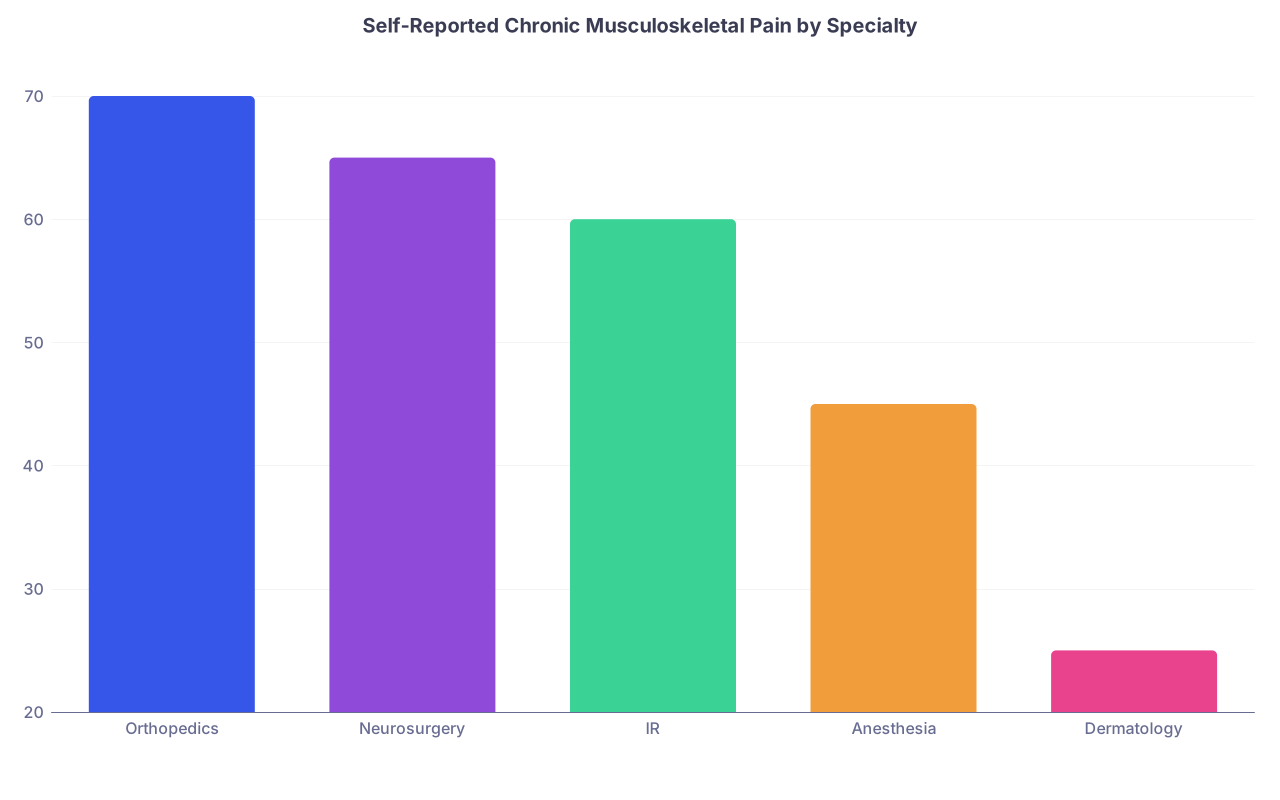
| Category | Value |
|---|---|
| Orthopedics | 70 |
| Neurosurgery | 65 |
| IR | 60 |
| Anesthesia | 45 |
| Dermatology | 25 |
Mistake: pretending you’re 25 forever and that physical burnout “won’t be me.”
I’ve seen:
- 50-year-old spine surgeons cutting clinical volume because of back surgery.
- IR docs actively avoiding certain cases due to lead fatigue.
- Ortho surgeons popping NSAIDs like candy to get through routine days.
Protect yourself early:
- Ergonomics is not optional:
- Speak up about table height, microscope setup, C-arm positioning.
- Learn proper body mechanics like you’d teach an athlete.
- Exercise is not “nice to have” for you; it’s job preservation.
- Consider longevity when choosing subspecialty:
- Does this rely on brute strength or static awkward positions?
- What’s the average age surgeons in this niche retire from OR work?
You don’t want to hit peak earning years just as your body taps out.
9. Letting Identity Fuse Completely With Being “High-Earning Doctor”
Burnout in high-paid specialties often ends up existential, not just “I’m tired.”
Here’s the pattern:
- You pick a shiny, highly-paid field.
- You sacrifice a decade-plus to get there.
- Everyone around you knows you as “the neurosurgeon” or “the plastic surgeon.”
- Your self-worth fuses with being:
- Important
- Needed
- Highly paid
Then any of this happens:
- A complication.
- A lawsuit.
- A health issue that limits your operating.
- A shift in the market.
- You just… stop loving it.
If your entire identity is that specialty + that income, losing enthusiasm feels like losing yourself. That’s next-level burnout.
Don’t make that mistake.
- Build other identities early:
- Mentor
- Parent/partner/friend
- Athlete, musician, writer, whatever
- Keep people in your life who don’t care what your RVU totals are.
- Practice saying, “I’m a person who happens to do [specialty],” not “I am [specialty].”
You will change over 20–30 years. Let your career be part of that, not a prison.
10. Red Flags in Training That Predict Burnout Later
Here’s the uncomfortable truth: most future burnout stories have warning signs in residency. People just ignore them.
Watch for these in yourself during high-paid specialty training:
- You’re already fantasizing about quitting medicine.
- You feel intense envy or rage toward peers in “easier” fields.
- You’re using money fantasies to self-soothe constantly (“Once I’m making X, it’ll be fine”).
- You feel trapped, like you “can’t” switch because you’ve “already invested too much.”
If that’s you, listen carefully: staying in a specialty you already hate because of sunk cost is one of the worst career mistakes you can make.
Don’t double down into burnout just because the paycheck looks big on paper.
Key Takeaways
- High income does not protect you from burnout; it often masks it and straps golden handcuffs on top.
- Be brutally honest about what you actually enjoy—patient type, workflow, physical demands, emotional load—not just what’s prestigious or lucrative.
- Start now with boundaries, financial sanity, and a broader identity than “high-earning doctor,” or you’ll pay for those shortcuts with a very expensive, very painful burnout later.