
Most residents chasing spine think “RVUs = money.” That is incomplete, and in some cases, flat‑out wrong. Call, trauma exposure, and case mix are what actually move spine surgery compensation into the top tier.
Let me break this down specifically, the way your fellowship director talks about it behind closed doors, not the way glossy salary surveys pretend it works.
The Real Drivers of Spine Surgery Income
Spine compensation lives at the intersection of three levers:
- How much urgent / emergent pathology you control (call + trauma).
- How complex and instrumentation‑heavy your case mix is.
- How your pay structure treats those two factors.
If you ignore any one of these, you will misread why one spine surgeon makes $650k working 50 hours a week while another makes $1.5M grinding 80+ hours with a pager that never dies.
Spine is RVU‑rich… but only if the right cases show up
A single multilevel instrumented fusion can generate more RVUs than an entire half‑day general ortho clinic. But spine is also bimodal:
- Low RVU: simple lumbar decompressions, microdiscectomies, non‑op neck/back pain, postop follow‑ups, “MRI says bulge” clinic visits.
- High RVU: multilevel fusions, deformity corrections, revision instrumentation, vertebral column resections, tumor resections with recon, complex cervical recon.
Who gets which? The answer is not “who is the best surgeon.” It is:
- Who owns hospital call.
- Who is embedded in the trauma system.
- Who gets first crack at transfers and red‑flag emergencies.
That is what residents and fellows usually underestimate.
Call: Your Most Undervalued Money Machine
Call is the spine surgeon’s tax and their biggest opportunity. Both things are true.
On paper, call “pay” looks bad. A lot of private hospitals: $1,000–$2,500 per 24 hours of spine call, some academic centers: essentially $0 “just part of your job.” But the stipend is not the point. The real money is in the cases that call generates.
Let’s separate reality into three spine practice archetypes.
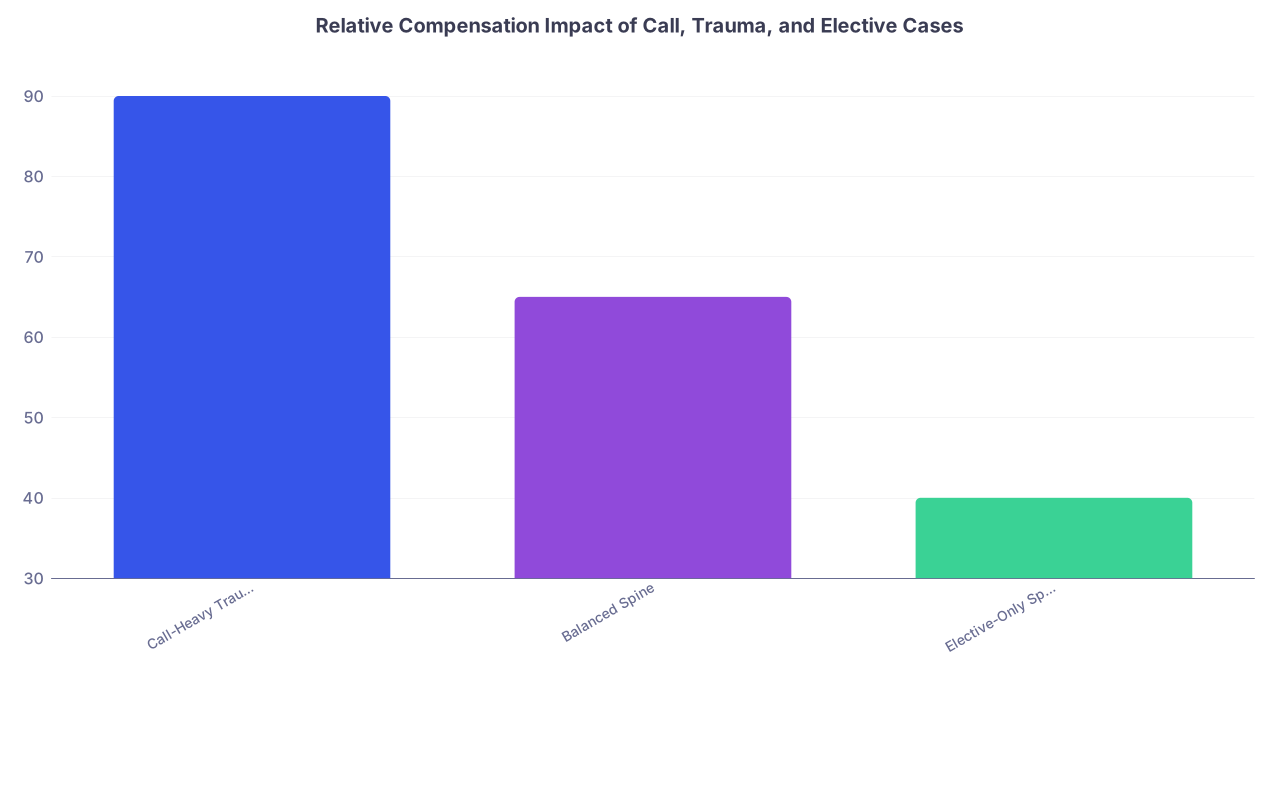
| Category | Value |
|---|---|
| Call-Heavy Trauma Spine | 90 |
| Balanced Spine | 65 |
| Elective-Only Spine | 40 |
1. Call‑heavy community spine (the “pager life”)
These surgeons cover:
- All spine trauma (falls, MVAs, gunshots, work injuries).
- Cord compression transfers from smaller hospitals.
- Epidural abscess, cauda equina, postoperative disasters from others.
Typical pattern:
- Call 1:3 to 1:5.
- High nighttime and weekend volume.
- Mix of ortho and neurosurgery sharing a pooled call schedule, or one group owning all spine.
Income reality:
- Base income: modest guarantee (say $400k–$600k).
- Real income: elective + emergent OR, especially multilevel cervical and thoracolumbar fusions, fracture instrumentation, revisions.
- Those 2 a.m. C6–7 fracture dislocations, T12 burst fusions, and L4–5 decompression + fusion for cauda equina are where the extra $300k–$800k appears.
The trap: If the group or hospital pays nothing extra for call and you do not capture the downstream OR work (e.g., hospitalists or a “spine service line” send big cases elsewhere), then you just bought yourself sleepless nights for free.
2. Balanced call (the “rational” spine job)
This is what many residents think they want but rarely structure deliberately:
- Call 1:4 to 1:7.
- Mix of routine consults, some trauma, a modest number of true emergencies.
- Beam in a few high‑value cases each month, but your life is not defined by midnight decompressions.
Often seen in:
- Strong private practice ortho groups with dedicated spine call stipends.
- Medium‑sized cities where spine volume is moderate but not level‑1 trauma‑level chaos.
- Academic departments with more evenly distributed call and fellows taking first hit.
Income pattern:
- Good base (mid to upper $600k–$900k).
- Annual total pushing $900k–$1.2M if the mix includes a couple of good trauma runs per month plus a healthy elective schedule.
This is where call truly “supplements” rather than dominates your life.
3. Elective‑heavy / minimal call (the “I’m done with 3 a.m.” model)
Think suburban or exurban practice with:
- Low trauma burden.
- Mostly degenerative lumbar and cervical disease.
- Voluntary call or rare ED consults.
Call 1:8 or less, or hospitalist/other group absorbing most emergencies.
Here, your income ceiling is determined by:
- How many elective OR days you control.
- Payer mix (commercial vs Medicare vs Medicaid vs workers’ comp).
- How efficient your team is (turnover times, block utilization).
You can still break $1M, but it is built on stacked elective cases, not on harnessing trauma. Surgeons in this bucket often choose lifestyle over maximal upside, or they earn on the higher end because they run an absurdly efficient elective machine.
Trauma: The Hidden Accelerator of Spine Pay
Trauma is a multiplier. It turns mediocre contracts into good ones and good contracts into obscene ones. It also burns people out. Both are true.

Why trauma cases print RVUs
Look at the pattern:
- Thoracolumbar burst fracture with canal compromise.
- Cervical flexion‑distraction injury.
- Chance fracture requiring long‑segment fixation.
These almost always require:
- Instrumentation (hardware = higher RVUs).
- Multiple levels.
- Combined decompression + fusion work.
Add in:
- Pre‑op imaging reads.
- Post‑op ICU and floor visits.
- 90‑day global period bundled with multiple follow‑ups.
Each trauma run is not one billable event. It is a cascade. The RVUs stack.
Trauma center level and your income ceiling
Your hospital’s trauma designation directly influences your top end.
| Trauma Level | Typical Spine Call Volume | Compensation Ceiling Trend |
|---|---|---|
| Level I | Very high trauma + transfers | Highest, often $1.2M–$2.0M+ |
| Level II | High local trauma | High, $900k–$1.5M |
| Level III | Moderate, selected trauma | Mid, $700k–$1.1M |
| No Trauma | Minimal, mostly degenerative | Lower upside, $600k–$900k |
Residents rarely ask this during job interviews, but they should. I have seen two jobs with the same base salary ($550k vs $575k) where the Level I trauma center surgeon ended up at $1.5M and the non‑trauma center surgeon plateaued at $750k. Exact same training. Different trauma environment. Completely different outcomes.
The transfer game
Big money often rides on something simple:
Who gets the transfer calls from regional hospitals?
If your name or your group is the automatic “transfer spine” answer for every OSH within a 2‑hour radius, your case volume and complexity will skyrocket:
- Neglected burst fractures needing complex recon.
- Late‑presenting epidural abscess with severe deficits.
- Failed fusions from smaller centers needing revision instrumentation.
The hospital benefits from high‑acuity admissions, ICU stays, and OR time. You benefit from huge RVU bundles. If that transfer stream is shared with a competing neurosurgery group or sent to a tertiary academic center 3 hours away, your upside collapses.
Case Mix: Degenerative vs Deformity vs Trauma vs “Garbage”
All RVUs are not created equal. Four spine surgeons seeing “20 patients” in clinic can be effectively in four different specialties from a compensation standpoint.
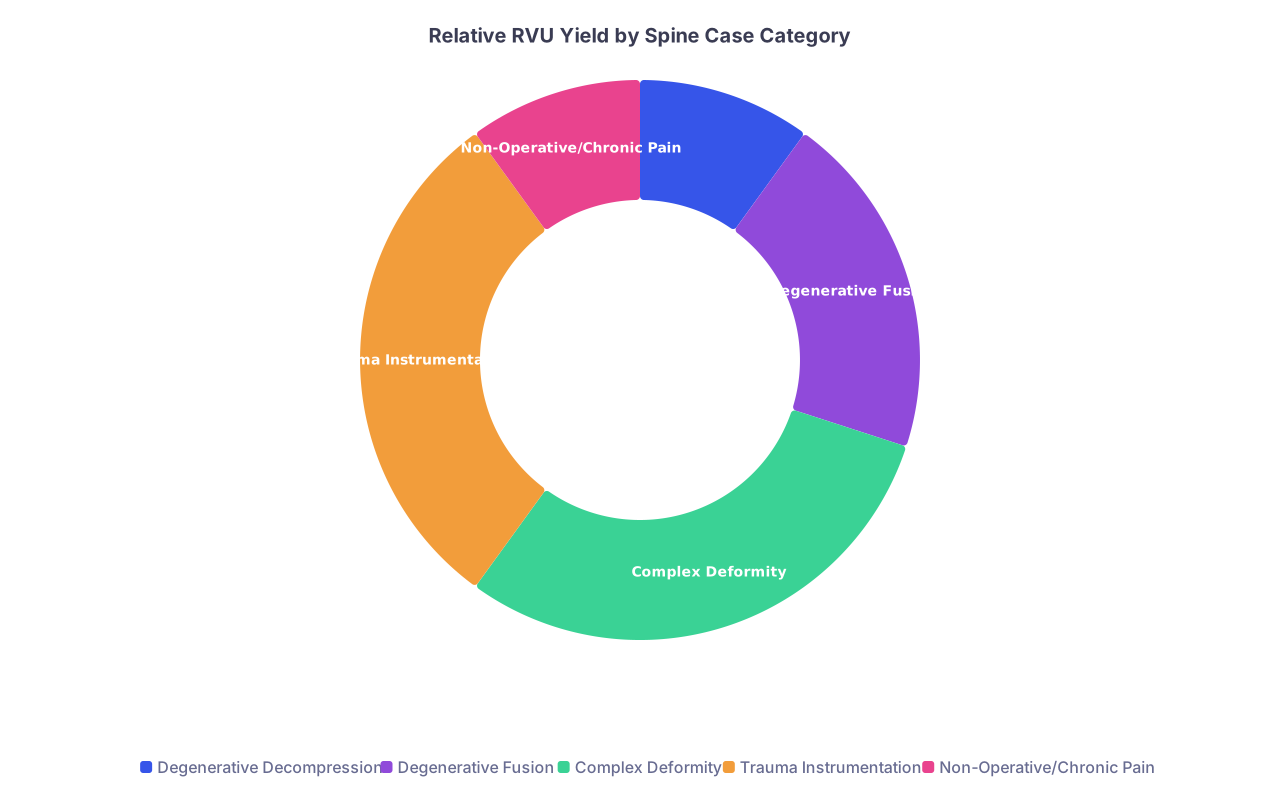
| Category | Value |
|---|---|
| Degenerative Decompression | 10 |
| Degenerative Fusion | 20 |
| Complex Deformity | 30 |
| Trauma Instrumentation | 30 |
| Non-Operative/Chronic Pain | 10 |
1. Bread‑and‑butter degenerative spine
Examples:
- Single‑level lumbar laminectomy.
- Microdiscectomy.
- Single‑level ACDF.
These are fine. Reliable. Predictable. But they have a ceiling.
If your panel is predominantly:
- Nonoperative neck/back pain.
- Single‑level decompressions.
- Occasional single‑level fusion.
You will make a good income, but you will not touch the upper stratosphere unless you have insane volume and perfect infrastructure.
Signs you are heading into “bread‑and‑butter only” land:
- EMG and MRI reports in clinic all day; few real neurologic deficits.
- Almost all referrals from primary care, very few from trauma service or oncology.
- Case board full of “L4–5 laminectomy” rather than multilevel recon.
2. Degenerative fusions and revisions
This is where the compensation curve starts bending upward:
- Multilevel lumbar fusions for instability.
- Cervical multilevel ACDFs or posterior cervical fusions.
- Revision fusions, pseudarthrosis fixes, hardware failures.
Why they pay more:
- Higher CPT complexity.
- More instrumentation.
- Longer OR times, more follow‑up, more post‑op care.
Surgeons with a strong base of degenerative fusions plus a modest trickle of trauma and tumor already sit in the upper quartile of spine income distributions.
3. Deformity and complex recon
Adult spinal deformity, large scoli corrections, kyphosis recon, sagittal balance surgeries. This is the deep end:
- Long segment instrumentation.
- Multiple osteotomies.
- High complication risk.
- High ICU usage.
Compensation: enormous RVU density per case.
Reality check: This is not a volume game for most surgeons. It is a niche within a niche, typically a couple of surgeons in a region, often academically connected, sometimes with national referral patterns.
But if you work in a center where these cases are routine and you are one of the few capable and credentialed to do them, your income potential is obvious. You might operate fewer days but on giant cases that are basically RVU bombs.
4. The “garbage” spine work that eats your life
Every spine surgeon gets stuck with some clinic sludge:
- Chronic nonspecific back pain.
- Widespread pain syndromes, high opioid dependence.
- “My MRI says I have three herniated discs” with minimal correlation to symptoms.
- Post‑op patients from other centers “dumped” after complication.
You cannot escape this entirely. But if your practice composition is 60–70 percent of this, forget top‑tier compensation. You will drown in low‑yield clinic.
Residents need to watch what their attendings’ actual clinic schedules look like, not just what goes to the OR. The red flag is not “I saw 40 patients.” It is “I saw 40 patients and had 2 small cases added for next month.”
How Contracts Translate Call and Cases Into Cash
If you do not understand the compensation model, you will misjudge what call and trauma are actually worth.
| Model Type | Where You See It | Key Risk/Reward Feature |
|---|---|---|
| Straight Salary | Academics, VA | Stable, weak linkage to call |
| Base + RVU Bonus | Hospital-employed | Strong link to case volume |
| Pure Eat-What-You-Kill | Private practice | Max upside, max volatility |
| Partnership Track | Large ortho groups | Adds ancillary profit sharing |
1. Academic spine: prestige, teaching, muted upside
Academic spine surgeons talk about R01s and h‑indices more than about transfer agreements. Compensation structure:
- Fixed salary based loosely on rank (Assistant / Associate / Full).
- Modest productivity component, often with RVU targets that do not fully match market rates.
- Call considered part of your expected duties, not aggressively compensated as a separate line item.
Where call and trauma matter academically:
- Cornerstone role in maintaining Level I trauma verification.
- Leverage for departmental negotiations (“Spine call is killing us; we need support”).
- But often not a 1:1 dollar translator into your personal paycheck.
Income range is wide, but even high‑octane academic deformity surgeons often earn significantly less than their community counterparts working similar hours.
2. Hospital‑employed: the RVU treadmill
This is where call and trauma can be weaponized for or against you.
Common pattern:
- Base salary $500k–$800k.
- RVU threshold (say 10,000–12,000 wRVUs).
- Per‑RVU payout above threshold ($50–$80/wRVU, sometimes higher, sometimes with tiering).
Call and trauma help you:
- Hit threshold faster.
- Blast past it with high RVU cases.
- Justify renegotiation (“I produced 20,000 wRVUs last year; this rate is outdated”).
But watch the fine print:
- Does call pay exist beyond RVU? Or is it “baked in”?
- Is there a cap? Some systems quietly cap bonuses, blunting your upside.
- How is block time allocated? No OR time = no conversion of call into income.
3. Private practice: spine as the group’s profit engine
In a multi‑specialty ortho group, the spine surgeons are often the financial engine. You see this dynamic:
- Spine brings in high RVUs and big technical fees.
- Joint guys bring in predictable arthroplasty income.
- Sports brings scope volume and clinic flow.
Revenue stream in private spine:
- Professional fees (your surgeon fees).
- Technical fees, if you own or co‑own an ASC (huge for elective lumbar and cervical work).
- Ancillary revenue: imaging, PT, injection suites.
Where call and trauma slot in:
- Hospitals often pay a stipend to have a spine surgeon on call.
- The group may collect and distribute the stipend, not the individual surgeon.
- The trauma cases themselves generate RVUs and hospital goodwill, which translate into better contract renewals, block times, and referral steering.
But if you are junior, here is the ugly truth: you might take a disproportionate share of call and garbage cases to “earn your place” while senior partners skim the best elective referrals and ASC days. You should ask very specific questions about how trauma call, transfer volume, and elective referrals are allocated among partners vs associates.
What Residents and Fellows Actually Need to Watch For
You do not shape your entire compensation future during residency. But you can at least stop walking into bad deals blindly.

| Step | Description |
|---|---|
| Step 1 | Job Offer |
| Step 2 | High Trauma Potential |
| Step 3 | Low Trauma Potential |
| Step 4 | High Volume Upside |
| Step 5 | Shared or Limited Volume |
| Step 6 | Link Income to Cases |
| Step 7 | Limited Upside |
| Step 8 | Trauma Level |
| Step 9 | Who Owns Transfers |
| Step 10 | Comp Model |
When you evaluate a spine job, stop asking only: “What is the base salary?” Start asking:
- What is the trauma level of the hospital, and how many spine trauma cases per month last year?
- Who gets the transfers from smaller regional hospitals?
- What is the spine call schedule? Is it shared with neurosurgery? Any plans to recruit more people?
- Is there a separate call stipend, or is it folded into base pay? If a stipend, who gets it—me or the group?
- How many OR block days will I have in year 1, and are they full days or half‑days?
- What percentage of current spine cases are:
- Simple decompressions
- 1–2 level fusions
- 3+ level fusions / deformity
- Trauma instrumentations
- For hospital‑employed positions:
- What were the last year’s RVUs for your current spine surgeons?
- At what RVU level did they hit bonus, and what did they actually collect in total compensation?
You are trying to see the shape of the practice, not just the starting number on your contract.
How This Feels Day‑to‑Day in Residency and Fellowship
Let me ground this in scenarios you have probably seen:
The “trauma workhorse” attending:
- Always on call.
- Operates late into the night.
- Has a steady stream of cervical fractures, burst fractures, urgent decompressions.
- Drives a car your attending salary could not buy in ten years.
- Complains constantly about lifestyle, but never leaves because the numbers are too good.
The “clinic swamp” attending:
- Endless clinic backlogs.
- Fifty‑patient days filled with diffuse pain and imaging reviews.
- Operative schedule dominated by 1‑level decompressions with the occasional 1–2 level fusion.
- Makes a good living, but nowhere near the first guy, and resents administration more than call.
The “deformity guru”:
- Operates 2–3 days a week.
- Each case is 8–14 hours, multi‑segment, high stakes.
- Academic presence, national talks, complex referral base.
- Either underpaid compared to their community value (if academic) or incredibly well‑compensated (if hybrid or private).
As a resident, you should be watching:
- Who takes what call.
- Who gets first pick of trauma and transfers.
- How cases are distributed between neurosurgery and ortho.
- How attendings talk about their bonuses, not just their base.
Lifestyle vs Compensation: You Do Not Get Both at Max Settings
You can absolutely make $800k–$1M+ as a spine surgeon with a reasonable schedule. That is not fantasy. But ultra‑high income almost always correlates with:
- Higher trauma exposure.
- More nights and weekends in the hospital.
- Willingness to take complex, sick, high‑risk patients.
- Aggressive utilization of OR time and call opportunities.
If you want:
- Clinic 3 days/week,
- OR 1–2 days/week,
- Minimal call, and
- Home for dinner most nights,
you can still land in the upper range of physician incomes. But you are not maximizing what spine can pay.
Residents often say, “I want to do big cases and make great money but also not have insane call.” Everyone wants that. The market bends against you. Someone has to do the ugly nights and the epidural abscess with septic shock at 2 a.m. Those people generally get the upside.
How to Position Yourself During Training
You cannot change hospital contracts as a PGY‑4. But you can shape your skillset and reputation so that future groups see you as the person who can monetize call and trauma safely.
- Get comfortable with trauma patterns.
- Do not duck the late‑night cases.
- Know the workup and management of cord injuries, epidural abscess, cauda equina without hand‑holding.
- Learn efficient, reproducible techniques for multilevel fusions and revisions.
- Senior surgeons trust residents and fellows who are predictable and safe with big cases.
- Understand the basics of wRVUs and how different CPTs compare.
- You should know off the top of your head why a T12 burst with decompression and fusion is a very different RVU animal than a straightforward microdiscectomy.
- Pay attention to referral channels.
- Who sends what to whom?
- Which services call spine early versus late?
- How are nonoperative pathways integrated?
You are not just learning “how to operate.” You are learning how a spine practice generates work and money.
Key Takeaways
- Call and trauma are not side details in spine; they are primary levers that determine whether you sit at $600k or push well beyond $1M.
- The mix of trauma, complex deformity, and degenerative fusions—not just “doing spine”—defines your RVU density and income ceiling.
- Compensation models and local ecosystem (trauma level, transfer patterns, block time) dictate how completely you can convert call and case complexity into actual dollars.