
It’s 7:15 p.m. You and your co-fellow are both dictating the last consult notes of the day. Same fellowship. Same hospital. Same call pool. Same “academic rank.” You’re both PGY-7 or PGY-8 by now.
What you do not see — yet — is that three years from now, one of you will be clearing $450k–$550k and the other will be stuck at $240k–$280k for essentially the same training pedigree. That gap only widens with time.
You think it’ll come down to “negotiate hard” or “join private practice.” That’s the fairy-tale version they tell residents. The real drivers are much uglier and much more specific. They’re baked into referral patterns, payer mixes, procedural control, and how ruthless you’re willing to be with your time and your geography.
Let me walk you through what actually happens behind closed doors when subspecialists start earning double — or triple — their co-fellows.
It’s Not the Specialty Title; It’s the Revenue Engine Inside It
Stop thinking “cardiology vs GI vs ortho.” At the subspecialist level, that’s too crude. Programs love to tell you you’re all “interventional cardiology fellows” as if that means you’ll be paid the same type of money.
You will not.
Inside every high-paying field, there are micro-tracks that behave like entirely different careers.

Think about cardiology:
- Interventionalist doing high-volume PCI, STEMIs, complex CTOs, and peripheral work in a community setting with good payers
- Versus a general cardiologist in a big academic center doing mostly follow-up clinic, HF rounds, and echo reads on a wRVU-light contract
Same fellowship door. Very different revenue engines.
Or GI:
- ERCP/EUS-heavy advanced endoscopist in a community or private group → procedure factory
- Versus IBD-focused academic GI spending half the week doing research and complex clinic on salaried pay
Same letters after your name: “Gastroenterologist.” Vastly different earning potential.
This pattern holds across “highest paid specialties”:
- Ortho: trauma vs elective joints vs hand vs tumor
- Anesthesia: cardiac/CT, pain, OB-heavy vs bread-and-butter general in an academic shop
- Radiology: neuro/IR/MSK vs non-interventional generalist reading inpatient films at a teaching hospital
- Urology: high-volume robotics and onc vs functional/voiding clinic and stones with weak OR access
The money magnet is not your specialty. It’s:
- How procedural you are
- How many billable units you personally control
- How frictionless your referral pipeline is
That’s the holy trinity.
Let me show you a rough comparison the way practice managers actually look at you — privately.
| Track Type | Typical Setting | Work Focus | Common Range (Mature Practice) |
|---|---|---|---|
| High-volume procedural | Community/PP | OR/lab-heavy | $500k–$900k+ |
| Mixed procedural + clinic | Community/hybrid | Split lab + clinic | $350k–$600k |
| Primarily cognitive subspecialist | Academic/hospital | Clinic/reading | $220k–$350k |
| Research-academic track | Tertiary academic | Research + complex | $180k–$280k |
| Lifestyle-scope procedural | Suburban/concierge | Limited volume | $300k–$450k |
Your co-fellow who’s eventually at $250k? Odds are they chose (or fell into) the bottom two rows. You chose the top two. Same fellowship. Entirely different axis of decisions.
The First Fork: Who Controls the Referrals
Let me be blunt: control of the funnel is where the money starts to tilt. And this is the part nobody teaches you in fellowship orientation.
At every hospital, for every procedure-heavy subspecialty, there is an unofficial hierarchy of who gets what:
- Who gets the straightforward high-paying elective cases
- Who gets the low-yield, time-sucking complex consults
- Who gets the “new patient with good insurance” vs “follow-up with no-show history and Medicaid”
You see this in cardiology and GI more clearly than anywhere.
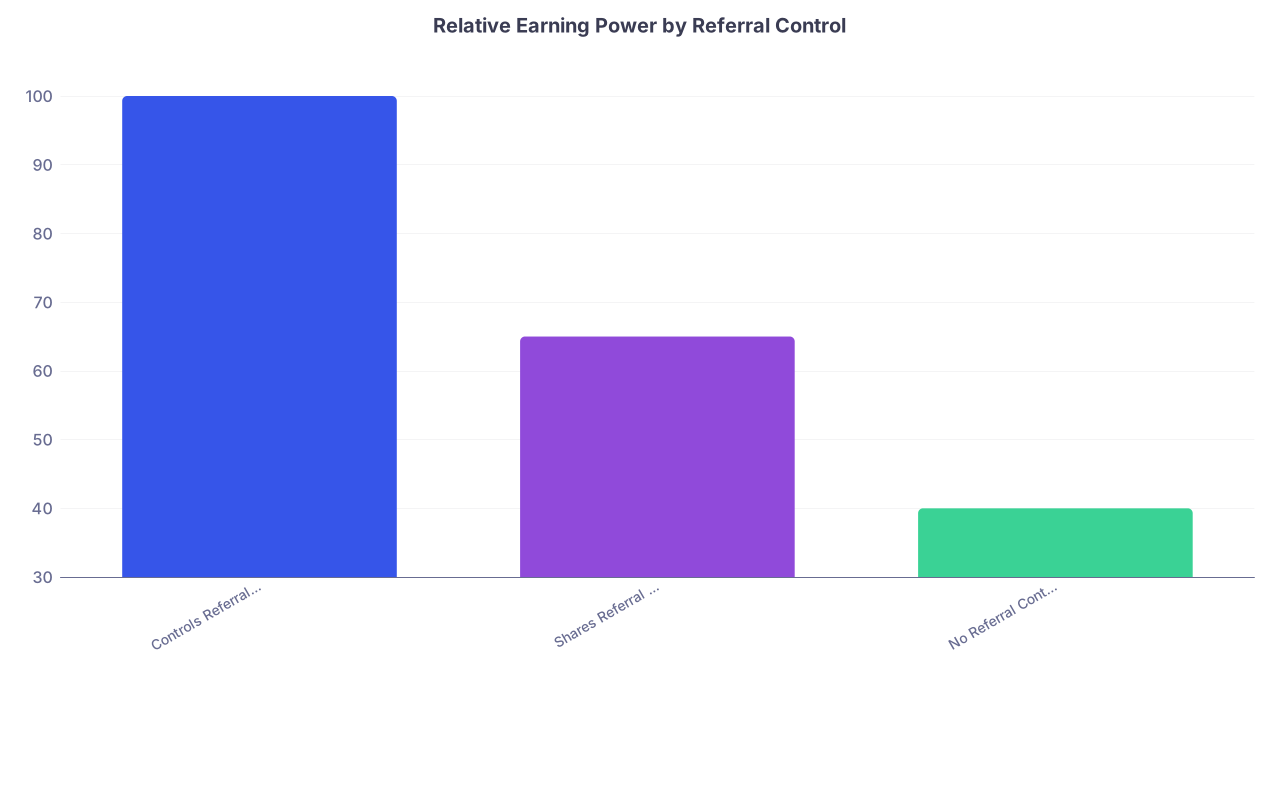
| Category | Value |
|---|---|
| Controls Referral Stream | 100 |
| Shares Referral Stream | 65 |
| No Referral Control | 40 |
Internally, when we look at which subspecialist is going to thrive financially, we map them very quickly:
- Does this person have or can they build primary care loyalty?
- Are they “the name” surgeons or hospitalists trust for a specific problem?
- Will they answer calls, be available, and not burn bridges?
- Are they willing to go where the patients actually are?
Here’s the dirty secret: programs and departments quietly know who’s being groomed for those streams.
You’ve probably seen some of this:
- The chair “happens” to send all the commercially insured structural heart cases to Dr X
- The old-guard GI who controls all the community PCP dinners keeps the high-yield endoscopy days for themselves and their chosen partner
- The highly political ortho attending “mentors” one fellow heavily and subtly steers all the best private group opportunities toward them
Your co-fellow who ends up making half your income? They might be:
- Less aggressive about meeting referring docs
- Less willing to answer midnight texts from hospitalists
- More “academic” in posture in a system that frankly does not reward that financially
You do not have to be sleazy. But if you are invisible to the referral sources, you are volunteering for the bottom half of the income distribution.
Procedure Mix: Not All RVUs Are Created Equal
Another behind-the-scenes reality: the RVU spreadsheet that administration waves at you is not telling the full story. The headline RVU rates might be equal on paper, but the environment makes certain procedures incredibly lucrative and others miserable.
Concrete example from GI:
- Screening colonoscopy, ASA II–III, frequent, well-scheduled, in an efficient ASC with predictable turnover
- Versus complex inpatient consults for decompensated cirrhotics, IBD flares, functional bowel disease → loads of time, low net compensation
Both are “GI.” Only one builds a $600k income track.
Same in anesthesia:
- High-volume ortho joints, healthy-ish patients, block-friendly surgeons, well-oiled ORs
- Versus night float, trauma-heavy, and endless “add-on” cases in a chaotic Level I center → same or worse pay, way worse life, lower net income potential
When you see a co-fellow out-earning you by 2x, it’s often because:
- Their practice pattern gravitates to short, high-margin procedures with low complication rates
- Yours skews to long, complex, poorly reimbursed work that academic departments glorify but rarely pay for
Departments love to call those complex cases “great learning.” They are. But long-term, if that is most of your practice, you’re going to be financially underwater compared to your more “boring” procedure-focused co-fellow.
Geography: The Multiplier You’re Underestimating by 10x
This is the one thing residents chronically misunderstand. Geography is not just cost of living and “I like the city.” It is a multiplier on your entire career’s earning trajectory.
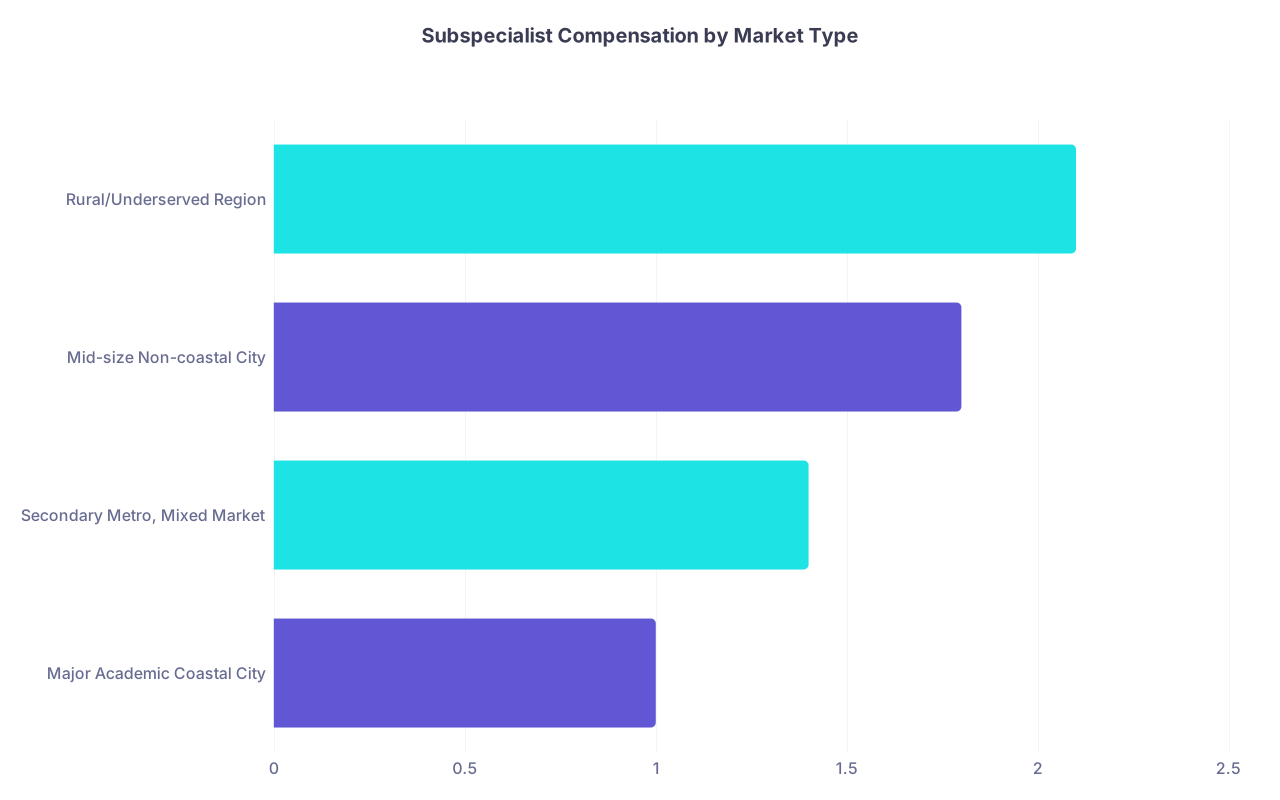
| Category | Value |
|---|---|
| Major Academic Coastal City | 1 |
| Secondary Metro, Mixed Market | 1.4 |
| Mid-size Non-coastal City | 1.8 |
| Rural/Underserved Region | 2.1 |
I’ve watched this play out with the same fellowship class:
- Two interventional cardiologists, same fellowship, same procedural skill
- One goes to Boston academic center on a $320k–$360k package, “protected time,” prestige
- The other goes to a mid-size Southern city with a hungry private group, partnership track, high-volume cath lab, and ASC ownership potential
Fast forward 7–10 years:
- Boston doc: maybe $400k–$450k, little to no equity, high COL, kids in private school because the public schools are a mess
- Southern doc: $800k+ between comp and distributions, owns part of the building, ASCs, maybe some imaging
Same training. Geography doubled the money.
And inside a single state, micro-geography matters just as much:
- Inside the city vs 30–60 minutes outside it
- Academic flagship vs strong community hospital with gaps that you can fill
- Competing saturated subspecialty density vs wide-open catchment area
The co-fellow making half your income often chose:
- Coastal, saturated markets
- Prestigious names over raw economics
- Large academic groups where leverage is weak and everyone is “replaceable”
You don’t need to run to the most rural county on the map. But if you’re dead-set on Manhattan, SF, or Boston academic life? Do not be surprised when your lower-paid co-fellow salary is you.
Employment Model: Who Owns the Cash Flow
Here’s the part attendings whisper about over drinks and pretend doesn’t exist the next morning: ownership is everything.

On paper, you’ll see:
- Academic employed → “Stable salary, benefits, prestige”
- Hospital employed → “Guaranteed base, RVU bonus, no admin drama”
- Private practice → “Partnership track, eat what you kill, risk and reward”
In practice, what actually changes your income 2x is:
- Do you have equity in anything that generates technical revenue? (ASC, imaging center, lab, building)
- Are you in a group where partners actually distribute profits transparently?
- Do you have protection against being squeezed by hospital systems or private equity?
Two interventional radiologists, same fellowship:
- IR #1 joins a hospital-employed model, great base, some RVU bonus, no equity. Salary tops around $450k–$550k in a decent market.
- IR #2 joins a strong IR/DR private group with ASC, OBL (office-based lab), and imaging ownership. After buy-in, total comp (salary + distributions) crosses $800k in a good year.
Guess which one is on the “double my co-fellows” side of the curve.
At fellow selection time, faculty often downplay this. Many are locked into academic or hospital-employed models and feel a kind of sunk-cost cognitive dissonance. They tell you stories that rationalize their choice. Some will be honest about the money gap. Many will not.
Personality and Risk Tolerance: The Stuff Nobody Puts in a Slide Deck
Between fellows of the same subspecialty, huge income gaps usually track back to a few behavioral traits. They’re not soft skills. They’re financial weapons.
The higher-earning subspecialists tend to:
- Say “yes” to opportunity for the first 3–5 years: early OR blocks, weekend add-ons, extra clinic, late cases
- Move quickly when they see a dysfunctional but high-potential market
- Have a higher tolerance for short-term pain (hours, moving, building a name) for long-term autonomy
- Treat their practice like a business, not a job
The co-fellow who ends up making half often:
- Optimizes for immediate lifestyle right out of fellowship
- Avoids conflict over case assignments or access to the lab/OR
- Stays in oversaturated academic centers for comfort and brand name cred
- Delegates all financial thinking to their employer and “just shows up”
Let me be very clear: there is no moral judgment here. Some people explicitly want the lower-earning, more predictable path. Good. That’s honest.
But if you want upper-tier subspecialist income, you cannot act like a passive employee for your first decade in practice. Your co-fellow who behaves like an owner from day one will out-earn you. Significantly.
Call, Nights, and the “Blood Money” Factor
Another unspoken lever: who’s willing to do the ugly work.

In many high-paying subspecialties, the real money is attached to:
- High-acuity emergency cases
- Uncomfortable hours (nights, weekends, holidays)
- Procedures nobody else wants (or can) do reliably
Examples:
- Vascular or ortho trauma in a region where elective surgeons duck call
- STEMI and acute neuro-intervention coverage in regions desperate for 24/7 coverage
- Ob anesthesia or complex ICU-level anesthesia services in hospitals that must meet coverage standards
Hospitals and groups will pay heavily to patch those holes. But they won’t advertise that in fellowship grand rounds. You see it at the contract level and in the back-channel:
- Extra stipends for certain call pools
- Side contracts for “medical directorship” of service lines
- Quiet bonuses for maintaining high-need coverage
Your co-fellow who refuses nights/weekends, who wants “no more call” right out of training? They’re voluntarily leaving the best-compensated slices of the field to someone else. Maybe to you.
Just don’t lie to yourself: if you chase the very top of income, some of that money is, frankly, blood money. You earn it in the OR at 3 a.m. when everyone else is asleep.
How Program Directors Really Talk About You Behind Closed Doors
You want the real Insider Mentor take? Here’s what PDs and senior faculty say in closed meetings about outgoing fellows when lucrative job opportunities pop up.
It sounds like this:
- “If I send that group Dr A, they’ll love the procedural volume, they’ll grind, they won’t complain about late cases.”
- “Dr B is brilliant but wants protected time and a heavy academic slant. They’re not going to be happy in a workhorse private group.”
- “That practice needs someone hungry and fast. Who’s actually willing to move and build a panel?”
- “This job is a gold mine in 5 years but brutal the first two. Who can handle that ramp?”
No one is saying:
- “Who got the best fellowship in-service exam score?”
- “Who published the most abstracts?”
They are matching temperament to economics.
So two co-fellows with equally solid CVs can be steered into entirely different income trajectories because faculty correctly sense:
- You will tolerate grind and hustle for upside
- Your co-fellow wants structure, prestige, and guardrails
That’s how, five years later, the income spread becomes massive. And both paths were “chosen” — partly by you, partly by your mentors, partly by the jobs they even let you see.
A Simple Mental Model: Which Column Are You Actually In?
If you want a rough self-assessment, ignore titles and think in columns:
| Archetype | Typical Income Band | Core Choices Driving It |
|---|---|---|
| Academic Builder | $200k–$320k | Big-name center, research/teaching heavy |
| Stable Employed Expert | $280k–$450k | Hospital-employed, mixed work, safe market |
| Aggro Proceduralist | $450k–$800k+ | High-volume procedures, call, hungry market |
| Owner-Operator | $600k–$1M+ | Equity in ASC/imaging, strong referral control |
| Lifestyle Hybrid | $300k–$500k | Selective procedures, good geography, balance |
Most co-fellows diverge because they’re subconsciously choosing different archetypes.
The ones earning double are almost never “Academic Builder.” They’re usually:
- Aggro Proceduralist for the first 5–10 years
- Then transition toward Owner-Operator when they can buy into something
Your co-fellow who earns less? Often consciously or unconsciously chose “Academic Builder” or “Stable Employed Expert.”
Neither is wrong. But pretending they should pay the same is delusional.
What You Should Actually Do While You’re Still a Trainee
You’re not signing a seven-figure PE deal in fellowship, so let’s keep this concrete.
Three practical moves that separate the high earners from the rest — that you can start now:
Get uncomfortably clear on your priorities.
Do you really want top-decile earnings? That comes with cost: moves, call, grind, politics. If the honest answer is no, that’s fine. But stop fantasizing about a compensation tier you’re not willing to bleed for.Study markets, not just specialties.
Spend as much time understanding where your field is desperately needed as you spent memorizing obscure trial names. Look at job boards, talk to alumni 3–5 years out, ask them point-blank what they’re taking home.Track who controls what in your fellowship.
On rotations, pay attention:- Who gets which cases?
- How are labs/ORs scheduled?
- Who do surgeons, PCPs, hospitalists actually call by name?
That’s a preview of how the real world works.

| Step | Description |
|---|---|
| Step 1 | Finish Fellowship |
| Step 2 | Academic Builder |
| Step 3 | Stable Employed |
| Step 4 | Aggro Proceduralist |
| Step 5 | Owner Operator |
| Step 6 | Lifestyle Hybrid |
| Step 7 | Primary Goal |
| Step 8 | Risk Appetite |
Once you see which node you’re drifting toward, your job search starts to make a lot more sense.
FAQ: Brutally Honest Version (5 Questions)
1. I’m in a high-paying subspecialty but at a low-paying academic job. Did I permanently screw myself?
No. But the longer you stay, the more your habits calcify. If you want to move toward higher-earning tracks, you typically need to pivot within 3–7 years: shift to a more procedural role, change markets, or join a group with ownership potential. The skill set is still there; the question is whether you’re willing to start over in a new ecosystem.
2. Is private equity automatically bad for subspecialists’ income?
Short term, it can boost your income with buyouts, guaranteed salaries, and “efficiency initiatives.” Long term, many PE-backed setups will squeeze margins and erode your leverage. The winners are often early partners who cash out; latecomers are upgraded employees with fancier titles. If you join after the big liquidity event, do not expect owner-level upside.
3. Does doing a more “elite” fellowship (top-5 program) actually increase earnings?
Only indirectly. Elite programs open doors, especially in saturated markets and big academic systems. But in the community and private world, what matters far more is procedure volume, reputation among referring docs, and your willingness to work. I’ve seen “mid-tier” fellowship grads in good markets out-earn Ivy-trained colleagues by 2–3x.
4. I care about money but don’t want to live rural and be on call constantly. Is there a middle ground?
Yes. Secondary and tertiary cities with 1–2 major hospitals are often sweet spots: enough volume, reasonable competition, and room for procedural growth. Joining a solid private group or hospital-employed role there, with some ASC access, can land you in the $400k–$600k range without annihilating your life. It’s not $1M a year, but it’s also not 1 a.m. trauma every night.
5. What’s the single biggest mistake I can avoid right now as a fellow?
Blindly chasing prestige and location while ignoring business reality. I’ve watched too many brilliant subspecialists lock themselves into low-paying, high-stress academic coastal jobs because the brand felt good. Five years later, they realize their “less impressive” co-fellow in a mid-market private group is making double, with more control and less bureaucracy. Do not make that decision on vibes alone. Get the numbers, ask the uncomfortable questions, and choose with your eyes open.
You’re at the point where “What specialty?” is already decided. The game now is what version of that specialty you’re going to live inside for the next 20–30 years.
Once you start looking at yourself not just as a future attending, but as a revenue engine inside a specific ecosystem, these income differences stop looking mysterious. They become predictable outcomes of very specific choices.
With that lens in place, you’re ready for the next step: evaluating concrete job offers, deciphering RVU contracts, and spotting which “partnership tracks” are real and which are traps.
But that’s a story for another day.