
The dirty little secret is this: most attendings in the highest-paid specialties made their real money from ownership, not salary. And almost none of them told the residents the full story.
You’re being groomed for employment right now. Hospital HR, big anesthesia groups, national EM corporations, private equity–backed radiology chains. They’re all polishing the pitch: “Great salary. No risk. Work–life balance. Student loans.”
What your older attendings whisper about in the lounge—when you’re not there—is completely different: “If I were starting again, I’d fight like hell for partnership or ownership earlier. Employment looks safe, until it isn’t.”
Let’s pull back the curtain.
The Real Difference: Control vs. Convenience
Forget the brochure versions. “Partnership track” vs “employed position” sounds like a benign menu choice. It isn’t. In the highest-paid specialties—orthopedics, neurosurgery, radiology, anesthesia, dermatology, GI, cardiology—this is the fork in the road that determines whether you end up with:
- A solid upper-middle-class doctor salary, dependent on an administrator’s mood
or
- Actual financial independence, equity, and leverage over your own schedule and practice.
Here’s what nobody explains clearly when you’re a resident: compensation is only about half of the story. The other half is who owns the revenue stream and who makes the rules.
Employed: you sell your time and skill, someone else owns the business.
Partner: you own part of the machine that prints money.
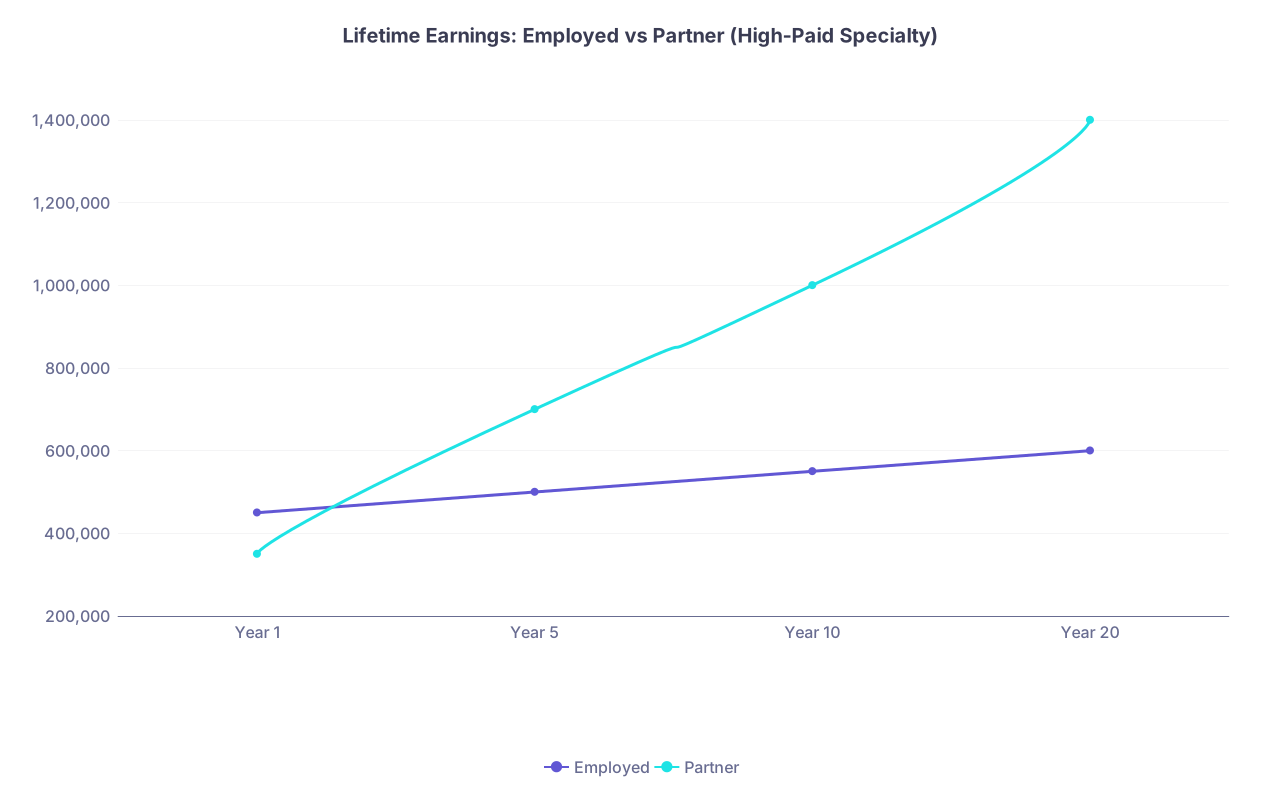
| Category | Employed | Partner |
|---|---|---|
| Year 1 | 450000 | 350000 |
| Year 5 | 500000 | 700000 |
| Year 10 | 550000 | 1000000 |
| Year 20 | 600000 | 1400000 |
Those numbers are conservative. I’ve seen ortho and GI partners clearing far more. But the important point: the employed line flattens; the partner line keeps accelerating as equity, ancillaries, and real estate stack.
How Older Attendings Actually Made Their Money
Let me tell you what really happened with a lot of your senior attendings in high-earning fields.
They didn’t get rich off the W-2 salary you see posted on Doximity. They got rich off:
- Partnership shares in a private practice group
- Ownership in imaging centers, ASC (ambulatory surgery centers), cath labs
- Real estate (they bought the building the group rents from)
- Owning the technical component of imaging or procedures
The pattern is almost boring once you’ve seen it enough.
The spine surgeon who “only works three days a week”?
He’s not living off his OR salary. He’s making bank from his equity in the surgery center, physical therapy, and imaging tied to his cases.
The procedural dermatologist who looks semi-retired at 52?
Her Mohs practice, cosmetics, pathology lab, and office building are all owned entities. Her “salary” is just one slice.
But here’s the catch: most of them got into those deals 10–20 years ago—before private equity and hospital consolidation really hit hard. They walked into relatively fair partnership tracks. Buy-ins in the low six figures. Real say in group decisions.
Now? You’re walking into a different battlefield.
What Employment Actually Buys You (and What It Quietly Takes)
Residents underestimate how seductive employment really is. I’ve seen it a hundred times.
You’re graduating from radiology, ortho, EM, or anesthesia with $250–400k in loans. You’ve lived on peanuts for a decade. Someone waves:
- $450–700k base guarantee
- Sign-on bonus
- Loan repayment promises
- “No call” or “reasonable call”
- Health, retirement, malpractice covered
You’re exhausted. You take it.
Here’s the part older attendings wish you would listen to: those offers are designed to feel like safety, but structurally, you are trading away almost every lever of power you have.
You give up:
- Fee transparency – you rarely see what you actually generate
- Upside – your productivity beyond a certain level enriches someone else
- Voice – you become one FTE line item in a cost center
- Flexibility – schedules, RVU targets, daily volumes get dictated to you
I’ve sat in meetings where administrators said, out loud, “We can probably push the EM docs to 2.6 patients/hour and bump RVU thresholds by 15% next year. They’re not going anywhere.” These were employed physicians. No equity. No real threat to walk as a group.
When you’re employed, you are easier to optimize. And optimization in healthcare usually means: more work per doctor, less pay per unit of work.
The Partnership Fantasy vs. Partnership Reality
Now, before you romanticize partnership, let’s be honest: there’s a lot of fantasy baked into that word.
Residents hear “partnership track” and imagine collegial ownership, open books, guaranteed millionaire status by year five. That’s not how it actually plays out across the board.
Here’s what older attendings know, and a lot of them learned it the hard way: not all partnerships are created even remotely equal.
Red flags they learned to smell from a mile away—some only after being burned:
- “Flexible” or “undefined” partnership terms – If the timeline, buy-in amount, and partner comp formula are not literally on paper, in detail, you are not on a partnership track. You are on an “indentured associate” track.
- Two-tier partnerships – Senior partners with one set of perks (higher collections, more ancillaries), junior partners forever locked into a lower tier. This exists more than people admit.
- Insane buy-in structures – You work like a partner for years, then are told the buy-in is $800k+ for shares valued at some magical internal number. It’s a wealth transfer from young to old.
- No governance voice – “Partners” who technically own shares but cannot block a sale to private equity, cannot change leadership, and basically have equity in name only.
A lot of older attendings in private groups will quietly admit: they themselves benefited massively from these structures… and they’re not sure they’d advise their own kids to walk into the same thing now. Especially with PE circling.
So no, partnership is not automatically the promised land. It can be a gold mine or a trap. The difference is in the details they don’t put in the recruitment brochure.
Specialty-Specific Truths: Where Ownership Still Matters Most
The phrase “highest paid specialties” is misleading. It should really be “highest paid if you have leverage and ownership.” Because the pecking order shifts dramatically between employed vs partner.
Let me give you the rough insider map.
| Specialty | Employed Ceiling (Approx) | Strong Partner Potential? | Key Ownership Angle |
|---|---|---|---|
| Orthopedics | $600–900k | Yes | ASC, imaging, PT, real estate |
| Neurosurgery | $800k–1.2M | Yes (select markets) | ASC, spine centers |
| GI | $600–900k | Yes | Endoscopy centers, pathology |
| Cards (interv) | $600–900k | Yes (limited now) | Cath labs, imaging |
| Radiology | $500–800k | Yes | T/C component, imaging centers |
| Anesthesia | $400–700k | Yes (shrinking) | ASC ownership, pain practices |
Notice something? In almost every one of those, the real kicker isn’t just the clinical work. It’s ancillaries plus ownership.
Hospital-employed GI making $650k looks good… until you meet a GI partner doing $900k+ plus distributions from an endoscopy center, pathology lab, and real estate.
Radiology groups that own their imaging centers can pay partners far more than hospital-employed radiologists tied to a flat salary with small RVU bonuses.
Older attendings will tell you: the trend is toward consolidation and employment, yes. But that doesn’t mean ownership is dead. It just means you have to be very intentional and very early about seeking it.
The Private Equity Problem Your Attendings Complain About Off the Record
If you’ve heard older attendings sounding bitter about “PE” or “the sale,” this is what they’re talking about.
Here’s the script they’ve watched play out:
- A strong, profitable private group in a high-paying specialty exists (GI, anesthesia, derm, radiology, EM, ortho subspecialties).
- Private equity comes knocking: “We’ll buy your group for 10–12x EBITDA. You partners cash out now, keep working, maybe even get some rollover equity.”
- Senior partners, late 50s and early 60s, jump at the chance. They’ve put in 20–30 years. They walk with 7-figure checks.
- Junior partners and associates? They become employees of the new entity. The leverage is gone. Ownership path, if it exists at all, is watered-down and vague.
I’ve seen older attendings admit flatly: “We sold too late for the juniors. It was great for us, not for them.”
And newer grads end up interviewing at the same practice with a completely different reality:
- Same workload or more
- Less transparency
- “Partnership” replaced by stock options in a PE-backed roll-up that may or may not ever pay out
If your attendings look a little guilty when PE comes up in conference, that’s why.
What Older Attendings Wish You’d Ask on Interview Day
Most residents ask safe, surface questions on interviews: call schedule, vacation weeks, mentoring. Fine. But that’s not where careers are made or broken.
Older attendings—especially the ones who’ve been through mergers, pay cuts, and buy-out drama—wish you’d ask the questions that actually matter for your long-term life:
- “Who owns the practice?”
- “Who owns the imaging center / ASC / lab / building?”
- “Is private equity involved? Has there been an offer? Has there been a sale?”
- “Is there a real partnership track? What’s the exact buy-in, timeline, and how is it valued?”
- “How are new partners protected if the group sells five years after I join?”
- “How are decisions made about schedule, call, new hires, and compensation changes? Who actually votes?”
The way people respond, not just what they say, tells you everything. If a senior partner dodges and an HR rep jumps in? Red flag. If details are vague or “we don’t really share that with candidates at this stage”? Walk carefully.
The attendings who look you in the eye and show you numbers, history, and governance? Those are the ones quietly trying to pay it forward.
The Hidden Risks of Employment Nobody Puts in the Contract
You think partnership is risky because of buy-ins and market volatility. Fair. But employment carries its own set of risks, and older docs have watched them unfold in real time.
I’ve watched:
- An entire EM department’s pay cut by 25% overnight after a national group lost a contract and “renegotiated” every doc’s rate.
- Radiologists told their shifts would be moving from 8–5 to 11–9 “to match volume patterns,” with no meaningful say.
- Anesthesia groups replaced by cheaper locums or a different corporate vendor with zero continuity. Physicians given 60 days to decide whether to move or accept less pay.
- Employed ortho surgeons told to increase RVUs by 20% “to match national benchmarks,” or face “compensation review.”
When you’re employed, your career is tied to forces way above your pay grade: contract negotiations, system mergers, administrator turnover, PE deal cycles. You think you’re choosing stability. Sometimes you’re just choosing a different form of instability that you don’t control.
Older attendings will tell you: the job that felt rock-solid at 35 can feel like a cage at 45 when your kids are in school, your life is rooted, and suddenly your group’s contract is out for bid.
So What Should You Actually Do as a Resident?
Here’s the part most articles chicken out on. I won’t.
You’re not going to fix the entire healthcare system. You need a strategy that works for you in this environment.
A blunt framework older attendings use (even if they never say it out loud):
Know your specialty’s realistic ownership path
In EM? True ownership is almost extinct in many markets. In ortho, GI, derm, certain cardiology and radiology groups? Ownership is still very real but competitive. You need to act like it.Early career: buy optionality, not just salary
That first job choice determines your slope, not just your starting point. A slightly lower starting salary in a true partnership-track group can be a dramatically better long-term move than a fat employed offer that tops out forever.Learn to read the business, not just the clinical landscape
Ask the uncomfortable questions. Ask to see sample partner comp. Ask to talk to someone 3–5 years out who just made partner—or didn’t. If they won’t let you? That tells you more than any number on the offer letter.Have an exit mindset from day one
Old attendings shake their heads at how many young docs trap themselves: buying the big house right away, overspending, then having zero flexibility when their job turns. Your power is in your ability to leave if the deal sours. Do not give that up lightly.Never confuse title with ownership
“Medical director” of an employed service line with a $30k stipend is not the same as owning 5% of an ASC. One is a fancy leash. The other is actual leverage.

| Step | Description |
|---|---|
| Step 1 | Residency Graduation |
| Step 2 | Stable but Capped |
| Step 3 | Lower Start Pay |
| Step 4 | Limited Control |
| Step 5 | Susceptible to Cuts |
| Step 6 | Buy in to Ownership |
| Step 7 | Higher Long Term Income |
| Step 8 | More Control and Equity |
| Step 9 | Job Type |
What Older Attendings Regret (and What They Don’t)
When you catch them one-on-one—after conference, out of the hospital, when they’re less guarded—older attendings will say things they’d never put in an email.
Common regrets I’ve heard over and over:
- “I sold to PE too early and lost long-term upside.”
- “I trusted a handshake partnership promise. It never materialized.”
- “I chased the highest first-year salary instead of the best long-term position.”
- “I didn’t understand the value of ancillaries until it was too late to get in.”
Things they almost never regret:
- Leaving a toxic or exploitative employed situation earlier than was comfortable.
- Taking a modest pay cut to join a group with real ownership and sane partners.
- Keeping their fixed expenses lower the first 5 years to preserve optionality.
- Learning basic business/finance early so they could evaluate offers themselves.
You’re in residency. You still think the main difference between jobs is nights vs days, 1:4 vs 1:6 call, big city vs medium city. That phase ends fast. By your late 30s, what keeps you up at night is whether your work is under your control or someone else’s.
Older attendings live with that reality every day. They’re just not always great at translating it back to you in a way you’ll actually listen to. That’s what this whole conversation is.