
It’s 4:12 a.m. You’re on your third cup of bad coffee, half-listening to monitors in the ICU, and you’re staring at the call schedule for next month. In five weeks, you’ve got four 24‑hour calls, two night-float blocks, and a string of “short calls” that mysteriously always seem to end after midnight.
And you’re asking the real question:
“When people say this specialty pays crazy money, where exactly does that show up in how they schedule us? Who’s actually deciding this… and what are they optimizing for?”
Let me tell you how it really works.
The Unspoken Rule: Money Drives Call Design
Nobody will say this to you directly, but here’s the quiet rule: in the highest paid specialties, the call schedule is built around protecting the attendings’ revenue and lifestyle first, and then retrofitted to “educational value” for residents.
The specialties I’m talking about:
- Orthopedic surgery
- Neurosurgery
- Plastic surgery (especially reconstructive/complex)
- Interventional cardiology
- Interventional radiology
- Some surgical subspecialties (ENT with big skull base practice, vascular, etc.)
These are the fields where:
- Call is tied to high RVU, high-bill procedures
- Hospitals compete to have them on staff
- One well-timed middle-of-the-night case can be tens of thousands of dollars in hospital revenue
So the call schedule is not a neutral grid of fairness and education. It’s a control system: who answers the pager, who must be available to staff a case within 30–60 minutes, and how often the big billers actually have to roll out of bed.
Let’s start with an unvarnished truth:
Residents are the shock absorbers of the system.
Call schedules are designed to use that.
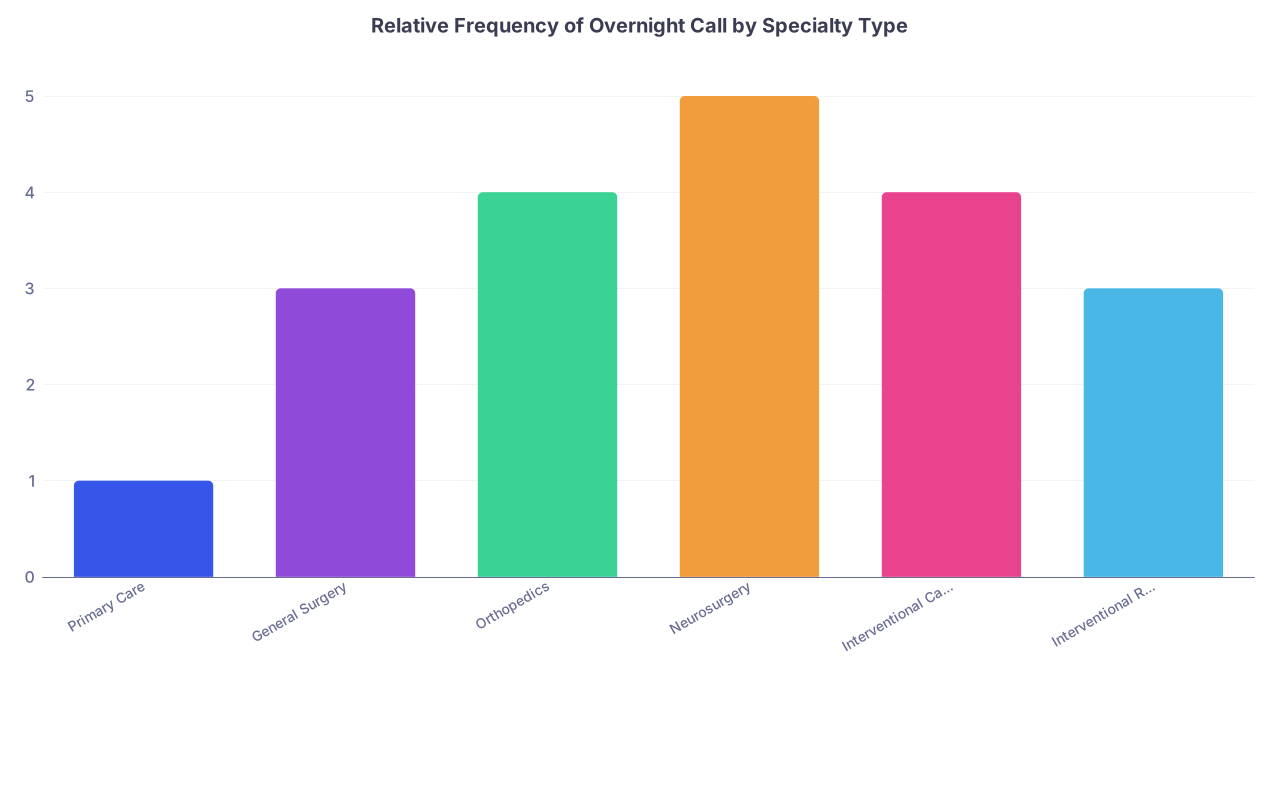
| Category | Value |
|---|---|
| Primary Care | 1 |
| General Surgery | 3 |
| Orthopedics | 4 |
| Neurosurgery | 5 |
| Interventional Cardiology | 4 |
| Interventional Radiology | 3 |
Who Really Designs the Call Schedule
In most high-paying specialties, the piece of paper (or Excel sheet) you see is usually the product of three layers of influence:
Front-facing “owner” – A chief resident, junior attending, or APD who “runs” the schedule. They get the emails, the complaints, and the passive-aggressive comments on rounds.
Hidden constraints – The program director and department chair quietly dictate non-negotiables:
- “Dr. X does not take in-house call anymore.”
- “EDS trauma call must be covered every night.”
- “No more than 1 in 3 call for attendings or we’ll lose them to the private group down the street.”
Hospital and service line demands – Trauma designation, stroke center status, cath lab/IR coverage requirements. These are tied to contracts and money, not education.
Here’s what that looks like in practice.
Example: Ortho Trauma Call in a Busy Center
You’re a PGY-2 in ortho at a Level 1 trauma center.
On paper, your schedule says:
- Q3 or Q4 in-house trauma call
- 24‑hour shifts, maybe “capped” at 28 hours if anyone pretends ACGME limits are a hard stop
- Senior residents “home call” some nights
What’s actually going on behind that:
- The trauma attending probably has a lucrative stipend in their hospital contract tied to trauma coverage.
- The hospital gets to keep its Level 1 badge, which pulls in transfers and regional referrals.
- Residents in-house = attendings can “take call from home” but still bill for consults/procedures without sitting in the ED all night.
So the schedule is designed to:
Always have a resident in-house to:
- See the consult
- Reduce the hip
- Splint the mangled extremity
- Start the note, orders, consent
Allow attendings to:
- Be physically present only when absolutely needed
- Skim the cream cases that matter (OR, big trauma, complex reductions)
- Avoid the tedium (low-energy trauma, stable fractures, phone calls)
Why are you on call more frequently than your attending? Because your time is cheap and your labor is non-billable but essential.
Specialty by Specialty: How the Call Game Is Played
Let’s go through the high-income fields and spell out how call is really structured.
Orthopedic Surgery
Lucrative drivers: trauma, spine, joints, sports.
Call is designed around two principles:
Someone must always be there to:
- Reduce dislocations
- Triage fractures
- Decide who goes to the OR tonight vs tomorrow
Attendings want:
- Predictability for elective high-RVU cases (joints, spine)
- To avoid being up all night before a full OR block
So programs use residents as buffers:
- PGY-1/2 often take the brunt of in-house call.
- Seniors take selective in-house call or more “home-call” setups, especially as they approach job hunting/fellowship.
You’ll see tricks like:
- “Short call” 3 p.m.–11 p.m. (but if a hip fracture rolls in at 10:45, you’re not leaving)
- “Night float” weeks that quietly extend into post-call afternoon clinics “for continuity”
For attendings, call “burden” might be:
- Q6–Q10 nights, often home call, with residents in-house
- Protected elective OR the next morning unless something exploded overnight
For residents in big ortho programs, it’s not unusual to have 6–8 truly miserable months across your first three years where call feels almost abusive. Those are the months subsidizing everyone else’s relative comfort.
Neurosurgery
Neurosurgery is different. It’s not just about RVUs; it’s about risk.
Hospitals will endure almost anything to keep neurosurgeons happy: they’re indispensable. One neurosurgeon leaving can cripple a hospital’s trauma or stroke program.
So call schedules are often built with:
- Strong protection of faculty – Many neurosurgery attendings end up on something like Q5–Q7 home call, with backup structures.
- 24/7 resident presence – At mid-to-large programs, you rarely see a night without a neurosurgery resident physically in-house.
Common setup:
- Junior resident in-house: fielding ED calls, floor issues, shunts gone bad.
- Senior resident may also be in-house or on back-up, depending on size.
- Attending at home, reachable within 15–30 minutes.
Cases that drive the structure:
- SDH/EDH
- SAH with hydrocephalus
- Acute cord compressions
- Big spine traumas
Those emergencies have huge liability and huge revenue. You need someone always ready to roll.
Residents get:
- Long, punishing in-house call early on
- Some transition to more supervisory or back-up roles as they go up in PGY-level
- Night float systems that are nominally “Q4–Q7” but feel worse because when stuff hits the fan, it’s neurosurgery, not cellulitis
Why people tolerate it? Because post-residency, call often becomes:
- High stipend
- Limited in-house presence
- Incredible negotiating leverage with hospitals who literally cannot function without neurosurgery coverage
Plastic Surgery (Especially Microsurgery / Recon)
Pure cosmetic plastics is its own world: minimal call, clinic-heavy, surgery center lifestyle. That’s not residency.
In academic or large hospital settings, plastics call is about:
- Trauma (facial fractures, hand injuries, soft tissue coverage)
- Microsurgical flaps for complex wounds (post-oncologic or trauma)
- Hand call (which can be brutal if combined with ED that consults for every fingertip)
Plastics residents and fellows end up:
- Covering in-house or home call depending on geography and volume
- Getting hammered by late consults (“by the way, someone broke their face at 2 p.m., but we’re calling you at 11 p.m. after the CT finally got done”)
Schedules are often “home call” on paper, but in reality:
- You’re in the hospital most of the night for traumas
- You cannot safely sleep because you’re waiting for scans, consults, and OR time
Attending call is often:
- Heavily negotiated in contracts
- Shared with community surgeons
- Structured so that big-wigs doing aesthetics are minimally exposed to ED call
Which means residents sometimes take disproportionate call to keep the faculty split “reasonable” and preserve recruitment power.
Interventional Cardiology
This is where money and misery really intersect.
Cath lab call is designed around:
- 24/7 STEMI coverage
- Some structural heart emergencies
- Occasionally other emergent interventions
This is not routine cardiology call. This is interventional:
Residents vs. fellows vs. attendings:
- Internal medicine residents may get dragged into night transfers and ICU issues, but the true intervention call rests with fellows and attendings.
- Cards fellows in many places have Q2–Q4 weeks of primary call during heavy rotations.
- Attendings usually have contractual limits: maybe 1 in 4, 1 in 5, sometimes 1 in 7 nights.
But notice how the system reloads:
- Residents and fellows often still have clinic or day responsibilities after being up all night with a STEMI or arrest.
- Attendings may cancel morning clinic or lighten their schedule depending on how big the group is.
Revenue reality:
- STEMIs, high-risk PCI, emergent interventions – all high RVU.
- Hospitals market “door-to-balloon under 90 minutes” like crazy.
So the call schedule is built to guarantee this promise, even if it means:
- Fellows’ lives are wrecked for a few years
- Attendings get differential comp, call stipends, and eventually enough partners to water down their own call ratio
Interventional Radiology
IR is the hospital’s Swiss Army knife at 2 a.m.
High-value emergency cases:
- GI bleed embolizations
- Trauma embolizations
- Ischemic limb interventions
- Nephrostomy tubes, biliary drains, abscess drainage in unstable patients
Academic IR fellowships and residencies:
- Residents and fellows usually rotate night call blocks, often Q2–Q4 within each block.
- Some programs use night float; others use traditional 24‑hour call.
Attendings:
- Often on home call, with the expectation of rapid response once something is flagged as emergent.
- Highly paid, often with explicit call pay or differential built into the job.
Where you get burned as a trainee:
- “Home call” that’s effectively in-house because you’re constantly being called in
- Completely destroyed circadian rhythm, then expected to show up for day cases
But after training, the reason people fight to get into IR is precisely this: call is high value. A small number of big cases, high billing, and hospitals terrified of losing IR coverage.

The Real Levers Behind Every Schedule
On the surface, you’ll hear a lot of talk about “fairness,” “education,” and “duty hour compliance.”
Behind the scenes, the real levers are:
- Hospital contracts – Trauma, stroke, cath lab, IR coverage clauses
- Recruitment and retention – If a high-RVU attending is threatening to leave, call requirements get softened
- ACGME minimums and optics – You need resident coverage, but you also need to pretend you’re not violating the spirit of duty hours, even when you dance on the line
Here’s how call structure differs across some of these fields in broad strokes.
| Specialty | Resident Call Style | Attending Call Style | Typical Night Workload |
|---|---|---|---|
| Orthopedic Surgery | In-house, Q3–Q6 | Home, Q6–Q10 | Trauma, fractures |
| Neurosurgery | In-house, Q3–Q7 | Home, Q5–Q7 | High-acuity emergencies |
| Plastics (Recon/Hand) | Home/In-house hybrid | Mostly home | Trauma, hand, flaps |
| Interventional Cards | Night float / Q call | Home, Q4–Q7 | STEMI, high-risk PCI |
| Interventional Radiol. | Night float / Q call | Home, Q4–Q7 | Bleeds, trauma, drains |
None of these are exact; each program is its own beast. But the pattern is consistent: residents absorb intensity so attendings can be “sustainably” lucrative.
Who Gets Protected (And Who Doesn’t)
Here’s the part nobody tells you on interview day.
When a department reshuffles call, three groups get explicit or implicit protection:
Star attendings – Big-name surgeons, high-volume proceduralists, or politically powerful people. They’ll:
- Take less night call
- Shift more call to juniors or colleagues
- Avoid being post-call on their prime OR days
Near-retirement faculty – Senior surgeons often get grandfathered into:
- Home call only
- Less frequent call
- No more weekends if they’ve “put in their time”
Certain senior residents/chiefs – Especially if:
- They’re highly trusted
- They’re being groomed for fellowship or internal hire
- They’re covering an indispensable niche (like spine, skull base, vascular)
Who gets squeezed?
- Mid-level residents (PGY-2 to PGY-4) – maximally useful, not yet protected
- Fellows in procedure-heavy fields – they’re the bridge between residents and attendings, so they take a ton of call intensity
I’ve seen this play out bluntly in scheduling meetings.
Someone complains: “This is too much Q3 for the juniors.”
Chair’s response: “We cannot move more call onto Dr. X; she already said she’ll walk if we push her call.”
Guess who wins. Every time.

| Step | Description |
|---|---|
| Step 1 | Hospital Coverage Requirements |
| Step 2 | Call Schedule |
| Step 3 | Attending Preferences |
| Step 4 | Resident Education and Fairness |
| Step 5 | Protected Faculty |
| Step 6 | Resident Call Burden |
| Step 7 | Attending Lifestyle |
How Call Evolves as You Advance
One of the few pieces of good news: in almost all these specialties, your call does usually get better over time. Not always fewer nights, but different kinds of pain.
Patterns you’ll see:
Early years (PGY-1/2) –
High volume, high scut, lots of in-house. You’re the first line for pages and consults.Mid years (PGY-3/4) –
Slightly more autonomy, still heavy call, but you’re doing more procedures at night rather than pure triage.Senior years (PGY-5+) –
More supervisory, more home-call in some programs, and some built-in protection to allow job/fellowship interviews and research.
In neurosurgery and some IR/IC programs, you might still be absolutely slammed as a senior, but your role shifts:
You’re now the one:
- Deciding who truly needs the OR
- Running the service overnight
- Shielding your juniors from some of the worst chaos
Meanwhile, attendings are doing their own version of this career arc:
- Younger attendings may take on heavier call loads to prove value.
- Mid-career people negotiate call down as they become rainmakers.
- Late-career people often are semi-protected or off call entirely.
You’re at the bottom of that pyramid as a resident. It’s ugly, but it’s also why the compensation is what it is at the end. You’re front-loading a lifetime of better schedules.

What You Should Look For on Interview Day (That They Won’t Say Out Loud)
You won’t get a program director to admit: “We dump inappropriate call volume on our residents so faculty can protect their lifestyle.”
But you can read between the lines. A few tells:
- “We have a very busy trauma service, great pathology” – Translation: your call will be heavy, especially early.
- “Our attendings mostly take home call while residents are in-house” – Good for training, bad for your sleep.
- “We’re the only Level 1 center for a 200-mile radius” – All the referrals, all the time. Amazing cases. Terrible nights.
- “We comply with ACGME guidelines” repeated 3 times – Means they’ve likely been cited before or skirt the edge.
Useful questions that actually reveal structure:
- “Who physically has to be in-house overnight on your busiest services?”
- “How does call change from PGY-1 to PGY-5+?”
- “What happens post-call? Are residents usually able to leave by noon or is there ‘flexibility’ based on workload?”
- “For interventional services, how often are you actually called in from home during home call weeks or weekends?”
Pay more attention to the residents’ faces than their words. They’ve been media-trained, but fatigue is hard to hide. If everyone looks wrecked, there’s a reason.
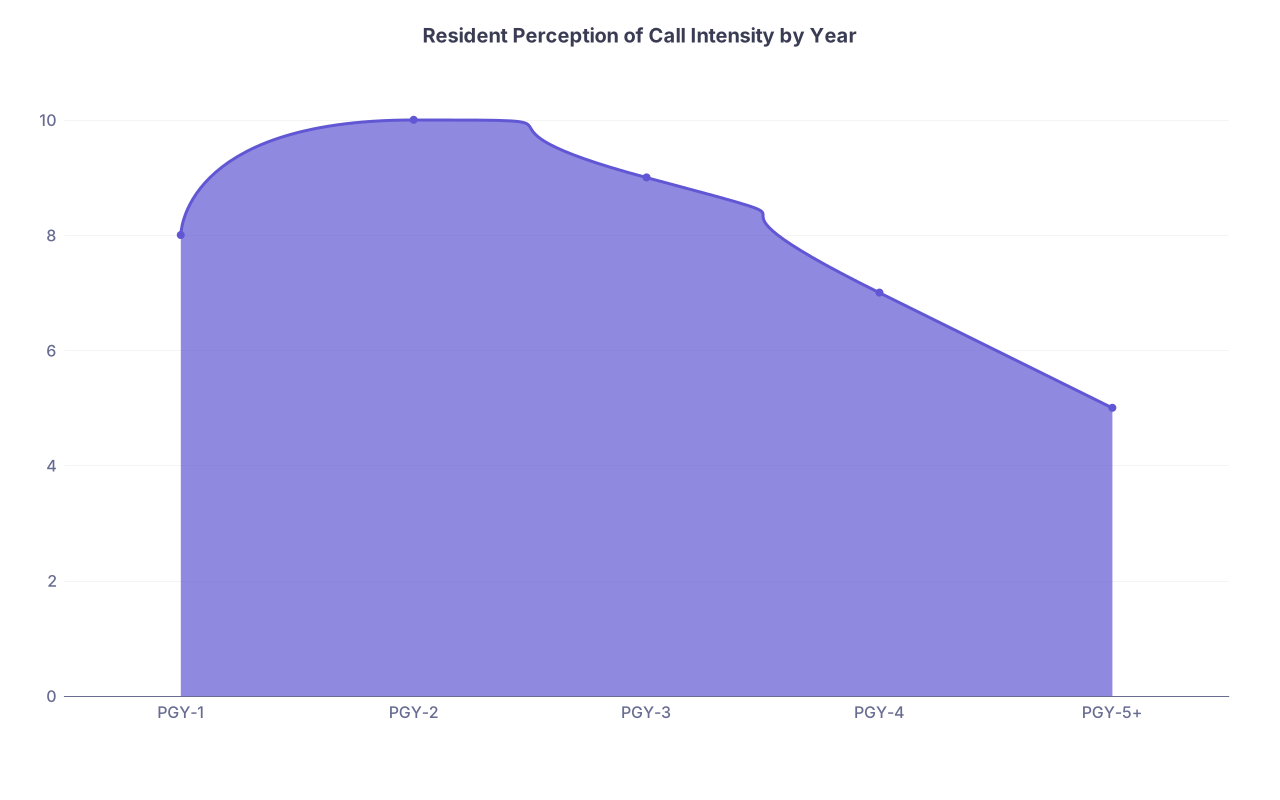
| Category | Value |
|---|---|
| PGY-1 | 8 |
| PGY-2 | 10 |
| PGY-3 | 9 |
| PGY-4 | 7 |
| PGY-5+ | 5 |
How This All Pays Off (Or Doesn’t)
Here’s the part you’re actually trying to calculate:
Is suffering through brutal call in these high-earning specialties “worth it?”
From a pure money/time standpoint after training:
- Orthopedic surgeons, neurosurgeons, interventional cardiologists, IR docs, and certain plastics can command top-tier compensation.
- Many shift to:
- Group practices where they can buy down call
- Partnerships where call is shared among many
- Structures where call is explicitly compensated with additional stipends
But not everyone plays it smart. I’ve watched people:
- Graduate into “dream jobs” that quietly have Q3 weekend call for the group’s newest hire
- Trade one hellish schedule (residency) for another (to “build a practice”)
- Burn out early because they never pulled back once they had bargaining power
The smart ones use their first 3–5 years post-training to:
- Leverage their scarcity to negotiate real call boundaries
- Get explicit call pay
- Join or build groups large enough to make call sustainable
- Walk away from jobs that treat them like replaceable cogs when they know they’re not
As a resident, you don’t have that power yet. But understanding how call is designed gives you clarity instead of resentment. You stop thinking “this is random abuse” and start seeing: “I’m currently the cost center that makes everyone else’s system work. I’m paying my dues upfront.”
That doesn’t make it fun. But it makes it legible.