
Your first attending contract is not the real number. It is the opening bid in a long, quiet game you were never taught to play.
Everyone in training obsesses about “starting salary” for ortho, derm, plastics, GI, IR, neurosurgery. But the people actually making serious money in those specialties are not living on their first-contract rate. They’re living on what happens in years 3–10, when the productivity ramps up, the RVU thresholds reset, and the buy‑ins and side deals start to hit.
Let me walk you through what really happens behind those closed doors. Because the public brochures and MGMA tables tell you the starting line. The hidden curve is what determines whether you end up at $450k or $1.5M eight years out.
The Two-Curve Reality: What You See vs What You Actually Earn
Here’s the dirty secret: almost every high-paying specialty has two income curves.
- The visible curve: what recruiters quote you, what’s on the offer letter.
- The hidden curve: what attendings actually earn once they’ve survived the first 2–3 years, renegotiated, and stopped being “expendable” FTEs.
In faculty meetings, we talk about this explicitly. Somebody pulls the MGMA data, someone else grumbles that “these numbers are garbage for our group because nobody here is under 5 years in practice anymore,” and then the partners quietly revise their comp model.
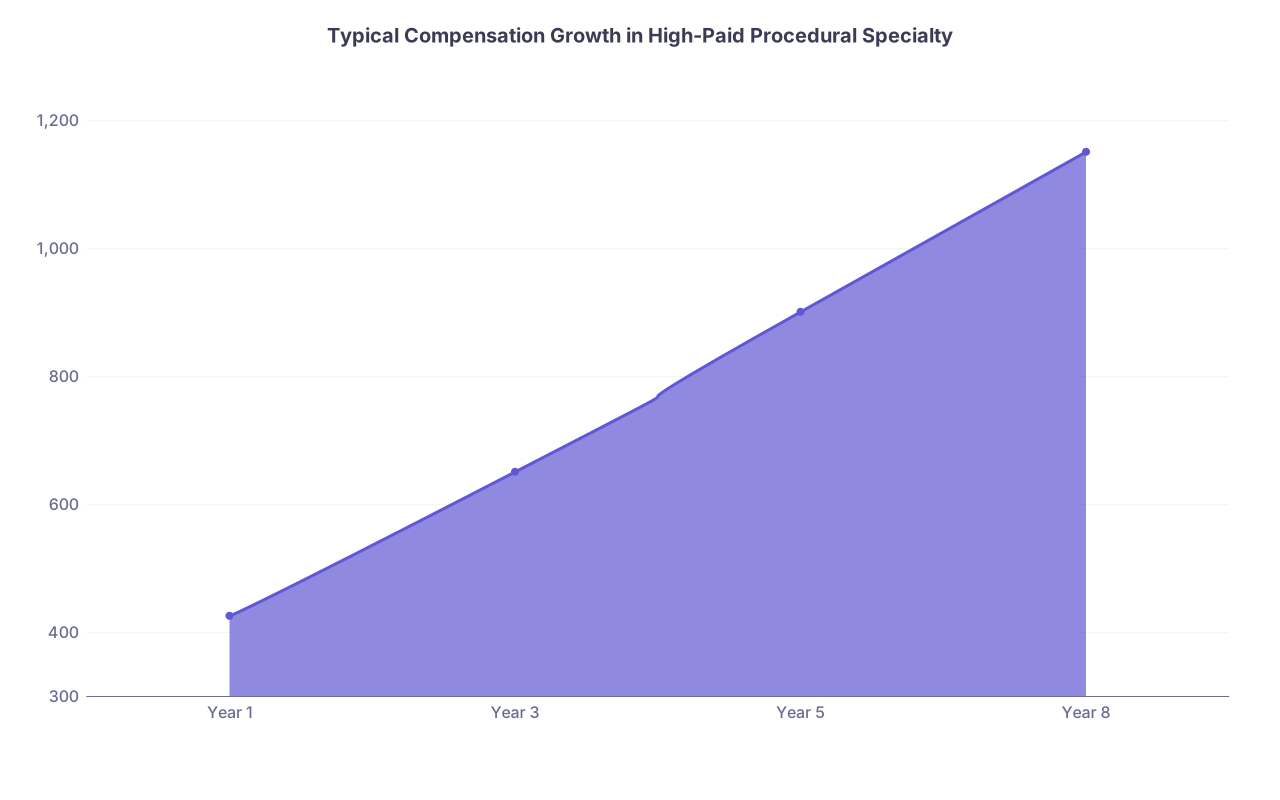
To make this concrete:
| Category | Value |
|---|---|
| Year 1 | 425 |
| Year 3 | 650 |
| Year 5 | 900 |
| Year 8 | 1150 |
That’s not hypothetical. That’s roughly what I’ve seen for solid-but-not-superstar partners in ortho, GI, IR, and some surgical subspecialties in medium-cost markets.
The catch? Almost nobody tells residents this curve exists. You see the $425k and assume that’s “the job.” Meanwhile, the senior partner in the same group is quietly clearing seven figures because of call differentials, ancillaries, and a comp formula that heavily rewards high RVUs once your panel is mature.
The game in years 1–3 is not just “work hard.” It’s surviving long enough, in the right structure, for your pay to jump to the real number.
How First Contracts Are Intentionally Designed (Against You)
Your first contract is engineered for one thing: risk transfer.
From the hospital or group… to you.
They know three truths you haven’t internalized yet:
- You do not know your market value.
- You do not know how much volume you can realistically generate in that environment.
- You are emotionally desperate to “just sign something” before fellowship ends.
So they design the first contract around these levers:
- A “generous” guaranteed base, often below what your eventual productivity would support.
- RVU thresholds set at or slightly above what the last young hire hit in year 2.
- A short guarantee period (1–2 years) and vague language about “reassessment.”
- Little to no transparency on what the senior partners are actually making.
I’ve literally heard a CFO say in a comp committee: “Give them $400k and a 2-year guarantee; if they produce like the others, they’ll be fine.” Translation: we’ll underpay their eventual production until they figure it out and have the spine to demand a new structure.
This is especially pronounced in the highest-paid specialties, because the gap between “new attending” production and “mature attending” production is massive.
The Hidden Curve in Specific High-Paid Specialties
Let’s get specialty specific. This is where residents’ fantasies collide with how the money actually flows.
Orthopedic Surgery
Ortho is the poster child for the hidden curve.
Year 1–2:
- You’re building cases, blocked time is stingy.
- Partners keep the choice cases.
- You’re stuffing your schedule with clinic just to fill your book.
- You’re on the worst call.
Pay? Usually:
- Hospital-employed: $450–600k all-in.
- Private/PPM-backed: low base + productivity bonus, might land you similar.
Year 5+ (if you pick the right structure):
- You’ve carved out a niche (sports, joints, spine).
- OR staff knows you, turnover times shrink, your room actually runs.
- Referrers send you the real stuff, not just the leftovers.
Now your income is driven by:
- RVUs well beyond your original threshold.
- Ownership in surgery centers, imaging, PT, DME, maybe real estate.
Here’s an honest snapshot I’ve seen in real groups (medium Midwest and Southeast markets):
| Stage | Total Comp Range (USD) |
|---|---|
| Years 1–2 | 450k–600k |
| Years 3–5 | 700k–1.0M |
| Years 6+ partner | 900k–1.8M+ |
The trap: a lot of young orthopods sign employed hospital deals that cap this curve. They’re thrilled with $550k at 29 years old and never realize their same effort would be worth 2–3x in a different structure 5 years in.
Dermatology
Derm is a different beast. The base salary is never the real story.
Year 1–2:
- Employed or pseudo-PPM arrangements paying $300–450k.
- You’re fed patients by the system; your schedule is pre-filled for you.
- You do mostly bread-and-butter: acne, rashes, some surgical.
Hidden curve:
- Cosmetics, Mohs, and ancillaries.
What changes post–first contract:
- You either start participating in upside (equity in the practice, profit-sharing on cosmetics, lab ownership),
- Or you remain a workhorse seeing 35–40 patients a day for a flat number while someone else extracts the margin.
Real numbers I’ve seen:
- Young derm in corporate/PE-owned practice, no ownership: stuck around $400–500k.
- Same derm five years later in small group, with cosmetics and modest equity: $800k–1.1M.
Again: not magic. Just the curve you never see during residency because the attendings making that money are too busy, too quiet, and frankly a little embarrassed to spell it out in front of residents.
Gastroenterology
GI has one of the sharpest hidden curves because of procedure volume and ancillaries.
First contract:
- Hospital employed: $450–600k, heavy call, procedures + clinic.
- Private group: 350–500k base with bonuses that are hard to model early on.
Year 3–5:
- Your scopes climb.
- The colon cancer screening pipeline you built starts to mature.
- You’re taking on higher RVU work (therapeutic procedures).
Where the curve really turns:
- Ownership in endoscopy centers.
- Pathology lab piece.
- Maybe infusion centers.
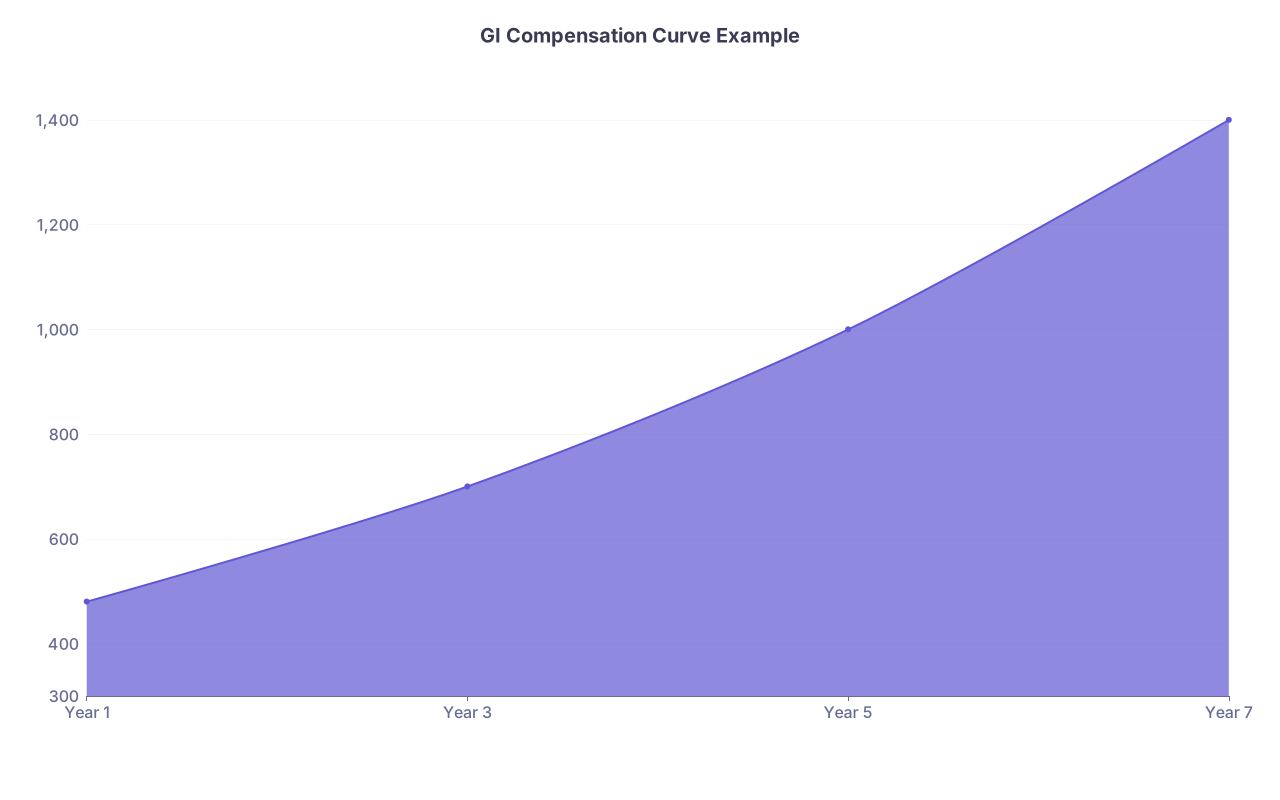
I’ve watched a GI in a busy community group go from $480k in year 1 to $1.4M by year 7. Not because she became some superstar influencer. Just because she bought into the center, increased scope volume, and the comp formula was written to massively reward productivity after partner status.
| Category | Value |
|---|---|
| Year 1 | 480 |
| Year 3 | 700 |
| Year 5 | 1000 |
| Year 7 | 1400 |
If you are choosing between GI jobs and you are not asking very specific questions about ancillaries and partner formulas, you’re playing this game blind.
Radiology / IR
Diagnostic rads and IR have their own flavor.
For IR:
- First contract: $450–650k, often as part of a larger rads group.
- There’s usually a base plus RVU/collections for IR work.
Post–first contract:
- If you stay in a group that lets you grow your IR line and participate in facility/technical fees, you can climb into $900k+ territory.
- If you’re in a hospital-employed, “we’ll give you a lab someday” fantasy, you’ll stagnate around that original range.
For diagnostic rads:
- Telerad and large groups are notorious: solid starting pay, but the senior guys are often quietly making one and a half to two times the “advertised” rate, with schedules tailored around their preferences.
- Partnership track often has a steep step-up at year 2–3. That’s the classic hidden curve: same work, different share of the pie.
Why Your Income Jumps Around Years 3–5
There’s a reason almost every serious compensation curve bends hard around year 3–5. A few mechanics you won’t hear on your residency noon lectures:
1. Panel and referral maturation
In procedural and consult-heavy specialties, it takes a couple of years for:
- Referring docs to trust you and remember your name.
- Your outcomes to circulate.
- Patients to re-enter the pipeline (follow-ups, staged surgeries, repeat scopes).
Hospitals and groups know this. That’s why they’re willing to overpay slightly in year 1–2 with guarantees. Once your volume supports a much higher income, their goal is to delay your realization of that fact.
2. You stop being interchangeable
In year 1, you’re a credentialed warm body. In year 3–4, you’re “the spine guy the ortho trauma team loves,” or “the IR who saves the surgeons at 3 am,” or “the derm who keeps the referring PCPs happy.”
At that point, losing you actually hurts.
That’s when leverage shifts. And that is exactly when smart attendings renegotiate comp, demand partnership, or walk to a better deal. I’ve watched people leave at year 3 from a $500k job to a $900k+ job literally across town, simply because they finally understood their value and were no longer easily replaced.
3. Ancillaries and ownership vesting
Most serious money in high-paid specialties comes from two things beyond your own hands:
- Technical components (facility fees from surgery centers, cath labs, endoscopy, imaging).
- Professional “overrides” and practice profit (from midlevels, employed juniors, cosmetic lines, etc).
Those doors almost never open for year 1 hires.
They open:
- After your initial contract ends.
- After a formal partnership track.
- After some vesting period “to prove loyalty.”
Which is why your second contract is often more important than your first.
How Contracts Quietly Cap Your Curve
The ugly side: I’ve seen countless contracts designed to flatten that hidden curve and keep you at “young attending” pay indefinitely.
Common tricks:
- “Cap” on production bonus or total comp.
- RVU thresholds that ratchet up faster than your volume growth.
- No defined pathway to partnership or ownership; everything “to be discussed later.”
- Non-competes that make walking away nearly impossible without uprooting your life.
Here’s a comparison I wish every fellow saw before signing:
| Feature | Job A (Looks Great) | Job B (Looks Average) |
|---|---|---|
| Year 1 Base | 575k | 450k |
| RVU Bonus | Small, capped | Uncapped above threshold |
| Endoscopy Center Equity | None | Buy-in year 3–4 |
| Pathology Revenue | 0% | Shared among partners |
| Non-compete | 50 miles, 2 years | 10 miles, 1 year |
| Realistic Year 7 Pay | 600–700k | 1.2–1.5M |
Most fellows will pick Job A. I’ve seen it, over and over.
The group hiring you is betting you’ll be satisfied with that extra $100–150k early and never realize you left seven-figure upside on the table later.
The Renewal: Where You Either Level Up or Get Stuck
The end of your first contract is not just “are they keeping me?” It’s the key fork in your financial life.
Here’s what actually happens in those renewal meetings, which nobody prepares you for:
- Administration pulls a 2-page “comp review” showing your RVUs, collections, and call hours.
- They compare it to your current salary and the MGMA median for your specialty and region.
- If you’re wildly underpaid relative to your production, they already know. They’re waiting to see if you know.
If you walk in and say, “I really like it here, I was hoping we could maybe adjust my salary a bit given my volume,” they’ll give you crumbs. A 3–5% bump. A little signing bonus. Maybe an extra week of vacation.
If you walk in with:
- Your 2–3 year RVU data.
- Clear MGMA/AMGA data for your specialty, by percentile.
- Concrete examples of value you bring (call burden, niche services, leadership).
- And the willingness to leave.
Then you suddenly see very different numbers. “Discretionary” pool money appears. New partnership offers materialize. Ancillary deals that “didn’t exist yet” become possible.
This is where the hidden curve either kicks in… or never does.
Employed vs Private vs PE-Backed: Different Curves, Different Traps
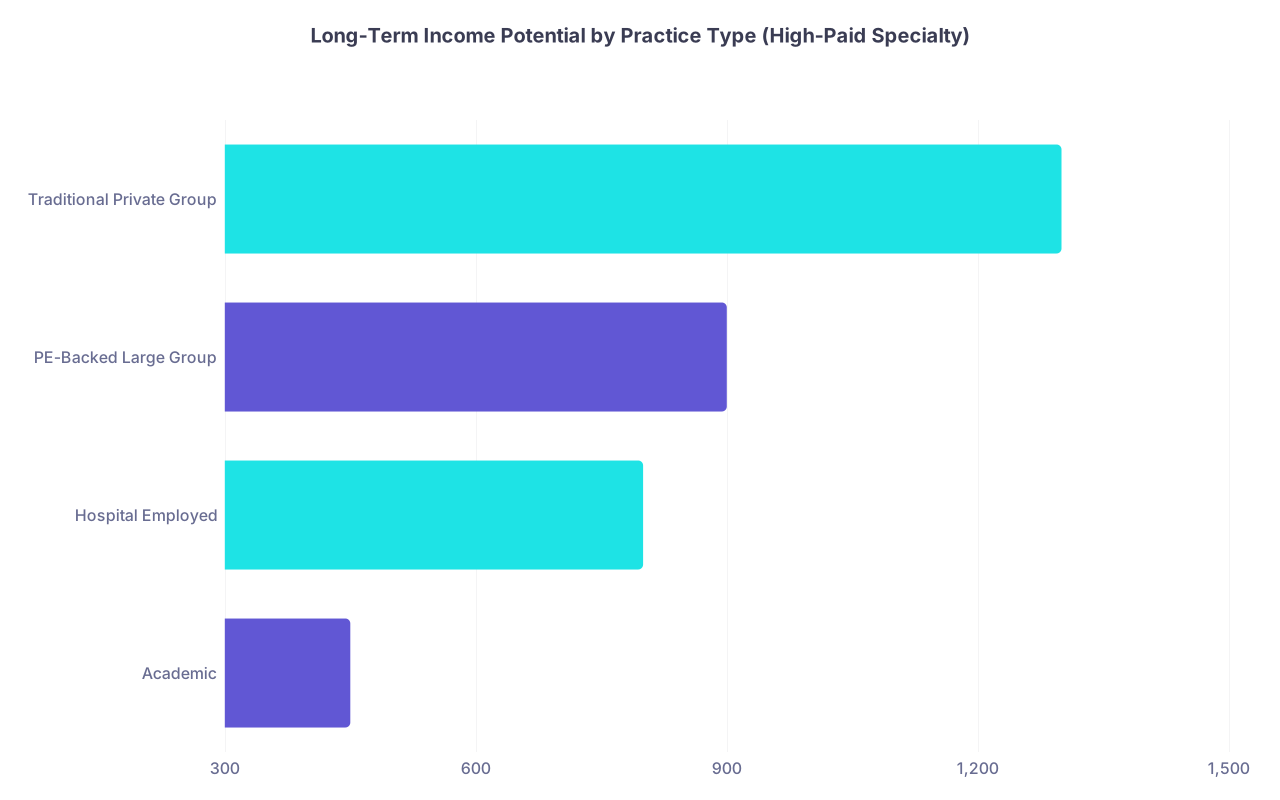
Let’s cut through the labels and talk real-world outcomes.
| Category | Value |
|---|---|
| Academic | 450 |
| Hospital Employed | 800 |
| PE-Backed Large Group | 900 |
| Traditional Private Group | 1300 |
Those numbers are rough median ceilings I’ve seen for procedural-heavy specialties over 7–10 years in practice.
Academic
- First contract often painfully low: $250–350k even in high-paying fields, occasionally higher in surgical subs.
- Curve is flatter. Yes, you might inch up with promotion, but the ceiling is often half of what a private partner can make.
- Hidden curve here is in protected time, prestige, and side gigs (consulting, expert witness, industry). Money is not the story for most.
Hospital Employed
- Great floor, weak ceiling.
- First contract looks fat, especially if they’re desperate (call-heavy ortho, trauma surgery, IR).
- Raises tend to be corporate: COLA + occasional “market adjustment.”
- You might get a decent bump after proving yourself, but it rarely matches what your RVUs would command across town in a group.
PE-Backed / Corporate Groups
- Flashy signing bonus, sometimes strong base.
- The hidden curve used to be equity events (recapitalizations, etc.). That game is now crowded and much riskier.
- The real trap is that these models often wall you off from ancillaries and real ownership. You become a very well-paid employee of a financial machine whose upside flows upstairs.
Traditional Private Group
- Often looks underwhelming on paper for the first 2–3 years.
- Buy-in checks scare people.
- The hidden curve, though, is exactly what you think it is: high, uncapped upside if the group is healthy and the partnership structure is honest.
The mistake residents make is optimizing entirely for year 1–2 cash instead of the 10-year area under the curve.
How to Protect Your Curve Before You Sign Anything
You can’t control every detail, but you can stop walking into a rigged game.
A few concrete moves:
- Ask to see recent partner-level comp data in de-identified range form. If they will not show you what senior folks are making, assume the curve is bad for you and good for them.
- Demand clarity on the partnership path. Timeline, buy-in, voting rights, access to ancillaries. Vague = bad.
- Get RVU thresholds and conversion factors in writing. And ask how those numbers have changed for prior hires at renewal.
- Hire a real physician contract attorney, not a random employment lawyer. Someone who has seen dozens of deals in your specialty and region.
- Think like you’re already in year 5. Ask: “If I become one of your high-volume attendings, what does my compensation realistically look like?” Push them to answer with numbers, not adjectives.
And a mindset shift: your first job is not a marriage. It’s your first round in a long negotiation. You are allowed to leave. In fact, the attendings with the best curves often did leave once, strategically, when their leverage peaked.