
The physicians who end up underpaid for a decade almost all have one thing in common: they never really understood RVUs when it still mattered.
If you’re headed toward one of the highest paid specialties—ortho, neurosurgery, cardiology, GI, derm, radiology, anesthesia—RVUs are not a side detail. They are the steering wheel of your future income. Ignore them, and you’re basically letting someone else drive your career with the headlights off.
Let me walk you through the mistakes I see over and over from residents and new attendings who think RVUs are “for later.” They pay for that attitude. Hard.
1. Thinking “I’ll Learn RVUs When I’m Negotiating” – You’ll Be Too Late
Here’s the ugly truth: by the time you’re signing your first attending contract, the leverage you wish you had built with RVU knowledge is already gone.
Most residents in high-paying fields make two critical errors:
- They don’t know what a “normal” RVU volume looks like in their specialty.
- They don’t know what a fair “dollars per RVU” rate is in their region.
So when the recruiter says, “Our doctors average 7,000 wRVUs a year at $55 per wRVU,” they just nod, because they have no frame of reference. Is 7,000 good? Bad? Decent for ortho but terrible for GI? They have no idea.
Here’s what should be happening during residency:
- You regularly check MGMA (or at least ask attendings who do) for benchmark RVUs and comp.
- You ask your attendings roughly what they generate in RVUs.
- You track your own productivity on rotations that measure it.
But almost nobody does this. They focus on the base salary number only. Big mistake.
Because once you accept RVU targets that are either:
- Unrealistically high (you’ll miss the bonus every year), or
- Too low for your specialty (you’re underutilizing your earning power),
you’ve locked yourself into a comp structure that can quietly bleed you by six figures a year.
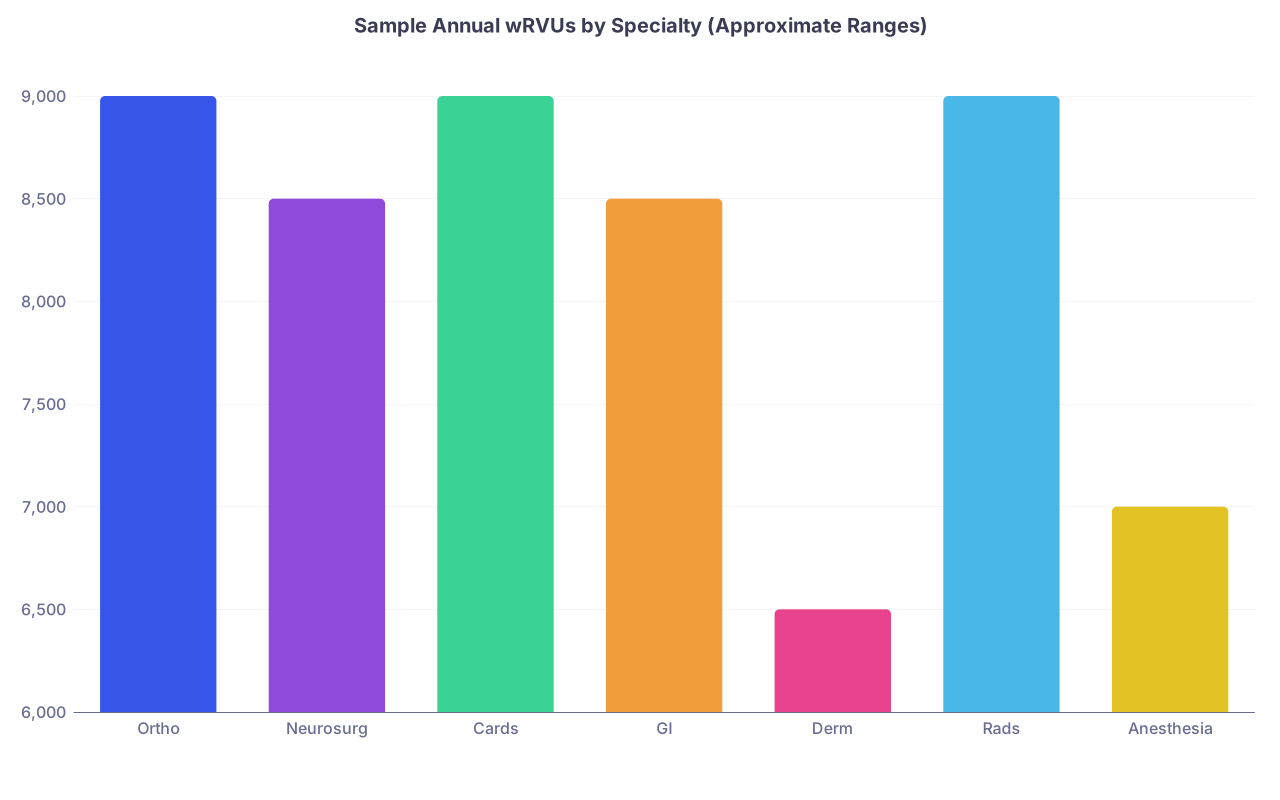
| Category | Value |
|---|---|
| Ortho | 9000 |
| Neurosurg | 8500 |
| Cards | 9000 |
| GI | 8500 |
| Derm | 6500 |
| Rads | 9000 |
| Anesthesia | 7000 |
If you don’t know where your specialty typically lands on that graph, you’re already behind.
2. Confusing “Big Salary Number” With “Good RVU Deal”
The hospital hands you a glossy offer: “$600,000 guaranteed for two years!” You feel like you’ve won the lottery. You haven’t even asked the RVU questions.
This is exactly how people get trapped.
Here’s how the trap works in high-earning specialties:
- Year 1–2: High guaranteed base, minimal pressure.
- Year 3+: Base drops. Now you’re on RVU-based compensation.
- Only then do you realize:
- The RVU conversion factor is low.
- The RVU target is high.
- You control less of your volume than you thought.
So while your co-fellow in another group might be making $800k for similar work, you’re capped in the low 600s because your RVU conversion factor is trash.
Do not fall for the “fake comfort” of the initial guarantee. You need to ask:
- What’s the wRVU conversion rate after the guarantee?
- What is the expected wRVU volume for similar attendings here?
- How many physicians are actually hitting bonus?
If they dodge or handwave those answers, that’s a red flag the size of a CT scanner.
3. Not Understanding How Your Specialty’s RVUs Are “Weighted”
In high-paid specialties, not all RVUs are created equal. And if you don’t know how procedures, follow-ups, and ancillary work convert to RVUs, you’ll underestimate or overestimate your earning potential.
Examples:
- Orthopedic surgery: Procedures are monster RVU generators. Clinic visits? Not so much.
- GI: Screening colonoscopies vs. complex therapeutic ERCPs—huge RVU differences.
- Interventional cardiology: Cath lab drives most of your RVUs; clinic can be relatively light.
- Derm: Procedures and cosmetics (if paid separately) may not align neatly with RVU-based comp.
The mistake is believing “I’m in a high-paying specialty, so any RVU job will be high paying.” Wrong.
You need to know:
- Which CPT codes in your specialty drive the bulk of RVUs.
- Whether the practice/hospital is structured to maximize those for you—or for someone else.

I’ve seen an ortho sports surgeon sign with a group where:
- The partners kept most of the high-RVU cases.
- The new hire got mostly clinic and low-RVU bread-and-butter work.
On paper, it was “RVU-based” and “fair.” In reality, he had no pathway to the RVU volumes assumed in his contract. It took him years—and a job change—to fix it.
4. Ignoring the RVU Conversion Factor: The Silent Income Killer
Ask residents what their ideal starting salary is. They’ll give you a number.
Ask them what a good $/RVU rate is in their specialty. Blank stares.
This is like shopping for a car and never asking the price per month. You just hear “nice car” and sign.
In RVU-based pay, the conversion factor is everything. Two cardiologists, both doing ~9,000 wRVUs a year:
- Cardiologist A: $48/RVU → ~$432,000 plus maybe a small bonus
- Cardiologist B: $70/RVU → ~$630,000
Same work. $200k+ difference. Every year.
| Annual wRVUs | $48/RVU Income | $60/RVU Income | $70/RVU Income |
|---|---|---|---|
| 7,000 | $336,000 | $420,000 | $490,000 |
| 9,000 | $432,000 | $540,000 | $630,000 |
| 11,000 | $528,000 | $660,000 | $770,000 |
If you don’t know:
- What your region’s median $/RVU is in MGMA or similar data
- How your offer compares to that
You are negotiating blind.
And if you accept a low conversion factor in a “prestige” system because “everyone wants to work here,” you may be trading away millions over your career for a nice logo on your ID badge.
5. Forgetting That RVUs Don’t Measure Everything You Do
RVUs reward billable work. Not all valuable work is billable.
In many high-paid specialties, this mismatch is brutal:
- ICU nights for anesthesia or critical care with tons of non-billable coordination and documentation.
- Neurosurgery “free” curbside consults, phone calls, family conferences that eat hours.
- Cardiology reading non-billable EKGs as favors for the hospital or ED.
- Radiology doing endless non-RVU-credited admin or quality meetings.
If your comp is heavily RVU-based and your job has a big load of:
- Call that doesn’t generate much billable work
- Teaching that’s not compensated
- Administrative roles without stipends
- Mandated committee time with zero RVU credit
Then your effective $/hour can plummet.
Residents make a classic mistake: they compare only headline salaries and ignore:
- Call RVU credit (or lack of it)
- “Citizenship” tasks that eat clinical time
- Whether call time is actually RVU-productive in that system
You want roles where either:
- Non-RVU work is separately compensated, or
- Non-RVU work is minimal, or
- Your base is high enough that RVUs are just upside, not survival.
If a job loads you with call, admin, and teaching but pays you purely on RVUs, that’s a red flag screaming “cheap labor.”
6. Not Tracking Your Own Productivity During Residency
You can’t negotiate what you don’t measure.
One of the worst mistakes I see future high earners make: they never develop the habit of tracking their own output. Then they walk into a contract having no idea what kind of RVU volume matches their work style.
Some programs actually show residents their RVUs. Most don’t spoon feed it. So this is on you.
What to track (even roughly):
- Number of procedures per week/month
- Types of cases (major vs minor procedures, high vs low RVU)
- Clinic volume (new vs follow-up patients)
- Call burden and how much real, billable work happens during it
Then, before you sign any RVU-based job, you ask direct questions like:
- “A typical full-time partner in your practice—rough ballpark—what annual RVU range are they in?”
- “What percentage of your doctors hit or exceed target RVUs?”
- “What did your last new hire actually generate in year 1, 2, 3?”
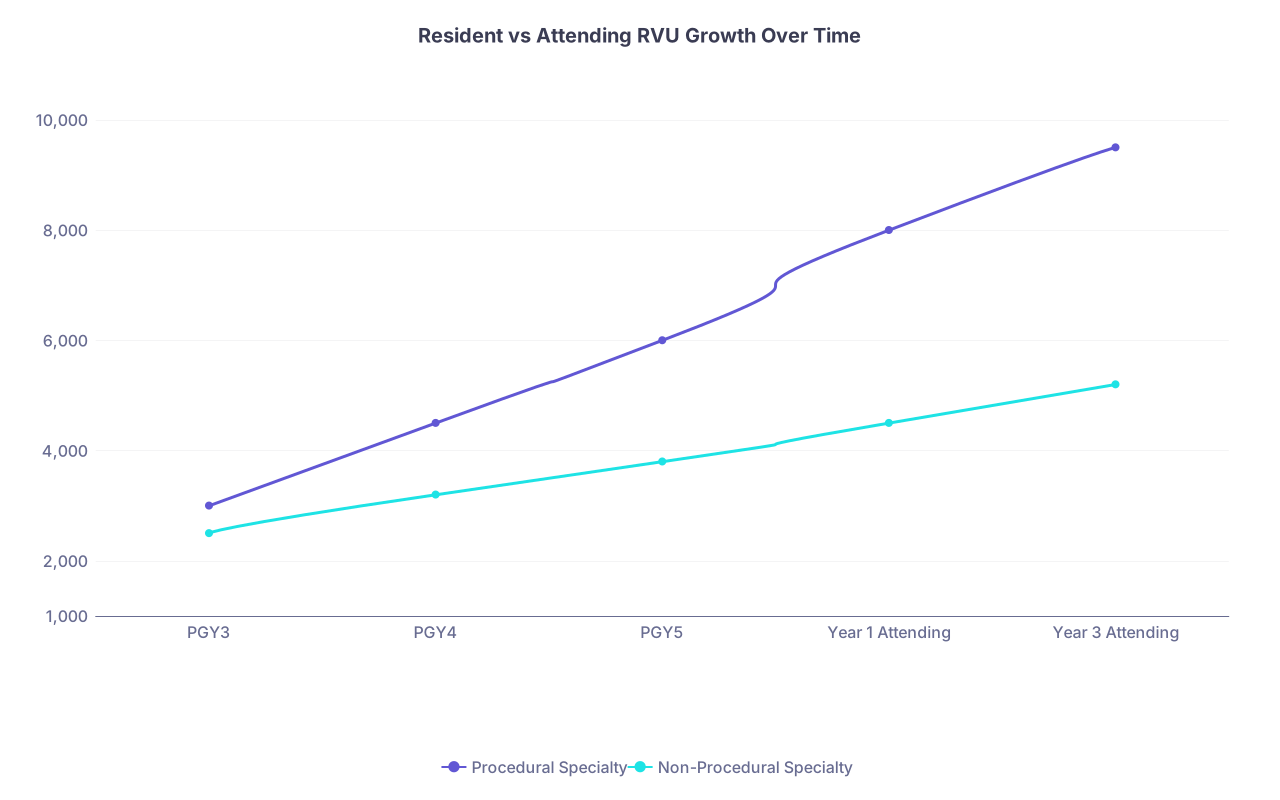
| Category | Procedural Specialty | Non-Procedural Specialty |
|---|---|---|
| PGY3 | 3000 | 2500 |
| PGY4 | 4500 | 3200 |
| PGY5 | 6000 | 3800 |
| Year 1 Attending | 8000 | 4500 |
| Year 3 Attending | 9500 | 5200 |
If you’ve never thought about your productivity until you’re staring at a target like “10,000 RVUs,” that number will mean nothing to you. And that’s how people get stuck in impossible bonus tiers.
7. Underestimating How Schedule Design Affects RVUs
Your contract can say “RVU-based compensation” all it wants. If you don’t have access to volume, you will never hit your targets.
Common traps in high-paid specialties:
- Radiology: Too many required non-billable “administrative” reads or peer reviews not counted as RVUs.
- Derm: Limited access to cosmetic or procedure-heavy blocks; you’re stuck in low-RVU medical derm clinics.
- GI: Competing with older partners for endoscopy block time; you end up with leftover slots.
- Ortho: Clinic schedule overstuffed with follow-ups, not enough new patients or OR days.
You must connect:
- How many clinic sessions,
- How many OR or procedure days,
- How scheduling is triaged and who controls it,
…to your RVU potential.
If partners or administration control:
- Who gets complex, high-RVU cases
- Who gets same-day add-ons
- Who gets prime-time OR blocks
They control your income, no matter what your contract says.
You want to know before signing:
- “How are new patients distributed?”
- “How is OR/endoscopy/cath lab time assigned?”
- “Is there any guarantee of minimum block time in my contract?”
If the answer is always “We’ll figure it out later” or “Trust us, you’ll be busy,” that’s not a plan. That’s wishful thinking at your expense.
8. Ignoring How RVUs Interact With Partnership and Buy-In
In many of the highest paid specialties, the real money isn’t just RVUs. It’s:
- Partnership distributions
- Ancillary income (ASC, imaging, labs, PT)
- Ownership in real estate or equipment
Residents make a big mistake by treating these as bonuses on top of an RVU salary. They’re not. They’re often the main course.
Here’s the trap:
- Initial years: You’re on RVU-based employed comp.
- Later years: You buy into partnership, get a share of ancillaries.
- But: Entry into partnership may depend on your RVU numbers.
If your RVU deal is bad early on, you may:
- Struggle to afford buy-in.
- Be “evaluated” as underproductive and delayed for partnership.
- Watch your co-fellows in other groups hit seven-figure totals while you’re stuck at $450–600k.
You must see the whole financial picture:
- What’s the path from your starting RVU-based comp to full partner?
- Are there RVU thresholds to qualify for partnership?
- How long did it take the last three people to become partners—and what were their RVU levels?

If you ignore this and only look at year-1 salary, you’re making a short-term decision in a long-term game.
9. Assuming “Academic” Means You Can Ignore RVUs
This one hits a lot of future specialists who picture themselves in a university job with “less focus on money.”
Here’s the harsh reality: most academic centers now track RVUs aggressively. Even with a supposedly “salary-based” structure, RVUs often affect:
- Promotions
- Retention
- Bonus eligibility
- Expansion or support for your program
The mistake: Residents choose academic jobs thinking, “I don’t care about RVUs,” then gradually realize:
- Their salary stagnates because they’re labeled “low productivity.”
- Extra admin and teaching time is expected but not compensated.
- The research they imagined doing is squeezed out by RVU pressure.
Being in academics does not absolve you from understanding RVUs. It just adds an extra layer: now you’re fighting for time and funding in a system that uses RVUs to justify everything from support staff to program growth.
If you want academics, fine. Just don’t be the attending who wakes up at 40 and realizes they’ve been subsidizing the system with their time because they never understood how their RVUs were being used as a scoring metric.
10. Believing You Can “Fix It Later” If You Hate Your RVU Deal
This is the most expensive lie residents tell themselves.
“I’ll just sign this first job, get a few years of experience, then I’ll renegotiate.”
Here’s what actually happens:
- You get busy.
- You put down roots.
- Your kids start school.
- You get used to the EMR and the system.
- Moving suddenly feels like tearing your life in half.
And your employer knows this. That’s why they’re in no rush to fix your bad RVU setup.
By the time you finally get angry enough to look around, several things are true:
- You’ve lost 3–7 years of optimal earning.
- You don’t have up-to-date comp benchmarks in your head.
- You may feel “too old” to start over somewhere new.
You aren’t. But it will feel that way.
The much smarter play is to be ruthless up front:
- Ask hard questions about RVUs before you sign anything.
- Walk away from offers that can’t explain volume, scheduling, or conversion factor clearly.
- Compare at least 3–5 offers so you see patterns.
You’re in a high-paying specialty. A few hours of hard RVU homework now can mean hundreds of thousands a year for the rest of your career.
Concrete Next Steps (Do These Before You Sign Anything)
Do not wait until fellowship graduation to care about this. Start now.
Grab a notebook (or spreadsheet) and list:
- Your target specialty
- Three practice settings you’d consider (academic, private, hospital employed, hybrid)
For each combo, write down:
- Typical annual RVUs (look up MGMA ranges, ask attendings)
- Reasonable $/RVU range in your region
- Typical procedure vs clinic mix
At your next rotation:
- Ask one attending: “Roughly what are your annual RVUs?”
- Ask: “Do you feel your $/RVU is fair compared to MGMA?”
- Watch their face when they answer. You’ll learn a lot.
Create a running list of questions to ask future recruiters:
- “What is the median annual RVU for physicians in this role?”
- “What is the $/RVU after the guarantee period?”
- “What percentage of your physicians hit target?”
- “Who controls scheduling and block time?”
The mistake to avoid is waiting. Open a blank document today and start writing those numbers and questions down. That’s your first line of defense against a decade of underpayment.