
The most dangerous job offers in high-earning specialties are not the obviously bad ones. They are the ones that look “too good to be true” and almost are.
If you are going into orthopedic surgery, dermatology, plastics, radiology, anesthesiology, GI, cardiology, or any other top-paying field, you will be aggressively courted. You will be told you are “like a partner from day one.” You will be promised top 1% income “with minimal call.” This is exactly when people sign away control, autonomy, and sometimes years of their career.
Let me walk you through the traps I keep seeing residents and early attendings fall into. The red flags that should make you slow down, ask questions, and probably get a real healthcare attorney involved before you touch a pen.
The “Too Good to Be True” Compensation Trap
This is the first classic mistake: believing headline numbers without asking how they are actually achieved.
You will see things like:
- “Guaranteed $800k first year!”
- “Seven-figure income potential in year 2!”
- “Partnership track with equity upside!”
Sounds great. Until you read the mechanics.
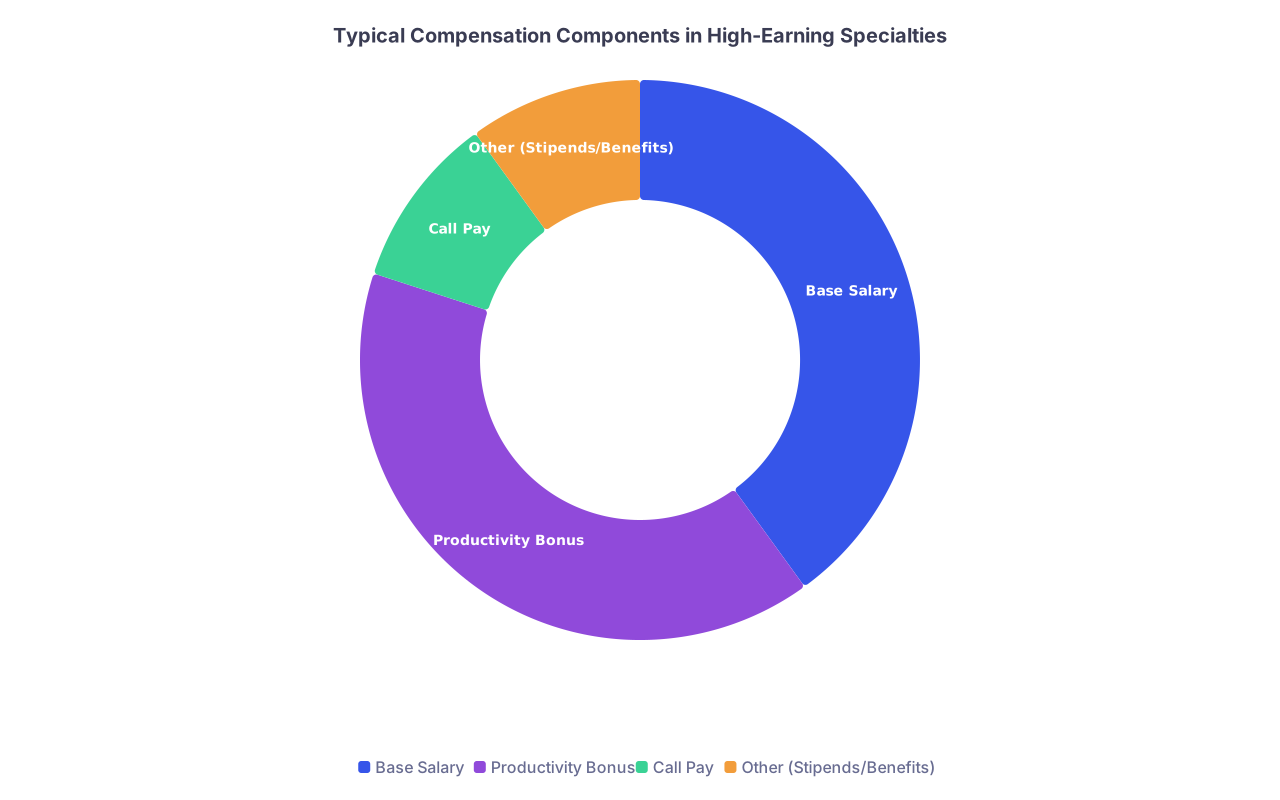
| Category | Value |
|---|---|
| Base Salary | 40 |
| Productivity Bonus | 40 |
| Call Pay | 10 |
| Other (Stipends/Benefits) | 10 |
Here are the red flags in comp structures you should not ignore:
Unrealistic wRVU expectations
If the offer is RVU-based, look at the target. I have seen radiology offers pegged at 11,000–12,000 RVUs and ortho offers at productivity levels that only the senior partners hit after 10 years.Red flags:
- No historical data on what current physicians actually bill.
- Targets well above MGMA 75th–90th percentile productivity for your specialty.
- “Everyone here hits this easily” with no proof.
You should explicitly ask for:
- The average RVUs per physician over the last 2–3 years.
- The median, not just the top outliers.
- How many people have failed to hit target and what happened to them.
Huge “guarantee” with steep clawbacks
Example I have literally seen: “$600,000 salary guaranteed for 2 years” in a specialty where starting offers are usually $350–450k. Tucked in the back of the contract: if you leave within 3–5 years, you owe back a portion of that guarantee, sometimes plus tail coverage.Translation: It is a loan dressed up as a salary.
Red flags:
- Any language about “forgivable loan,” “advance,” or “promissory note.”
- Payback terms that survive termination “for any reason.”
- Forgiveness tied to long service commitments (5+ years) without reciprocal protections.
Bonuses based on opaque or uncontrollable metrics
“Quality bonuses” can be legitimate. They can also be a black box that never pays.Bad signs:
- No clear written formula for how bonuses are calculated.
- Bonuses controlled entirely by administration’s “discretion.”
- Metrics depending on system-level outcomes you do not control (e.g., hospital readmission rates for the entire service line, regardless of your own care).
Collections-based pay with zero transparency
Common in plastics, derm, GI, cardiology, private anesthesia groups. “You will be paid X% of collections.”Innocent on paper. Dangerous if:
- You cannot see detailed monthly collection reports by CPT code and payer.
- The practice uses in-house billing that is a black box.
- They refuse to show you historical payer mix and denial rates.
If your pay depends on collections and you cannot verify how money comes in, you are asking to be underpaid.
The Partnership Mirage: “You’ll Be a Partner in 2 Years”
Partnership is where high earners really make money. That is why some groups weaponize the word.
I have seen this movie over and over: fancy private practice anesthesia, ortho, GI, radiology, derm, promises partnership “in 2 years.” Residents sign. Work insane hours. At the end of year 2, the goalposts quietly shift.
Here are the ugly patterns:
No written partnership criteria
If partnership is not spelled out in writing, it does not exist.Absolute red flag:
- Contract says “potential for partnership after 2–3 years based on mutual agreement.”
- No clear buy-in amount.
- No formula for partner income.
- No description of how many partners there are vs non-partners.
Ask for:
- Written criteria for partnership (RVUs, citizenship, quality metrics, etc.).
- The exact buy-in cost, structure (cash, promissory note), and timeline.
- Current partner and associate compensation ranges.
Endless “associate” purgatory
Some groups intentionally churn associates. They make more money keeping you as a lower-paid worker than sharing partner profits.Red flags:
- High turnover of associates in the last 5 years.
- No one has actually made partner in the timeframe they are quoting.
- Vague stories about “fit” or “readiness” when you ask about people who left.
If the last three associates all left at year 2–3 and “it just was not a good fit,” believe the pattern, not the story.
Insane buy-in structures
A big buy-in is not always a scam, but it can be structured to trap you.Bad signs:
- Buy-in tied to an inflated, unexplained “practice valuation” done by someone’s friend.
- Requirement to finance the buy-in through a specific bank or internal loan with punitive interest.
- No documentation of what exactly you are buying (accounts receivable? real estate? equipment? goodwill?).
Reasonable: transparent valuation, clear explanation, multiple physicians have done it and are happy.
Red flag: “This is just how we do it, everyone pays it, you will make it back in 2 years, trust us.”Partners still doing clearly unequal work
If partners are still taking the worst call, weekends, and nights, that is one thing. But if you notice that partners have cushy schedules while associates take all the bad shifts, and this is presented as “paying your dues,” be very careful.That usually means they see you as cheap labor, not a future owner.
Non-Competes and Geographic Traps
You ignore the non-compete at your own risk. This is one of the most common catastrophic mistakes.
I have watched young interventional cardiologists, orthopods, and anesthesiologists move to “dream cities” only to be locked out of practicing anywhere within 30–50 miles if things go south. That is career and family disruption on a massive scale.
Typical red-flag patterns:
Overly broad geographic scope
For most employed specialists, a non-compete that covers an entire metropolitan area or 30–50 miles in every direction is absurdly aggressive.Red flags:
- Any non-compete that essentially forces you to move states to continue practicing your specialty.
- Coverage of multiple hospitals and clinics where you never work.
- “Any facility owned or affiliated with [MegaSystem Health]” in the whole region.
Long durations
One year can be tolerable. Two years is heavy-handed but sometimes negotiable. Three years or more is unreasonable in many markets.You should be asking:
- Is this even enforceable in this state? (Some states are very hostile to physician non-competes.)
- Can this be narrowed to specific sites where you actually work?
Non-competes that apply even if they fire you
The worst: the group can terminate you “without cause” and still enforce a broad non-compete.If they can:
- Cut you loose with 60–90 days’ notice.
- Keep you from working anywhere nearby.
Then you are carrying all the risk while they keep all the leverage.
Non-solicitation + non-compete combos that crush your options
Non-solicitation (cannot take staff or patients) plus a non-compete (cannot work nearby) plus heavy liquidated damages (e.g., $250,000 if you breach) is a real prison.Get a healthcare attorney to dissect this before you sign. Not your cousin who does divorces. Not your med school roommate who just finished law school. A real physician-contract attorney.
Call Schedules and Lifestyle Lies
For high-earning fields, call is everything. It is where revenue, burnout, and resentment all live.
I have yet to see a bad job where the call schedule looked honest and sustainable.

The red flags are straightforward:
Vague call descriptions
Phrases like “reasonable call,” “shared equitably,” or “comparable to peers” are meaningless without numbers.You want:
- Exact call frequency: “1 in 4 home call,” “1 in 6 in-house,” etc.
- Who covers holidays, weekends, and backup call.
- How call is adjusted for part-time or newer physicians.
If they refuse to put numbers in writing, assume reality is much worse than they are saying.
No compensation for heavy call
In high-earning specialties, especially anesthesia, cardiology, ortho trauma, neurosurgery, OB anesthesia, overnight and weekend call are massive value generators. If partners get rich off that work while you are not paid differentially for brutal stretches, that is a bright red flag.Hidden “unassigned” or “community” call obligations
The schedule might look fine on paper, but then there is a separate list:- “Unassigned trauma call”
- “ER coverage for community patients”
- “Backup coverage for affiliated sites”
Suddenly your “1 in 6” is really more like “1 in 3” for actual interruptions.
Nobody is willing to show you the real call schedule
You ask to see the last 6–12 months of call schedules. They stall. They send a “representative week.” That is deliberate.The honest groups proudly show you the real thing. The others hide.
“System-Owned” Hospital Jobs With Hidden Strings
Hospital-employed jobs in radiology, anesthesia, cardiology, surgery, GI, etc. look safe. Stable base salary. Benefits. Name-brand system.
They can still be red flag nightmares.
| Aspect | Red Flag Version | Safer Version |
|---|---|---|
| RVU Targets | Above 90th percentile with no data | Around median with historical data shared |
| Autonomy | Admin can change schedule unilaterally | Changes require physician committee input |
| Compensation | Admin can adjust formula annually at will | Changes defined and limited in contract |
| Non-Compete | Large radius, all system sites | Narrow, tied to specific facilities |
| Call | “As assigned by department” | Defined frequency and compensation |
Watch for:
Unilateral change clauses
These are poisonous. Language like:- “Compensation plan may be modified at employer’s discretion.”
- “Work schedule and duties may be adjusted as needed by administration.”
Translation: they can increase your workload, change your comp formula, or reassign you to less desirable locations without your agreement.
Productivity expectations that quietly ratchet up
The first year: easy targets, guaranteed salary. Year 2–3: RVU thresholds jump. If the contract gives the hospital full power to revise the comp plan annually, expect downward pressure.Committee and coverage obligations buried in fine print
Some contracts require:- Mandatory committee work.
- Cross-coverage at multiple hospitals 30–60 minutes apart.
- Floating to other specialties or sites whenever “operational needs” arise.
That is not inherently evil, but it can turn the “9–5 with light call” you were sold into something very different.
Employed “partnership” illusions
Administrators know you want “ownership.” So they offer:- “Medical director stipends”
- “Service line leadership roles”
- “Quality incentive panels”
As substitutes for true equity or meaningful income upside. If you want a real ownership path, be honest with yourself about whether an employed hospital job will ever give you that.
Private Equity–Backed Groups: The Short-Term Candy, Long-Term Handcuffs
Private equity has invaded derm, anesthesia, radiology, ER, GI, urology, and more. Sometimes these jobs are fine. Sometimes they are landmines.
The pattern is predictable:
- Year 1–2: generous salaries, sign-on bonuses, smooth operations.
- After a few years: cost-cutting, more volume per doc, lower new-hire salaries, shrinking bonuses.
Red flags specific to PE-backed offers:
Equity “carrots” that are vague or backloaded
You will hear: “You will have a chance to buy equity later.”
Or: “There is a second bite at the apple when we recapitalize.”Ask:
- Exactly what equity class do physicians hold now.
- What multiple the last sale was done at.
- Whether new physicians are even eligible for equity or if that ended two deals ago.
Extreme focus on metrics with no guardrails
PE loves dashboards. You may be pushed to:- Increase RVUs per hour.
- Shorten patient encounter times.
- Cut staff and use cheaper supplies.
Without meaningful language protecting you from being pressured into unsafe or unethical practice. That is not hypothetical; people feel this every day.
Short-term guarantee with long non-compete and clawbacks
The deal: “We will pay you like a king for 2 years.”
The catch: 3-year non-compete radius that covers any PE-owned site plus heavy repayment obligations for sign-on and relocation.By the time the true culture emerges, you are stuck or moving your family again.
Cultural and Operational Red Flags You Cannot Quantify but Must Not Ignore
Not every red flag lives in the contract. Some are in the room when you interview.
If you blow past these, the signed terms will not save you.

| Step | Description |
|---|---|
| Step 1 | Receive Offer |
| Step 2 | Review Compensation Details |
| Step 3 | Request Clarification |
| Step 4 | Review Noncompete and Call |
| Step 5 | Get Attorney Review |
| Step 6 | Assess Culture and Turnover |
| Step 7 | Strongly Consider Walking Away |
| Step 8 | Negotiate Final Terms |
| Step 9 | Sign Only If Comfortable |
| Step 10 | Red flags? |
| Step 11 | Still vague or concerning? |
| Step 12 | High turnover or evasive answers? |
Pay attention to:
High physician turnover
Ask directly: “How many physicians have left in the last 3–5 years?”
Then ask: “Where did they go?”
If they get cagey, or tell you people “left medicine” in suspiciously high numbers, something is wrong.No one is willing to talk candidly off the record
When candidates visit a healthy group, somebody pulls them aside and tells the unvarnished truth. If everyone seems tightly scripted, guarded, and will not talk without admin in the room, take that seriously.Junior physicians look exhausted and disengaged
Watch the body language. I have sat in lounges where the younger attendings warn candidates with their eyes long before they say a word.You are rushed and pressured to sign
“We need an answer in 48 hours, we have other candidates.”
That is not how good, stable groups operate. That is how people act when they know you might discover something if you look too closely.
How to Protect Yourself Before You Sign Anything
You can avoid most of these disasters if you accept one thing: the job market for high-earning specialties is asymmetric. They do this every year. You sign a contract a handful of times in your life.
Here is how you level that playing field.
Get a real physician-contract attorney
Do not “skim it” yourself. Do not let a friend who did a summer internship at a law firm glance over it. Pay for proper review from someone who reads specialty contracts for a living. The cost is trivial compared to a single bad year in a toxic job.Demand actual data, not vague assurances
Ask for:- Historical RVU or collections data for physicians in your role.
- Call schedules for the last 6–12 months.
- Turnover numbers for the last 3–5 years.
- Clarification of any unilateral-change language.
If they refuse, that is your answer.
Treat non-compete clauses as career-level decisions
Assume the job may not work out. Can you live with the restrictions if you leave in 1–2 years? If the answer is no, you negotiate or you walk.Value culture as much as compensation
A $50–100k bump is meaningless if you are miserable, trapped, or burning out. Plenty of orthopedic surgeons, dermatologists, radiologists, and anesthesiologists make slightly less but actually like their lives.Be willing to walk away
The most common regret I hear: “I saw some red flags, but the money was so good and I felt pressured, so I signed anyway.”
The happiest attendings say the opposite: “I walked away from a sketchy offer. Something better came 3 months later.”
The Bottom Line
Three things I want you to remember:
- The biggest red flags are vague promises: of partnership, of bonuses, of “reasonable” call, with nothing concrete behind them.
- Non-competes, clawbacks, and unilateral-change clauses can matter more than the starting salary. They determine your freedom if the job goes bad.
- If a group or system will not show you real data, define expectations in writing, and let you get independent legal review without pressure, you should not work there—no matter how big the number at the top of the offer letter looks.