
You’re three months from finishing residency in a high-paying specialty—say ortho, derm, neurosurg, ENT, IR, GI, plastics, anesthesia. The offer letters are trickling in. Your co-resident just bragged about a $650k “base” plus RVUs. Someone else signed with a private equity–backed group that “guaranteed” crazy bonuses.
You’re about to lock in decisions that will dictate your earnings curve for the next decade.
This is the five-year, post-residency timeline to hit peak earnings sooner—without burning yourself out or getting trapped in a bad deal. I’ll walk year-by-year and, when needed, month-by-month. At each point: what you should be doing, what’s a trap, and what moves actually move the needle for the highest-paid specialties.
Big Picture: Your Five-Year Earnings Curve
Let’s frame the target first.
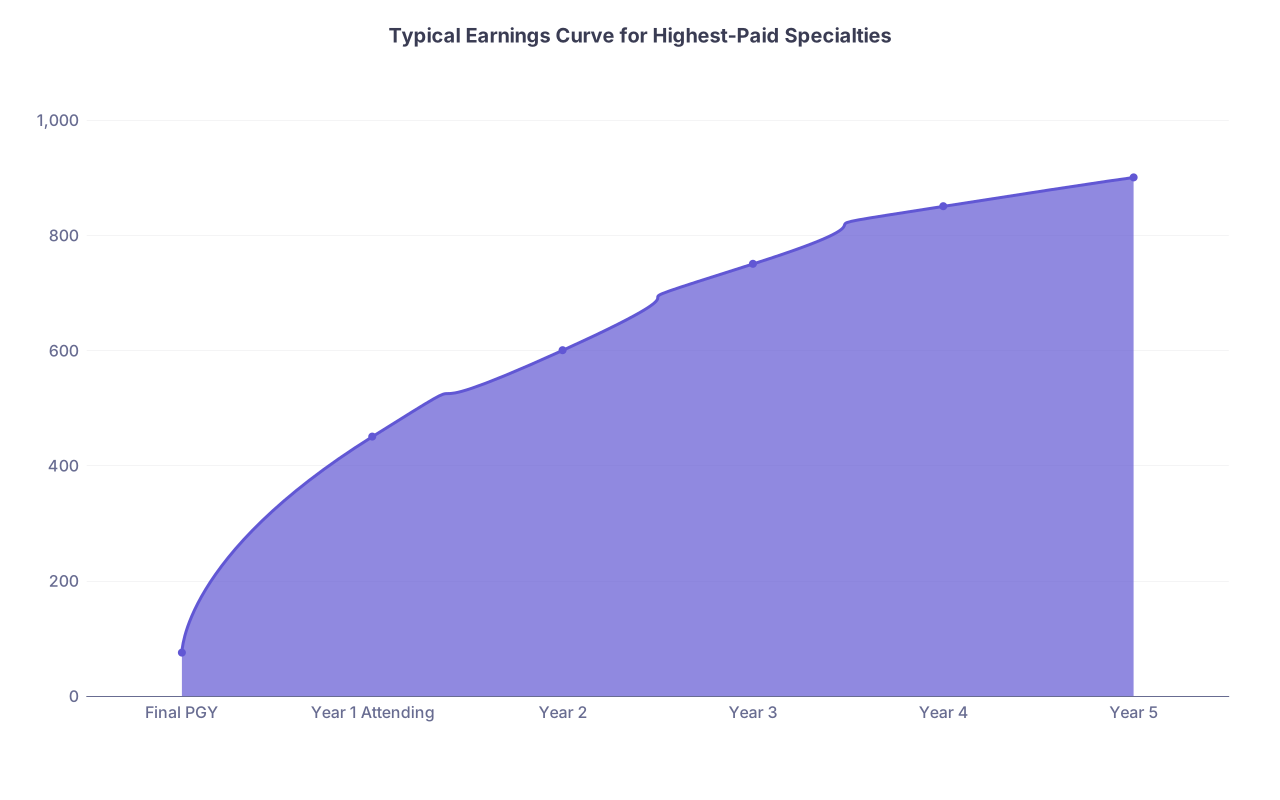
For most top-paying specialties, a realistic peak earnings window looks like this (median, not unicorn):
| Category | Value |
|---|---|
| Final PGY | 75 |
| Year 1 Attending | 450 |
| Year 2 | 600 |
| Year 3 | 750 |
| Year 4 | 850 |
| Year 5 | 900 |
Not everyone hits these numbers. Many never get past Year 2 levels because they choose the wrong structure, negotiate badly, or never build volume/skills strategically.
Your job: compress what usually takes 7–10 years into 5.
Final 6–9 Months of Residency: Set Up the Launch
At this point you should stop thinking like a trainee and start acting like a future business owner, even if you plan to be “just an employee.”
Month -9 to -6: Decide on Your Earnings Model
You’re here:
- You know your specialty (e.g., ortho spine vs sports, interventional vs diagnostic, GI advanced vs general).
- You’re getting early interest from groups and hospital systems.
Your task in this window: pick the model that matches your fast-earnings goal.
Broadly:
| Model | Pros | Cons |
|---|---|---|
| W-2 Employed | Stable, less admin | Often caps earnings |
| Private Practice Partner Track | Huge upside | Risk, more business work |
| Private Equity–Backed Group | Big early money | Loss of control, unstable long term |
| Academic with Heavy RVU | Brand name, niche | Slower peak pay |
If your priority is peak earnings as soon as possible, and you’re in a highest-paid field, I rank them:
- Strong private group with real partnership
- Hybrid hospital-employed with uncapped RVUs and transparent data
- PE-backed only if you understand the exit and what you’re giving up
- Pure academic – fine, but you’re accepting a lower ceiling for most specialties
This is where people blow it: they sign too early for a “guarantee” and never see upside.
Month -6 to -3: Get Ruthless with Contract Details
At this point you should:
- Narrow to 2–3 serious options.
- Have a physician contract attorney and a senior mentor in your specialty look at offers.
For high-paying specialties, the only numbers that matter long term:
- Time to partnership (if any) and what partnership actually means (equity? ASC share? imaging? ancillaries?)
- RVU rate or collections % after the guarantee period
- Non-compete radius and duration
- Ownership of procedures/ancillaries (ASC, imaging center, pathology, cosmetics, etc.)
Red flags I’ve personally seen sink earnings:
- Non-compete that effectively blocks your entire metro area.
- “Partnership” that is just a title, no equity, no change in comp formula.
- Collections percentage under 40–45% for procedural specialties in private practice.
- RVU compensation that doesn’t increase when your volume does.
You should create a one-page grid comparing your offers:
- Base / guarantee (Years 1–2)
- Realistic Year 3+ earnings based on existing partner data (demand it, anonymized is fine)
- Call expectations and pay
- Nonclinical time vs expectations
- Ownership/partnership path
If they “can’t show you numbers,” that’s all you need to know.
Year 0–1: New Attending – Lay the Earnings Foundation
Think of Year 1 as infrastructure year. You’re building the machine that will print money later.
Months 0–3: Onboarding and Rapid Volume Build
At this point you should:
- Know your clinic templates cold: slots per half-day, new vs follow-up, procedure blocks.
- Meet the schedulers, MAs, NPs/PA-Cs, and admin one by one. These people control your volume far more than your chair does.
Your focus areas:
Fast Access = Fast Money
Make it stupid-easy to get on your schedule early on:- Accept same-day add-ons for referring docs.
- Hold a few “urgent” slots that your staff can fill without begging you.
- Say yes to the annoying consults early. They become pipelines.
Referrer Relationships I’ve seen this move the needle faster than any marketing.
In the first 90 days:
- Identify top 10 referring physicians/clinics you want (PCPs, ED, onc, rheum, OB, etc., depending on your field).
- Physically go to them. Shake hands. Give your cell.
- Turn around consult notes fast. Call them back on complex cases.
That’s how you become “the person” for X problem in that region.
Operational Efficiency You should:
- Standardize pre-op, post-op, injection, or procedure protocols.
- Use templates and smart phrases aggressively.
- Ask your MA/scheduler weekly: “What’s slowing us down?” Then fix one thing each week.
Aim by Month 3–4: be at 60–70% of your target clinical volume, not waiting around for perfect systems.
Months 4–12: Skill Differentiation and Early Leverage
This is the part people ignore while chasing RVUs: your niche.
In high-paying specialties, top 10–20% earners almost always:
- Do something others in the group cannot or will not (complex cases, niche procedures, advanced endoscopy, microvascular, Mohs, interventional pain, etc.).
- Manage high-value, high-reimbursement cases efficiently and safely.
Your timeline here:
By Month 6:
- Identify 1–2 high-value procedures you want to own (e.g., spine deformity, complex endoscopy, advanced cosmetics, complex recon, complex IR procedures).
- Start tracking your outcomes and complications personally.
- Ask for more of those cases when they come up.
By Month 9–12:
- Be the “go-to” within the group for those cases.
- Negotiate block time that supports this focus.
You’re not trying to be a generalist forever. Generalists top out earlier.
Year 2: Turn Volume into Leverage
Year 2 is where most people either get stuck in “busy but underpaid” mode or start climbing fast.
At this point you should:
- Have reliably full clinics and OR/procedure days.
- Know your personal revenue numbers (collections, RVUs).
Early Year 2: Data and Negotiation
Your tasks:
Get Your Actual Revenue Data You want:
- RVUs per month
- Collections per month
- Payer mix
- Case mix
Do not rely on vague summaries. Ask for reports.
Compare to Benchmarks Use MGMA or specialty society data. Look specifically at:
- Your percentile for work RVUs.
- Your percentile for compensation.
If you’re at 75th percentile for work RVUs and 40th percentile for pay, your timeline for negotiation moves up.
- Renegotiate Structure if Needed
This might mean:
- Moving from pure base + small bonus to higher RVU rate.
- Shortening partnership track if you’re significantly out-producing peers.
- Tying more of your compensation to collections where you clearly generate high revenue.
Don’t threaten. Do show math:
- “In the last 6 months I generated X RVUs / Y in collections. Here’s how that compares to benchmarks. I’d like to discuss a compensation structure that reflects that level and keeps me here long term.”
I’ve seen reasonable groups respond well to that; unreasonable ones…are useful information.
Mid–Late Year 2: Streamline and Offload
Your earning ceiling is limited by:
- How many high-yield cases you can do.
- How much low-yield work you can offload safely.
At this point you should be aggressively:
Offloading:
- Routine follow-ups that a PA/NP can handle.
- Inbox triage.
- Low-yield procedures you don’t want as your bread and butter.
Streamlining:
- Pre-op and post-op pathways so you’re not reinventing the wheel every case.
- EMR templates so you’re not wasting time charting.
- Delegable phone calls and refill protocols.
Quick sanity check for late Year 2
You should be able to answer, in one sentence each:
- “What is my most profitable procedure type, and how often do I do it?”
- “Which 20% of my work do I want to stop doing by Year 3?”
- “What is my realistic Year 3 earnings target here?”
If you can’t answer that, you’re just working harder, not smarter.
Year 3: Critical Fork – Double Down or Change Course
By the start of Year 3, you’re out of “new attending” land. You either:
- Like your group, see a clear path to equity/partnership/true upper-tier earnings.
- Are clearly being underpaid or blocked structurally.
This is the pivot year.

Scenario A: Good Group, Clear Upside
If your group is solid, at this point you should:
- Push toward partnership/equity on the fastest realistic timeline.
- Clarify, in writing:
- Buy-in amount and what you’re buying (ASC shares, real estate, ancillaries, practice equity).
- Expected distribution ranges for partners at your volume level.
- Governance: how decisions are made, what you can influence.
Year 3 focus moves to:
- Maximizing your high-yield case mix.
- Locking in predictable block time.
- Building your brand locally (talks, referring doc loyalty, maybe a limited social media presence if relevant—derm/plastics especially).
This is where your nonclinical reputation starts paying off.
Scenario B: Bad Fit, Earnings Ceiling Obvious
If:
- You’re producing at high levels.
- You’re clearly under-compensated.
- Promises keep getting pushed back or changed.
At this point you should start planning an exit with a 12–18 month horizon.
Steps, in order:
- Review your non-compete and tail coverage obligations.
- Quietly explore:
- Comp at nearby groups/hospitals.
- Whether you can move within the region or need to leave.
- Tighten expenses and cash reserves to handle any short-term income hit.
You don’t have to jump in Month 1 of Year 3, but you do need a plan by the end of it.
Year 4: Scale and Ownership – Where Peak Starts to Show
If things went reasonably well, Year 4 is where your income can make a real leap.
At this point you should be:
- Either a partner or close enough that it’s scheduled and clear.
- Doing a higher percentage of profitable work you actually like.
Year 4 Priorities
- Own Something That Pays While You Sleep
For high-paying specialties, this is often:
- ASC ownership (huge).
- Imaging or procedure center equity.
- Cosmetic or cash-pay service lines (derm, plastics, ENT).
- Formal medical directorships or service line leadership with real stipends.
This is how you move from “well-paid worker” to “high-earning physician-owner.”
Guard Your Time Like It’s Also Money (Because It Is) At this point, over-scheduling yourself with low-margin work is just bad math.
You should be:
- Saying no to poorly reimbursed, high-hassle work when you have leverage.
- Restructuring clinic templates to favor new consults and high-yield follow-ups.
- Evaluating every committee/task: does this help my earnings, skillset, or long-term options? If not, decline.
Optimize Locational Leverage For some of you, Year 4 is when relocating to a less-saturated market can immediately boost earnings by 20–50%. Or when moving across town to a better system/group makes sense now that you have a strong track record and references.
You don’t have to move—but you should at least run the math now that you have experience and data.
Year 5: Consolidate at Peak and Protect the Machine
By Year 5, if you played this right:
- You’ve either hit or are close to your peak earning trajectory.
- You know your case mix, referrer base, and revenue streams.
- You understand your comp model better than your own HR department.
Now the goal shifts: keep the earnings high and sustainable.
Year 5: Fine-Tuning for Maximum, Defensible Income
At this point you should:
Trim the Bottom 10–20% of Your Work Specifically:
- Drop unprofitable clinic sites or satellite days that don’t make sense.
- Hand off chronic, low-reimbursement follow-ups where appropriate.
- Prune your schedule so your best energy hits your highest-yield activities.
Add 1–2 Nonclinical Income Streams (Optional but Smart) Not the influencer fantasy. Solid stuff:
- Consulting for device/pharma, with clear boundaries.
- CME speaking based on your niche.
- Medical directorships for centers that actually need your specialty.
- Thoughtful real estate investment if that’s your thing, but only after your practice is humming.
Plan for Contract Cycles
- Know exactly when your contract or partnership terms renew.
- Start data collection and renegotiation discussions 6–9 months in advance.
- Keep your outside offers and market data current; they’re leverage even if you never use them.
Visual: 5-Year Action Timeline

| Period | Event |
|---|---|
| Final Residency Months - -9 to -6 months | Choose practice model and geography |
| Final Residency Months - -6 to -3 months | Compare offers and negotiate key terms |
| Final Residency Months - -3 to 0 months | Sign contract and plan onboarding |
| Year 1 - Months 0-3 | Build access and referrals |
| Year 1 - Months 4-6 | Stabilize volume, start niche focus |
| Year 1 - Months 7-12 | Optimize workflows, grow high-yield cases |
| Year 2 - Early Year 2 | Get data and renegotiate structure |
| Year 2 - Mid Year 2 | Offload low-yield work |
| Year 2 - Late Year 2 | Clarify Year 3 goals and path |
| Year 3 - Early Year 3 | Decide stay or exit strategy |
| Year 3 - Mid Year 3 | Lock in partnership path or prep move |
| Year 3 - Late Year 3 | Execute on chosen track |
| Year 4 - All Year | Acquire ownership, refine case mix, protect time |
| Year 5 - All Year | Trim low-value work, add income streams, secure renewals |
Specialty-Specific Notes (Very Brief, Very Real)
These are blunt, but accurate enough:
Orthopedic Surgery / Neurosurgery
- Peak earnings are tightly tied to OR block time and ASC ownership.
- By Year 3 you should know exactly how you’re getting into an ASC, or you’re behind.
Dermatology / Plastics
- Cash-pay is king. Start integrating cosmetic/cash early even if it’s a small slice.
- Brand and patient experience matter more; don’t ignore them while chasing volume.
GI / Interventional Card / IR
- Procedural mix and facility fees drive earnings.
- Control over scheduling and lab/room access is your bottleneck—fight for it.
ENT / Urology
- Bread-and-butter cases pay fine, but sub-niches (sleep, recon, oncology, advanced stone/BPH procedures) often separate top earners.
- Early on, position yourself for the procedures that fit your market.
Anesthesia / Pain
- For anesthesia, group structure and coverage contracts matter more than your individual skill once you’re competent.
- For pain, get clear on procedure vs med management mix; long-term high earners tend to be procedure-heavy with good systems.
Today’s Action Step
Do something concrete right now:
- Open a blank page and write “Five-Year Post-Residency Earnings Plan” at the top.
- Under it, list:
- Your target Year 3 and Year 5 annual income (real numbers).
- The practice model you’re currently aiming for.
- One move you can take this week to push that plan forward:
- Email a contract attorney,
- Schedule a call with a senior attending in your specialty,
- Request a sample contract,
- Or map out 3 geographic markets that fit your goals.
If that page stays blank, your earnings will be driven by other people’s agendas. Fill it, and you’ve started your actual five-year timeline.