The real recruiting for the highest-paying specialties does not happen on ERAS. It happens in quiet emails, “informal” dinners, invite-only group chats, and closed-door discussions where your name is either on the list—or it is not.
Let me pull back the curtain on how private groups actually recruit for radiology, derm, ortho, plastics, IR, neurosurgery, and the other top-comp fields. Because what you see on the website and what attendings say at the official info session is the polished version. The real machinery sits behind it.
The Hidden Market: Where High-Paying Fields Actually Recruit
Everyone pretends the system is “holistic” and “transparent.” It is not. For the highest paying specialties, there’s a parallel, semi-secret market running alongside the official match.
Here’s how it really works.
Programs formally “recruit” through:
- ERAS applications
- Visiting rotations
- Personal statements
- Standardized letters
But high-income specialties add an extra layer: informal vetting through private networks and closed groups. The faculty who actually make the rank list don’t comb every application equally. They start with a shortlist generated by whispers, DMs, and emails from people they trust.
I’ve watched this play out in real time on selection committees.
A PD opens the stack of 800 applications and says, “Let’s pull all our home students, our away rotators, and any names emailed to us by X, Y, and Z.” That’s the initial “shortlist.” Everyone else has to fight through the noise.
Where do those “emailed names” come from? That’s the part nobody explains to you as a student.
The Quiet Gatekeepers: Who Actually Puts Your Name on the List
There are four recurring gatekeepers who matter for top-paying specialties: subspecialty attendings, alumni in private practice, “whales” in academic circles, and fellows/upper-levels embedded in the right networks.
1. Subspecialty attendings with real power
In derm, plastics, ortho, IR, rads, ENT, neurosurg—there is always a small handful of attendings who actually move the needle. Everyone in the department knows exactly who they are.
They’re the ones who:
- Run the major research projects
- Sit on the actual rank committee
- Get emails from PDs at other institutions that say, “Who do you have this year?”
If one of those people decides you’re “their person,” you are playing a different game than your classmates. That’s when the private recruitment pipeline opens.
Behind closed doors, it sounds like this:
“We’ve got a strong home applicant—USMD, top quartile, very responsible, worked with me for a year. I’d like us to make sure we interview him/her.”
Or even more blunt:
“I told [Top Program] they should interview you. They owe me one.”
That’s not in any official handbook. But it’s real.
2. Alumni in high-earning private groups
In the big money specialties, the private groups have their own recruiting needs. Radiology mega-groups, ortho practices, anesthesia groups, cardiology practices. Many of them track “their” pipeline at the med school and residency they came from.
An alum texts an old residency colleague:
“Hey, who’s good in your 3rd year class thinking rads? We like to hire from you guys.”
That conversation never touches your inbox. But it might decide who gets an early read, an away slot, or a “keep an eye on this one” tag.
Those alumni will occasionally email the PD directly:
“We’d be interested in this resident down the line—worth you taking a look at them for IR/advanced spots.”
And guess what? That name goes on a list. A private one.
3. “Whales” at big-name institutions
Certain faculty at brand-name places—think MGH, UCSF, Penn, Mayo, Hopkins—carry outsized weight. If a derm or rads PD at a lesser-known program gets an email from one of those people, it’s basically a golden ticket to an interview.
I’ve seen this happen:
- Applicant at a mid-tier school
- Average Step 2, but insane research with a big-name mentor
- The mentor sends exactly two emails—to their friends at two top programs
Both of those programs not only interviewed the student, they discussed them at length at ranking.
No public posting ever said: “Having Dr. X vouch for you will compensate for a 230-something Step 2.” But in practice? It did.
Where the Private Recruitment Actually Happens: Channels You Don’t See
The channels are not mystical. They’re just not advertised to students, because then everyone would try to use them and they’d be worthless.
Let me show you the back channels.
1. Invite-only message threads and group chats
At a lot of programs, there’s a quiet GroupMe / WhatsApp / Signal thread where seniors and fellows discuss students.
For example, in ortho:
- Resident A: “Anyone worked with [Student Name]? Thinking about recommending him for an away at [Big Name Program].”
- Resident B: “Good worker, dependable, not a superstar, but solid. Shows up early. I’d vouch.”
- Resident C: “Had him on nights. No drama. You’re safe putting your name on him.”
That’s your real “evaluation.” Not the canned comments on your rotation eval.
Same in radiology, except the chat might be more about, “Who’s actually serious about IR vs just saying it?” or, “Which MS3 is worth looping into the research project group?”
You are either in the conversation or you never get mentioned.
2. Closed “interest groups” that are not really student-run
Every specialty has a “student interest group.” You already know that part.
What you might not know is that in derm, rads, plastics, ortho, anesthesia, there’s often a smaller, quieter inner circle run by a single powerhouse attending or fellow. The email list or chat for that group is where:
- Early research opportunities get dropped
- “We have a visiting student spot that opened last minute” gets advertised privately
- “This faculty member is looking for a mentee” gets circulated to 3–5 names, not 30
From the outside, it looks like things appear randomly. “Wow, crazy that Sarah got that derm research year at [Top Place].” From the inside, Sarah was looped in a year earlier because she showed up, followed through, and impressed the right fellow when nobody was watching.
3. “Informal dinners” and off-the-record chats
You’ve seen the email:
“Residents are hosting an informal dinner the night before interview day. Not evaluated.”
That’s not entirely true.
Officially, they are not writing scores. Unofficially, by the time faculty rank, someone asks:
“Any red flags from the dinner?”
“Who did you like personally?”
Same thing with “get to know us” evenings for interest groups—pizza with the ortho team, coffee with IR, a derm “Q&A” evening.
If a resident really likes you, they will mention you later. If they really do not, that also gets mentioned. The “non-evaluative” label just keeps things legally clean. It does not mean the impressions disappear.
The Money Factor: Why Private Groups Care So Much About Who You Are
High-paying private groups aren’t just looking for smart. They’re looking for profitable and low-maintenance.
That sounds crass. It’s reality.
In top-earning fields like ortho, rads, derm, GI, cardiology, anesthesia, IR, neurosurg—physician compensation is downstream of:
- Volume
- Reputation
- Referral patterns
- Group stability
So when private groups peek into the residency pipeline, they ask two questions behind closed doors:
- Is this person going to produce?
- Is this person going to cause drama or leave?
Faculty and residents answer that not from your Step score, but from how you behaved at 4:45 pm on a Friday case, or how you handled a crappy consult, or whether you actually finished the paper you promised to write.
I’ve sat in meetings where someone said about a trainee:
“He’s smart, but I would not bring him into our group. Too much ego, not enough work.”
That one comment cost that person more long-term money than a 10-point Step differential ever would.
Specialty-by-Specialty: How the Quiet Recruiting Actually Looks
Let’s get concrete. I’ll skim through how it plays out in several of the highest-paid fields.
Radiology (and IR)
Radiology is one of the most “network-heavy” specialties. On paper, it’s numbers and research. In reality, private rads groups and IR practices are constantly asking:
“Who are your good people this year?”
Behind closed doors, there’s a clear pattern:
- Research with a “name” in rads or IR gets you into the private email circle
- Strong work ethic on night float gets reported up the chain
- If an IR group has a close relationship with your residency, you might have a job half-lined up before you’ve even applied formally
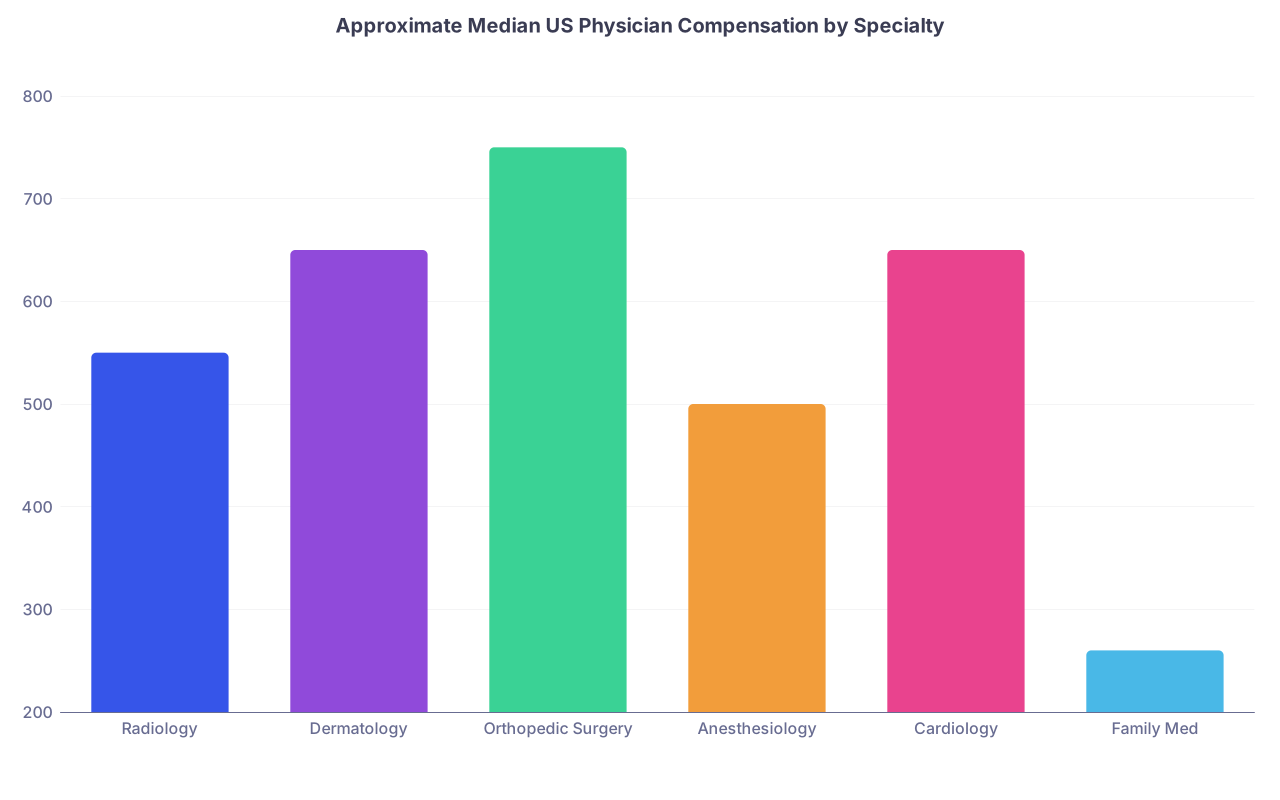
| Category | Value |
|---|---|
| Radiology | 550 |
| Dermatology | 650 |
| Orthopedic Surgery | 750 |
| Anesthesiology | 500 |
| Cardiology | 650 |
| Family Med | 260 |
That table is why they’re picky. At those numbers, hiring the wrong person is expensive.
There are also “trainee-only” listservs in rads/IR where jobs get floated privately months before they ever reach recruiters. If your PD and senior residents like you, your name gets passed into those circles with a soft endorsement.
If they don’t? You will be sifting through cold recruiter emails while your co-resident signs with a partnership-track group that never posted publicly.
Dermatology
Derm is a cartel of reputation and whisper networks.
The public story is: grades, research, AOA, professionalism. All true. But when I’ve heard derm faculty talk behind closed doors, what matters just as much is whose student you are.
You become “Dr. X’s mentee.” Once that label attaches, the recruiting network kicks in.
You get:
- Early intel on which programs have unspoken preferences
- Realistic, not sugar-coated, feedback: “You will not match at [Top 5], but you’re very competitive for [these 10]”
- Direct emails sent on your behalf: “We have an excellent applicant, I’d appreciate if you could take a look at their file.”
I’ve seen derm PDs at lower-volume programs openly ask during meetings:
“Who belongs to [Big Name Derm Faculty] this year? We should at least talk about those applicants.”
You want to be one of those names.
Orthopedic Surgery and Neurosurgery
Ortho and neurosurg are still old-school in one way: they heavily reward “our kind of person.” That doesn’t mean a stereotype. It means someone who fits their internal culture.
Behind those closed doors, recruiting looks like:
- Residents vouching hard for a student who stayed late, didn’t complain, owned mistakes
- Faculty texting colleagues at other programs: “We have a solid away rotator you should take”
- Visiting rotations used as extended job interviews—more than any other fields

If you impress the right senior who’s tight with the PD, you’ll get an invite. If you irritate the wrong senior—even once—you will quietly fall off lists you never saw.
Anesthesiology
Anesthesia’s market is directly tied to OR volume and group politics. Private groups care a lot about whether you’ll:
- Handle stress
- Get along with surgeons
- Show up, do the cases, not start fires
That translates into a recruiting style that leans heavily on resident-to-attending recommendations.
On the residency side, PDs get regular pinged by alumni:
“We’re hiring two people next year, anyone good finishing in 202X?”
The PD will walk down the hall, ask the chiefs for three names, and those three people suddenly get “informal invites” to consider a role—sometimes before the job ever goes public.
You will never see that advertised on a website.
Cardiology and GI (from internal medicine)
Cards and GI are textbook examples of subspecialties where private groups and academic divisions recruit from a tiny informal pool.
Fellowship PDs trade names in text threads, call each other, and say:
“Who do you have for interventional this year?”
“Any GI applicants you’d strongly recommend?”
If a big private GI group is attached to the hospital, they start scouting during residency. You’ll know it’s happened when you get “invited” to a lunch that mysteriously includes only the two or three strongest people in your class.
They’re recruiting. They just won’t call it that.
How You Actually Get Into These Private Pipelines
Here’s the part you care about: how you, as a med student or resident, get pulled into the private recruiting channels instead of orbiting outside them.
And no, the answer is not “Just be yourself and work hard.” That’s brochure talk.
1. Attach yourself to one or two anchored mentors—early
In high-paying fields, “mentor” isn’t fluffy. It’s structural.
You want:
- A faculty member with real juice (on the rank committee, runs research, or has national name recognition)
- A fellow or senior resident who actually has face time with that faculty and can vouch for your day-to-day behavior
You don’t need 12 mentors. You need 1–2 who are invested enough to feel some ownership over your trajectory.
I’ve seen mid-range applicants punch way above their statistical weight because they were “Dr. Y’s person” and Dr. Y picked up the phone for them.
2. Show reliability before you ask for access
The people who get let into the hidden groups are not always the smartest. They’re the most reliable. The least annoying. The ones who finish things.
Concrete examples:
- You say you’ll collect data by Friday. You send it Thursday. Clean. Labeled.
- You show up to 6:30 am conferences on time without being required.
- You volunteer for one extra call shift and don’t complain about it for the next six months.
That is the behavior senior residents talk about in their private chats. That’s how your name comes up positively when no faculty are around.

| Step | Description |
|---|---|
| Step 1 | Student shows interest |
| Step 2 | Works with key resident |
| Step 3 | Resident judges reliability |
| Step 4 | Introduces student to key faculty |
| Step 5 | No further action |
| Step 6 | Faculty mentorship and research |
| Step 7 | Faculty or resident emails PDs |
| Step 8 | Interview invites and away rotations |
That’s the actual flow. You either feed it, or you never enter it.
3. Be selectively visible in front of the right people
You cannot be everywhere. Stop trying. Choose your exposure carefully.
Places where impressions stick:
- Pre/post-op huddles
- End-of-day sign-out
- Small-group teaching sessions
- Project meetings with faculty where you are one of 3–4 people
Standing out here—by being prepared, concise, and calm—does more than asking 20 forced questions in a giant lecture hall.

4. Do not be high-maintenance
This is the fastest way to get quietly blacklisted from private recruiting pipelines in high-paying fields.
Red-flag behaviors faculty and residents actually talk about:
- Constantly asking, “Where do I rank?” or “Do you think I can match at [Top X]?”
- Complaining about hours, cases, or “scut” in front of people who control your letters
- Needing constant hand-holding on simple tasks
- Drama with other students or nurses that lands in the chief’s lap
Your clinical skills can be excellent and you will still get described as, “Not worth the headache.”
If that phrase attaches to you, you will never hear about it—but you will feel the effects when people mysteriously stop volunteering your name.
What Students Get Wrong About “Networking”
Most med students think networking means going to a panel, asking a question, and emailing a thank-you note. That is cosmetic.
Insider networking in these specialties is:
- Getting pulled into the real work: ongoing projects, coverage, QI initiatives
- Being around enough that residents trust you as one of “their people”
- Getting invited to the small things—the text threads, the lab meeting, the dinner with one visiting faculty

You’ll know you’re doing it right if:
- Residents start giving you real, not sanitized, advice
- Faculty mention opportunities to you before they hit the listserv
- You hear, “We were talking about you in conference the other day—did you ever consider [Program X]?”
If none of that is happening, you’re still outside the inner recruiting circle.
A Hard Truth: You Cannot Opt Out of This Game
A lot of students say, “I don’t like politics. I’ll just let my application speak for itself.”
You can do that—for pediatrics, FM, maybe general IM at a broad range of programs. For the top-paying, limited-slot, high-status specialties? The private networks will still operate whether you acknowledge them or not.
If you’re not in the room, someone else is. If nobody is casually saying good things about you when lists are made, you become “application #427.” And application #427 does not get the benefit of the doubt when there are 50 nearly identical Step scores and research experiences.
You don’t have to become fake, slimy, or sycophantic. But you do need to:
- Attach to the right people
- Be low-friction and high-output
- Put yourself physically and intellectually where decisions are shaped
| Stage | Public Version | What Actually Matters Most |
|---|---|---|
| Choosing applicants | Holistic ERAS review | Shortlists from trusted contacts |
| Away rotation offers | First-come, fair distribution | Resident/faculty recommendations |
| Interview invitations | Scores, CV, personal statement | Direct emails, whispered vouching |
| Rank list decisions | Consensus after interviews | 2–3 strong advocates in the room |
| Job opportunities | Recruiter emails, job boards | PD/alumni texts and private offers |
That right column is where the money is.
FAQ (Exactly 3 Questions)
1. I’m at a mid- or low-tier med school. Can I still break into these private networks for high-paying specialties?
Yes, but you have less room to be passive. You must aggressively seek out the 1–2 people at your institution who actually have connections in that specialty—often a single powerhouse attending or a former fellow who trained at a big program. Get on their radar through work, not flattery. Do a project, show up to their clinics or reading room consistently, and make yourself the student they think of first when opportunities arise. Then explicitly ask for strategic advice and, when appropriate, support. They cannot read your mind.
2. How do I know if a faculty member actually has the clout to help me?
Watch who everyone else defers to. Whose name comes up repeatedly when residents talk about “the rank meeting”? Who is on invited talks, national committees, or leading big trials? Who gets the emails from outside programs asking, “Who’s good this year?” If residents roll their eyes and say, “Nice person, but not on the rank meeting,” that mentor might help you academically, but they won’t move your application across the country. Choose at least one mentor who clearly sits at the center of the local network.
3. What if I don’t have the stats for a top-paying specialty—can networking really compensate?
It cannot erase massive deficits, but it absolutely shifts you from “no chance” to “in the conversation.” A strong advocate can get you interviews you statistically shouldn’t have, at programs that trust that advocate. I’ve seen applicants with middle-of-the-road scores and strong work ethic match into rads, derm, or ortho at places they had no business reaching on paper—solely because someone powerful was willing to say, “I will stake my reputation on this person.” That doesn’t bypass the match. It just places you in the small subset of applicants people actually talk about when the doors close.
Key takeaways:
First, in the highest-paid specialties, recruiting runs on private networks layered on top of the official process—ignore that at your own cost. Second, your reputation with a small number of powerful attendings and trusted residents matters more than a dozen generic “networking” events. Third, if you want in on the real opportunities, stop chasing visibility everywhere and start being indispensable to one or two people who are actually in the room when names get written down.