
The myths about “rich specialties” are lazy. The data shows a far more nuanced picture once you actually plot compensation curves at 1, 5, and 10 years out.
If you only look at peak salaries, you miss the real story: how quickly different specialties ramp up, when growth plateaus, and which fields quietly outperform over a decade even if they start slower. That is what actually matters for your long‑term financial life.
Below, I will walk through specialty compensation using a simple but powerful framework: approximate income at 1, 5, and 10 years after completing residency (or fellowship, where relevant), and what those curves imply for lifetime earning power and risk.
All numbers are ballpark U.S. figures, blending MGMA, Medscape, and large-group anecdotal data as of roughly 2024. Your local market can swing 20–40 percent either way. The shapes of the curves, though, are remarkably consistent.
1. The Big Picture: Who Really Makes the Most Over Time?
Strip away the noise and the hierarchy becomes obvious. Certain specialties dominate the upper income tiers very early and stay there.
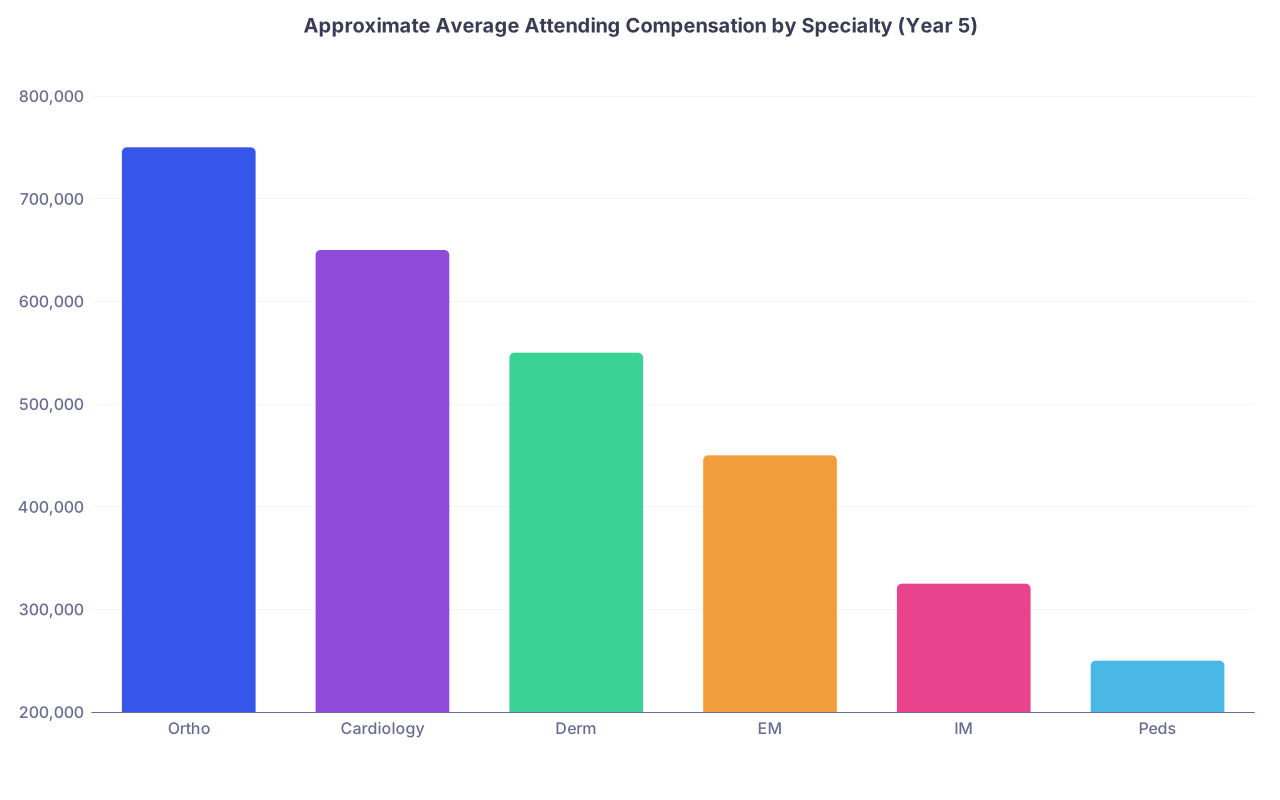
| Category | Value |
|---|---|
| Ortho | 750000 |
| Cardiology | 650000 |
| Derm | 550000 |
| EM | 450000 |
| IM | 325000 |
| Peds | 250000 |
The pattern that emerges by year 5 (post-training) looks roughly like this:
- Orthopedic surgery and other procedural surgical subspecialties: top tier, often $700k+ for orthopedics, neurosurgery, some spine-focused roles.
- Interventional and invasive specialties (cardiology, GI, procedural radiology, anesthesia with heavy pain work): just below the top, often $550k–$700k.
- Lifestyle or prestige outpatient specialties (dermatology, radiology, ophtho): strong but less explosive growth, typically $450k–$600k.
- Shift-based acute specialties (emergency medicine, critical care): good early pay, slower growth, often $400k–$500k then flattening or declining in real terms.
- Broad cognitive specialties (internal medicine, pediatrics, family med, psych): lower absolute numbers, but with very stable, predictable curves.
Now let’s stop talking in abstractions and quantify the curves.
2. Compensation Curves: 1, 5, and 10 Years Out
Here is a compact comparison for some of the highest paid specialties. These are approximations for full‑time clinical physicians in reasonably competitive markets, excluding extreme outliers and pure private equity plays.
| Specialty | Year 1 Out | Year 5 Out | Year 10 Out |
|---|---|---|---|
| Orthopedic Surgery | 550 | 750 | 900 |
| Interventional Cardio | 525 | 700 | 850 |
| Gastroenterology | 500 | 650 | 800 |
| Dermatology | 400 | 550 | 650 |
| Radiology (Diag) | 425 | 550 | 625 |
| Anesthesiology | 425 | 525 | 600 |
To keep things honest:
- “Year 1” = first full attending year after all required fellowships.
- Compensation includes salary + productivity incentives + call pay where common.
- These are not starting offers in Manhattan academic centers; think solid multi‑specialty groups or hospital‑employed roles in average-to-high demand markets.
Look at the shape, not the exact numbers.
- Rapid growth curve (orthopedics, interventional cardiology, GI): very high upside, big spread between year 1 and year 10.
- Strong but moderated curve (derm, radiology, anesthesia): high floor, good growth, then plateau.
- Plateauing early (many shift-based models, some academic tracks): strong year 1–3, relatively flat thereafter in real terms once adjusted for inflation.
Now break it down by specialty.
3. Orthopedic Surgery: Steepest Curve, High Variability
The data is brutal and clear: orthopedic surgery sits at or near the top of almost every compensation survey.
Typical approximate compensation (attending, full‑time, non‑academic):
- Year 1: $500k–$600k
- Year 5: $700k–$800k
- Year 10: $850k–$1.0M (or more in high‑volume private practice, particularly spine, joints, or sports in affluent markets)
Growth drivers:
- RVU-heavy procedures (joint replacements, spine, trauma).
- Ancillaries (surgery center ownership, imaging, PT) in private practice.
- Aggressive productivity bonuses after buy‑in or partnership.
Risks and constraints:
- Long training (5 years residency + 1 fellowship common).
- Higher burnout and physical wear; some surgeons cut back heavy OR volume in their 50s.
- Market consolidation and competition with large ortho groups in some regions.
The curve for ortho is steep and front‑loaded. The delta between year 1 and year 10 is often $300k–$400k annually. That is massive when compounded over 20–25 years.
4. Interventional Cardiology and GI: The RVU Engines
Interventional cardiology and gastroenterology sit in a similar earnings lane: very high productivity potential, with early six-figure procedural bonuses in many settings.
Approximate compensation:
Interventional Cardiology (after 3-year IM + 3-year cards + 1-year interventional):
- Year 1: $475k–$550k
- Year 5: $650k–$750k
- Year 10: $800k–$900k+ (busy PP/large system roles)
Gastroenterology:
- Year 1: $450k–$525k
- Year 5: $600k–$700k
- Year 10: $750k–$850k
What the numbers say:
- Both rely heavily on high-RVU procedures (caths, stents, EP for cards; colonoscopies, EGDs, ERCPs for GI).
- Groups often structure deals where year 1–2 are “income guarantee” years, then partnership hits and incomes jump significantly.
- Call burden is meaningful, especially in interventional cardiology; GI call can be brutal in certain markets.
The compensation curve is similar to ortho but slightly lower peak and with more intense lifestyle costs, particularly nights/weekend call and emergency procedures.
5. Dermatology and Radiology: High Floor, Smoother Slopes
Dermatology and diagnostic radiology are the “quiet winners” from a compensation-per-hour and risk-adjusted standpoint.
Dermatology:
- Year 1: $350k–$450k
- Year 5: $500k–$600k
- Year 10: $600k–$700k+
Diagnostic Radiology:
- Year 1: $400k–$450k
- Year 5: $525k–$575k
- Year 10: $575k–$650k
Patterns:
- Growth is more linear and less explosive than orthopedics or interventional.
- The spread between year 1 and year 10 is often $200k–$250k instead of $300k–$400k.
- Lifestyle and schedule flexibility are major hidden variables. Many derms shift toward higher-margin cosmetics. Many radiologists scale up with telerad or additional shifts.
Risk factors:
- Radiology: telerad commoditization, reimbursement pressure, AI anxiety (overstated in the short term, but still there).
- Dermatology: PE ownership pressures, cosmetic vs medical mix affecting stability.
If you optimize for high income with moderate slope, good control over hours, and relatively lower burnout risk, these curves are attractive.
6. Anesthesiology: Strong Start, Modest Long-Term Slope
Anesthesiology often surprises people. The starting pay is very solid, but the long‑term growth curve can be flatter than procedural surgical or interventional subspecialties.
Typical comp:
- Year 1: $375k–$450k
- Year 5: $475k–$550k
- Year 10: $550k–$625k
The data pattern:
- Many anesthesia jobs are salaried with modest productivity or call differentials.
- In heavily CRNA-utilizing markets, MDs can see pressure on compensation over time.
- Pain-focused practices can explode income beyond $700k–$800k, but that is a somewhat different beast (pain management rather than OR anesthesia).
The compensation curve looks like a strong “step up” from residency into early attending years, then a slow climb and eventual plateau. The key lever here is case mix and practice structure.
7. Comparing Growth Rates: Who Accelerates, Who Plateaus?
If you normalize year 1 income to 100 and just look at relative growth by year 10, you see interesting differences.
Approximate index (Year 1 = 100):
- Orthopedic Surgery: Year 1 = 100, Year 5 ≈ 136, Year 10 ≈ 164
- Interventional Cardiology: Year 1 = 100, Year 5 ≈ 133, Year 10 ≈ 162
- Gastroenterology: Year 1 = 100, Year 5 ≈ 133, Year 10 ≈ 156
- Dermatology: Year 1 = 100, Year 5 ≈ 138, Year 10 ≈ 163
- Radiology: Year 1 = 100, Year 5 ≈ 129, Year 10 ≈ 144
- Anesthesiology: Year 1 = 100, Year 5 ≈ 124, Year 10 ≈ 141
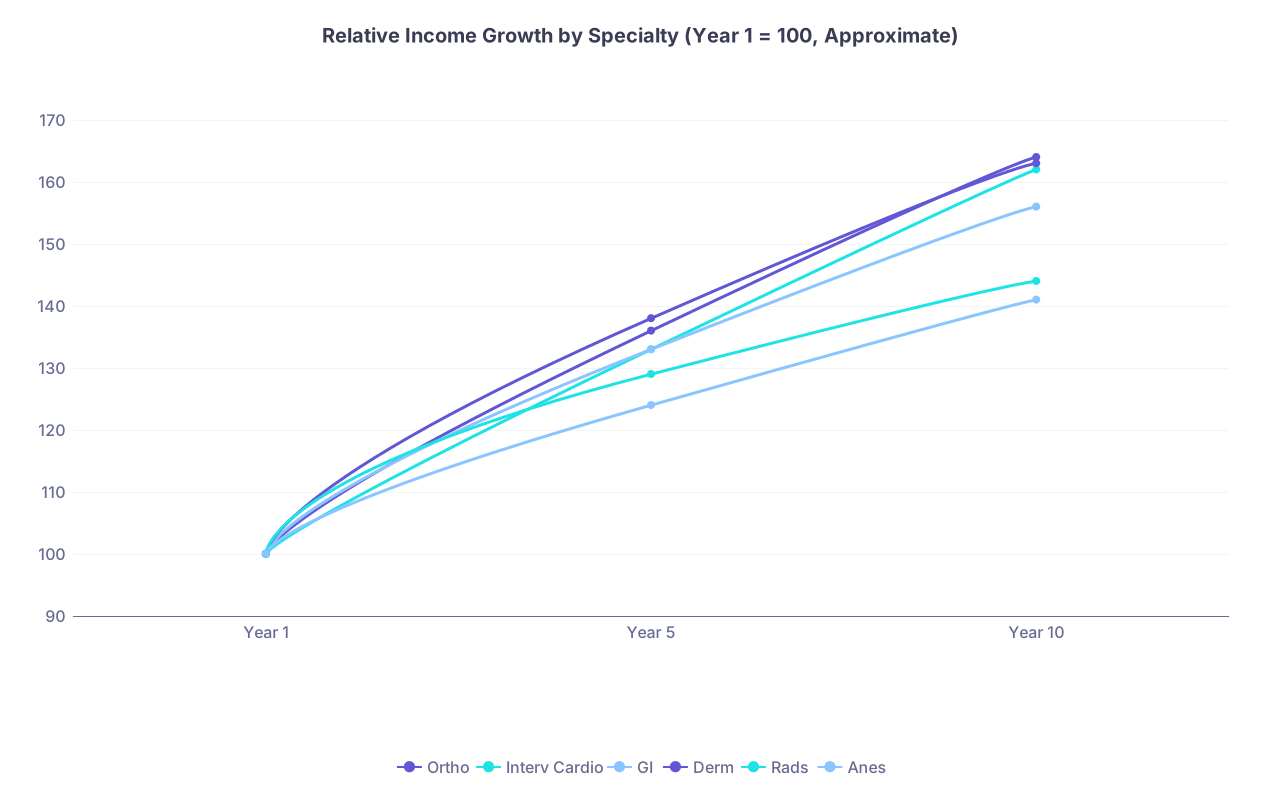
| Category | Ortho | Interv Cardio | GI | Derm | Rads | Anes |
|---|---|---|---|---|---|---|
| Year 1 | 100 | 100 | 100 | 100 | 100 | 100 |
| Year 5 | 136 | 133 | 133 | 138 | 129 | 124 |
| Year 10 | 164 | 162 | 156 | 163 | 144 | 141 |
What this shows:
- Orthopedics, interventional cardiology, and GI offer both high starting pay and strong growth.
- Dermatology starts lower than ortho/interventional but catches up surprisingly well due to practice building and cosmetics.
- Radiology and anesthesia have excellent starting points but slower percentage growth.
If you are trying to choose between two high-income fields, the shape of the growth curve matters as much as the starting offer.
8. Academic vs Private: The Hidden Salary Penalty
You cannot talk about compensation curves without addressing the elephant in the room: academic medicine.
A rough cross‑section:
- Academic comp at 1, 5, 10 years out is often 25–40 percent below private practice for the same specialty.
- The “growth curve” is often flatter, with much smaller jumps after promotions (assistant → associate → full professor).
- Some academic physicians supplement income with moonlighting, call stipends, or external clinical work, effectively creating a blended curve.
For example, orthopedic surgery:
- Academic: Year 1 maybe $350k–$450k, Year 5 $450k–$550k, Year 10 $550k–$650k.
- Private: as we saw, more like $550k → $750k → $900k+.
Same skill set, dramatically different lifetime earnings. Over a 25‑year career, that gap can exceed $5–8 million in gross pre-tax income.
I am not saying academics is “wrong.” I am saying you need to be honest about the trade-off and decide whether research, teaching, and prestige are worth a multi‑million‑dollar discount.
9. Time to Peak and Career Longevity
Compensation curves are not just about raw dollars. Two variables matter just as much:
- Time to peak earnings
- How long you can (or will) sustain those earnings
Procedural heavyweights (ortho, interventional, neurosurgery):
- Time to peak: often 5–10 years post-training as you build a referral base, gain partnership, and secure ancillaries.
- Longevity: many reduce OR time in their 50s, shift to clinic, admin, or lighter call. That can flatten or even reverse the curve in late career.
Outpatient/lifestyle specialties (derm, ophtho, psych):
- Time to peak: often 7–12 years, especially in private practice where panel growth, cosmetic lines, or group ownership accumulate slowly.
- Longevity: more sustainable into 60s, even 70s, if desired.
Shift-based or hospital-employed (EM, hospitalist, some anesthesiology):
- Time to peak: quick. Many hit their “plateau” within 3–5 years.
- Longevity: many doctors burn out and cut clinical hours or shift patterns by mid‑career, leading to a downward shift in total annual comp.
The data-backed conclusion: high, steep curves are often physically and emotionally expensive. Gentle curves with high floors can yield competitive lifetime earnings with less volatility if you work longer.
10. Debt, Net Worth, and the “Catch-Up” Problem
You are not choosing a salary; you are choosing a financial trajectory.
A high‑paying specialty that delays income (extra fellowships) must be evaluated against something like emergency medicine or hospitalist work that starts paying sooner, even if ultimate peak salaries differ.
Illustrative scenario:
- Physician A: Emergency Medicine, starts attending at 30, earns $425k flat for 20 years.
- Physician B: Orthopedic Surgery, finishes at 32, ramps from $550k to $900k over first 10 years, holds $900k for another 10.
Ignoring taxes and returns, total gross income age 30–50:
- EM: 20 years × $425k ≈ $8.5M
- Ortho: 18 years with ramp (approximate sum)
Years 32–36 average $600k (5 years) = $3.0M
Years 37–41 average $800k (5 years) = $4.0M
Years 42–50 at $900k (9 years) = $8.1M
Total ≈ $15.1M
Even with a later start, the steep ortho curve utterly overwhelms the earlier but flatter EM curve. But that only translates to real wealth if spending discipline and saving behavior are aligned with that trajectory. The data on physician savings suggests many do not fully exploit their income advantage.
11. What Residents Should Actually Do With This Data
You should not pick a specialty only for money. But ignoring compensation curves is equally naive.
Here is how to use this information like an adult:
- Identify your realistic specialty options based on interest and competitiveness. If you hate the OR, orthopedics is irrelevant.
- For each candidate specialty, sketch a 10-year post-training income trajectory using conservative estimates. Use numbers like the ones above, then haircut them by 10–20 percent to be safe.
- Overlay your personal constraints: desired geography, academic vs private preference, family plans, tolerance for call.
- Estimate debt at completion of training and create a rough payoff plan using your year‑1 and year‑5 incomes. A derm at $400k–$550k with moderate hours can obliterate $300k of loans aggressively. A GI at $500k–$650k can do it even faster, but with heavier call.
- Decide what trade-off you are consciously making:
- More money vs more control
- Early plateau vs late surge
- Academic prestige vs raw earnings
The data should sharpen your choices, not dictate them.

12. Common Misconceptions the Data Destroys
A few persistent myths do not survive contact with actual numbers:
“Dermatologists do not make as much as surgeons.”
Wrong. While ortho or neurosurgery may have the highest peaks, an efficiently run derm practice can match or exceed many surgical incomes, especially on a per-hour basis, once cosmetics and ownership are layered in over 10+ years.
“Academic medicine pays fine; the difference is small.”
Also wrong. For procedure-heavy fields, the delta between academic and high-earning private practice can easily be $200k–$400k per year. Over decades, that is massive. If you choose academics, do it with your eyes open.
“Anesthesiology is one of the top-paying fields forever.”
Strong but not at the very top anymore, and the growth curve is much flatter than orthopedics, interventional cardiology, or GI. New grads often have a rosy view based on early offers that later plateau.
“Radiology is dying because of AI, so salaries will crater.”
Right now, the data does not support a collapse. Demand for imaging remains high; telerad and group consolidations have kept incomes robust. The long‑term future is uncertain, but near‑term comp remains in the top tier.
13. Final Takeaways
Three core conclusions from the compensation curves:
- Procedural subspecialties (orthopedics, interventional cardiology, GI) dominate both starting salaries and growth trajectories, often doubling EM/hospitalist lifetime earnings.
- Dermatology, radiology, and anesthesiology offer high floors with smoother curves, trading some peak upside for stability and, often, better lifestyle and longevity.
- Academic vs private practice choice, and your willingness to sustain high‑intensity work, can swing your realized lifetime earnings by several million dollars, even within the same specialty.
Use the numbers as a lens, not a dictator. But do not pretend they do not matter.