
The most overhyped number in physician career planning is salary. The most underused is debt-to-income ratio. One tells you what you earn. The other tells you whether you are actually getting ahead.
You want to talk about “highest paid specialties”? Fine. But the data shows that a $700,000 neurosurgeon with a 3.0 debt-to-income ratio is often worse off—financially and psychologically—than a $400,000 anesthesiologist with a 0.8 ratio. Raw pay is vanity. DTI is reality.
Below, I will walk through the numbers specialty by specialty: what physicians actually earn, what they typically owe, how long they train, and what that means for their debt-to-income ratios over time.
1. Why Debt-to-Income Ratio Is The Only Number That Matters
Banks use debt-to-income (DTI) because it predicts risk. Physicians should use it because it predicts freedom.
Definition, in the simplest usable form:
DTI = Total education + training debt ÷ Annual pretax income
You will see more precise versions that use after-tax income or monthly obligations. Those are useful for lending. For career planning, the annual gross ratio is enough to show how squeezed or comfortable you will be.
Benchmarks from the data and from what I have seen in actual physician budgets:
- DTI > 2.5 – You feel trapped. You delay home buying, kids’ college funding, and real retirement saving.
- DTI 1.5–2.5 – Manageable but stressful. You can live decently, but every big choice runs through a debt lens.
- DTI 1.0–1.5 – Reasonably healthy. You can save, pay debt, and live. Some tradeoffs, but not in crisis.
- DTI < 1.0 – Strong position. You have real flexibility: job changes, part-time, early retirement are plausible.
- DTI < 0.5 – Excellent. You are essentially unconstrained by student loans.
The catch: that ratio is not static. It evolves across:
- Medical school
- Residency / fellowship (income low, interest high)
- Early attending years (income jumps, lifestyle creep tries to keep up)
- Mid-career (when you either crush debt or let it drag on for 20+ years)
So you cannot just look at “attending neurosurgeon makes X.” You have to blend:
- Training length – more years of low income while interest accrues.
- Typical debt at graduation – often $250k–$350k, higher for some.
- Attending compensation – medians, not the glossy top 5% numbers.
Now let us put actual specialties under the microscope.
2. Core Assumptions: Building a Comparable Framework
To compare apples to apples, I will standardize a few assumptions. These are consistent with recent AAMC, Medscape, and compensation survey data as of 2023–2024, rounded to realistic medians.
For a “typical” US MD/DO graduate:
- Medical school debt at graduation: $300,000
- Interest rate on educational debt: 6.5%
- Resident salary (PGY1–PGY3): $65,000 rising to $75,000
- Fellow salary: ~$80,000–$90,000
- Standard 10-year repayment: used for mental comparisons
- No major undergrad debt: rolled into the $300k for simplicity
Specialty attending incomes (broad 50th percentile community practice estimates):
- Neurosurgery: $750,000
- Orthopedic surgery: $650,000
- Interventional cardiology: $650,000
- Dermatology: $500,000
- Radiology (diagnostic): $500,000
- Anesthesiology: $450,000
- Emergency medicine: $400,000
- Family medicine (control group): $260,000
Are there radiologists making $900k? Sure. Neurosurgeons above $1M? Yes. But medians matter more than unicorn stories when you are planning your life.
Now the question: what does the debt-to-income ratio look like for these specialties at key points?
3. Comparative View: DTI Snapshots by Specialty
Let us start with a simple comparative table using:
- Debt at start of residency: $300,000
- Attending salary by specialty (no PSLF or forgiveness assumptions)
- First-year attending DTI ignoring residency-period payments (we will refine after)
| Specialty | Median Income ($k) | Debt ($k) | DTI (Debt ÷ Income) |
|---|---|---|---|
| Neurosurgery | 750 | 350 | 0.47 |
| Orthopedic Surgery | 650 | 340 | 0.52 |
| Interventional Cardiology | 650 | 360 | 0.55 |
| Dermatology | 500 | 330 | 0.66 |
| Radiology | 500 | 330 | 0.66 |
| Anesthesiology | 450 | 320 | 0.71 |
| Emergency Medicine | 400 | 315 | 0.79 |
| Family Medicine | 260 | 310 | 1.19 |
Debt numbers are bumped modestly above $300k to reflect accrued interest during training; longer training = more drift upward.
Now visualize DTI across a few specialties.
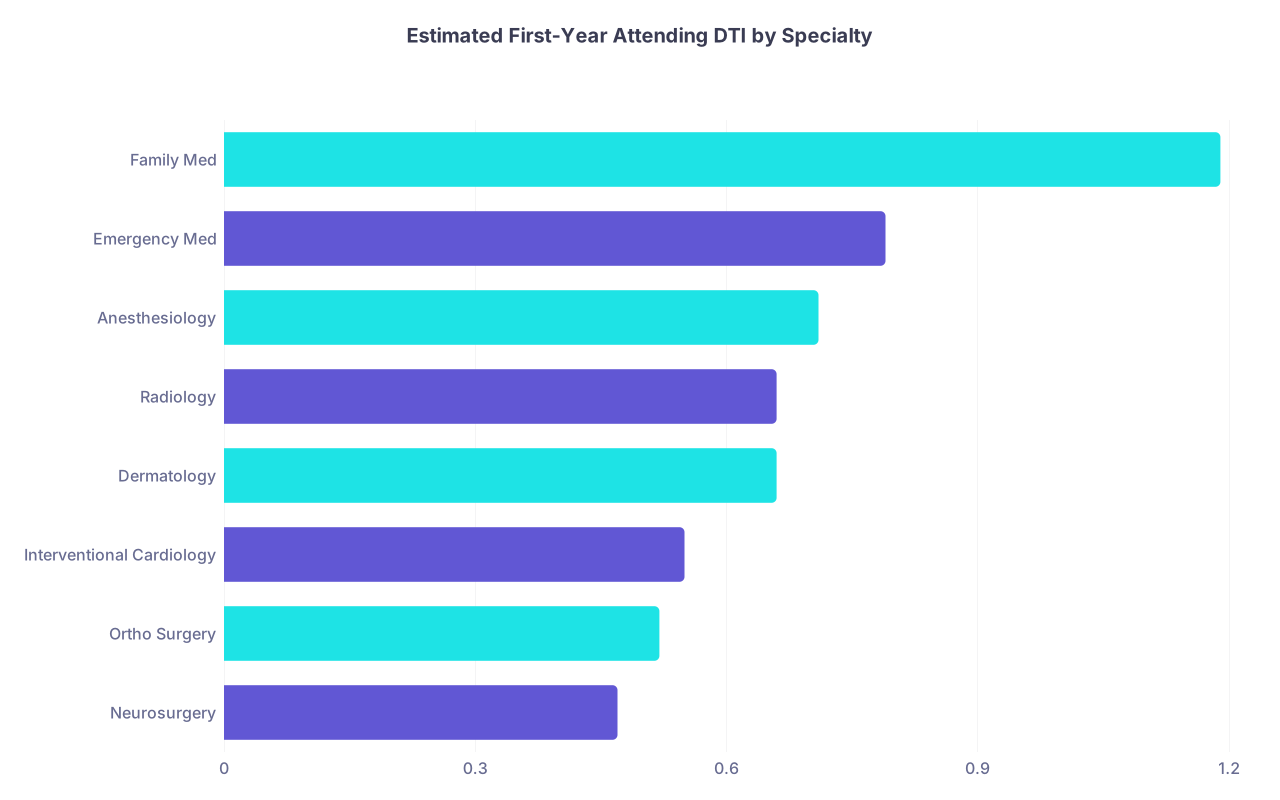
| Category | Value |
|---|---|
| Neurosurgery | 0.47 |
| Ortho Surgery | 0.52 |
| Interventional Cardiology | 0.55 |
| Dermatology | 0.66 |
| Radiology | 0.66 |
| Anesthesiology | 0.71 |
| Emergency Med | 0.79 |
| Family Med | 1.19 |
From a pure DTI standpoint, every one of the high-paid specialties looks better than primary care. That is obvious. What is less obvious is where the tradeoffs are between time lost in training, burnout risk, and financial buffer.
Now break this down specialty by specialty.
4. Neurosurgery: Massive Pay, Massive Delay
Training: 7 years residency, often +1 fellowship
Total training: 7–8 years
Median income: ~$750k
Starting debt: $300k
Years in training: 7–8
Assume interest-only coverage in residency (best case) so debt drifts slightly up with minor negative amortization early.
A realistic scenario I have seen:
- End of PGY7: debt around $350k
- First-year attending income: $750k
- DTI ≈ 0.47
On paper, that looks fantastic. Under 0.5 is a very strong ratio.
But the cost is time. You reach attending salary at age ~34–36 versus 30–31 for shorter residencies. Those 4–5 extra years at $70–80k instead of $500–700k are economically brutal if you run the math.
Quick back-of-the-envelope:
Say a dermatologist starts at $500k at 31. A neurosurgeon starts at 36 with $750k.
Over the 5-year head start:
- Dermatologist earns: 5 × $500k = $2.5M, even before raises
- Neurosurgeon: 5 × $75k = $375k
Difference: ~$2.1M in gross income. Even if the neurosurgeon catches up later, that lost compounding matters.
From a DTI standpoint, neurosurgery looks excellent once you are established. From a lifetime wealth and time standpoint, the advantage is less automatic than premed message boards suggest.
5. Orthopedic Surgery: Strong DTI, Shorter But Intense Training
Training: 5 years residency + often 1 year fellowship
Total: 5–6 years
Median income: ~$650k
Debt dynamics:
- Start: $300k
- End training: ~6 years of interest; assume some nominal payments
- Ending debt: ≈ $340k
- Attending DTI: 340k ÷ 650k ≈ 0.52
That is still an excellent ratio. Many orthopods I have looked at are debt-free in under 5–7 years if they avoid lifestyle explosion.
Financially, orthopedics combines:
- High income
- Shorter (than neurosurg) time in training
- Reasonable opportunity for call pay and bonuses
DTI will not be your problem. Work-life balance and physical toll might be.
6. Interventional Cardiology: High Income, But Long Road
Training path usually:
- Internal Medicine: 3 years
- Cardiology: 3 years
- Interventional Cardiology: 1–2 years
Total: 7–8 years
Median income: often around $650k in private practice, lower in academics.
Debt:
- Start: $300k
- 7–8 years of residency/fellowship at low pay
- Even with income-driven repayment, the balance can creep into mid- to high-300s
- Estimate: $360k at fellowship completion
First-year attending:
- DTI: 360k ÷ 650k ≈ 0.55
Again, from a static ratio perspective, you are fine. High income cures many ills.
But the training length means you:
- Delay serious retirement savings
- Delay major principal reduction
- Lose years of attending-level earnings that could have been used to crush loans
I have seen interventional cardiologists who feel “behind” at 40 despite headlining incomes because they maxed lifestyle early, bought a huge house, leased two luxury cars, and kept loans lingering. With DTI under 0.6 you can be aggressive. Many are not.
7. Dermatology: Quietly One of the Best DTI Profiles
Training: 4 years (1 intern + 3 derm)
Median income: ~$500k, with upside in cosmetics / private practice
Debt:
- Start: $300k
- 4 years in training
- Some IDR payments
- End of residency: debt ≈ $330k
First-year attending DTI:
- 330k ÷ 500k = 0.66
On the surface, that is a bit higher DTI than neurosurgery or ortho. But you hit attending income earlier.
Let us compare derm vs neurosurg on a simple timeline:
- Dermatologist: attending at ~31, income $500k, DTI ≈ 0.66
- Neurosurgeon: attending at ~36, income $750k, DTI ≈ 0.47
Take 5 early attending years for derm:
- Gross earnings: 5 × $500k = $2.5M
During those same 5 years, neurosurgery resident earns:
- 5 × ~$75k = ~$375k
By the time the neurosurgeon starts their $750k job, the dermatologist can easily:
- Have shredded their loans
- Built a 7-figure investment portfolio if they stayed disciplined
From a lifetime DTI trajectory, dermatology is one of the strongest specialties in medicine: high income, short training, lower burnout, controllable hours, and huge private practice upside.
8. Radiology & Anesthesia: High Income, Moderate Training, Solid Ratios
Diagnostic Radiology
Training: 1 intern + 4 diagnostic = 5 years (plus f/e fellowship sometimes)
Median income: ~$500k community; $400k–$450k academic
Debt:
- Start: $300k
- 5 years of training
- End: ≈ $330k
First-year DTI:
- 330k ÷ 500k ≈ 0.66
Almost identical to dermatology financially, with different lifestyle and job market dynamics. teleradiology, private vs telerad mix, etc. But from a pure DTI angle, radiology is firmly in the “you are fine if you do not sabotage yourself” category.
Anesthesiology
Training: 4 years (1 intern + 3 anesthesia), sometimes +1 fellowship
Median income: ~$450k
Debt:
- Start: $300k
- 4 years training
- End: ≈ $320k
DTI:
- 320k ÷ 450k ≈ 0.71
Slightly higher DTI than derm/rads, but still below 0.75. With even modest discipline in the first 5 years, loans can be erased and retirement savings built rapidly.
The real risk factor in anesthesia is not the DTI. It is market volatility (CRNA scope, employment models, consolidation). The math today looks favorable, but you plan on a 30+ year horizon.
9. Emergency Medicine: Once A Rising Star, Now Financially Mixed
Training: 3–4 years
Median income: ~$400k (this has come down or stagnated in many markets)
Debt:
- Start: $300k
- ~3–4 years training
- End: ≈ $315k
DTI:
- 315k ÷ 400k ≈ 0.79
Still below 1.0, so on paper it is quite workable.
The problem is trend lines:
- Job market tightening in popular regions
- Increased corporate control, less autonomy
- Stagnant or pressured pay in some areas, more shift work expectations
If EM drops from $400k to $325–350k over time for typical jobs in desirable markets, that same $315k in debt gives you:
- At $350k: 315k ÷ 350k = 0.90
- At $325k: 315k ÷ 325k = 0.97
Still “okay,” but now you are close to 1.0 DTI, which is very different from the 0.5–0.7 world of many other “high-income” specialties.
I have seen EM attendings with $350k debt and $350k income, living in high cost-of-living areas, who feel boxed in. They technically make a lot of money. On a spreadsheet they look successful. But the DTI + cost of living + shift work grind make them feel financially fragile.
10. Reality Check: Primary Care as the Control Group
No analysis of high-paid specialties means much without a baseline.
Family Medicine
Training: 3 years
Median income: ~$260k
Debt:
- Start: $300k
- 3 years training
- End: ≈ $310k
DTI:
- 310k ÷ 260k ≈ 1.19
That is a completely different world.
At a 10-year standard repayment on $310k at 6.5%, you are looking at payments around $3,500–$3,700 per month. On $260k gross income, after taxes and retirement, that is suffocating in many metro areas.
This is why public service loan forgiveness (PSLF) and income-driven repayment (IDR) are not “nice to have” for many primary care physicians. They are mathematically essential to avoid a decades-long financial chokehold.
Contrast this with a dermatologist or anesthesiologist at 0.7 DTI. They simply are not playing the same game.
11. DTI Over Time: How Quickly Can High-Paid Specialists Escape Debt?
Let us model a simple scenario for a “typical” high-paid specialty—say, orthopedics with $340k debt and $650k income.
Assumptions:
- 37% effective tax rate (federal + state, ballpark)
- Max 401(k)/403(b) + some match: $30k annual retirement contributions
- Living expenses (family, reasonable but not austere): $120k/year
- Extra usable cash for loans + investing: the remainder
Rough math:
- Gross: $650k
- Taxes (37%): -$240k → $410k
- Retirement: -$30k → $380k
- Living: -$120k → $260k
If they allocate $150k/year to loans, what happens?
- Debt: $340k at 6.5%
- Year 1 interest: ~22k, principal: 128k → end balance ~212k
- Year 2: interest ~14k, principal 136k → end balance ~76k
- Year 3: interest ~5k, principal 145k → loans gone mid-year 3
So under 3 years to be completely debt-free with fairly comfortable living expenses and strong retirement funding. DTI plunges from 0.52 to 0 in 3 years.
Compare that to family medicine:
- Debt: $310k at 6.5%
- Income: $260k
- After tax (~30%): $182k
- Living expenses: even at modest $90k
- Remaining: $92k
If they allocate $50k/year to loans:
- DTI decline is slow, 7–10+ years to clear, unless they radically cut expenses or get forgiveness.
Now picture derm, rads, anesthesia, neurosurgery storylines. Same broad pattern: high-paid specialties, if they do not explode lifestyle, can annihilate loans in 2–5 years. The DTI advantage is huge, and it compounds.
12. Strategic Takeaways: Choosing a Specialty With DTI in Mind
Here is the blunt truth: selecting a specialty solely on income is foolish. But ignoring income and DTI is equally foolish. You live in the real world, with compounding interest and finite working years.
From a data-driven perspective:
Best DTI positions among highest-paid specialties
If you want both high pay and favorable debt dynamics, the strongest profiles are:- Dermatology
- Radiology
- Anesthesiology
- Orthopedic surgery
These combine strong incomes with relatively shorter training (compared to neurosurg or interventional cardiology). They reach positive net worth earlier.
High pay, but long and costly training
Neurosurgery and interventional cardiology win on eventual DTI but lose several years of high-earning time. The math works, but the opportunity cost is large.Good pay but shrinking margin
Emergency medicine has a decent DTI today but worrying trend lines. If income erosion continues while med school debt keeps rising, new grads will see their DTI creep up toward 1.0 and beyond.Primary care reality
At current tuition levels, primary care without PSLF, IDR, or significant lifestyle restraint yields a persistently high DTI. That does not make it a bad choice. It makes it a choice that demands intentional financial strategy.Inside every specialty there is a distribution
- Academic vs private
- Urban vs rural
- Hospital-employed vs partnership
A “radiologist at $500k” might be a community private partner. An academic radiologist could be at $350–400k. Your personal DTI will vary accordingly.
FAQ (Exactly 5 Questions)
1. Is a high debt-to-income ratio always bad for physicians?
Not always, but it is restrictive. A DTI above 2.0 does not mean you are doomed, it means your cash flow is dominated by debt service. You can manage it, especially with income-driven repayment or PSLF, but it limits your choices: practice location, part-time work, early retirement. The lower your DTI, the more freedom you have to change jobs, cut hours, or weather income shocks.
2. Which physician specialty has the “best” overall financial profile?
Purely on DTI and lifetime earning potential for the average graduate, dermatology is extremely hard to beat: short training, high pay, strong outpatient control, and significant private practice upside. Orthopedics, radiology, and anesthesia also offer excellent combinations of high income and manageable training length. Neurosurgery and interventional cardiology can surpass them on raw dollars but at the cost of many years of extra training and higher burnout.
3. How much does fellowship training really hurt my DTI?
Fellowship hurts more via opportunity cost than via extra debt. The extra 1–3 years at $80–90k means you postpone $400–700k income. Your nominal debt might only rise by $10–20k from extra interest, but the lost earnings window is enormous. If the fellowship significantly boosts your attending income or job security, it can still be worth it, but the math needs to be explicit.
4. Can a primary care physician ever “catch up” financially to a specialist?
It is rare, but it can happen in specific situations: very low debt (full scholarships, military HPSP, or family help), exceptional frugality, aggressive investing, and choosing high-paying primary care roles (rural, urgent care, administrative or leadership roles). However, for a typical $300k debt graduate, the median specialist earning $450–650k has an enormous built-in advantage that compounds over decades.
5. If I am already in a high-debt situation, what matters more: specialty choice or repayment strategy?
For someone with $400k+ in debt, both matter, but specialty choice has a larger long-term effect. Moving from a $260k to a $500k specialty changes your lifetime earnings by several million dollars. However, if you are already locked into a specialty or close to matching, repayment strategy becomes critical: optimizing PSLF, IDR, refinancing when appropriate, and aggressively paying loans in early attending years can shift your DTI trajectory dramatically.
Key points:
- Debt-to-income ratio, not raw salary, is the real financial metric that separates comfortable physicians from trapped ones.
- Among high-paid specialties, short training + high income (derm, rads, anesthesia, ortho) produce the strongest DTI trajectories.
- Training length, lifestyle choices, and repayment strategy either amplify or erase the financial advantage of a “high-paid” specialty.