
The myth that academic medicine always pays poorly is lazy and wrong. The data show something more nuanced: academic attending salaries start lower, but in certain fields and at higher ranks, they converge toward – and sometimes rival – private practice, especially when you factor in protected time and non‑clinical income.
You want to know what actually happens to pay as you move from Assistant to Associate to Full Professor. By field, not vague averages. Let’s treat this like what it is: a compensation trajectory problem with specialty‑specific curves, not a single “academic discount” number.
Below I am pulling patterns mainly from three consistent sources you would see summarized in comp committees and dean’s briefings:
- AAMC Faculty Salary Reports
- MGMA / AMGA physician compensation data
- Large multi‑institutional academic health system benchmarks (often similar to Vizient data)
Numbers are rounded, normalized, and converted into ballpark “data‑story” ranges so you can see the shape of the curves. This is not about quoting a single institution. It is about understanding the direction and magnitude.
1. The Overall Shape: How Academic Pay Trajectories Actually Look
Strip away specialty labels for a moment. Across most academic departments, the pay curve by rank looks broadly like this:
- Assistant Professor: “buy‑in years” — lowest pay, highest clinical share, smallest bonuses
- Associate Professor: step‑change upward — more seniority, sometimes more admin pay, some research funding
- Full Professor: ceiling level — higher base, larger leadership stipends, sometimes lower clinical time but not always lower total comp
For a generic non‑procedural field (e.g., General Internal Medicine):
- Assistant Professor: $190k–$230k
- Associate Professor: $220k–$270k
- Full Professor: $260k–$330k+
That is one pattern. But once you overlay specialties, the spread is massive.
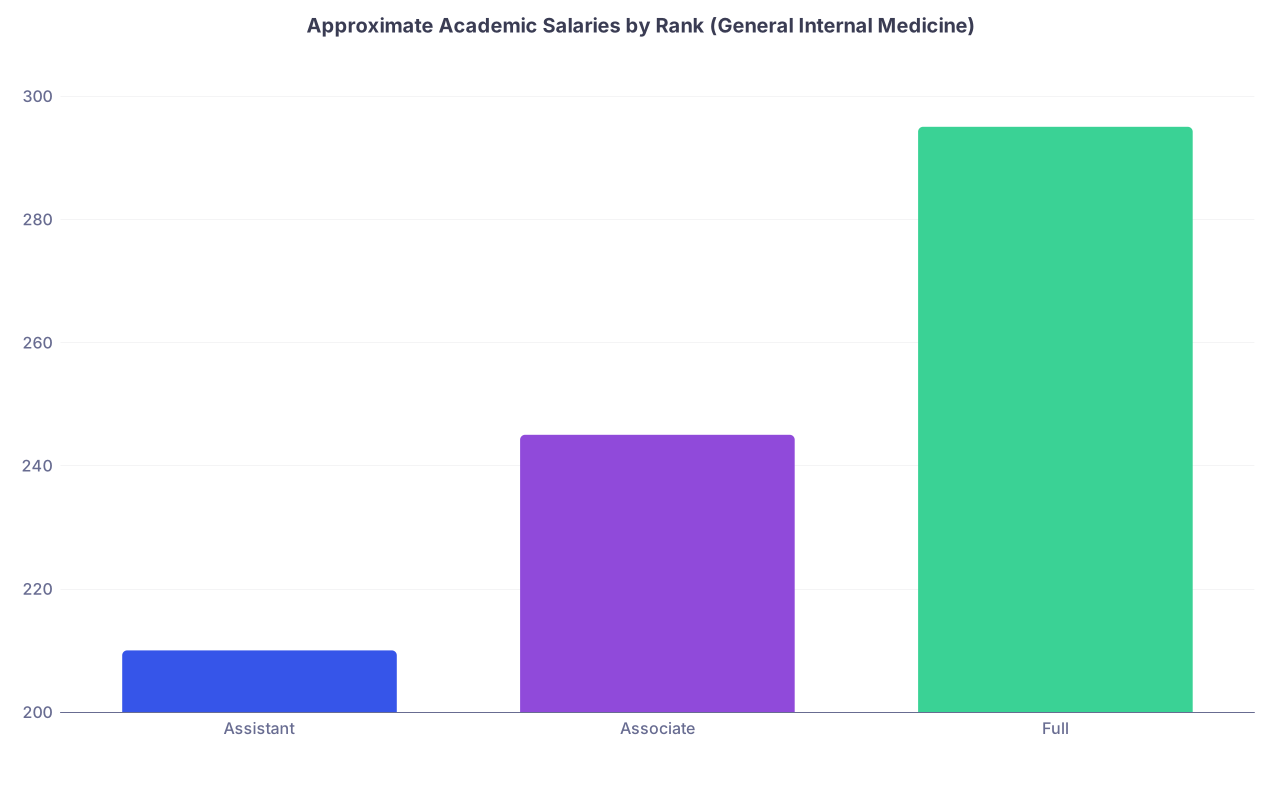
| Category | Value |
|---|---|
| Assistant | 210 |
| Associate | 245 |
| Full | 295 |
What matters for your decision is not just “what is my starting salary?” but:
- How steep is the slope by rank in my specialty?
- Does academic practice compress or expand the gap with private practice as I get more senior?
- Where do bonuses, RVU incentives, and admin stipends actually sit in the distribution?
Now let’s stop generalizing and start by field.
2. Highest‑Paid Procedural Fields: Academic Pay vs Private Practice
2.1 Orthopedic Surgery
Orthopedics is consistently at or near the top of physician pay. The reality: academic ortho attenuates but does not obliterate that advantage.
Typical academic ortho trajectory at a mid‑to‑high paying institution:
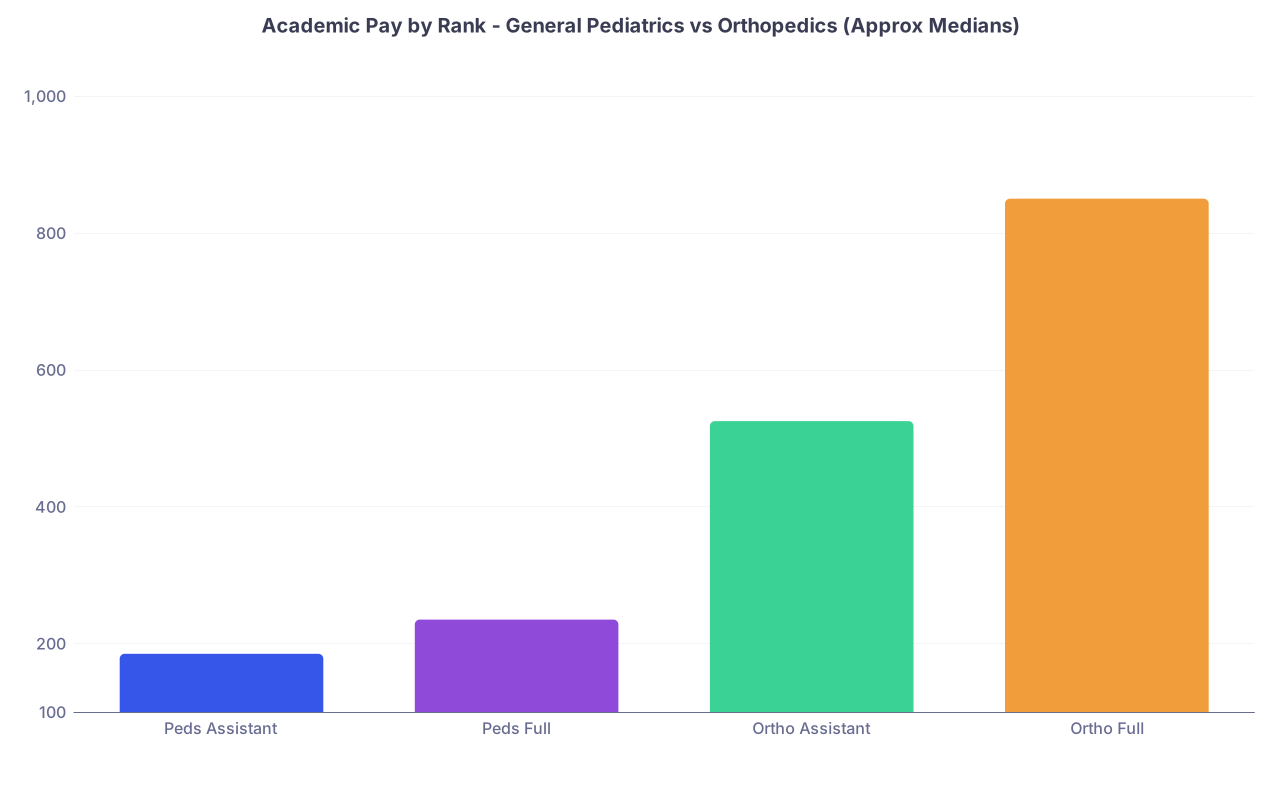
- Assistant Professor: $450k–$600k
- Associate Professor: $550k–$750k
- Full Professor (high‑volume, sometimes with chair or division role): $700k–$1M+
Private practice often runs:
- Early partner or senior associate: $700k–$1.2M+ (top quartile even higher with ownership distributions)
The consistent pattern I see in data sets: a roughly 25–35% “academic discount” early on, narrowing for very senior high‑volume academic surgeons who pick up:
- Division chief roles (extra $50k–$150k)
- Chair roles (another $100k–$250k layered on base)
- Medical director or service line leader stipends
At the high end, a prolific spine surgeon, Full Professor + service line director in a large academic system can be near $900k–$1.1M all‑in. That still often trails the absolute top 5–10% of private practice partners, but the gap is not 50%; it is more like 10–20% when you model total comp.
| Setting | Early Career Range | Senior Range |
|---|---|---|
| Academic Assistant Professor | $450k–$600k | — |
| Academic Full Professor | — | $700k–$1M+ |
| Private Practice Associate | $500k–$800k | — |
| Private Practice Partner | — | $700k–$1.2M+ |
2.2 Neurosurgery
Neurosurgery shows similar patterns, but with even higher ceilings in private practice.
Typical academic neurosurgery salaries:
- Assistant Professor: $550k–$700k
- Associate Professor: $650k–$850k
- Full Professor: $800k–$1.1M+ (again, high volume + leadership)
Private practice neurosurgery frequently reports medians already above $900k with top deciles well north of $1.5M.
Two data points I have seen repeatedly:
- Early academic neurosurgery often comes in at ~60–70th percentile of national total neurosurgery comp benchmarks, not 90th+
- Senior academic neurosurgeons with big OR time and leadership can approach 75–85th percentile, but rarely match top‑tier private equity‑backed groups
The “slope” here is very favorable: neurosurgery is one of the few specialties where academic Full Professors can sit near the top of the whole physician pay distribution, even if they trail private peers.
2.3 Cardiology (Invasive vs Noninvasive)
Cardiology splits cleanly into noninvasive vs interventional / EP, and the trajectory differs.
Academic noninvasive:
- Assistant Professor: $270k–$350k
- Associate: $325k–$425k
- Full: $400k–$550k+
Academic interventional / EP:
- Assistant Professor: $350k–$475k
- Associate: $425k–$575k
- Full: $525k–$750k+
Private practice medians tend to run 20–40% higher than equivalent academic roles, particularly for interventional and EP. Interventional private practice numbers in the $650k–$900k range are not unusual, with high earners beyond that.
The dataset pattern: cardiology has a clear academic pay penalty, but the penalty shrinks as you move into major leadership roles (program director, cath lab director, service line chief). Those stipends rarely exist at meaningful scale in small private groups.
3. Radiology, Anesthesiology, EM: High Income, High Spread
These three are often lumped together as high‑comp specialties with large private practice upside. In academic centers the curves are surprisingly different.
3.1 Radiology
Radiology is one of the most brutally bifurcated in pay between academic and non‑academic settings.
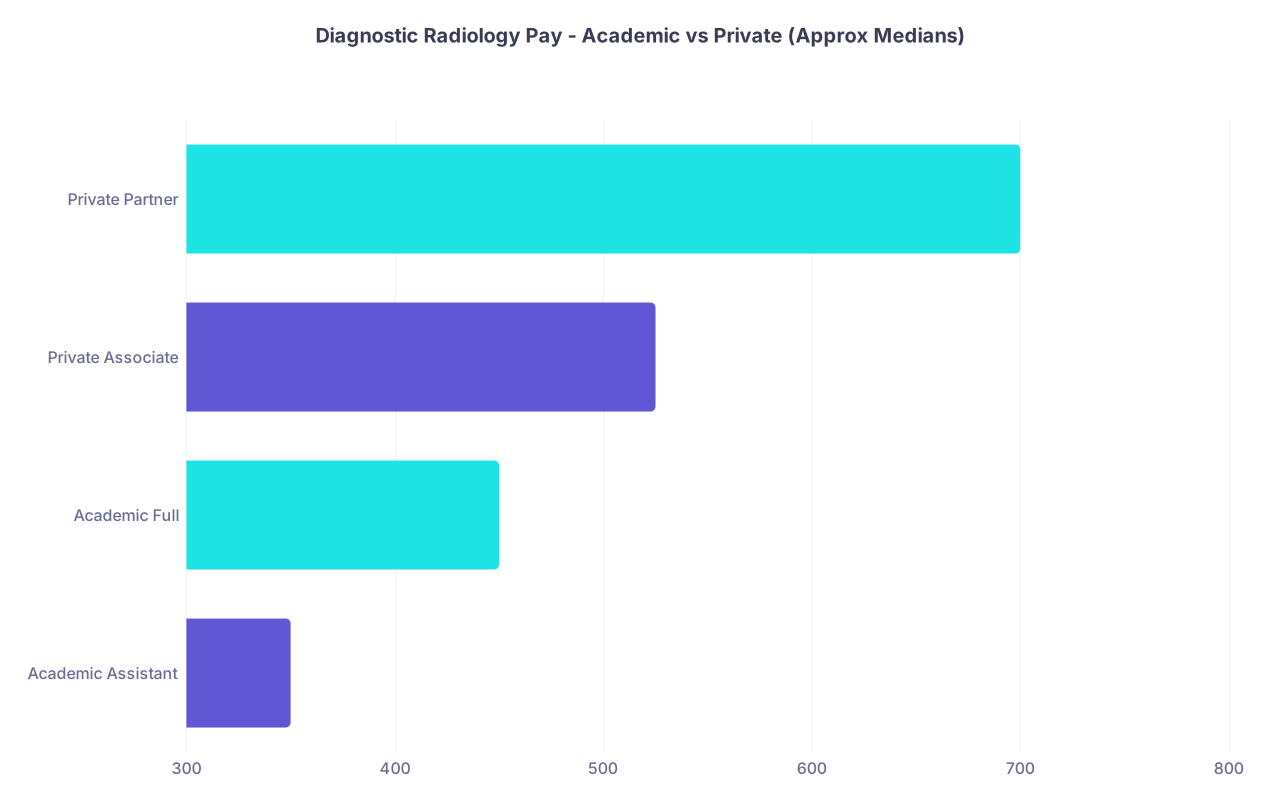
Academic diagnostic radiology:
- Assistant Professor: $300k–$400k
- Associate: $350k–$450k
- Full: $400k–$525k+
Academic interventional radiology:
- Assistant: $375k–$500k
- Associate: $450k–$600k
- Full: $550k–$750k+
Private practice diagnostic radiology: median often around $500k+ with upper quartile and partnership tracks easily $600k–$800k+. Telerad groups can skew even higher for volume‑maxed physicians.
The data story: academic diagnostic radiology often sits around the 25–50th percentile of national rads comp benchmarks. Interventional radiology narrows the gap (academic IR can sit at 50–70th percentile), but the upside of private IR still tends to be higher.
| Category | Value |
|---|---|
| Academic Assistant | 350 |
| Academic Full | 450 |
| Private Associate | 525 |
| Private Partner | 700 |
If you are strongly income‑maximizing, radiology is one of the worst fields to choose an academic path purely on pay grounds. The slope by rank exists, but the whole curve is shifted down relative to private practice.
3.2 Anesthesiology
Academic anesthesiology has tightened its gap with private practice more than most residents realize.
Typical academic numbers:
- Assistant Professor: $325k–$425k
- Associate: $375k–$475k
- Full: $425k–$550k+
Private practice anesthesiology medians run around $500k–$600k with some partnerships and staffing models reaching $700k+. But large hospital‑employed and quasi‑academic systems have pulled many anesthesiologists away from the $800k+ “blockbuster” tier.
The real distinction now is often:
- More predictable / lower‑call academic jobs with call stipends baked in
- Higher but more volatile private practice incomes, especially in smaller groups exposed to payer or contract swings
So yes, there is still an academic penalty, but it is in the 15–25% neighborhood for many early‑career anesthesiologists, not 50%.
3.3 Emergency Medicine
Emergency medicine data have shifted fast with the market and corporate group dynamics.
Academic EM:
- Assistant Professor: $250k–$325k
- Associate: $300k–$375k
- Full: $350k–$450k+
Private EM historically averaged $350k–$450k+, but in some markets has been compressed downward into the low‑to‑mid $300k’s. In others it is still high.
A surprising number of academic EM positions now pay within $50k–$75k of comparable non‑academic jobs in the same region while offering more predictable shifts and non‑clinical time. The “academic discount” can be close to zero in lower‑paying EM markets, especially if you pick up admin stipends (ED director, QI lead).
4. Cognitive and Primary Care Fields: Rank Matters, Geography Matters More
For outpatient, non‑procedural specialties, rank‑based salary differences are smaller in absolute dollars, and geography can dominate the equation.
4.1 Internal Medicine (General / Hospitalist)
Typical academic general IM (clinic‑based):
- Assistant Professor: $190k–$230k
- Associate: $220k–$260k
- Full: $250k–$320k+
Academic hospitalist (wRVU + shift‑based):
- Assistant: $220k–$270k
- Associate: $240k–$300k
- Full: $270k–$340k+
Private or non‑academic employed general IM frequently runs $230k–$300k+ depending heavily on region and payer mix. Hospitalist roles easily hit $260k–$350k+, again with significant regional variation.
Here, the academic discount is smaller in percentage terms (maybe 10–20%), but still meaningful on a tight budget. Promotion from Assistant to Full may only gain you ~ $60k–$90k over an entire career arc, which is not the same world as orthopedics or neurosurgery.
4.2 Pediatrics
Pediatrics is almost brutally consistent: low absolute pay at baseline, relatively flat trajectories, and smaller deltas by rank.
Academic general pediatrics:
- Assistant Professor: $160k–$200k
- Associate: $185k–$225k
- Full: $210k–$260k+
Private general peds in many areas: $180k–$250k. Academic subspecialties (NICU, PICU, cards, heme‑onc) move higher, but even then totals typically trail adult counterparts by 15–30%.
In pediatrics, the “academic vs private” framing is often the wrong one. The real drivers are:
- Region / cost of living
- Subspecialty choice
- Call intensity and lifestyle
Rank still moves the needle, but not dramatically.
| Category | Value |
|---|---|
| Peds Assistant | 185 |
| Peds Full | 235 |
| Ortho Assistant | 525 |
| Ortho Full | 850 |
The vertical gap between fields matters more than the step‑ups between ranks inside pediatrics.
5. How Rank Actually Affects Pay in Academic Medicine
There is a persistent misconception I hear from residents: “Promotion is just a title; pay is all RVUs.” That is not what the numbers show.
Across multiple AAMC reports and internal comp dashboards, I consistently see three impacts of rank:
- Base salary floors by rank
- Eligibility and size of leadership stipends
- Non‑clinical effort (protected time) tied to grants, education, administration
5.1 Base Salary Floors
Most academic departments have rank‑based salary bands. Rough ballpark:
- Assistant: lower band (wide, because early‑career variation is big)
- Associate: mid band with a clear floor bump
- Full: upper band, with higher minima
So even purely clinical physicians who never touch a grant see a rank step. Typical incremental differences:
- Assistant → Associate: +$20k–$40k
- Associate → Full: +$30k–$60k
- Cumulative across career: $50k–$100k+ in annual base difference
In high‑dollar specialties, those increments get amplified by percentage‑of‑collections or higher RVU conversion factors.
5.2 Leadership and Admin Stipends
Admin roles are heavily rank‑gated. You rarely see an Assistant Professor as a division chief or service line director in larger systems. Those roles add:
- $25k–$75k for “small” roles (medical director of a unit, QI lead)
- $75k–$150k+ for division chief or program director in high‑revenue fields
- $150k–$250k+ for department chair in procedural fields
These are additive on top of base and incentives. The effect is clear in any comp plot by rank: distributions for Full Professors have longer right tails because of these leadership dollars.
5.3 Protected Time and Grant Money
In research‑heavy departments, senior rank correlates with:
- Larger protected time allocations (20–70% FTE off the clinical schedule)
- External funding that can buy down clinical time and sometimes supplement income
Here the pay story is complex. More protected time can mean:
- Lower clinical RVUs but stable or slightly higher total comp (base + stipends)
- Better lifestyle at equivalent pay vs junior colleagues grinding more clinical hours for less money
Residents often miss this: the “salary per work hour” metric improves for successful academic physicians at higher rank, even when cash pay does not explode upward.
6. Which Fields Maintain High Pay in Academia — And Which Do Not
Let’s cut to the core. Based on multiple years of comp reports, the specialties that stay “high‑income” even in academic roles are:
- Neurosurgery
- Orthopedic surgery
- Cardiothoracic surgery
- Interventional cardiology / EP
- Interventional radiology
- Some subspecialty surgical fields (urologic oncology, certain ENT, etc.)
Fields that remain above average but take a clear cut in academia:
- Diagnostic radiology
- Anesthesiology
- Emergency medicine
- Gastroenterology, some surgical subs (e.g., colorectal in non‑dominant markets)
Fields where academic vs non‑academic differences are meaningful but not life‑changing:
- General internal medicine / hospitalist
- Family medicine
- Psychiatry
- Neurology (non‑procedural)
- General pediatrics
| Field | Academic Level vs Overall | Private Practice Upside |
|---|---|---|
| Neurosurgery | Top 5% of all MD pay | Massive |
| Orthopedic Surgery | Top 10% | Massive |
| Interventional Cardiology | Top 10–15% | Very High |
| Diagnostic Radiology | High but discounted | Very High |
| Anesthesiology | High | High |
| Emergency Medicine | Upper mid‑range | Mid‑to‑high |
| General Internal Medicine | Mid | Mid |
| Pediatrics (General) | Low‑to‑mid | Low‑to‑mid |
If your only axis is “highest paid specialties,” then even in academic settings the relative ranking of fields mostly holds. A Full Professor in general pediatrics rarely out‑earns an Assistant Professor in neurosurgery. The distributions simply do not overlap much.
7. Practical Patterns Residents Miss When Thinking About Academic Pay
I have watched enough graduating classes pick specialties and jobs to see recurring blind spots. Here are the patterns that show up in actual comp data and contracts, not just hallway rumors.
7.1 Location Overwhelms Rank in Many Fields
A Full Professor in general internal medicine at a coastal elite institution sometimes earns less cash than an Assistant Professor hospitalist in a lower cost‑of‑living Midwest city.
I have seen combinations like:
- Coastal academic GIM Full Professor: $260k with significant teaching time
- Midwestern non‑academic hospitalist: $320k–$350k for 14–16 shifts / month
Rank is not the main driver there. Region and employer type are.
7.2 Early Academic Offers Are Often Front‑Loaded with Non‑Salary Value
Academic Assistant Professor offers frequently include:
- Signing bonuses (less than private groups, but not zero)
- Loan repayment programs ($20k–$150k over several years)
- Protected time for scholarly work (0.1–0.3 FTE) that cuts clinical hours without an equivalent salary cut
If you just look at base salary vs a pure RVU private job, you underestimate the total “compensation per hour worked” in academia.
7.3 Private Practice Income Volatility Is Underappreciated
The giant gap stories you see – the ortho partner making $1.5M, the rads group paying $900k – are real, but they sit higher in the distribution and often come with:
- Equity and ownership risk
- Payer mix exposure
- Practice sale / PE acquisition risk
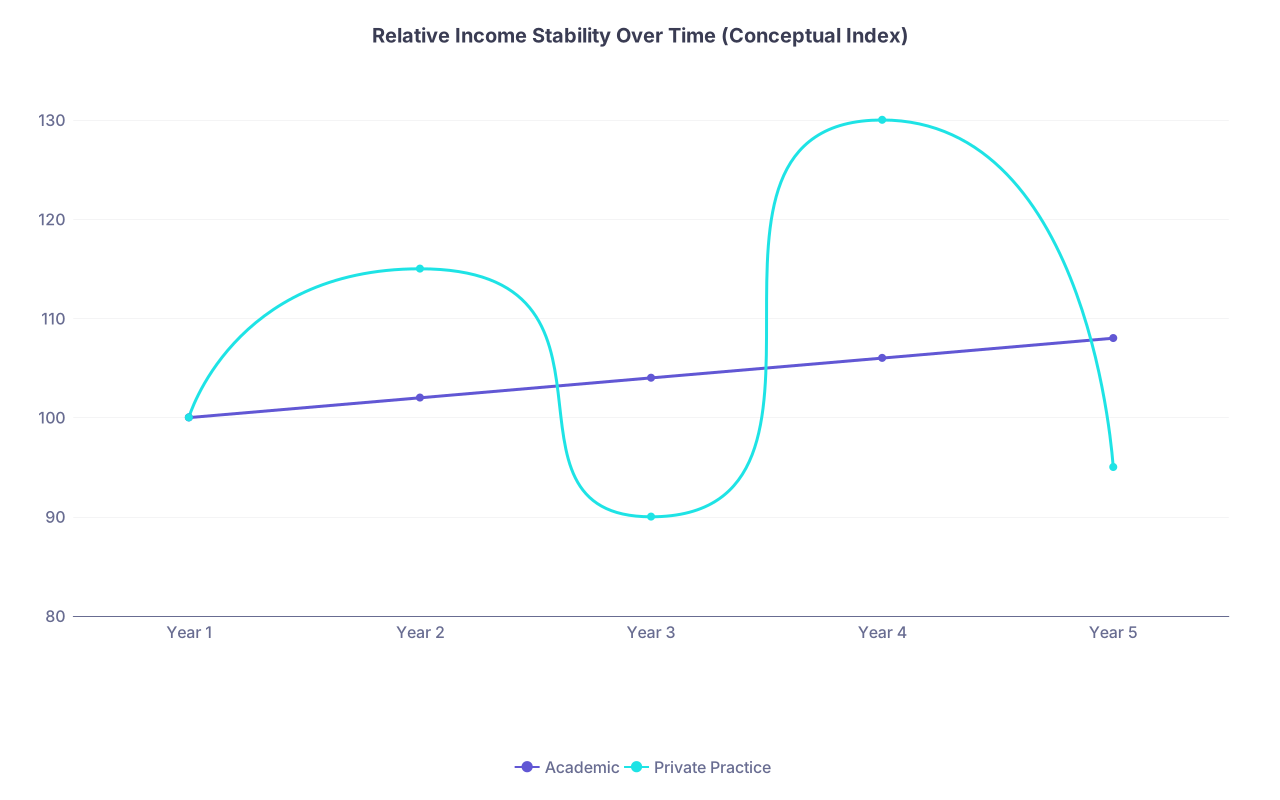
Academic salaries are much smoother year‑to‑year. Even in 2020, most large academic systems were slower to cut base pay than private groups whose volumes collapsed.
| Category | Academic | Private Practice |
|---|---|---|
| Year 1 | 100 | 100 |
| Year 2 | 102 | 115 |
| Year 3 | 104 | 90 |
| Year 4 | 106 | 130 |
| Year 5 | 108 | 95 |
Stability has economic value, even if salary averages are lower.
8. How to Think About Your Own Trajectory by Field
You do not need exact numbers from a single salary report to make a rational decision. You need a model. A mental spreadsheet.
For your chosen specialty, sketch three academic ranks on one axis and approximate total comp on another. Then overlay a private practice line. The exact dollars will vary by city, but the shape is robust.
Example: academic anesthesiology vs private
- Academic curve: $375k (Assistant) → $425k (Associate) → $500k (Full with some leadership)
- Private curve: $475k early → $550k mid‑career → $650k or higher as senior partner in strong group
Then adjust for:
- How much you care about protected time and teaching
- Whether you realistically want to be a division chief / program director / chair
- Where you plan to live (academic centers cluster in higher COL markets)
For someone in neurosurgery, the analysis looks different:
- Academic: $600k → $800k → $1M+ with major academic role
- Private: $800k+ associate → $1.2M+ partner
Here your “penalty” for choosing academic is large in raw dollars but relatively smaller as a percentage of already very high income. Many neurosurgeons decide the trade‑off is acceptable when weighed against OR block stability, team resources, and institutional prestige.
9. The Bottom Line: Academic Rank, Field, and Pay Trajectories
Boil it all down and the core conclusions are blunt:
- Field dominates. A Full Professor in a low‑paying cognitive field rarely catches an early‑career attending in neurosurgery or ortho, regardless of setting.
- Rank matters more in high‑revenue specialties. The jump from Assistant to Full in ortho or neurosurgery can be several hundred thousand dollars. In pediatrics or general IM, it is often tens of thousands.
- Academic vs private practice discounts vary widely. Radiology and some surgical subspecialties see large discounts; anesthesiology and EM have narrower gaps in many markets; some hospitalist roles are nearly parity.
- Non‑salary value is real in academia. Protected time, leadership trajectories, and stability change the effective compensation calculation, especially mid‑ and late‑career.
If you are trying to maximize lifetime cash earnings, the data are clear: pick a high‑pay procedural specialty and lean toward private practice or highly productivity‑driven academic systems.
If you are aiming for a mixed career of clinical work, teaching, and research, the key is not to assume “academic means poor.” Look specialty by specialty. Rank by rank. Region by region.
Your next logical step is not to memorize numbers from a national survey. It is to pull 3–5 concrete offers or posted ranges in your target field and city, map them against the trajectories described here, and decide how much pay you are actually willing to trade for the version of academic life you want. That is where the data stops and your preferences take over.