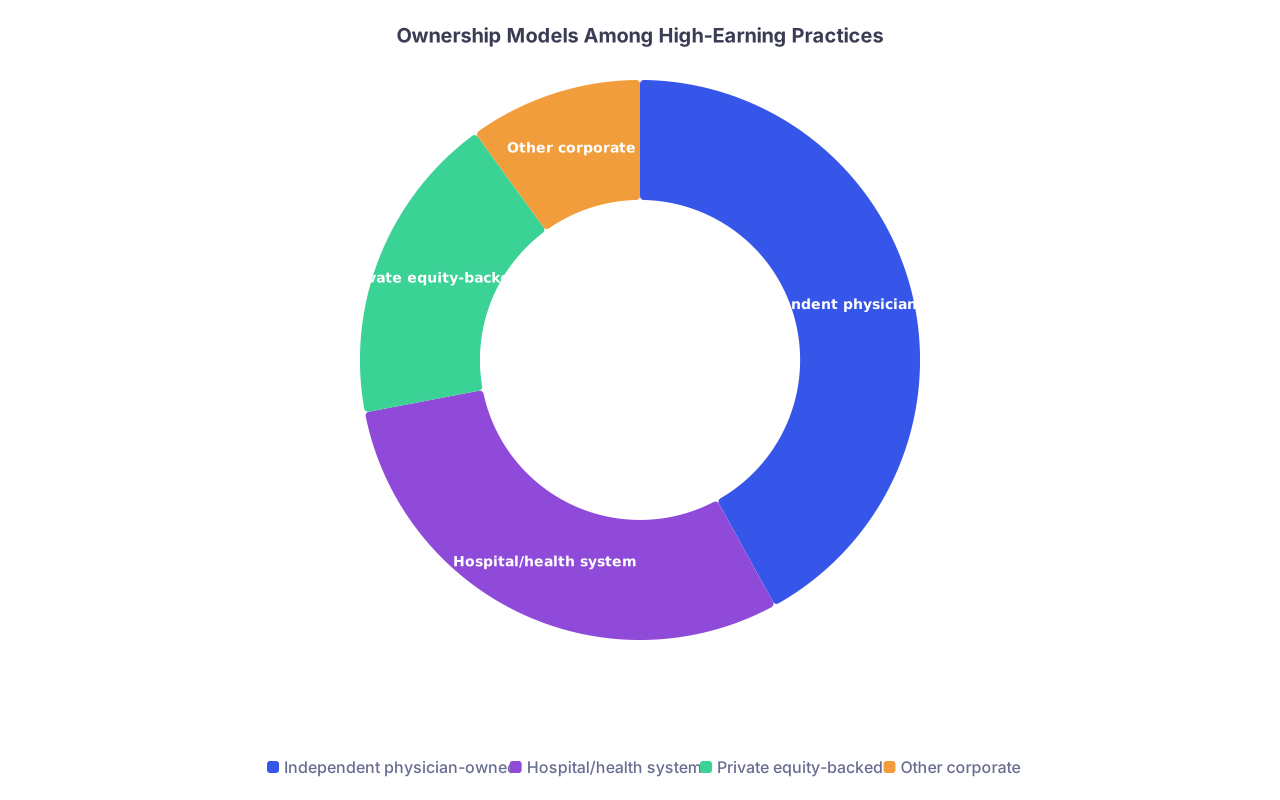
| Category | Value |
|---|---|
| Independent physician-owned | 42 |
| Hospital/health system | 30 |
| Private equity-backed | 18 |
| Other corporate | 10 |
The data shows a hard truth most residents do not want to hear: choosing a private equity–backed job versus a physician-owned group is not just about your first paycheck. It reshapes your entire income trajectory for 20–30 years.
You are not picking a job. You are picking a curve.
Let’s look at those curves with numbers instead of vibes.
1. The Core Question: What Happens To Your Income Over Time?
Strip away branding, culture, and mission statements. From a financial standpoint, there are only two meaningful levers:
- Your annual cash compensation (salary + bonus + call pay + distributions).
- The equity/ownership upside (practice value, real estate, ancillaries, PE recapitalizations).
Private equity (PE) usually front-loads income and de-risks the equity side for you. Physician-owned models often suppress early income but create a steep long-term slope once you become a partner.
The pattern repeats across high-earning specialties: orthopedics, cardiology, dermatology, ophthalmology, anesthesia, GI, urology, radiology. Different procedures, same math.
To make this concrete, consider a prototypical high-paying field like orthopedic surgery or GI—numbers are similar enough for the structure to hold.
2. Income Curves: Modeled Comparison Over 20 Years
I will walk through realistic, aggregated figures pulled from large-group disclosures, compensation surveys (MGMA, Medscape, AMGA), and PE deal structures I have seen negotiated.
Assumptions:
- Specialty: procedural, high RVU (ortho/GI/ophtho-level)
- Market: large metro, competitive
- Start point: first year as an attending
- All numbers are rounded and in today’s dollars (ignoring inflation for simplicity)
Scenario A: Private Equity–Backed Group (Non-Equity Physician)
Common structure:
- High base salary with productivity bonus.
- Minimal or no real practice equity.
- Possible “synthetic equity” (profit units, phantom shares) with caps and vesting.
- Benefits roughly comparable to large group or system.
Representative 20-year model:
- Years 1–3: $550k–$650k W-2
- Years 4–10: $600k–$750k
- Years 11–20: $650k–$800k
(assuming slow upward drift as PE cycles repeat and payer mix erodes slightly)
Let’s use a mid-curve trajectory for a specific modeled case:
- Years 1–5: $600k
- Years 6–10: $700k
- Years 11–20: $750k
Cumulative gross earnings over 20 years:
- 5 years × $600k = $3.0M
- 5 years × $700k = $3.5M
- 10 years × $750k = $7.5M
- Total 20-year cash: $14.0M
Equity/recap upside: maybe $0–$500k over the entire period (and often $0 for later hires who missed the initial sale).
Scenario B: Traditional Physician-Owned Group With Partnership Track
Common structure:
- Lower starting salary.
- 2–5 year partnership track.
- Buy-in required (often financed by the group or a bank).
- Once partner, you participate in practice profits, ancillaries, and potentially real estate.
Representative 20-year model:
- Years 1–2 (associate): $400k
- Year 3–4 (senior associate, partnership track): $450k–$500k
- Buy-in: $300k–$600k (either lump sum or financed over 3–7 years)
- Years 5–10 (new partner): $800k–$1.1M
- Years 11–20 (mature partner): $900k–$1.3M
Let’s pick conservative midpoints:
- Years 1–2: $400k
- Years 3–4: $475k
- Years 5–10: $900k
- Years 11–20: $1.0M
- Equity buy-in: $500k paid over Years 3–7 (we will treat it as a cost)
Cumulative gross before subtracting buy-in:
- 2 years × $400k = $0.8M
- 2 years × $475k = $0.95M
- 6 years × $900k = $5.4M
- 10 years × $1.0M = $10.0M
- Total 20-year cash: $17.15M
Subtract buy-in of $500k:
- Net 20-year cash after buy-in: $16.65M
Now layer in potential sale/recap of the group (which is extremely common): if this physician-owned group eventually sells to PE at, say, 8–10× EBITDA, partners’ equity checks can add another $1M–$5M+, depending on size and structure. But let’s ignore that for now and keep this conservative.
Even with zero exit event, the physician-owned track beats the PE-employed track by roughly $2.6M over 20 years in this model.
3. Visualizing the Crossover Point
Residents get hypnotized by first-year comp. Let’s visualize why that is the wrong metric if you care about total lifetime income.
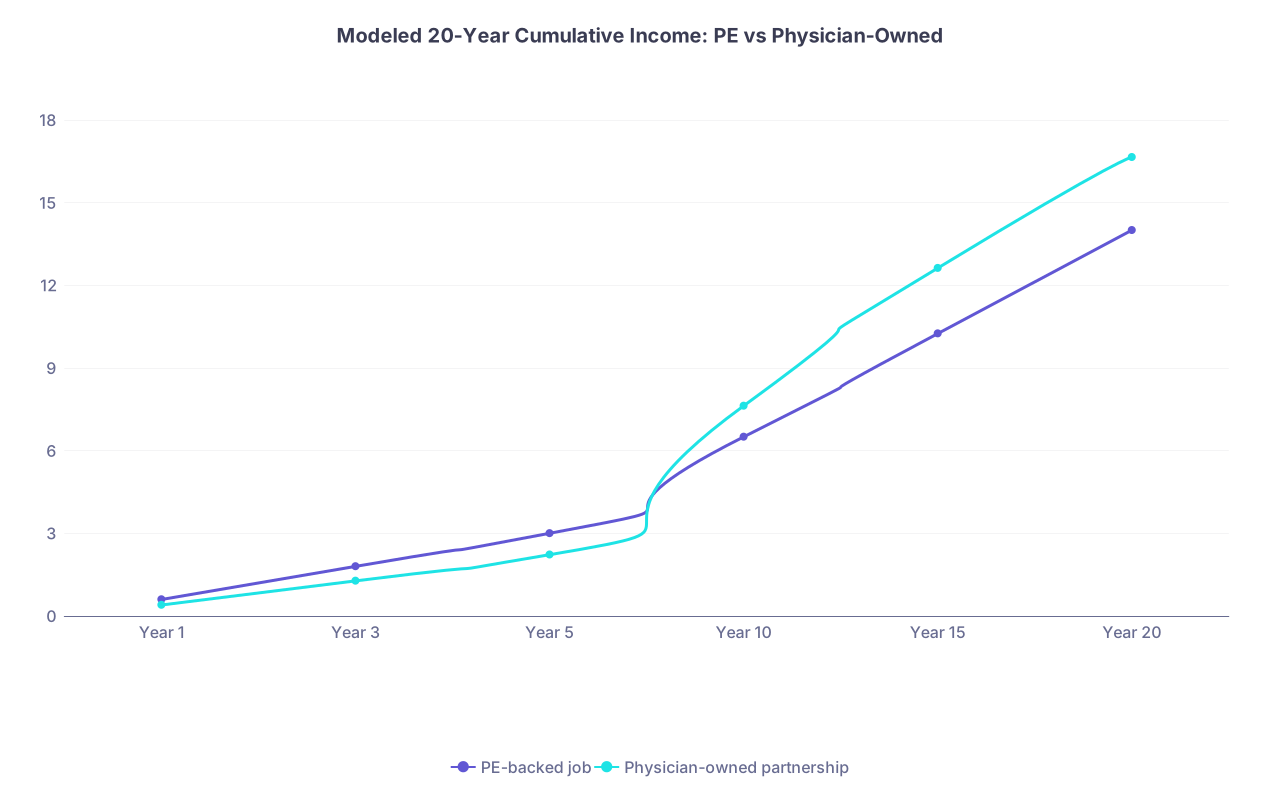
| Category | PE-backed job | Physician-owned partnership |
|---|---|---|
| Year 1 | 0.6 | 0.4 |
| Year 3 | 1.8 | 1.275 |
| Year 5 | 3 | 2.225 |
| Year 10 | 6.5 | 7.625 |
| Year 15 | 10.25 | 12.625 |
| Year 20 | 14 | 16.65 |
What the curve shows:
- Years 1–4: PE-backed job wins on cumulative cash. No surprise.
- Around Years 5–7: the curves cross.
- By Year 10: the physician-owned path has usually pulled ahead by $1M+ cumulative.
- By Year 20: the gap widens to $2–3M+, before accounting for any major equity event.
This is the part recruiters rarely spell out. They keep you anchored on Year-1 and Year-2 compensation. The data says you should be looking hard at Year-7 to Year-20.
4. Specialty-Specific Patterns in High-Earning Fields
Not all specialties behave identically, but certain specialties are structurally hostile—or favorable—to long-term independence. Here is how the income trajectories typically compare for some of the highest paid specialties.
| Specialty | Model Type | 20-Year PE-Backed Cash | 20-Year Physician-Owned Cash* |
|---|---|---|---|
| Orthopedic Surg | Procedural, high RVU | $15M–$17M | $18M–$22M |
| Cardiology | Mixed procedural | $13M–$15M | $16M–$19M |
| Dermatology | Cosmetic + medical | $12M–$14M | $15M–$18M |
| Ophthalmology | High-volume surgical | $13M–$15M | $16M–$19M |
| GI | Endoscopy-heavy | $13M–$15M | $16M–$19M |
| Anesthesia | Group/hospital-based | $11M–$13M | $13M–$16M |
*Physician-owned numbers assume timely path to partnership and equity participation in ancillaries. PE numbers assume generous W-2 with some productivity upside, no true equity.
The delta is consistently 20–30% higher lifetime cash in favor of physician-owned models for those who become full partners and stay long enough.
5. Where Private Equity Actually Wins (Financially)
PE is not automatically “bad”. It just optimizes for different things.
5.1. Early Career Cash and Risk Management
The main financial advantages of a PE-backed job:
- Higher starting salary.
- Lower personal financial risk (no big buy-in, no personal guarantees on lines of credit, less exposure to payer shifts).
- Less variability from month to month.
If you are:
- Deep in debt ($400k+ student loans).
- Risk-averse.
- Unsure about geography or even your specialty long term.
Then a high W-2 PE job can be rational for the first 3–5 years while you stabilize.
5.2. Short Horizon Physicians
If you have a short horizon—because you plan to transition to administrative roles, industry, early retirement at 50, or a lighter concierge practice—locking in high stable W-2 income early can make sense.
In those cases, you might not care about the massive tail that partnership generates in Years 10–25. You care about saving aggressively in Years 1–10, then pivoting.
5.3. The Rare “Second Bite” Upside
There are situations where junior physicians in PE-backed practices get some synthetic equity or profit units that participate in recapitalizations. I have seen cases where someone gets a $200k–$500k windfall from a recap they barely knew was coming.
But let’s be blunt: the bulk of transaction value flows to the original selling partners and PE, not to newly hired physicians.
If your recruiter's slide deck talks more about “rollover equity” and “carried interest” than about your actual W-2 and buy-in terms, read the spreadsheet carefully. Usually the math is underwhelming.
6. Where Physician-Owned Models Dominate
The physician-owned model is mathematically superior for those who:
- Intend to stay in one geography or group for 10+ years.
- Actually achieve partner status.
- Join a group with real ownership of ancillaries: imaging, ASC, pathology, labs, PT, real estate.
The drivers of long-term outperformance:
Participation in profit, not just wages.
Once you move from “employee” to “owner,” you are no longer trading only hours for dollars. You participate in margin from other physicians, midlevels, ancillaries, and contract arbitrage.Ancillary revenue scale.
A busy orthopedist doing 8–10 cases a week in a physician-owned ASC can generate six figures of additional partner profit per year just from facility fees and anesthesia contracts—on top of professional fees. GI and ophtho see similar patterns with endoscopy centers and surgical centers.Exit optionality.
Physician-owned groups can themselves sell to PE or a strategic buyer at 7–12× EBITDA. For a large group, that often translates to low seven-figure checks per partner. That event is fundamentally off the table for a physician who only ever worked as a W-2 in a PE-owned practice.Tax efficiency.
A large portion of partner income can be framed as pass-through distributions or capital gains instead of pure W-2 wage income. The after-tax difference over 20–30 years is not trivial.
7. The Subtle Drag of Private Equity on Long-Term Earnings
Most PE models follow the same script. It just plays out slowly enough that young attendings do not see it until they are locked in.
Mechanically, here is what happens economically:
PE buys a group at, say, 10× EBITDA.
To support that, they must:
- Maintain or grow EBITDA.
- Pay debt service.
- Eventually sell at a higher EBITDA or multiple for a profit.
EBITDA growth levers are finite:
- Increase volume (more RVUs, more visits per day).
- Decrease physician share of revenue (worse splits).
- Increase use of NPs/PAs and shift lower-acuity work to them.
- Cut costs (support staff, benefits, equipment deferrals).
- Negotiate better with payers and facilities (sometimes positive, sometimes not).
For you, the physician, the typical long-term pattern:
- Slight upward drift in base salary.
- Increasing pressure on productivity benchmarks.
- Gradual erosion of autonomy over schedule, OR time, and clinical decisions that affect throughput.
Financially, that often translates into your real earnings growing slowly, or stagnating, while the value you help create is capitalized and paid to the investors.
8. Longitudinal Income vs Lifestyle: The Real Tradeoff
Let me be explicit: highest lifetime income is not the same as best life.
The physician-owned route, especially in the highest paid specialties, often means:
- More business meetings.
- More exposure to partner politics.
- More responsibility for managing staff, contracts, and strategic decisions.
- More risk during downturns, payer changes, or regulatory hits.
PE or large corporate employment can mean:
- More predictable hours.
- Less admin on paper (until they reallocate it as “quality metrics” and “dashboard reviews”).
- Easier exit and geographic mobility.
So you must weigh the curve against your tolerance for hassle.
But if you are asking strictly, “Which model maximizes my expected 20–30 year income in a high-earning specialty?”—the data leans heavily toward physician-owned partnership.
9. Short-Term vs Long-Term: A Simple Numerical Sanity Check
Residents often tell me they “cannot afford” to take a lower associate salary in a physician-owned group.
So let us quantify that.
Example decision:
- PE-backed job offer: $600k starting, likely flat-ish over time.
- Physician-owned associate job: $425k with partnership in 3 years, expected partner income of $900k+.
Difference in the first 3 years:
- PE cumulative: 3 × $600k = $1.8M
- Physician-owned cumulative: 3 × $425k = $1.275M
- Short-term gap: $525k disadvantage to the physician-owned route.
Now, once partnership hits:
- Physician-owned partner earns, say, $900k vs your $650k in PE land.
- Annual delta: $250k+ per year.
That initial $525k gap is erased in just over 2 partnership years. After that, every additional year is pure upside.
Here is the payoff period if you compare pure cash delta:
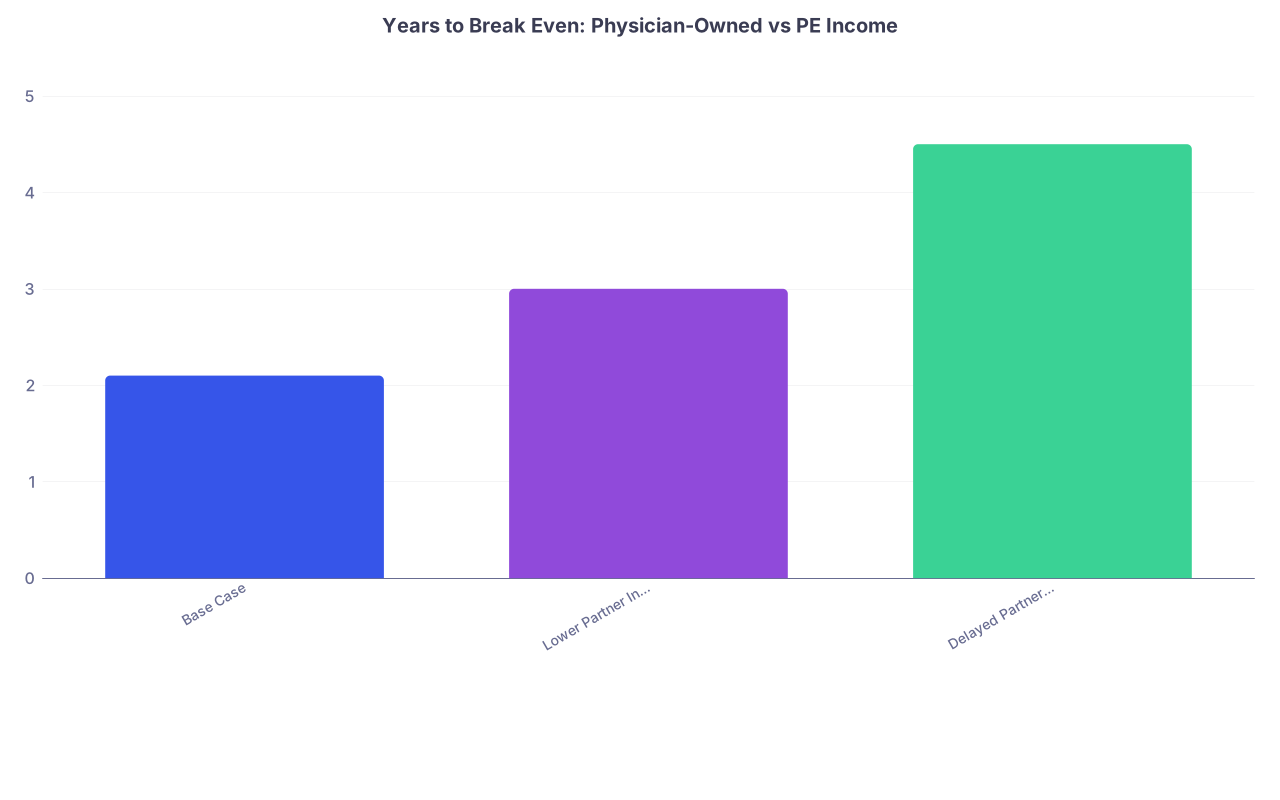
| Category | Value |
|---|---|
| Base Case | 2.1 |
| Lower Partner Income | 3 |
| Delayed Partnership | 4.5 |
- Base case: $250k annual advantage as partner → ~2.1 years to recover early loss.
- If partner income is lower and the delta is only $175k/year → ~3.0 years.
- If partnership is delayed or buy-in is higher, you might stretch to ~4–5 years.
So you are effectively “investing” 3–5 early years of lower cash for 15–20+ years of higher annual income. On pure NPV terms, that is usually a very good trade for someone planning to stay clinically active long term.
10. Red Flags and Green Flags in Each Model
You cannot just pick “PE” or “physician-owned” as a label and assume the numbers. You need to interrogate the specific deal.
For PE-Backed Offers, watch for:
- Hard caps on bonus or RVU incentives that prevent you from truly scaling income.
- Vague or non-transferable “equity-like” instruments.
- Non-competes that effectively lock you into the corporate ecosystem in your region.
- Compensation committees controlled entirely by non-physician executives.
For Physician-Owned Opportunities, scrutinize:
- Transparency around partner income (actual K-1s, not hand-wavy “our partners do well”).
- Realistic partnership timelines and the percentage of associates who actually make partner.
- Buy-in structure and what you are buying: just goodwill, or real assets and ancillaries.
- Governance: do a few founding partners siphon off outsized profits, or is it genuinely equitable?
The worst financial outcome is not PE vs physician-owned. It is joining a physician-owned group that never really intends to make you a full partner while dangling it as bait for a decade.
11. What This Means For Your Specialty Choice
Since this is in the “highest paid specialties” category, let’s connect it to specialty selection itself.
Some specialties have been more aggressively consolidated by PE and corporate players:
- Dermatology
- Ophthalmology
- Emergency medicine
- Anesthesia
- Radiology
Others retain stronger independent ownership footprints:
- Orthopedic surgery
- GI
- Urology
- Many cardiology groups (though shrinking)
If you highly value long-term ownership upside and are choosing between, say, derm vs orthopedic surgery, the structural playing field is already tilted. There are still independent derm groups, but the density of PE-backed options is completely different.
That does not mean “do not choose derm.” It means that if you do, you should be brutally realistic about where the practice consolidation curve is going and how that constrains your long-term income trajectory.
12. The Bottom Line: Curves, Not Snapshots
Look at the data and the pattern is obvious:
- Private equity maximizes short- to mid-term wage income and extracts equity value for investors.
- Physician-owned partnership suppresses early wage income but creates substantial long-term ownership income, especially in procedural, ancillary-rich fields.
Over 20–30 years, modeled lifetime gross income in high-earning specialties is frequently 20–40% higher in real, functioning physician-owned partnership tracks compared with high-paying PE W-2 jobs.
That does not automatically make physician-owned “better” for you. It makes it the superior vehicle if:
- You want to maximize long-horizon earnings.
- You are willing to accept more risk, business involvement, and delayed gratification.
- You actually intend to stay clinical and in one region long enough to harvest those years 10–25.
Your next step is not to memorize these numbers. It is to start demanding longitudinal data from every recruiter who calls you.
Ask for:
- Actual 5-, 10-, 15-year compensation histories of physicians in your role.
- Partner vs associate income graphs, not anecdotes.
- Details on equity events that have occurred—and who got paid.
You are not just matching into a specialty. You are signing onto an income trajectory that will either compound for you or for someone else. With this framework in hand, you are ready to dissect specific offers in your specialty and, more importantly, put every “lucrative” job into its proper long-term context.
The detailed modeling of specific contracts and how to negotiate them? That is the next part of the journey.