

The blunt truth: missing your dream high-paying specialty is not the end of a lucrative career. It is the beginning of needing a smarter strategy than your classmates.
If you did not match derm, ortho, ENT, plastics, IR, rad onc, neurosurg, or another top-comp field, you are not doomed to low pay and burnout. You are doomed only if you keep thinking “I’ll just reapply and hope.” Hope is not a plan. You need a pivot.
This is the playbook.
1. First 7 Days: Stop the Bleeding and Get Clear
Your first moves after not matching will determine whether you recover or drift for years.
Step 1: Control the emotional free-fall (24–48 hours)
You are going to feel:
- Embarrassment (“Everyone knew I was going for ortho.”)
- Panic (“My career is over.”)
- Anger (“My advisor told me I was competitive.”)
Fine. But you cannot make career decisions in that mental state.
Very short protocol:
- Tell 2–3 people you trust: “I did not match. I am working on next steps. I’ll share more once I have a plan.” This stops the rumor mill and buys you space.
- Sleep, hydrate, move. I am not doing wellness fluff. I am telling you your brain cannot solve complex problems with 3 hours of sleep and 5 coffees.
- Set a rule: no irreversible decisions (reapply, quit medicine, scramble into any program) until you have gathered data.
Step 2: Know exactly where you stand (Day 2–3)
You cannot pivot intelligently without a brutally honest inventory:
- USMLE/COMLEX scores (Step 1 pass/fail + Step 2, Step 3 if taken)
- Class rank / quartile / honors
- Research: number of pubs, first-author vs middle-author, relevance to the specialty
- Red flags: leaves of absence, professionalism issues, failed exams, visa issues
- Application pattern: number of programs applied, interview count, how far you got
Write it out. One page. No fluff.
Then categorize yourself:
| Profile Type | Step 2 Score | Research in Dream Field | Interviews Received |
|---|---|---|---|
| Near-competitive | ≥ 245 | Yes, multiple projects | 6–15 |
| Borderline | 230–244 | Limited or unrelated | 3–8 |
| Undermatched profile | < 230 | Minimal | 0–4 |
You cannot pick the right pivot until you know which row you live in.
Step 3: Get two outside opinions (Day 3–7)
Your med school advisor is not enough. They are often too soft or too biased.
You want:
- A faculty member in your dream specialty who will be honest: “You are not matching here without X, Y, Z.”
- A program director or associate PD in a closely related field (e.g., IM or anesthesia if you targeted cardiology, neurosurg, or ortho).
Questions to ask:
- “If this were your career, what would you do next cycle?”
- “Would you reapply, pivot to a related specialty, or do a one-year gap with research/transitional year?”
- “What specifically killed my application?”
Write down their answers. Look for patterns. That is your reality check.
2. Understand the Real Money: Not Just the Specialty Name
Here is the mistake I see repeatedly: students chase “ortho” or “derm” as if the job title alone prints money.
Compensation is driven by:
- Procedures
- RVUs and productivity models
- Geography (urban vs rural, coastal vs Midwest)
- Call burden and scarcity
There are multiple “second-choice” specialties that can still land you in the $400k–$700k+ range with the right subspecialty and practice setting.
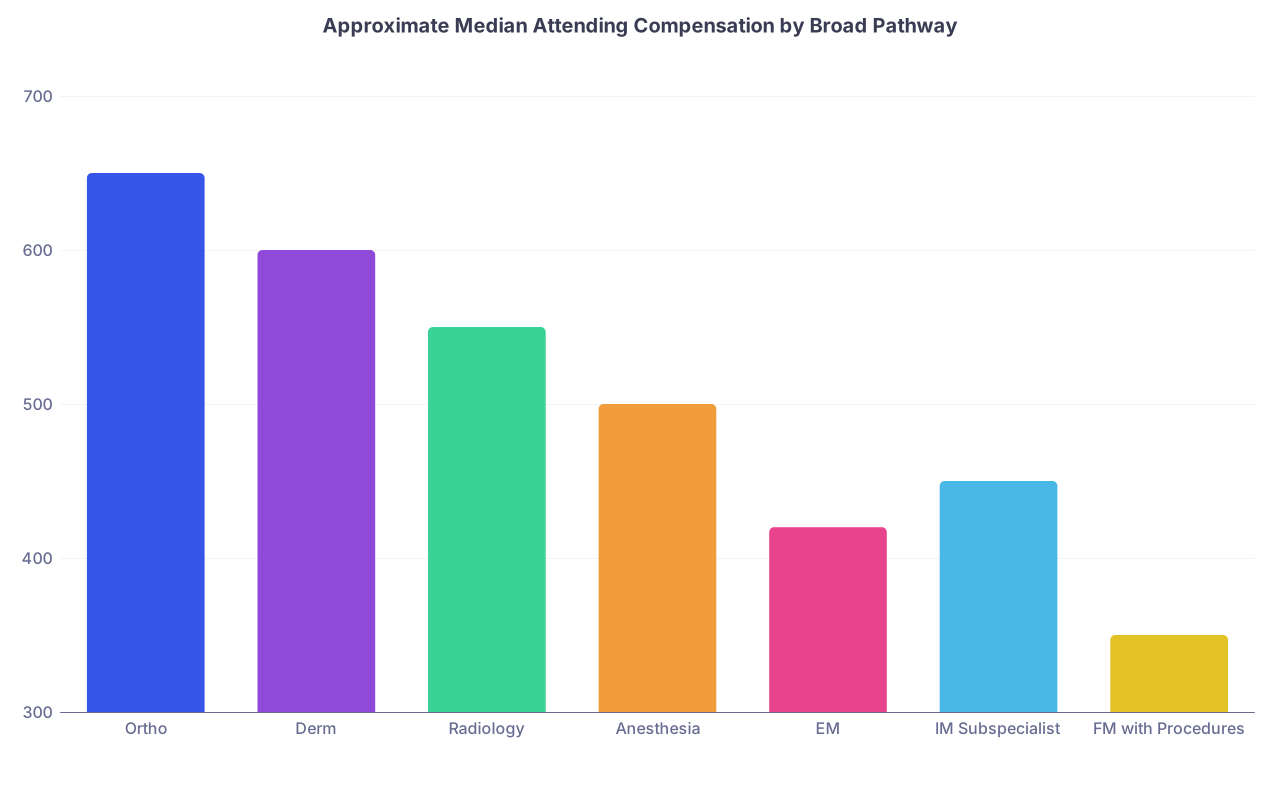
| Category | Value |
|---|---|
| Ortho | 650 |
| Derm | 600 |
| Radiology | 550 |
| Anesthesia | 500 |
| EM | 420 |
| IM Subspecialist | 450 |
| FM with Procedures | 350 |
Numbers are ballpark and vary wildly, but the pattern is clear: you have more than two entry doors to a high-income career.
Think less “I lost ortho” and more “What paths still lead to a high-procedure, high-RVU life?”
3. Smart Pivot Paths From Common “Dream” Specialties
Let us get tactical. I am going to give you the actual pivot ladders people use, not the fairy tales.
If you missed Orthopedics / Neurosurgery
Your likely profile: decent scores, strong letters, some research, but not enough interviews or you got squeezed out.
Realistic pivot ladders:
General Surgery → Orthopedic Fellowships?
Very rare now. Used to be a thing; these doors are nearly closed. Do not bank on “I’ll do gen surg then switch to ortho.”General Surgery → High-paying surgical subspecialties
- Vascular surgery
- Surgical oncology
- Bariatric surgery
- Trauma/acute care surgery (busy groups can pay well)
Anesthesiology → Pain Medicine
- Pain physicians in high-volume private practice can hit $500k–$800k+
- Daytime work, interventional procedures, outpatient-based
PM&R → Interventional Pain / MSK / Spine
- Many PM&R → Pain docs have ortho-level procedural lives
- Less OR time, more outpatient, still procedure dense
If your core drive is procedure + pay, anesthesia or PM&R with a pain focus is a very smart pivot from failed ortho/neurosurg.
If you missed Dermatology
You likely had strong academics but got crushed by research, connections, or Step 2 score.
Smart paths:
Internal Medicine → Rheumatology / Allergy / Endocrinology + side interests
- Not as high as derm, but certain private groups do very well
- Lifestyle is generally decent: clinic-heavy, predictable
FM or IM → Cosmetics / Aesthetics
- Botox, fillers, lasers, weight loss clinics
- Some FM/IM physicians run aesthetic practices and clear derm-level incomes
- Business skills matter more than residency name here
Pathology → Dermatopathology
- Niche, requires strong academic performance and networking
- Not for everyone, but financially and intellectually strong
Reapply only if:
- You have a clear plan for 1–2 years of derm-focused research
- You are willing to move anywhere
- A derm PD explicitly says, “If you do X with us, I’ll strongly support your reapplication”
If no PD is putting their name on you, do not burn another year chasing a mirage.
If you missed Radiology / Interventional Radiology
Radiology and IR are hot, but the real prize for many is procedural + high pay + limited clinic.
Alternative ladders:
Anesthesiology → Pain / Critical Care
- Highly compensated, lots of procedures
- Many anesthesia groups have blended OR and pain models
Internal Medicine → Cardiology / Interventional Cardiology
- Yes, the road is longer, but cardiology (especially interventional) can out-earn many rads jobs
- Very procedure heavy; cath lab lifestyle is intense but lucrative
PM&R → Interventional Spine / Pain
- Similar to above: outpatient procedures, injections, RFA, etc.
General Surgery → IR-adjacent roles?
- Vascular surgery, HPB surgery, and some trauma roles give you heavy procedural exposure, but do not confuse them with IR-light. Different beast.
The question to ask yourself: “Do I love imaging itself, or did I love the lifestyle and pay I thought radiology gave me?” Your pivot depends on that answer.
If you missed ENT / Plastics / Urology
These are brutal to match. If you came up short:
- General Surgery → Vascular / Plastics via gen surg route (rare) / Bariatric
- Urology miss → General Surgery or IM → hospitalist then entrepreneurial side gigs
- ENT / Plastics miss with strong scores → Anesthesia, Radiology, PM&R can still give you procedure-heavy careers with strong compensation.
Do not cling to “I will just reapply ENT next year” unless an ENT PD you trust explicitly pushes you to do so.
4. Reapply vs Pivot: The Decision Tree
Here is the decision problem you are actually facing, stripped of emotion:
“Do I spend 1–2 more years trying to match this same ultra-competitive specialty, or do I pivot now into a high-upside alternative?”
Use this simple framework.

| Step | Description |
|---|---|
| Step 1 | Did not match |
| Step 2 | Pivot now |
| Step 3 | Dedicated gap year + targeted reapply |
| Step 4 | Any interview offers in dream field? |
| Step 5 | PD-level feedback says reapply? |
| Step 6 | Can fix main weaknesses in 1 year? |
You should consider reapplying only if:
- You had at least a handful of interviews
- A PD in the field tells you clearly: “Your app was close. If you spend a year doing X with us, your odds will be reasonable.”
- You can meaningfully fix what was wrong:
- Weak research → 1–2 high-quality projects with strong mentor
- Late Step 2 score → Now in hand and competitive
- Poor letters → New rotations with strong LORs
You should pivot now if:
- You had zero or 1–2 interviews in that field
- Your Step 2 score is significantly below that specialty’s unofficial cutoff
- No PD is willing to champion a reapplication
- You are sitting on financial pressure: loans, family, etc., where another year of delay is a serious burden
5. Maximizing Income Inside “Less Competitive” Specialties
You did not get your dream field. Fine. That does not mean you cannot engineer a high-earning career.
The money inside a “less competitive” specialty depends more on how you practice than on the name on your diploma.
Here is what I mean.
| Base Specialty | High-Income Track | Typical Range (Approx) |
|---|---|---|
| IM | Cardiology / GI / Heme-Onc | $450k–$800k+ |
| Anesthesia | Community private group / Pain | $450k–$700k+ |
| PM&R | Interventional Pain / Spine | $400k–$700k+ |
| EM | Rural EM, locums-heavy practice | $400k–$600k+ |
| FM | Rural + procedures + side ventures | $300k–$500k+ |
Levers that move your income:
Geography
- Rural Midwest with high need: money up, lifestyle often decent
- Coastal academic center: prestige up, pay often down
Practice model
- W2 employed academic jobs: predictable but rarely top-paying
- Private practice / partnership: higher upside, more risk and business involvement
- Locums: higher hourly rate, variable stability
-
- FM with OB, vasectomies, scopes, aesthetics, or pain will beat plain clinic FM
- IM with endoscopy, stress tests, or imaging beats pure clinic
You can absolutely be an “FM doc” or “IM doc” on paper and still out-earn many derm and ortho attendings if you structure it right. I have seen it repeatedly.
6. If You Go SOAP or Transitional Year: Use It Properly
Many unmatched applicants end up in:
- SOAPed prelim medicine or surgery
- Transitional year (if lucky)
- A categorical spot in a non-dream specialty
Big mistake: treating that year as “wasted” or “temporary limbo.”
Treat it as:
- A 12-month audition
- A chance to build fresh, stronger letters
- Time to prove reliability, work ethic, and clinical skill
If you might reapply
Your one-year playbook:
- Crush your current job. No drama. No excuses. Be the intern everyone wants back.
- Tell 1–2 key faculty your plan early: “I am strongly interested in [specialty]. I did not match this year. I want to earn a letter that will truly help me.”
- Keep one foot in the target field:
- Research projects with that department
- Elective rotations if possible
- Conference attendance, case reports
If you decide to pivot fully
Then your goals shift:
- Get into a categorical spot as soon as possible
- Build relationships and reputation in your new home specialty
- Look for high-income niches within it from day 1:
- Ask who does procedures
- Learn about fellowship match outcomes from your program
Your temporary year is still part of your permanent story. Treat it like it matters, because program directors read those evaluations.
7. Negotiating Your Future: Think Like a Businessperson Early
Want a high-paying career after a pivot? You must start thinking like a businessperson long before fellowship graduation.
Key skills and habits:
-
- Learn basic compensation structures: base + bonus, RVU models, partnership tracks
- Understand non-compete clauses and how they restrict your future options
Track your value
- RVUs generated
- Procedures performed
- Patient satisfaction metrics
- All the data that justifies higher pay later
Develop non-clinical leverage
- Extra roles: medical director, quality improvement lead, informatics
- Side ventures: urgent care ownership, telemedicine, aesthetics, consulting
- These can turn a $350k job into a $500k+ reality over time
Be willing to move
- One of the harsh truths: some of the highest-paying jobs are not where you “want to live”
- A 3–5 year stint in a high-need region can change your financial trajectory permanently
8. A Concrete Example: Turning “Failure” Into a $600k Path
Let me walk you through a very real pattern I have watched more than once.
- M4 aims for ortho. Step 2: 238. Solid but not stellar research. 4 interviews. No match.
- SOAPs into a prelim surgery year. Works like a machine. Great team player.
- Honest feedback from ortho PD: “You are good, but not competitive enough in this climate to justify another cycle.”
He pivots.
- Applies broadly to anesthesia during prelim year.
- Matches a strong anesthesia program.
- During anesthesia residency, discovers interventional pain. Loves procedures, clinic is tolerable.
- Does pain fellowship. Joins a high-volume pain group in a secondary market.
Five years later:
- Income: ~ $650k with potential upside.
- Mix of procedures and clinic, minimal overnight call.
- Still scratching the “procedural” itch he wanted from ortho.
Did he “fail” to become an orthopedist? Yes. Did he land in a high-paying, procedure-heavy, sustainable career? Also yes.
That is what a smart pivot looks like.
9. Exact Action Plan: Next 3, 6, and 12 Months
Let me strip this into marching orders.
Next 3 months
- Do your brutally honest assessment: scores, research, interviews, red flags.
- Have at least two hard conversations with faculty/PDs about your future.
- Decide: reapply with a clear, realistic plan, or pivot now.
- If you SOAPed or took a prelim/TY spot, commit to being top 10% in work ethic and reliability.
Next 6 months
If reapplying:
- Lock in a concrete research or clinical year with real responsibility in the target specialty.
- Get on projects that can realistically produce something in 6–9 months (case series, QI, retrospective reviews).
- Line up at least one future letter writer who knows your plan and supports it.
If pivoting:
- Learn the high-value niches in your new specialty (fellowships, procedures).
- Adjust future rotations and electives toward those areas.
- Start reading and networking in that new field as if you chose it on purpose (because now you are).
Next 12 months
- Build a track record that solves your previous weaknesses (poor letters, low exposure, no research).
- Apply strategically—stop shotgun-applying 80 programs in a single hyper-competitive field without a sponsor.
- Keep your eye on the long game: where the money, lifestyle, and meaning intersect in your chosen path.
You are not trying to win Instagram prestige. You are trying to build a 30-year career that does not crush your health or your bank account.
FAQ (exactly 3 questions)
1. Should I ever take a year completely off (no clinical, no research) and just reapply?
Usually no. A “blank year” looks terrible to program directors unless you have a very strong, unavoidable reason (serious illness, family crisis, military, immigration issues). If you must step away, be ready to explain it clearly and show that your skills did not atrophy: CME, part-time clinical work, ongoing study. In almost all cases, you are better off in a structured role: research fellow, prelim/TY, or some form of supervised clinical work.
2. Is it still worth reapplying to an ultra-competitive specialty if my Step 2 score is below the usual cutoff?
Only if a PD in that specialty, who has seen your full file, explicitly tells you: “We would consider you if you strengthen X and Y, and I am willing to support you.” Without that kind of backing, reapplying with a sub-threshold Step 2 is usually a waste of time and money. Better to pivot into a related specialty that still allows a high-income, procedure-heavy career than to burn another cycle on long odds.
3. How much does specialty choice really matter for long-term income compared with business decisions?
Less than you think. Specialty opens certain doors and closes others, but within most fields, business decisions (private vs academic, rural vs urban, partnership vs employed, procedural focus, side ventures) will eventually outweigh the pure specialty effect. A business-savvy FM or IM physician with procedures and entrepreneurial projects can out-earn a risk-averse derm or ortho working in a low-paying academic role. Specialty is your starting line, not your ceiling.


