

The way most residents think about “making more money” in procedure-based specialties is backward. It is not about working more hours. It is about engineering your case mix.
If you are in a procedure-heavy field—orthopedics, cardiology, GI, interventional radiology, anesthesia, pain, ENT, ophthalmology, urology—your income ceiling is set less by how hard you work and more by which cases you do, in what environment, and how consistently. That is the game. You either learn it during residency or you spend your first 5–10 years donating money back to the system.
Let me show you how to fix it.
1. Understand the Money Engine: RVUs, Payer Mix, and Site of Service
If you do not understand how money flows, you cannot optimize anything. You are just “being a good doctor” and hoping the numbers work out. That rarely ends well.
The three levers that actually matter
- RVUs per case
- Payer mix (who is actually paying you)
- Site of service (where the procedure happens)
Get those three right and you can work less and earn more than someone grinding twice as hard with a bad case mix.
A. RVUs per case: stop guessing
Work RVUs (wRVUs) are the basic productivity currency. For any procedure-based specialty, your income in employed models is usually:
Income ≈ (wRVUs × conversion factor) + base + bonuses
A few rough examples (these are approximate, change over time, and vary by code set, but the relationship holds):
| Procedure Type | Example wRVUs | Typical Duration |
|---|---|---|
| Minor in-office procedure | 0.5–2 | 5–15 min |
| Simple diagnostic endoscopy | 3–4 | 15–20 min |
| Interventional cath/PCI | 8–25 | 45–90 min |
| Major joint replacement | 20–30 | 90–150 min |
| Complex spine surgery | 30–50+ | 3–6 hours |
Notice something: more complexity does not always mean proportionally more RVUs per hour. Some “boring” procedures have phenomenal RVU density.
What to do in residency:
- Ask attendings or your billing office for a basic wRVU list of your 20–30 most common procedures.
- For each, note:
- wRVUs
- Typical room time
- Setup/turnover time
- Calculate RVUs per hour for at least a few hallmark procedures. You will start to see patterns fast.
You are not doing this to turn into a coder. You are doing it so that when someone says, “You can build a great practice doing X,” you can quietly think, “No, that is a 2.5 RVU procedure that takes 45 minutes. Absolutely not as my bread and butter.”
B. Payer mix: the silent multiplier
Same procedure. Same RVUs. Completely different pay if the payer is commercial vs Medicaid.
At a high level:
- Commercial insurance: Often pays a multiple of Medicare (e.g., 150–300% of Medicare rates)
- Medicare: Baseline
- Medicaid: Often below Medicare
- Self-pay / cash: High variance; some procedures (aesthetics, certain pain, some ophtho) can be very lucrative
You cannot fully control this as a resident. But you can learn:
- Which hospitals, clinics, and ASCs in your system have higher commercial payer volumes
- Which attendings are known to have a “good payer mix” in their practices
- Which service lines tend to attract which payer types (e.g., cosmetic vs reconstructive plastics; screening colonoscopy vs advanced IBD work)
You are not cherry-picking patients. You are choosing your practice environment. Big difference.
C. Site of service: hospital vs ASC vs office
Same CPT code → wildly different actual dollars depending on where it is done.
General pattern:
- Hospital outpatient department (HOPD): Higher facility fees, more bureaucracy, often slower turnover
- Ambulatory surgery center (ASC): Lower facility payment than HOPD but higher efficiency, lower overhead, more surgeon leverage
- Office-based procedure: No facility fee, but potential to capture more of the global payment if you own equipment and space
For many procedure-based specialties, ASC + office-based procedures is the sweet spot for income and lifestyle.
2. Case Mix 101: Map Your Specialty’s Economic “Sweet Spots”
Every procedure-based specialty has a cluster of “workhorse” procedures that:
- Have strong RVU per hour
- Can be done in high volume
- Are predictable and repeatable
- Are not constantly interrupted by emergent chaos
That is your target case mix base. Then you add selectively on top.
Let’s look at a few examples.
Orthopedic surgery
Rough buckets:
- High-RVU but low-efficiency cases
- Complex revision joints
- Multi-level spine
- Massive trauma cases
- Moderate-RVU, high-efficiency workhorses
- Primary total knees/hips in a well-run ASC
- Single-level decompressions
- Rotator cuff repairs, sports procedures
- Low-RVU, time-sink cases
- Long, complex non-operative visits that do not convert to surgery
- Small fracture management with tons of follow-up and minimal procedure pay
Well-compensated ortho surgeons generally:
- Anchor their schedules with predictable primary joints / bread-and-butter sports in efficient settings (ASC)
- Limit the percentage of revision / train-wreck cases that wreck the daily schedule
- Push clinic toward evaluation that leads to a clear procedure path rather than endless “come back in three months” visits
Gastroenterology
Buckets:
- High-efficiency, moderate-RVU procedures
- Screening colonoscopies
- Upper endoscopies
- Complex interventions
- ERCP, EUS, advanced therapeutic endoscopy
- Low-RVU time drains
- Chronic functional GI clinic visits with low procedure conversion
- High-need patients with minimal reimbursable intervention
High-earning GI docs typically:
- Run tight endoscopy blocks with high on-time starts and short turnover
- Build primary case mix around screening/surveillance scopes
- Layer in a controlled amount of advanced procedures for differentiation and referrals
Cardiology / Interventional
Buckets:
- Diagnostic caths + PCI
- EP studies and ablations
- Structural heart (TAVR, etc.)
- Non-procedural clinic and imaging reads
The step most fellows miss: understanding which labs and which hospitals give them the best combo of:
- Reasonable RVU rates
- Efficient turnover
- Solid payer mix
I have seen interventional cardiologists doing the same number of caths per month, but one working in a chaotic lab with bad turnaround and mostly Medicaid, the other in a well-run private ASC-ish environment with strong commercial volume. Income difference: 2–3×.
Anesthesia & Pain
For anesthesia, your “case mix” is often the cases your surgeons are doing. But you still have levers:
- Block-heavy vs simple cases
- High-acuity ICU-heavy programs vs bread-and-butter elective OR
- Taking on pain procedures, regional anesthesia, or perioperative clinics
For pain specialists, the economics are sometimes extreme:
- Short, moderate-RVU injections and minimally invasive procedures in ASC or office
- Longer, complex cases that are flashy but destroy RVU/hour
Same pattern: best-compensated folks standardize on their efficient procedures, in an efficient facility, with a tolerable payer mix.
3. The Four-Step Protocol to Optimize Your Case Mix (Even as a Resident)
You are not an owner yet. You probably do not control your schedule. But there is a lot you can do.
Here is the protocol I push on residents and fellows who actually want to be intentional about income in procedure-based specialties.

| Step | Description |
|---|---|
| Step 1 | Learn RVU and payer basics |
| Step 2 | Map current case exposure |
| Step 3 | Target high-yield procedures |
| Step 4 | Shape training and early job choice |
| Step 5 | Refine case mix yearly |
Step 1: Audit your exposure now
Do a 2–4 week snapshot:
- List every procedure you participate in
- For each case, jot down:
- Procedure type
- Approximate duration (wheels in to wheels out)
- Setting (hospital OR, ASC, office)
- Attending
- Elective vs emergent
Then, approximate wRVUs per case from:
- Internal billing sheets
- Online databases (even rough CPT benchmark data is fine)
- Asking a coder or admin you get along with
You are not trying to be exact. You just want relative RVU/hour.
You will quickly see:
- Which procedures are RVU-dense and efficient
- Which are RVU-poor and time-consuming
- Which attendings run efficient rooms with predictable lists
This becomes your internal map of “what actually pays in my field.”
Step 2: Decide your target case mix profile
You cannot have everything. The job with 90% sexy complex tertiary referrals and no bread-and-butter is usually a lifestyle and financial mess.
Define, in writing, your ideal distribution. For example, as a GI fellow:
- 60–70%: screening/surveillance colonoscopy and EGD
- 15–25%: advanced procedures (e.g., ERCP/EUS)
- 10–20%: clinic / non-procedural
Or as an orthopedic resident aiming for adult reconstruction:
- 60–70%: primary hips/knees
- 10–20%: revisions and complex deformity
- 10–20%: clinic / fractures / misc
The exact numbers can shift, but the key is this:
You choose a base of efficient, repeatable, mid-complexity procedures and cap the percentage of schedule-wrecking cases.
Without this, your practice will default to whatever the hospital needs filled. Which is usually not what is best for your income or sanity.
Step 3: Shape your training to match your target mix
Residents underestimate how much control they have here.
Specific moves:
- Prioritize rotations with your “workhorse” attendings
- The surgeons or proceduralists whose lists match your target mix
- The labs/ORs where turnover is actually efficient
- Ask explicitly for more of certain cases
- “I am really trying to get comfortable with bread-and-butter [procedure]. Can I scrub into more of your cases on Thursdays when you do those?”
- Track your log with intention
- Most specialties have minimum numbers; you want target numbers for financial workhorses:
- Example: “I need at least 300–400 colonoscopies where I am primary operator.”
- Or “I want 200+ primary joints before graduation.”
- Most specialties have minimum numbers; you want target numbers for financial workhorses:
- Learn clinic filtering and triage
- Watch attendings who:
- Efficiently identify who actually benefits from procedure
- Avoid endless follow-ups that never lead anywhere
- This is how you build a clinic that feeds your desired case mix instead of clogging your schedule with low-value visits
- Watch attendings who:
You are basically reverse-engineering your future practice starting now.
Step 4: Choose your first job with brutal clarity
Most new grads choose jobs based on vague impressions:
- “Seemed nice”
- “Good location”
- “They said I would be busy”
Busy doing what? That is the only question that matters.
When you interview, you ask:
- “Can you show me anonymized breakdowns of case mix for someone 3–5 years ahead of me in this group?”
- “How many [target procedures] does the typical partner do per month?”
- “What percentage of my schedule, realistically, will be emergent or add-on?”
- “What percent of procedures are in ASC vs hospital vs office?”
- “What is the current payer mix by site?”
Then you test their answers against your target profile.
If your target is 60–70% efficient bread-and-butter ASC cases and the current partners are doing 80% hospital inpatients with scattered cases at weird times, you know what that means. You pass or adjust your expectations.
4. Advanced Levers: Efficiency, Scheduling, and Saying No
Once you are in practice, optimizing case mix is about discipline. You will always feel pulled toward:
- “Interesting” but schedule-destroying cases
- Hero complex: taking every last complicated disaster
- Admin pressure: filling gaps no one else wants
You do not have to say yes to everything to be a good physician.
A. Build “anchor blocks” for high-yield cases
You want specific, protected time for your bread-and-butter procedures. For example:
- Ortho: Two full primary joint days per week in the ASC
- GI: Three scope blocks per week where your first case starts on time, last case is planned, and add-ons are capped
- IR: Dedicated half days for core bread-and-butter interventions rather than only emergent hospital work
This creates:
- Predictable RVU production
- Less chaos
- Easier staffing and turnover
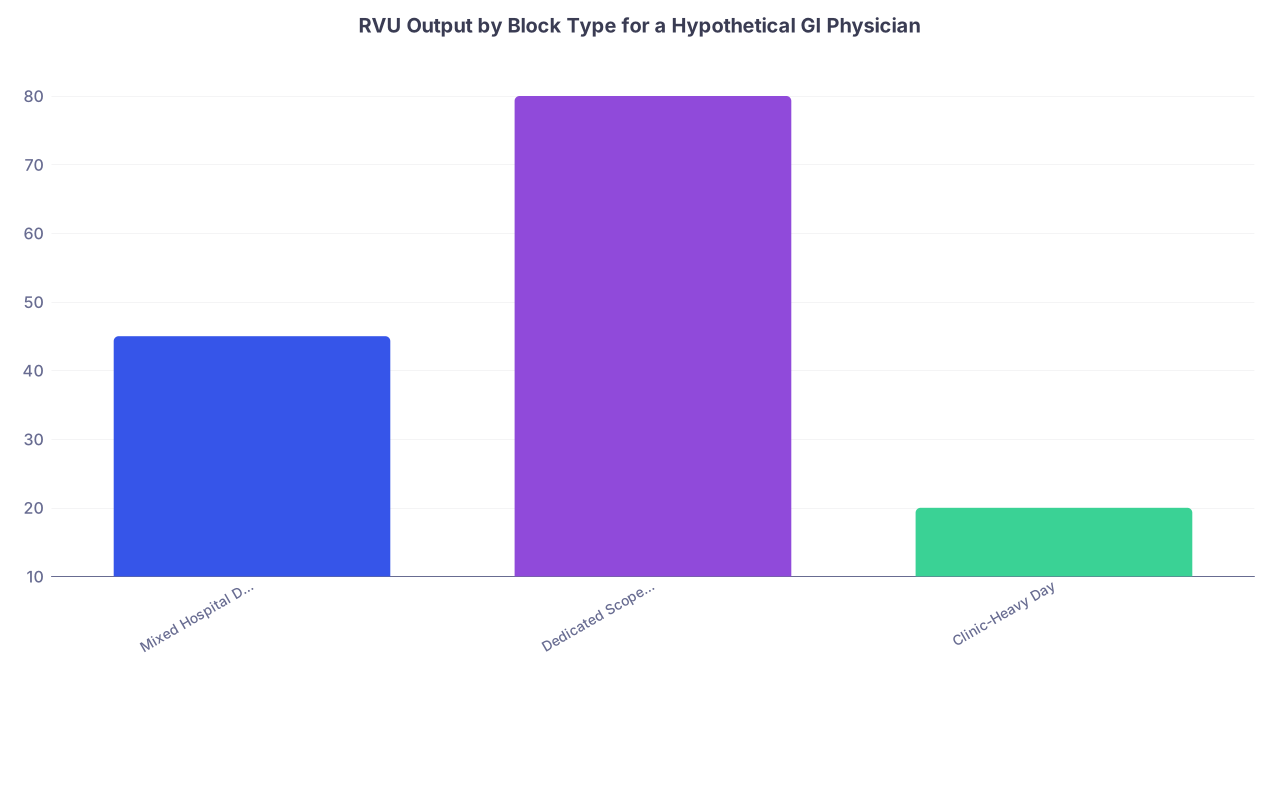
| Category | Value |
|---|---|
| Mixed Hospital Day | 45 |
| Dedicated Scope Block | 80 |
| Clinic-Heavy Day | 20 |
Same hours. Wildly different RVU output. That is why anchor blocks matter.
B. Use scheduling rules, not vibes
If you let schedulers and referring docs fill your day however they like, your case mix will drift.
You need written rules:
- Which procedures you perform only on specific days/sites
- Maximum number of long complex cases per day
- Clear criteria for certain procedures (e.g., not offering low-value interventions)
Example for an ortho practice:
- Tues/Thurs: ASC primary joints and sports (no revisions)
- Wed: Complex revisions, odd cases, and trauma that truly requires main hospital OR
- Cap at one complex revision per block unless absolutely unavoidable
This prevents “death by a thousand complex cases.”
C. Learn to say a professional “No”
You will be asked to:
- Take cases that do not fit your target case mix
- Fill clinic slots with low-value follow-ups
- Add last-minute complex cases to a carefully built block
A script that works:
- “For this type of case, I reserve specific OR days so I can do it safely and thoroughly. Let us schedule it on my next [complex day] instead of squeezing it into a high-volume block.”
Or:
- “Given my current schedule and the setup this case requires, I cannot do it justice today. I can see them on [date] and book the appropriate time.”
You are not bailing. You are protecting patient safety and your long-term viability. Burned-out, overbooked physicians are not good doctors.
5. Common Case Mix Mistakes That Tank Income (and How to Fix Them)
I see the same patterns over and over.
Mistake 1: Chasing only high-complexity, “prestige” cases
Problem:
- You become the go-to person for everything no one else wants
- Your schedule is full of out-of-proportion time sinks
- RVUs per hour plummet
Fix:
- Cap the percentage of your schedule that can be complex or revision work
- Make sure you have a strong base of mid-complexity, high-efficiency procedures that you actually like
- Protect those blocks from encroachment
Mistake 2: Ignoring clinic structure
Clinic is not just “extra.” It is your case funnel.
If your clinic is filled with:
- Non-procedural issues you cannot treat procedurally
- Patients who are poor candidates or uninterested in intervention
- Chronic, unsolvable problems with no clear plan
Then your OR / lab / procedure schedule will suffer.
Fixes:
- Work with scheduling and referring providers on clear referral criteria
- Build templates:
- New consults likely to need procedures
- Follow-up slots for post-op or post-procedure
- Limited slots for chronic without clear procedure indication
- Use midlevels or collaborators for non-procedural chronic follow-up where appropriate
Mistake 3: Wrong site of service for high-volume work
Doing bread-and-butter cases exclusively in a main hospital OR when an ASC or office-based setup is feasible is like commuting in a dump truck when you could use a car.
Fix:
- Early in practice, target groups that:
- Have ASC access
- Already run efficient high-volume days
- Are open to you shifting appropriate cases to ASC/office
- Long term, consider:
- Partial ASC ownership
- Collaborating to build a new ASC or join an existing high-performing one
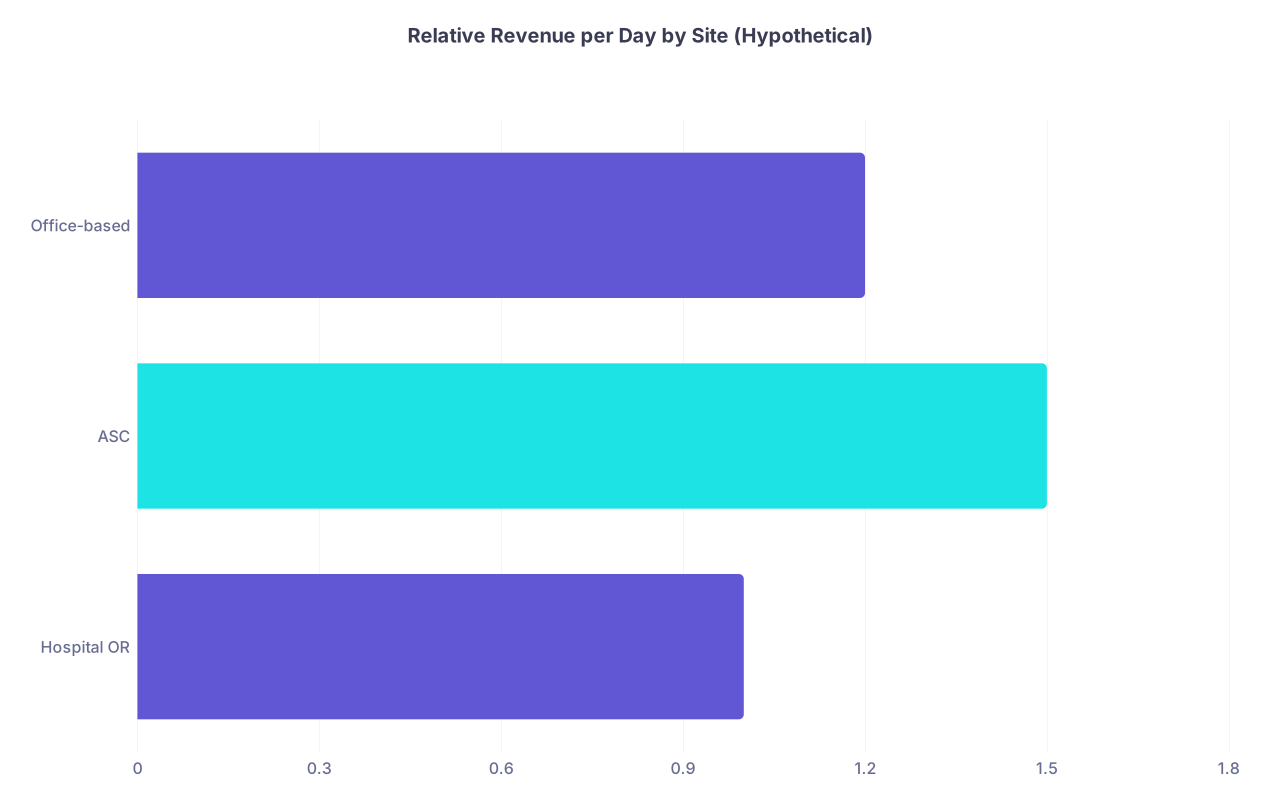
| Category | Value |
|---|---|
| Hospital OR | 1 |
| ASC | 1.5 |
| Office-based | 1.2 |
The exact numbers differ, but the pattern is common: ASC and office, when done well, usually beat hospital OR for day-in, day-out procedures.
Mistake 4: Never checking your own data
You cannot optimize what you do not measure. Too many physicians have literally no idea:
- Which 10 procedures generate most of their RVUs
- Which clinic templates lead to actual booked cases
- Which referrers send the kind of patients that fit their expertise and practice model
Fix:
At least once a year (ideally quarterly):
- Pull a report of:
- RVUs by procedure code
- Cases by site (hospital vs ASC vs office)
- Payer mix breakdown
- Identify:
- Top 10 RVU-generating procedures
- Bottom 10 time-consuming, low-RVU procedures
- Ask:
- Can I increase volume or efficiency of the top 10?
- Can I reduce or re-structure how I handle the bottom 10?

| Step | Description |
|---|---|
| Step 1 | Pull data reports |
| Step 2 | Identify top and bottom procedures |
| Step 3 | Adjust templates and blocks |
| Step 4 | Communicate rules to staff |
| Step 5 | Monitor for 3-6 months |
This loop is how you compound improvements over time.
6. Specialty-Specific Quick Wins (Residency and Early Practice)
Let me give you some ultra-specific, fast wins by specialty type. These are not universal, but they apply often enough that they are worth thinking about.
Orthopedics
- In residency:
- Get heavy exposure to primary joints or core sports procedures
- Learn fast, safe techniques that do not drag on forever
- Pay attention to how attendings structure their OR days—copy the efficient ones
- Early practice:
- Lock in at least 1–2 days/week of predictable ASC work
- Do not let revisions creep into every block
- Build relationships with PTs and PCPs who refer straightforward osteoarthritis / sports you can help predictably
Gastroenterology
- In fellowship:
- Maximize your comfort with high-volume scope days
- Learn anesthesia/sedation setups that keep turnover tight
- Watch how attendings handle “difficult colon” cases without exploding the schedule
- Early practice:
- Fight for full, protected scope blocks
- Do not overstuff clinic with non-procedural chronic complaints
- Educate referrers about when a visit should lead to a scope (and when it should not)
Cardiology / Interventional
- In fellowship:
- Track lab efficiency: which rooms run on time, which do not
- Understand call vs elective work balance and its financial hit
- Train in both complex and bread-and-butter procedures, but mentally flag which you want as your core mix
- Early practice:
- Insist on clear block times in cath/EP labs
- Avoid practices where you are basically a full-time hospitalist with occasional procedures unless that is really what you want
- Pay close attention to hospital vs ASC arrangements for cath/EP, especially if private practice
Anesthesia & Pain
- In residency/fellowship:
- Spend time on regional and pain if you might want them; they can be major revenue streams
- Learn which surgeons run efficient rooms and which do not
- Early practice:
- As anesthesia: align with high-volume elective surgeons; avoid being stuck in low-output rooms all day every day
- As pain: define your core procedures (injections, RFA, stim, etc.), schedule them in tight blocks, and limit endless med management visits that never move to intervention
7. The Mindset Shift: From “Take What Comes” to “Design Your Practice”
The big mistake is believing that case mix is something that happens to you.
Hospitals and systems benefit when you are indiscriminate. They plug you into whatever gaps they have. That might be fine for a year or two. It is not fine as a career.
You are allowed to be intentional about:
- Which procedures you perform most often
- Where you perform them
- How your clinic feeds your procedure schedule
- Which patients and referrers you want to build around
That is not greed. That is sustainability. High-burnout, low-control careers do not serve patients in the long run.
Your Next Step Today
Do this before you forget:
- Open a note on your phone or computer.
- List your specialty at the top.
- Under it, create three headers:
- “Workhorse procedures I want as my base”
- “Complex cases I want in limited doses”
- “Settings I want to prioritize (ASC, hospital, office)”
Spend 10 minutes filling those out based on what you have seen so far in residency or fellowship. Then, over the next week, start asking attendings specific questions about RVUs, payer mix, and site of service for those procedures.
That 10-minute exercise is the first real step in designing your case mix instead of letting the system design it for you.


