

It is 1:30 a.m. You are between consults, sitting in a dim workroom, scrolling through posts about “highest paid specialties” and screenshots of MGMA data. One attending says, “Just do what you love, the money will follow.” Another says, “If you are not at least considering GI or cardiology you are naive.” You are tired, in debt, and residency is not exactly gentle.
You want a structured, numbers-first way to decide: which fellowship track actually makes the most sense if you care about income, lifestyle, and risk, not just prestige and social media flex.
Here is that framework.
1. Start With the Right Question: “Profitable” Over “High Salary”
The worst way to choose a fellowship is by memorizing “top 5 highest paid specialties” lists and trying to reverse‑engineer your life around them. You are not a spreadsheet line. You have constraints, location preferences, debt, family, tolerance for call, and actual skills.
Shift your question from:
“What pays the highest?”
to
“What is the most profitable track for me over 30–35 years, after training, taxes, geography, and burnout risk?”
That shift forces you to look at:
- Time to earning real money
- Risk of never matching the fellowship you want
- Geographic flexibility and market demand
- Procedures vs cognitive work and how they are paid
- Practice models (W2, partnership track, private equity, academic)
- Exit options if you burn out or change your mind
Before we go into a protocol, let us anchor on some real ranges.
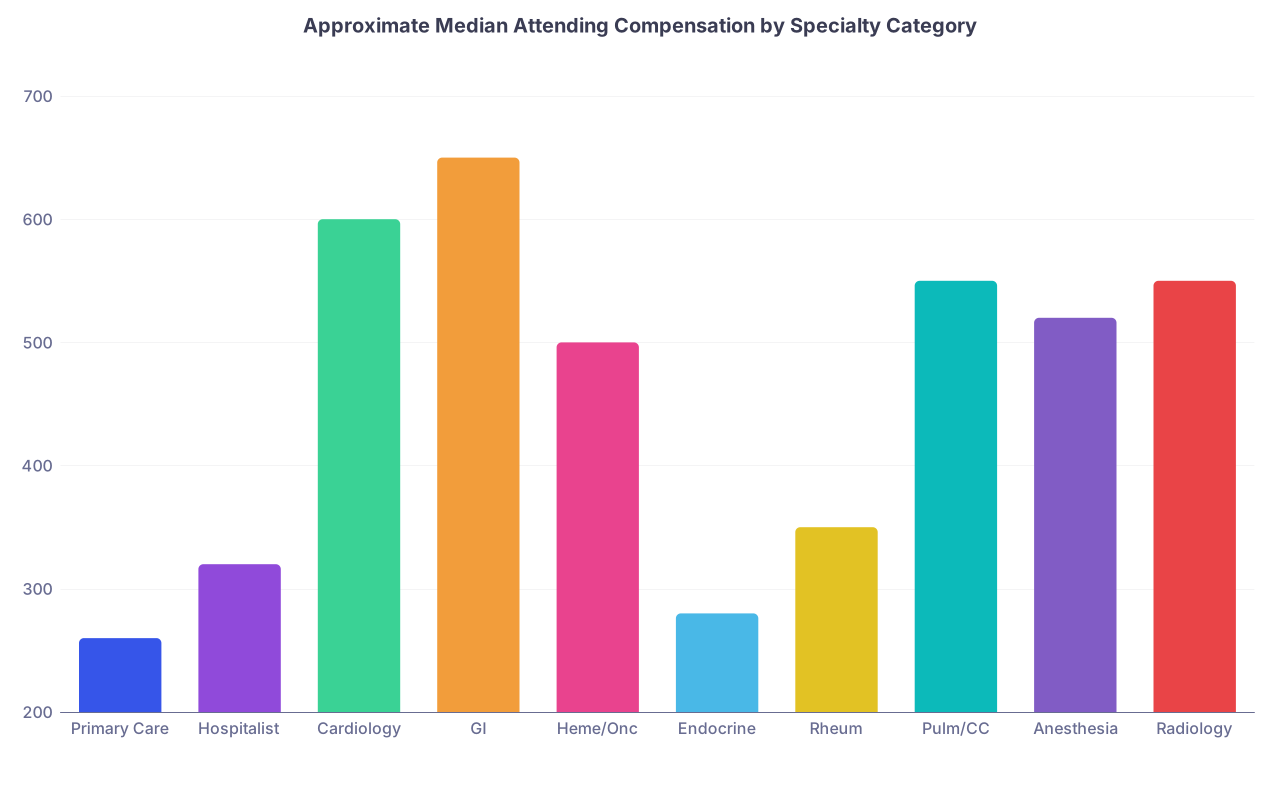
| Category | Value |
|---|---|
| Primary Care | 260 |
| Hospitalist | 320 |
| Cardiology | 600 |
| GI | 650 |
| Heme/Onc | 500 |
| Endocrine | 280 |
| Rheum | 350 |
| Pulm/CC | 550 |
| Anesthesia | 520 |
| Radiology | 550 |
These are rough composite numbers from MGMA/Medscape/AMGA style data, private practice included. Yes, outliers exist (radiologists over $800k, GI groups over $1M). The goal is not fantasy. The goal is probable outcome, not unicorn scenario.
2. The 4-Variable Framework: How to Actually Compare Fellowship Tracks
Stop treating this like a vibe-based decision. Treat it like an investment decision. For any fellowship path you are considering, you evaluate it across four major variables:
- Net Lifetime Earning Potential
- Time and Risk to Get There
- Market Power and Flexibility
- Lifestyle and Burnout Exposure
You put structure on each of these. Not vague hand‑waving.
2.1 Net Lifetime Earning Potential
You care about after-tax, after-training, realistic income, not the glossy ceiling number.
For each specialty, you want:
- Typical median total compensation (not just base salary)
- High-percentile compensation for productive private practice (75th–90th percentile)
- Common partnership models (buy-in, collections-based, RVU multipliers)
- Call pay, shift differentials, bonus structures
Then you model a 30-year window:
- Residency years (low income)
- Fellowship years (lower income, opportunity cost)
- Early attending years (salary or low partnership draws)
- Mature attending years (peak earnings)
Because people struggle to do this in their head, here is a simple comparison framework.
| Pathway | Training Length (Post-MD) | Typical Start Attending Comp | Mature Median | High Outlier Range |
|---|---|---|---|---|
| IM → Hospitalist | 3 yrs | $280k–$320k | $320k–$380k | $450k+ (rural, high-shift) |
| IM → Cardiology | 3 + 3 | $450k–$550k | $600k–$750k | $900k+ (PP, procedures) |
| IM → GI | 3 + 3 | $450k–$600k | $650k–$800k | $1M+ (PP, high-volume) |
| IM → Heme/Onc | 3 + 3 | $375k–$475k | $450k–$600k | $700k+ |
| IM → Endocrine | 3 + 2 | $230k–$280k | $250k–$320k | $350k+ |
Your risk profile should influence your decision heavily:
- High-pay + high-risk (GI, interventional cards, dermatology via medicine/allergy, certain surgical fellowships)
- Moderate-pay + moderate-risk (heme/onc, pulm/CC, electrophysiology within cards once in)
- Modest-pay + low-risk (hospitalist, general IM with procedures, outpatient specialties in shortage areas)
If your risk of not matching your “dream” high-paying fellowship is significant, you must consider:
- Is the fallback specialty still profitable and tolerable?
- Could you be happy long-term as a hospitalist, general IM, non-interventional cardiology, etc.?
2.3 Market Power and Flexibility
The most profitable path is not just about the biggest number. It is about leverage.
You want to know:
- How many job offers will I get in the cities I actually want?
- How replaceable am I in that market?
- How reliant is the field on outpatient referrals that can be steered by systems or payers?
- How likely is mid-level encroachment or commoditization?
High-income, high-market-power fellowships tend to be:
- GI – Heavy procedural, shortage in many areas, high leverage in private practice
- Cardiology (especially interventional / EP) – High demand, aging population, procedural dominance
- Pulm/CC – ICU coverage plus clinic, very hard to replace, hospitals need you
- Radiology (diagnostic/IR), anesthesia – Still strong in many markets but under PE and telerad/locums pressures
Fields with weaker leverage despite decent pay:
- Heme/Onc in saturated metro markets tied tightly to big systems
- Certain surgical subspecialties where hospitals/employers control the referral firehose
- Non-procedural cognitive subspecialties (endocrine, ID) – compensated poorly relative to training
Ask yourself: “If I show up in a mid-sized city as an attending, am I the scarce resource or just another CV in a stack of 50?”
2.4 Lifestyle and Burnout Exposure
If you burn out and cut down to 0.7 FTE at 42 because call destroyed your sleep, your theoretical million-dollar GI salary evaporates.
You want sustainable profitability.
For each fellowship track, list:
- Call structure (home, in-house, q4, 1 in 7 weekends, etc.)
- Night coverage expectations long-term
- Vacation and CME weeks
- Outpatient vs inpatient time split
- Typical “full” work week hours vs what people actually do for $600k+
Then decide your tolerance honestly:
- Can I handle a career of middle-of-the-night STEMIs or GI bleeds?
- Am I okay doing 2–4 nights of in-house ICU per month at 50?
- Would I rather cap at $400k but have minimal call and a predictable lifestyle?
The most profitable fellowship is one that you can do at 0.9–1.0 FTE for 25+ years without imploding.
3. High-Earning Tracks: What Actually Moves the Needle
Let us go specialty-specific and concrete. I will assume you are coming from the big common feeder residencies: internal medicine, general surgery, anesthesiology, radiology, pediatrics.
3.1 Internal Medicine → High-Earning Fellowships
From IM, the heavy hitters financially:
- Gastroenterology
- Cardiology (especially interventional / EP)
- Pulmonary / Critical Care
- Heme/Onc (good but a notch below in many markets)
GI
- Pros:
- Top of the pay stack in most surveys
- Shortage in many areas, huge procedural volume
- Endoscopy center ownership = equity upside
- Cons:
- Brutal fellowship match from mediocre programs
- Hard physical work, burnout from scoping all day
- Night/weekend call for GI bleeds, emergent ERCP
Cardiology
- Pros:
- Very high comp, particularly interventional and EP
- Multiple sub-niches (imaging, advanced HF, structural, etc.)
- Strong job demand in most non-oversaturated cities
- Cons:
- Very long training tail if you add subspecialty (6–7+ years post-MD)
- High call burden for interventional, STEMI coverage
- Competitive within a competitive fellowship
Pulm/CC
- Pros:
- High compensation, especially with strong ICU involvement
- Hospitals desperate for consistent intensivist coverage
- Mix of clinic and ICU gives variety and leverage
- Cons:
- Nights and holidays in ICU, emotionally heavy
- Can feel treadmill-like in some hospital-employed models
If your goal is raw earning power and you have the profile for a competitive fellowship, GI and cards usually win. If you want a mix of high pay + strong job security + decent variety, Pulm/CC is an underrated powerhouse.
3.2 Anesthesiology → Maximizing Profitability
Base anesthesia is already well compensated. Many never do fellowship and make $450k–$600k+ in the right market with good call pay.
Fellowships that can change the money equation:
- Cardiac anesthesia
- Pain management
- Critical care (anesthesia pathway) – more job security than raw pay boost
Pain is unique: it is often a bridge to very high-paying, procedure-heavy outpatient practices with injections, RFA, and sometimes questionable ethics depending on the group. I have seen pain docs clear seven figures in aggressive markets. I have also seen them loathe their work.
If you are anesthesia PGY-2 thinking “fellowship purely for money,” your decision is more nuanced:
- Anesthesia + good group + high-call rural area can beat a mediocre pain job financially
- Pain can deliver very high upside but also higher business risk and regulatory scrutiny
So your structured check here:
- Does fellowship multiply my options or just narrow them?
- Do I actually like pain clinic days, or am I attracted only to the income memes?
3.3 Radiology → Diagnostic vs IR and Beyond
Both diagnostic rads and IR sit comfortably in the high-earning tier. Classic pattern:
- Diagnostic radiology: high income, more control over shifts, telerad options
- Interventional radiology: procedure-heavy, high pay, more call and patient management
Profitability questions to ask:
- Do I want the high-shift, low-relationship lifestyle (diagnostic)?
- Or the clinic + procedures + call lifestyle (IR)?
- How comfortable am I with telerad commoditization and private equity impact?
Radiology’s big profitability lever is often location + practice type, not fellowship title alone.
- Rural / underserved areas = huge pay premiums
- Independent groups vs PE-owned groups = different partnership / buyout math
3.4 Surgery → Profit-Heavy Subspecialties
General surgery alone can pay well in the right setting, but many chase subs:
- Orthopedic surgery (if you are still at the med student stage choosing residency)
- Neurosurgery (ditto)
- Vascular surgery
- Surgical oncology, HPB (more reputation than pay boost in many markets)
- Plastics – wildly variable; cosmetic-heavy private practice can be extremely lucrative
The problem: these paths are long and punishing. You should never pick neurosurgery “for the money.” Survival bias is brutal here. The net profitable decision is usually:
- If you already love operating and can handle that lifestyle → pick the surgical field early
- Do not go gen surg planning to “later pivot to plastics or ortho” without elite credentials and a clear pipeline
3.5 Pediatrics and Others
Peds-based fellowships (NICU, PICU, peds cards) rarely hit the same income strata as adult IM-based ones. They can still be “profitable enough” with:
- Lower burnout in some niches
- Strong job security in underserved or academic markets
If your prime directive is maximum income, pediatrics is usually not the base you choose. If you are already in peds and want to maximize within it, PICU and peds cards are typically higher-paying, but you will not match adult GI or cards numbers.
4. Step-by-Step Protocol: How to Decide Your Fellowship Track
You do not need more data. You need a process. Here is one you can actually follow over 2–3 months.
Step 1: Hard Filter by “No Way” Factors
First pass, ruthlessly exclude:
- Procedures you hate or fear
- Patient populations that drain you
- Call structures you know you cannot tolerate long-term
Outcome: A “no” list. Example:
- “No ICU nights in my 40s.” → probably out for Pulm/CC, PICU, NICU
- “No surgical scrub marathons.” → you are not a surgical subspecialist, stop lying
- “No full clinic of chronic pain or disability claims.” → pain clinic likely out
This shrinks the option set faster than anything else.
Step 2: Build a Shortlist of 2–3 Candidate Tracks
From what is left, pick 2–3 realistic, income-competitive tracks.
Example for IM resident:
- Hospitalist (baseline for comparison)
- Cardiology
- GI
Or:
- Hospitalist
- Pulm/CC
- Heme/Onc
You will compare everything to the hospitalist baseline because it is the “stop training and start earning” option.
Step 3: Quantify Each Track Against the Four Variables
For each of your 2–3 tracks, fill in a simple grid for yourself:
| Variable | Hospitalist | Cardiology | GI |
|---|---|---|---|
| Extra Training Years vs Hospitalist | 0 | +3 | +3 |
| My Realistic Match Odds | 100% | High | Moderate |
| Median Long-Term Comp | $340k | $650k | $700k |
| High-End Realistic Comp | $450k | $800k | $900k+ |
| Call Burden | Nights but shift-based | STEMI call, some nights | Bleed call, some nights |
| Market Demand Where I Want to Live | Very high | High | Medium–high |
Populate this with data, not imagination:
- Talk to your program director: “Where did our last five GI / cards applicants match?”
- Ask recent grads in those fellowships: “What offers did you see? Comp? Call?”
- Look at real job postings and MGMA/Medscape data, not just Reddit threads
Step 4: Run Simple Lifetime Financial Scenarios
You do not need a PhD in finance. Use rough numbers:
- Assume you start hospitalist at age 30 (for example) vs cardiologist/GI at 33
- Subtract fellowship years of low salary (~$70k–$80k) when your peers are making $330k
- Project 30 years attending income afterward
A basic structure:
- Hospitalist: 0 extra years, 30 years at $340k average = $10.2M gross
- Cardiology: 3 extra years, 27 years at $650k average = $17.55M gross
- GI: 3 extra years, 27 years at $700k average = $18.9M gross
Even with very blunt math, the extra training usually pays for itself several times if you actually match and stay full-time.
But then apply probability adjustment:
- If your real chance of matching GI is, say, 40%, your expected GI path becomes a mix of:
- 40% GI outcome
- 60% fallback (hospitalist or general IM)
This is why honest match odds matter.
Step 5: Stress-Test Against Burnout and Lifestyle
Take your leading option and ask:
- If I had twins, elderly parents, or health problems at 40, could I still reasonably work this job 0.8–1.0 FTE?
- What does a sustainable schedule look like in this field?
- Can I find 3 real attendings in this field who I would gladly trade places with?
If the only happy people you see in that subspecialty are single 33-year-olds who live at the hospital and brag about RVUs, you should be skeptical.
Step 6: Decide on a Primary and a Structured Backup
You end with:
- One primary fellowship target
- One backup profitable track that you could live with:
Example:
- Primary: GI
- Backup: Hospitalist in high-demand market with procedures and leadership tracks
Or:
- Primary: Interventional cardiology
- Backup: General cardiology (still highly profitable)
Then you plan like this:
- Apply and work as if primary is the only option
- Build credentials and networking in a way that also keeps backup strong (e.g., leadership roles, QI projects, hospital medicine skills)
5. Tactics to Maximize Profitability Within Any Fellowship Choice
Once you pick a track, there is still a huge spread between mediocre and top-tier financial outcomes.
Here is where you can actually move the needle.
5.1 Choose Fellowship Program Strategically
Do not just chase “prestige name.” Chase:
- Programs with strong procedural volume and autonomy
- Faculty known for placing fellows in high-quality private groups, not just academic jobs
- Locations that align with where you might want to practice (regional networks matter)
A no-name but high-volume GI program that feeds into strong private groups in your desired region can be more profitable than a brand-name academic program that mainly sends people into RVU-capped university jobs.
5.2 Optimize for High-Value Skills
Within your field, the market does not pay uniformly. It pays for:
- Procedural efficiency and safety
- Comfort with high-acuity situations
- Ability to handle complex mix without falling apart
Examples:
- Cardiology: mastering cath lab skills, complex PCI, or EP yields more leverage than being “the echo person” at a large academic center.
- GI: high-throughput endoscopy, comfort with advanced procedures (ERCP, EUS) moves the income dial significantly.
- Pulm/CC: strong ICU management skills + bronchoscopy and procedures keep you indispensable.
5.3 Be Aggressive but Smart About First Job Negotiations
New attendings often leave $50k–$200k per year on the table by not:
- Getting multiple offers to compare
- Asking for production-based comp once they see their volume
- Clarifying ownership / partnership track terms in writing
Quick rule: if a group refuses to spell out the actual path to partnership, your future profitability is in danger.
5.4 Location: The Unsexy Multiplier
The single biggest factor I see separating high-earning attendings from average ones is not fellowship title. It is location.
Mid-sized cities, secondary markets, and rural regions offer:
- Higher base salary
- More signing/retention bonuses
- Housing cost advantages
- Leverage when renegotiating
Big coastal metros often mean:
- Lower salary, higher competition
- Higher housing and tax burdens
- More politics and less leverage
You can literally double your effective profitability by choosing a higher-paying market with lower cost of living, even if the nominal salary gap looks like 20–30%.
FAQ (Exactly 4 Questions)
1. Is it ever rational to skip fellowship and stay as a hospitalist or generalist if I care about money?
Yes. If your fellowship odds are poor, you are burnt out on training, or you are willing to work in high-demand, less popular geographies, hospitalist and generalist roles can be very profitable. A hospitalist working extra shifts in a rural system can out-earn a burned-out academic cardiologist in a saturated city. The structured way to view it: compare realistic attending offers you could get in 1–2 years as a generalist vs 4–6 years as a subspecialist, then look at probability of actually landing the subspecialist role you are modeling.
2. How much should Step/Level scores and research matter in a “profit-maximizing” decision?
They matter quite a bit for the most competitive, highest paying fellowships. GI and cardiology from non-elite programs usually require you to be near the top of your residency class, with decent test scores and some research interest. If you are average on all metrics in a mid-tier program, banking on GI or interventional cards as your “financial plan” is risky. In that scenario, leaning toward more accessible high-demand fields (Pulm/CC, hospitalist leadership, heme/onc in certain markets) is often more rational.
3. Are academic jobs always less profitable than private practice?
Generally yes, over a full career, private practice or productive hospital-employed positions pay more than pure academic roles. However, not all “academics” are equal. Hybrid models where you have university affiliation but are on RVU-heavy or mixed comp plans can be very profitable. Pure academic tracks with heavy teaching and low RVU expectations usually trade income for prestige and stability. If your primary goal is income, do not pick academic roles as your default; treat them as a conscious trade-off you are willing to make.
4. What if I choose a lower-paying fellowship now and regret it later—can I still pivot to a more profitable path?
Sometimes, but it is usually hard. Moving from endocrine or ID to GI or cards is almost impossible without redoing core training or securing a very unusual opportunity. More realistic pivots are within related high-demand spaces: a pulm/CC doc shifting into higher-paying locums, a cardiologist moving toward more procedural or rural work, a radiologist going from academic to private group. That is why you must front-load this decision with honesty and structure now. Do not assume a magical future pivot into a top-paying fellowship if the gate is nearly closed once you finish your current path.
Key Takeaways
- Stop chasing “highest paid specialties” lists; build a structured comparison of net lifetime profitability, adjusted for your actual match odds, risk tolerance, and burnout risk.
- Within IM and similar cores, fellowships like GI, cardiology, and Pulm/CC usually offer the strongest mix of income and leverage, but only if you realistically can match and sustain the lifestyle.
- The biggest multipliers after choosing a track are location, practice type, and skill focus—a disciplined, data-driven approach to those decisions will matter more than obsessing over tiny salary differences between prestigious fellowships.


