

The biggest mistake high-earning new attendings make is this: they negotiate like residents, not like revenue generators.
You are not “asking for a favor.” You are negotiating the terms under which you will make someone else millions of dollars. Act accordingly.
Below is the playbook I wish every new interventional cardiologist, orthopedic surgeon, radiologist, anesthesiologist, GI doc, derm, or neurosurgeon had in hand six months before they signed their first real contract.
1. Understand Your True Value Before You Touch the Contract
If you do not know roughly how much revenue you generate, you have no business negotiating. You are playing blind.
Here is what I tell new grads in high-paying specialties:
Your leverage = your ability to walk + your understanding of your value.
Most residents underestimate both.
Step 1: Know your benchmarks
Use real data, not vibes. You should know these for your specialty and region:
- Median and 75th percentile:
- Base salary
- Total compensation
- WRVU production
- WRVU conversion factor
- Typical call requirements
- Typical partnership buy-in amounts and timelines
Go to:
- MGMA data (often available via your institution or faculty)
- AMGA or specialty society compensation surveys (e.g., SCAI, ACR, ASA, AANS, AGA)
- Talk to:
- Last 3–5 fellows who graduated from your program
- Recruiters (they see dozens of offers)
- Senior partners who are not your future employers
You want a simple mental model:
- “In the Midwest, non-academic ortho jobs are paying $550–700k starting with RVU bonuses after 8–10k WRVUs.”
- “Private practice GI in my region: $450–550k base, then big jump after partnership year 2–3.”
Step 2: Calculate rough revenue impact
No, you do not need to be exact. You need order of magnitude.
Ask or estimate:
- What is the average RVU per:
- Cath
- Joint replacement
- Screening colonoscopy
- 3D mammo, MRI, interventional case
- What is the payer mix:
- Commercial vs Medicare vs Medicaid vs self-pay
- Typical collection per RVU in that group or system
A simple model:
- You produce 8,000 WRVUs in year 1
- Group collects $55 per RVU on average
- 8,000 × $55 = $440,000 collections attributable to you
(In many high-paying specialties, that number will be much higher. It is not unusual for orthopedic or neurosurgery collections to cross $1–2M once ramped up.)
Now compare that with what they are offering you.
If your specialty reasonably produces >$1M in collections once ramped and they are offering $350k with brutal call and no path to upside, that is not a “great opportunity.” That is cheap labor.
2. Dissect the Contract: What Actually Matters
New attendings obsess over base salary and ignore the clauses that will control their life and their exit. That is how you trap yourself.
Here is the checklist I walk through line by line.

| Step | Description |
|---|---|
| Step 1 | Receive Contract |
| Step 2 | Compensation |
| Step 3 | Schedule and Call |
| Step 4 | Productivity and Bonus |
| Step 5 | Partnership or Promotion |
| Step 6 | Restrictive Covenants |
| Step 7 | Termination and Exit Terms |
| Step 8 | Negotiate Revisions |
Core areas to analyze
Compensation structure
- Base salary
- RVU/production bonus
- Collections-based bonus
- Sign-on bonus
- Relocation
- Loan repayment
- Stipends (call, medical directorships, admin)
Schedule, call, and scope
- Clinic days vs OR/procedure days
- Call frequency and type (home vs in-house, level 1 trauma vs community)
- Weekend and holiday expectations
- Telemed / outreach clinics
- Expected procedures vs ones you can or cannot do (this matters for IR, anesthesia, cardiology especially)
Support and infrastructure
- Advanced practice providers (APPs) support
- Number of exam rooms / OR block time
- Equipment and access (e.g., robotics, cath lab time, MRI slots)
- Scribes, MAs, nurse support
Partnership or promotion track
- Timeline
- Objective criteria (RVUs? buy-in? vote?)
- Ownership percentages
- Distribution formula for profits
Restrictive covenants
- Non-compete
- Non-solicitation
- Geographic radius
- Duration
Termination and exit
- Without cause notice period
- With cause definitions
- Tail insurance responsibility
- Repayment of bonuses/relocation if leaving early
Benefits
- Retirement match
- Health, disability, life insurance
- CME time and funds
- Vacation and PTO (and whether it is truly usable)
If you do not see explicit detail in these areas, that is not an accident. Vagueness favors the employer.
3. The Numbers: How to Evaluate a “High-Paying” Offer
A high base salary can hide a bad deal. Especially in lucrative specialties.
Here is the rough framework I use.
| Specialty | Region | Base Salary | RVU Threshold | RVU Rate | Partnership Track |
|---|---|---|---|---|---|
| Ortho Surgery | Midwest | $600,000 | 8,000 | $60 | 2–3 years |
| Interventional Cards | Southeast | $550,000 | 7,000 | $55 | 2 years |
| GI | Southwest | $500,000 | 6,500 | $50 | 2–3 years |
| Anesthesia | Northeast | $475,000 | N/A salary | N/A | No equity |
| Radiology | Mountain | $520,000 | 9,000 | $65 | 3 years |
Key calculations
- Effective RVU compensation
Example: Interventional cardiology
- Base: $550,000
- RVU threshold: 7,000
- RVU rate above that: $55
- Your expected RVUs: 9,000 (ask what current partners produce)
Total comp if you hit 9,000:
- 7,000 RVUs baked into salary
- 2,000 above threshold × $55 = $110,000 bonus
- Total: $660,000
Red flag: If RVU thresholds are set at partner-level production but you have no say over schedule, block time, or referrals, that “bonus” is fictional.
- Collections-based models
Some private practices in derm, ortho, GI, and plastics pay:
- X% of your collections after covering fixed costs, or
- Salary guarantee year 1–2, then transition to pure collections-based
You must ask:
- What is the overhead percentage?
- What do junior partners actually take home?
- Show me anonymized distribution numbers for the last 3 years.
If they refuse, that tells you more than any spreadsheet.
- Partnership economics
For high-paying specialties, partnership is usually where the real money sits. Do not fixate on PGY-to-attending salary jump and ignore this.
Ask:
- Buy-in amount and what you are buying (AR, equipment, ASC share, real estate?)
- Historical partner take-home range
- How profit is divided (equal shares vs production-weighted vs seniority)
- Whether ancillary revenue (ASC, imaging, labs) is included
If partnership bump is marginal (e.g., from $550k to $650k) with a $300k buy-in and brutal call, that is a weak deal compared to true high-earning practices where partners clear $900k+.
4. The Non-Compete Trap: Do Not Sign Blind
In high-paying specialties, non-competes are a primary weapon. They know if they lock you out of a 20-mile radius in a metro area, your leverage plummets.
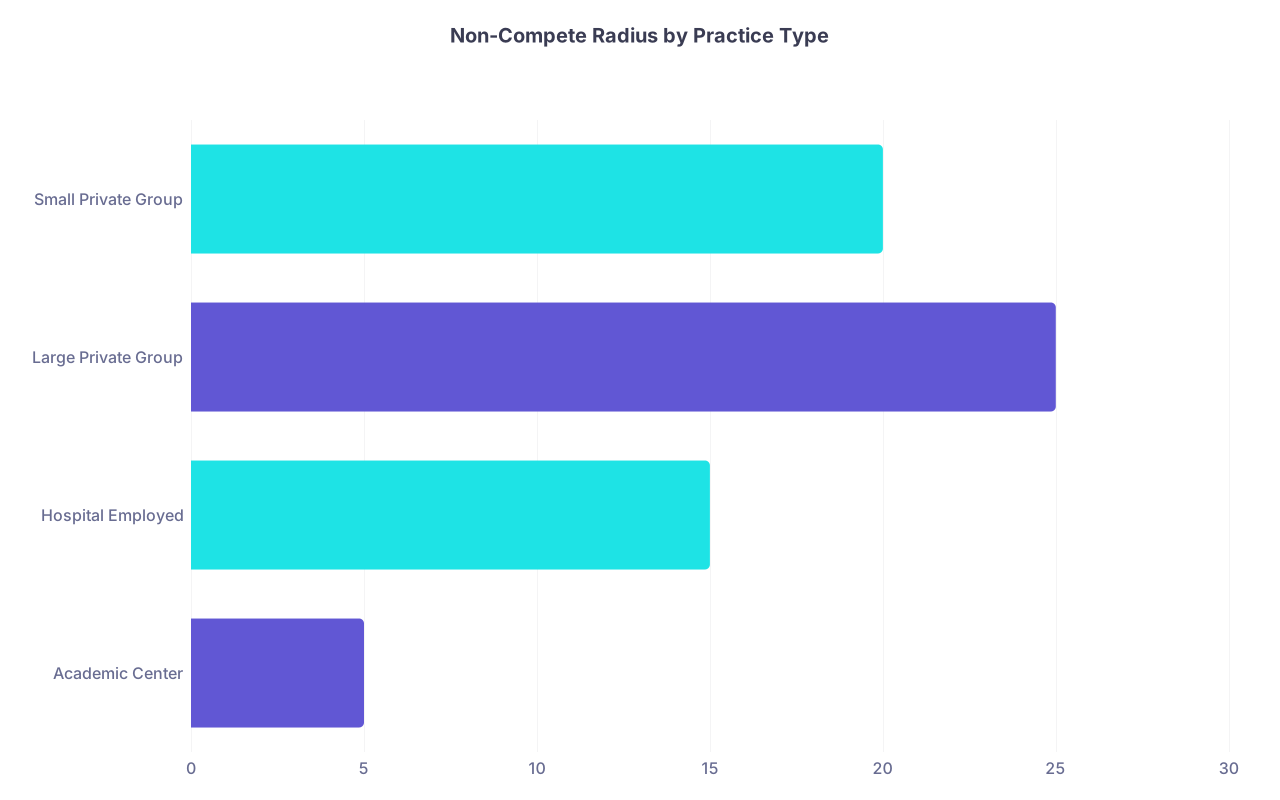
| Category | Value |
|---|---|
| Academic Center | 5 |
| Hospital Employed | 15 |
| Large Private Group | 25 |
| Small Private Group | 20 |
How to evaluate your non-compete
Look for:
- Radius (miles)
- Duration (typically 1–2 years)
- Scope (any medical practice vs your specialty vs specific procedures)
- Trigger (only if YOU leave, or also if THEY terminate you without cause?)
Rules of thumb:
20 miles in a metro area = effectively career relocation
- More than 2 years = excessive in most states
- “Any medical practice” non-compete = absolutely unacceptable
- Non-compete triggered even if you are terminated without cause = major red flag
You are not powerless here. In many states, non-competes for physicians are being restricted or closely scrutinized. Even before law catches up, you can negotiate.
What to push for
- Smaller radius: “10 miles from my primary practice site only.”
- Shorter term: 12 months instead of 24
- Narrow scope: Limited to your specific specialty, not “any medical services”
- No non-compete if:
- They terminate you without cause
- You leave due to material breach
If they refuse to budge at all, that is data. They intend to keep you stuck.
5. Malpractice and Tail: The Hidden Six-Figure Problem
Malpractice is boring until it is not. Tail coverage is where people get crushed.
Understand your coverage type
- Claims-made: You need tail coverage when you leave.
- Occurrence: You do not need tail; each year’s policy covers claims for that year permanently.
Many high-paying specialties with high risk (neurosurg, OB-related, interventional fields) are on claims-made.
The question is simple: Who pays for tail?
Tail can run:
- 150–250% of your annual premium
- Frequently $50k–200k+ depending on specialty and region
How to handle in negotiation
You want one of the following:
Employer pays 100% of tail
This is ideal. For many hospital-employed roles, this is standard if you complete your initial term.Tiered vesting
Example:- Year 1: If you leave, you pay 100%
- Year 2: You pay 66%
- Year 3: You pay 33%
- After Year 4: Employer pays 100%
Shared cost or buy-down
If they insist you pay, negotiate:- Higher base or bonus to offset
- A written cap on your tail obligation
- Language specifying they choose a reasonably priced carrier
If they say, “No one else negotiates this,” do not accept that at face value. I have seen many first-contract physicians get $0 tail responsibility after simply asking firmly.
6. The Actual Negotiation: How to Play It
Stop thinking you are “bothering” them. You are negotiating a multi-million-dollar relationship.
Step 1: Use a physician contract attorney
Not your uncle who does real estate. A physician contract attorney who sees your specialty’s offers weekly.
You want:
- Line-by-line redline review
- Specific market comparison: “This is low/average/high for your specialty and region”
- Strategy suggestions: what is realistic to push on, and what is not
The $1,000–3,000 fee is noise compared to the thousands you gain or protect yearly.
Step 2: Decide your top 3 must-fix items
If you try to rewrite the whole thing, they will dig in.
Pick your top three non-negotiables. Common ones I recommend in high-paying specialties:
- Excessive non-compete radius / duration
- Tail coverage responsibility
- Unreasonable call burden vs compensation
Then have a second tier you would like but will not die on:
- Slightly higher base or RVU rate
- More sign-on or relocation reimbursement
- Lower RVU thresholds
Step 3: Script the discussion
You do not email a 3-page emotional essay. You have a focused conversation.
Example script:
“I have reviewed the contract carefully and discussed it with a physician contract attorney. I am very interested in this position and see a good long-term fit. There are three areas I would like to adjust so that I can comfortably sign and commit:
- The non-compete radius and duration
- Responsibility for tail coverage
- Call frequency and backup coverage
If we can find reasonable middle ground on these, I am ready to move forward quickly.”
Then you go through each:
- Anchor with something reasonable
- Explain your rationale briefly
- Offer a specific alternative
Example for RVUs (for ortho):
“Given the MGMA data for orthopedic surgery in this region and what you have told me about partner production, a 7,000 RVU threshold before bonus seems more aligned with realistic year 1–2 ramp-up than 9,000. I am proposing 7,000 as the threshold with the same $60 per RVU above that.”
Step 4: Time it right
You have the most leverage:
- After they have spent time interviewing you
- After they have decided you are their preferred candidate
- Before you have signaled you will accept no matter what
Do not start nitpicking during the first phone call. But also do not wait until the expiration date on the offer.
7. Specialty-Specific Pressure Points
High-paying specialties each have their own traps. A few quick ones.

Orthopedic surgery / neurosurgery
- OR block time is everything. No block = no cases = no production = no bonus.
- Implant choices and vendor relationships matter for economics and politics.
- Trauma call can burn you out fast. If you are covering level 1 trauma frequently, that should be explicitly compensated.
Negotiate:
- Guaranteed minimum block time per week
- Call schedule caps (max number of primary trauma calls per month)
- Explicit compensation for excess call or holiday coverage
GI / interventional cardiology / IR
- Lab time and procedure mix dictate your actual earning potential.
- Watch carefully who controls referrals and how new partner volumes ramp.
- Some groups dump all the urgent add-ons and night work on new hires.
Negotiate:
- Protected procedure slots
- Equity participation in endoscopy centers or cath labs (timing and buy-in terms)
- Clear guardrails: “X weekends per month,” “Y holidays per year.”
Radiology
- Telerad vs on-site matters for lifestyle and leverage.
- RVU expectations can be insane in some groups (think >16k RVUs).
- Night coverage models vary hugely.
Negotiate:
- Caps on overnight shifts or extra pay for them
- Strong language about equitable case distribution, not cherry-picking for partners
- Partnership track that actually leads to equity in the group and imaging centers, not just a title
Anesthesia
- CRNA supervision ratios affect both legal risk and your workload.
- Who controls the anesthesia staffing contract with the hospital? That is the power lever.
- Beware “1099 contractor” roles masquerading as equivalent to W-2 without accounting for your tax and benefit burden.
Negotiate:
- W-2 vs 1099 terms clearly spelled out
- Call and post-call rules in writing
- Stipends for medical direction and administrative work
8. Common Rookie Mistakes That Cost You Hundreds of Thousands
I see the same patterns again and again.
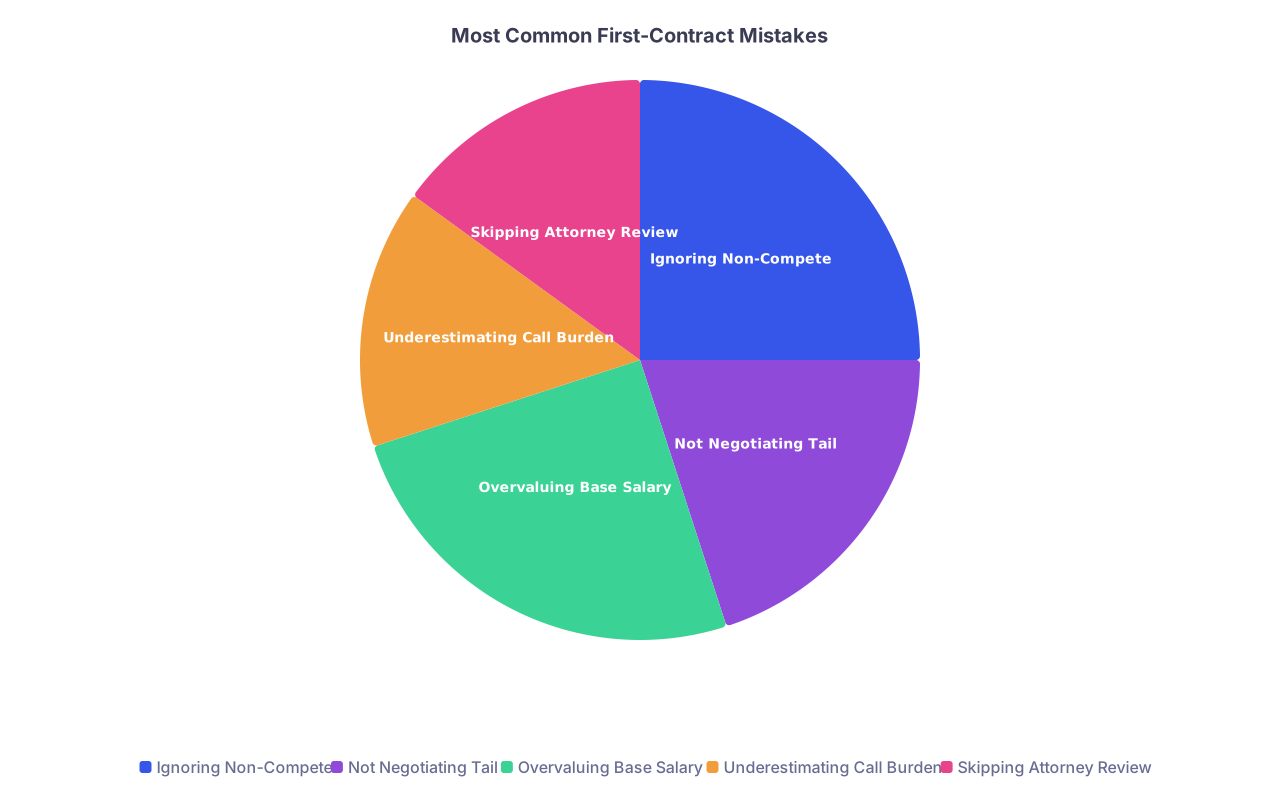
| Category | Value |
|---|---|
| Ignoring Non-Compete | 25 |
| Not Negotiating Tail | 20 |
| Overvaluing Base Salary | 25 |
| Underestimating Call Burden | 15 |
| Skipping Attorney Review | 15 |
Here is the short list to avoid:
Chasing the highest starting salary only
A $50k higher base is meaningless if:- RVU threshold is unrealistic
- Call is abusive
- No realistic path to partnership
Ignoring non-competes because “I plan to stay forever”
People change jobs within 3–5 years constantly:- Leadership changes
- New administration
- Mergers
- Spouses move You need exit options. Non-competes control that.
Not understanding tail at all
New attending leaves after 2 years, gets a $150k tail bill. I have seen this. It is ugly.Treating the contract like a formality
Verbal assurances mean nothing. If it is not in writing, it does not exist.Negotiating emotionally instead of strategically
You are not trying to “win.” You are trying to shape the terms so:- You are safe
- You are fairly compensated for your production and risk
- You have a path to upside and a clean exit if needed
9. Practical Step-by-Step Playbook
If you want a straight blueprint, here it is.
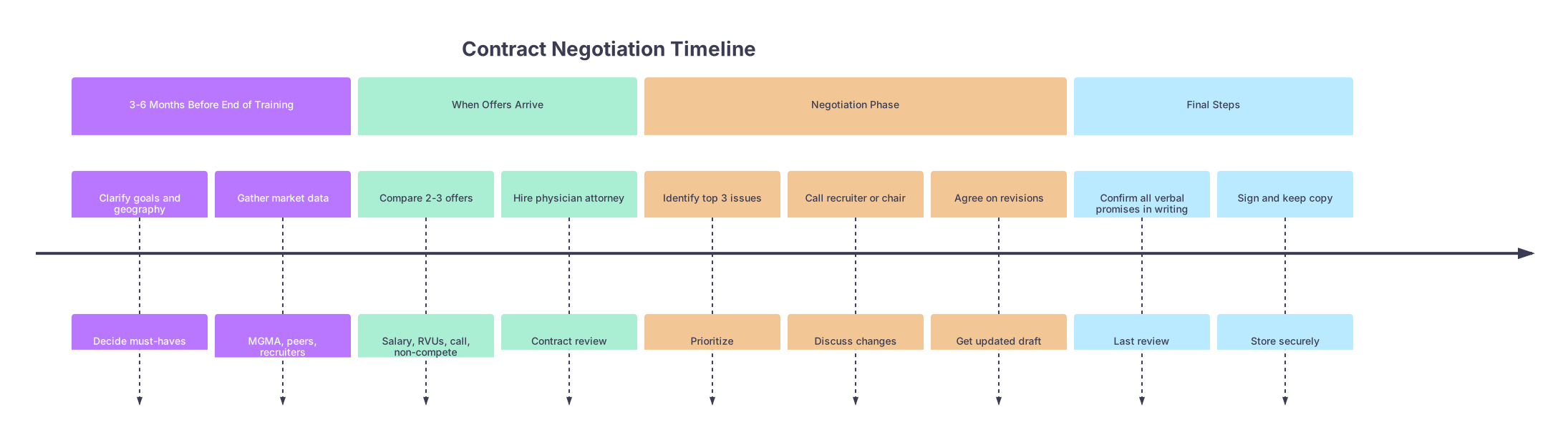
| Period | Event |
|---|---|
| 3-6 Months Before End of Training - Clarify goals and geography | Decide must-haves |
| 3-6 Months Before End of Training - Gather market data | MGMA, peers, recruiters |
| When Offers Arrive - Compare 2-3 offers | Salary, RVUs, call, non-compete |
| When Offers Arrive - Hire physician attorney | Contract review |
| Negotiation Phase - Identify top 3 issues | Prioritize |
| Negotiation Phase - Call recruiter or chair | Discuss changes |
| Negotiation Phase - Agree on revisions | Get updated draft |
| Final Steps - Confirm all verbal promises in writing | Last review |
| Final Steps - Sign and keep copy | Store securely |
6–9 months before graduating
- Define your priorities: geography, practice type (academic vs private vs hospital-employed), procedure mix, call tolerance.
- Start gathering compensation data and real job offers for comparison.
When you receive the first contract
- Do not sign anything in the moment.
- Get a clean PDF or Word version.
- Read it once fully without a pen. Just to understand tone and structure.
Within 3–5 days
- Hire a physician contract attorney.
- Ask them for:
- Written summary
- Redline suggestions
- Their honest opinion: “Would you let your kid sign this?”
Refine your asks
- Identify 3 must-change items.
- Identify 3–5 “nice-to-have” but flexible items.
Schedule a call with decision-maker
- Not just HR. You want someone who can actually change terms:
- Department chair
- Practice managing partner
- CMO or service line leader
- Use the earlier script: “I am very interested. There are three areas I need to adjust…”
- Not just HR. You want someone who can actually change terms:
Negotiate once, cleanly
- Present your requests in one round as much as possible.
- Be professional, direct, and unemotional.
- Ask for revised written contract incorporating agreed changes.
Final review
- Compare final contract to your notes:
- Is non-compete updated?
- Is tail language accurate?
- Are call limits and compensation spelled out?
- Confirm that every verbal promise is in writing.
- Compare final contract to your notes:
Then sign
- Save a copy in at least two places.
- Make a one-page summary for yourself of:
- Salary and bonus triggers
- Call expectations
- Non-compete details
- Notice period and termination terms

FAQ (Exactly 3 Questions)
1. How much can I realistically negotiate on my first contract in a high-paying specialty?
Quite a lot on structure, less on pure base salary. You can often move:
- Non-compete radius and duration
- Tail coverage responsibility
- Call schedule and compensation
- RVU thresholds and how bonuses are calculated
- Partnership terms clarity and timeline
Base salary might shift 5–15%. Changing call structure, tail, and non-compete can be worth far more over time than chasing an extra $20–30k in year 1.
2. Should I ever accept a lower-paying offer if the specialty is already high-paying?
Yes, sometimes that is the smarter financial move. A slightly lower initial salary can be right if:
- Partnership track is clear, real, and lucrative
- Non-compete is mild or absent
- Call is sustainable
- Ancillary income (ASC, imaging, real estate) is available after partnership
I have seen people in ortho or GI take $50–100k less in year 1 and end up ahead by $300–500k per year five years later because they chose the right structure.
3. Is it risky to negotiate hard on my first contract? Could they pull the offer?
If you are reasonable and professional, the risk is low. High-paying specialties are high-revenue fields. Good candidates are valuable. Do not make it adversarial or nitpicky. Focus on a few critical issues, present clear rationale, and show that you want a long-term fit. If a group rescinds an offer simply because you asked for fair changes on core issues like non-compete or tail, that is a bullet dodged, not a loss.
Bottom line:
- Know your value in hard numbers, not just feelings.
- Fix the structural traps: non-compete, tail, call, and partnership terms.
- Negotiate like a professional whose time and risk are expensive—because they are.


