

You are sitting in the call room at 1:30 a.m., half-eaten cold pizza on the desk, doom‑scrolling a Reddit thread titled “Top 10 Highest Paid Specialties in 2026.” The same numbers keep coming up. Ortho. Derm. ENT. GI. Cards. You just finished a brutal medicine admit shift and you are thinking one thing:
“I am not going through all of this to make 250k.”
This is the fork in the road where people quietly wreck their careers. Not immediately. Slowly. Year by year. Because they picked an ultra‑lucrative specialty for the wrong reasons and then tried to live with it.
Let me walk you through the warning signs before you join them.
The Core Mistake: Confusing “Highest Paid” With “Best For You”
Here is the trap: you are exhausted, in debt, and surrounded by attendings who casually talk about their mortgage, private school tuition, and “RVU targets.” Money starts to feel like the only rational filter.
The mistake is not caring about money. That is rational. The mistake is letting money become your primary or only filter.
Classic thought process I hear all the time:
- “I like procedures… I guess. And ortho makes 800k, right?”
- “Derm has lifestyle and money. I like skin enough.”
- “GI and cards are the ‘smart IM’ routes. Better pay, more procedures. Done.”
You are reverse‑engineering your personality around a salary table. That almost never ends well.
To make this concrete:
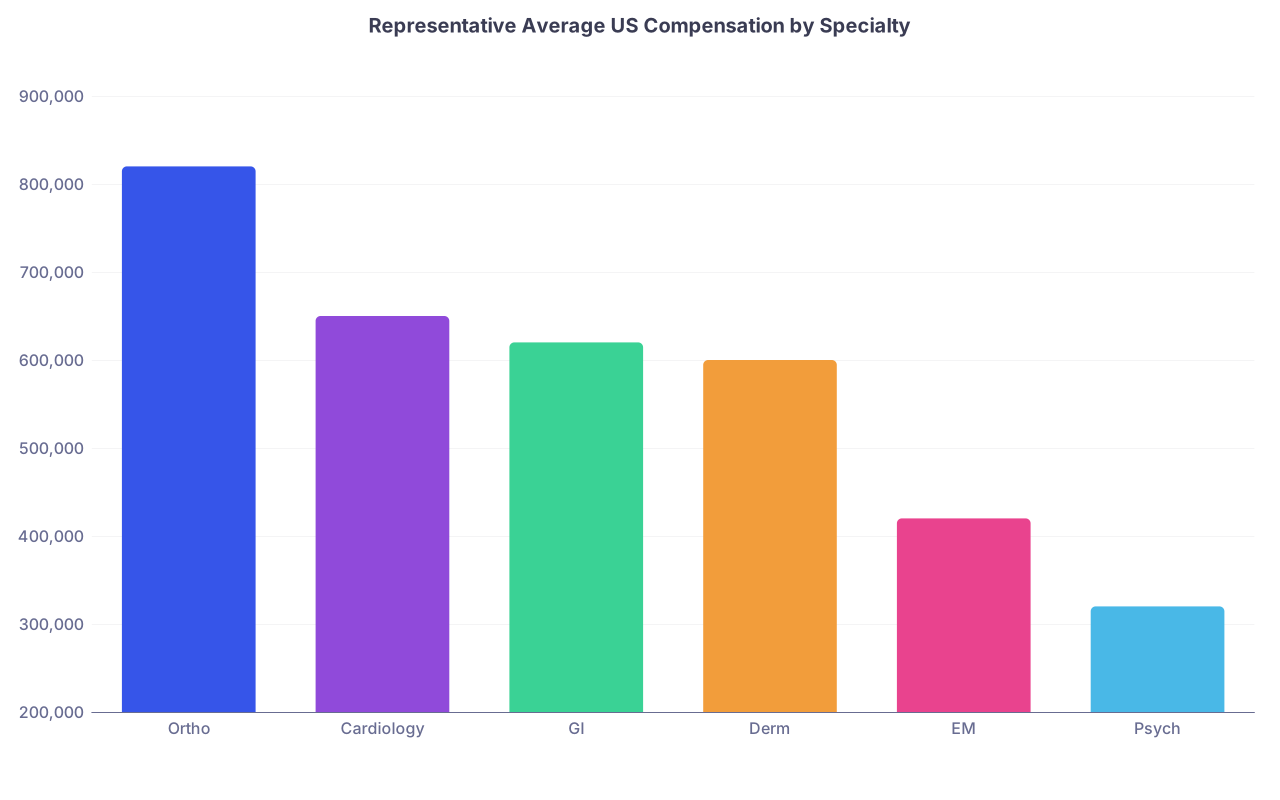
| Category | Value |
|---|---|
| Ortho | 820000 |
| Cardiology | 650000 |
| GI | 620000 |
| Derm | 600000 |
| EM | 420000 |
| Psych | 320000 |
Those numbers are real‑enough ballpark figures. But they tell you nothing about:
- Your tolerance for 6 a.m. OR starts.
- Your reaction to a never‑ending procedural queue.
- Your patience for anxious patients with vague complaints.
- Your ability to function in a high‑stakes, low‑sleep environment. For decades.
You need to recognize when your reasoning has quietly shifted from “What work do I want to do every day?” to “What number feels high enough to make this pain worth it?”
That pivot is the first red flag.
Warning Sign #1: You Talk More About Income Than Actual Work
Listen to yourself. Or better, listen to how you sound to other people.
If your specialty conversations sound like:
- “Derm is 4 days a week, no call, 600k+ with cosmetics.”
- “GI gets procedural RVUs, plus ASC ownership.”
- “Cards can hit seven figures if you do enough interventions.”
…but when someone asks “What part of the day‑to‑day excites you?” you go vague or generic—there is a problem.
I have had students tell me:
“I mean, I liked my derm rotation. Clinic was… fine. But the lifestyle is unbeatable.”
That word. “Fine.”
Fine is not enough for 30 years.
Flip the script. Ask yourself specific, uncomfortably concrete questions:
- Do I enjoy the volume and pace this specialty usually runs at?
- Do I enjoy the types of patients this specialty attracts?
- Did I leave those rotations tired but mentally satisfied, or just… tired and counting down?
- Am I actually curious about the subspecialty content, or do I memorize just enough to pass?
If you cannot give enthusiastic, detail‑rich answers, but you can quote the average MGMA compensation by region, you are picking the field for the wrong anchor.
Warning Sign #2: You Are Using Money To “Fix” Burnout Or Identity Problems
There is a particularly dangerous line of thinking that sounds very mature and is completely wrong:
“I am already burnt out. If I am going to be tired and miserable anyway, I might as well get paid the most for it.”
This is how people end up in very high‑paying fields that intensify everything that is already breaking them.
Snapshot of what this looks like in real life:
- The student who hates high‑pressure, real‑time decision making picks interventional cardiology “for the challenge and comp” and then crumbles under 2 a.m. STEMI calls and constant performance pressure.
- The resident who is already emotionally exhausted by complex, high‑acuity patients chooses critical care for the “procedures and prestige.” By year three, they are dead inside and counting shifts to contract end.
- The introvert who finds social small talk draining dreams of concierge derm or aesthetics for “cash pay, low admin,” then realizes it is 95% relationship management and sales.
Money is not therapy. It does not fix hating:
- Constant emergencies
- Chronic disease management
- Endless clinic days
- OR politics
- Call schedules
- Documentation burden
It just pays you more while you slowly detach and resent your life.
Warning Sign #3: You Are Blind To Lifestyle Trade‑offs, Not Just Lifestyle
Students talk about “lifestyle specialties” like it is a monolith. That is lazy thinking.
Every specialty has its own version of “you pay for it somewhere.” The danger is looking only at the highlights and pretending the rest will not bother you.
Let’s sketch a few:
| Specialty | Headline Perk | Hidden Trade-off |
|---|---|---|
| Dermatology | High pay, low call | Repetitive clinic, heavy cosmetic business pressure |
| Orthopedics | Huge comp | Early OR mornings, physical strain, long training |
| GI | Procedural + clinic income | High-volume work, lots of on-call GI bleeds |
| Cardiology | Prestige, big pay | Intense fellowship, nights/weekends, high liability |
| ENT | Variety, surgery + clinic | Long OR days, cancer care emotional burden |
You may be ignoring the cost side because the dollar sign is so shiny.
Three specific blind spots I see:
Call and emergencies
You say “I can handle call, I am young.” But you are not picking a specialty for your next five years. You are picking for 45‑year‑old you with kids, aging parents, and cumulative sleep debt.Volume expectations
High comp often comes from high volume. High RVUs. Short visits. Procedural churn. If you are a slow, methodical thinker who likes time with each patient, high‑RVU fields can crush you.Business and hustle demands
Private practice derm, ortho, GI, ENT—these often require aggressive business building, marketing, patient retention, or ASC buy‑in. If you hate “selling” anything, you may hate what the top earners in those fields actually do all day.
You cannot just say “money and lifestyle” in the same sentence like they are both guaranteed. Something is giving way. You had better know what.
Warning Sign #4: You Are Chasing Prestige, Not Fit
Let me be blunt: many people are not chasing money; they are chasing status. They just use money to justify it.
You hear it in comments like:
- “I did not work this hard to be ‘just’ a pediatrician.”
- “I have a 260. I should do something competitive.”
- “Everyone in my class aiming high is going for ortho, derm, or plastics.”
“Competitive” is not a personality type. It is not a calling. It is just a match statistic.
I have watched more than one very bright student shoehorn themselves into a field that does not match their temperament at all, simply because their scores made it “wasteful” to pick anything else.
That is backwards. Your Step score is not a moral statement about what you must do with your life. It is a test result.
If your internal logic sounds anything like “I need a field that reflects how hard I worked,” you are not choosing a specialty, you are choosing a trophy. Trophies gather dust.
Warning Sign #5: You Are Ignoring How You Actually Felt On Rotations
This is the quiet killer. You already have data. You just do not like what it says, because the numbers on Medscape compensation tables are louder.
Ask yourself, rotation by rotation:
- On ortho, did you enjoy fracture clinic, pre‑ops, and post‑ops—or did you just like the OR days when you could hold instruments and feel “surgical”?
- On cards, did you like clinic and longitudinal heart failure management—or just the cath lab and the adrenaline?
- On GI, did you enjoy the consults, the diarrhea workups, the cirrhotics—or did you just like scoping and images?
Your brain will cherry‑pick the cool parts and forget the rest. Money amplifies that selective memory.
I have had students say things like,
“I was bored out of my mind in derm clinic, but I could tolerate that for 600k and three days a week.”
Tolerate. For decades. Do you hear yourself?
If your main emotion on a rotation was relief when the day ended, and the only reason you are still considering that field is the compensation column, you are actively trucking toward long‑term dissatisfaction.
Warning Sign #6: You Have Not Talked To the Right Attendings (The Honest Ones)
You probably have not done this properly: sit down with mid‑career and late‑career attendings in the field you are eyeing and aggressively ask about downside.
You need to hear:
- The private practice ortho who had a back surgery at 52 because years of lead aprons and OR time broke him.
- The derm attending who spends half her time negotiating cosmetic pricing, dealing with Yelp reviews, and managing staff drama.
- The GI doc who spends every Christmas on backup call for GI bleeds and feels trapped by income expectations.
- The interventional cardiologist who tells you plainly: “I am one malpractice case or one complication away from losing my mind.”
Do not just talk to the early‑career, brand‑new attendings who still have honeymoon energy and low overhead. Talk to the ones who have lived through EMR changes, admin wars, and life transitions.
And if you ask, “Would you choose this specialty again?” and learn to watch their face—not just their words—you will learn a lot.
Warning Sign #7: You Have No Exit Strategy If You Hate It
Here is the part people do not like to think about.
Once you commit to:
- Med + cards + interventional
- Gen surg + fellowship (plastics, vascular, surg onc)
- Ortho, ENT, urology, neurosurgery
…you are locking yourself into extremely narrow and specialized lanes. If you hate that lane five years in, changing course is painful, sometimes financially catastrophic.

| Category | Value |
|---|---|
| Derm | 4 |
| GI (IM + GI) | 6 |
| Cardiology (IM + Cards) | 6 |
| Ortho | 5 |
| Neurosurgery | 7 |
These numbers are years of your life after medical school. Add in fellowship for the higher‑paid subsets and you can easily hit 7–8 years post‑MD.
If your only real driver is income, you are gambling a decade of training on the assumption that you will not change, burn out, develop new priorities, or discover that the daily work does not suit you at all.
Ask yourself directly:
“If I grow to hate the day‑to‑day of this field, what is my realistic plan B?”
If the honest answer is “suck it up because of my income and loans,” that is not a strategy. That is a sentence.
How To Pressure‑Test Your Motives (Before You Lock In)
Enough warnings. Here is what to actually do to avoid this mistake.
1. Do a “Money‑Blinded” Exercise
On a blank page, write down:
- The tasks that energize you (procedures, counseling, diagnosis puzzles, surgeries, continuity).
- The settings you prefer (OR, ICU, outpatient clinic, ED, procedure suite).
- The patient populations you tolerate or enjoy.
- The pace you like: slow and thorough vs fast and high‑acuity.
Then, as an exercise, list 3–5 specialties that match those patterns without looking at any salary data. Only after that, compare them to actual compensation.
If the only ones you feel drawn to before seeing income numbers are low‑paying, you have a decision to make. But at least it will be an honest one.
2. Shadow On Bad Days, Not Just Good Days
Do not just ask for “cool” days: big OR cases, cath lab marathons, cosmetics days. Ask attendings if you can see:
- Their clinic day with 28 overbooked follow‑ups.
- A full day of inpatient consults and pager chaos.
- A 24‑hour call plus the post‑call clinic.
Then pay attention to your body and mood at 4 p.m. Are you engaged? Drained? Irritated? Numb?
You can fool yourself in theory. Your nervous system is harder to trick in practice.
3. Ask Directly About the Bottom 20% of the Job
When you talk to attendings, stop asking, “Do you like your specialty?” That invites a canned speech.
Ask:
“What are the bottom 20% of tasks, stresses, or responsibilities in this field that you would get rid of if you could?”
Then ask yourself: “Can I tolerate those for a long time?”
Not, “Can I tolerate them for a paycheck?”
“Can I tolerate them without slowly rotting on the inside?”
4. Do a Values vs Income Reality Check
Make a simple list:
- Top 5 things you value in life (not in medicine—life): autonomy, time with family, prestige, intellectual challenge, predictable schedule, location flexibility, etc.
- Top 3 financial goals: debt payoff timeline, target savings rate, specific lifestyle desires.
Now map which specialties realistically align with both. Not perfectly. Realistically.
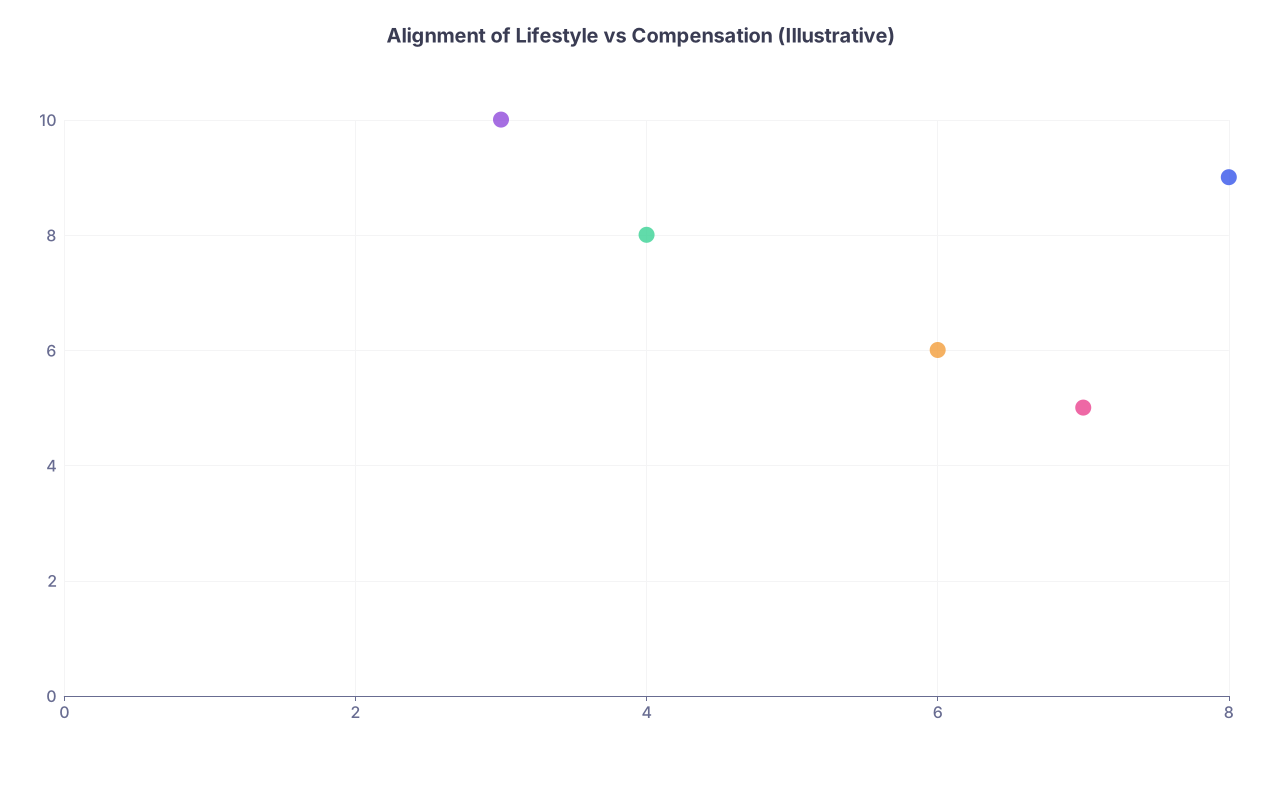
| Category | Value |
|---|---|
| Derm | 8,9 |
| Ortho | 3,10 |
| GI | 4,8 |
| EM | 6,6 |
| Psych | 7,5 |
(Example: x-axis = lifestyle rating, y-axis = income rating, 1–10. The point is: there are trade‑off clusters, not one perfect answer.)
You may realize you can hit your financial needs with a mid‑range specialty and avoid sacrificing your sanity.
Frequently Asked Questions
1. Is it “wrong” to factor in money heavily when choosing a specialty?
No. It becomes a problem when money is doing 90% of the decision‑making and you are forcing your personality, values, and interests to contort around that. You should absolutely know what different fields pay, what your loans look like, and what lifestyle you want. But if you catch yourself rationalizing away consistent boredom, misery, or misfit on rotations because the comp looks good, you are likely building a very expensive trap.
2. What if the specialty I genuinely love pays significantly less than others?
Then you have a trade‑off to face with your eyes open. Many physicians live comfortably, pay off loans, and build wealth in “lower‑paid” fields by being intentional: geography choices, side work, smart financial planning, sometimes dual‑income households. If you truly love a lower‑paid specialty, it is usually better to build a financial plan around that than to chain yourself to a high‑paid field you hate and then try to buy your way out of unhappiness.
3. How do I know if my interest in a high‑paying field is genuine or just salary‑driven?
Remove the salary from the picture. Ask: “If this specialty paid exactly the same as family medicine, would I still be this interested?” If the honest answer is no, your motivation is probably mostly financial or prestige‑based. That does not automatically mean you should not do it, but it means you need much deeper exposure and hard conversations before committing.
4. I am already in residency in a lucrative specialty and I am miserable. Did I ruin my career?
Probably not, but you cannot stay in denial. Many people pivot: switch specialties early, change practice settings, narrow their scope, or redesign their work hours and compensation expectations. The worst outcome is not “I changed paths and took a pay cut.” The worst outcome is “I stayed for the money, became bitter, and burned out so hard I could not function.” Talk to mentors outside your specialty, career counselors, and honest attendings. There are more paths than you think, but you need to move before you are completely depleted.
5. What is a healthy way to think about money when choosing a specialty?
Treat money as a constraint and planning variable, not your North Star. Decide on a floor: the minimum income that lets you meet your obligations, save reasonably, and have a decent life. Then among the specialties above that floor, optimize for fit: the daily work, patient population, pace, and lifestyle you can see yourself sustaining. You respect your financial reality without letting it hijack your entire identity.
Key points, stripped down:
- If you talk more about salary and lifestyle than the actual work and patients, you are on the wrong track.
- Money magnifies a good fit; it does not fix a bad one. A lucrative miserable career is still miserable.
- Your future self has to live with this choice every day. Choose for them, not for a spreadsheet.


