
The hype about “top-paying specialties” is misleading if you do not run the 20‑year math.
The 20‑Year Reality: It Is Millions, Not Thousands
Let me answer your core question first:
Over a 20‑year attending career, the highest paid specialties can easily earn $3–6 million more (pre-tax) than many core fields like pediatrics, family medicine, psychiatry, or hospitalist internal medicine.
That’s not a rounding error. That’s “pay off loans early, buy time, and build real wealth” money.
But the spread is not infinite, and people exaggerate both sides:
- Yes, orthopedics will almost certainly out-earn pediatrics.
- No, derm vs radiology vs ortho is not a $10M swing over 20 years for most real-world physicians.
To make this concrete, I’ll walk through:
- Typical annual incomes for high vs mid vs lower‑paid fields
- A 20‑year earnings comparison with simple but realistic assumptions
- How training length, hours, and burnout risk change the real picture
- When the extra money is absolutely worth it—and when it is not
Then I’ll give you a decision framework you can actually use.
Baseline Numbers: What Top Specialties Actually Make
You do not need exact down-to-the-dollar accuracy. You need realistic bands.
Using recent compensation surveys (Medscape, MGMA ranges, large group anecdotes), here’s a reasonable approximation of average attending incomes* in the U.S. (full-time, typical productivity):
| Tier | Example Specialties | Typical Annual Income Range |
|---|---|---|
| Ultra-high | Orthopedic surgery, Neurosurgery, Interventional cardiology | $700k–$900k+ |
| High | Cardiology (non-interventional), GI, Dermatology, Radiology, Anesthesia, Urology | $550k–$750k |
| Mid | Emergency Med, General Surgery, Hospitalist IM, Pulm/CC, Heme/Onc | $350k–$500k |
| Core | Internal Med (clinic), Family Med, Pediatrics, Psych, Neurology | $250k–$350k |
These are ballparks, not contractual guarantees. But they’re good enough for 20-year modeling.
The 20‑Year Earnings Gap: Clean Example
To keep this clear, I’ll compare three buckets over 20 attending years:
- Top-paid procedural: Orthopedic Surgery (Ortho) – assume $800k/year average
- High-paid cognitive/procedural mix: Cardiology – assume $650k/year average
- Core primary care: Family Medicine (FM) – assume $275k/year average
And we’ll keep it simple first:
- Ignore taxes, inflation, and raises (we’ll talk about those later)
- Assume full-time work for 20 years as an attending
- Assume you actually match into that specialty and stay in it
Raw 20‑Year Earnings (Attending Only)
Multiply annual income by 20:
- Ortho: $800k × 20 = $16,000,000
- Cardiology: $650k × 20 = $13,000,000
- Family Med: $275k × 20 = $5,500,000
Now the deltas:
- Ortho vs Family Med: $10.5M more gross over 20 years
- Cardiology vs Family Med: $7.5M more
- Ortho vs Cardiology: $3M more
Those are the headline “wow” numbers. But they ignore training time and resident pay.
Add Training Length: The Years You Are Not Earning Big Money
Here’s where people get sloppy. Training length matters, but not as much as students think.
Let’s compare realistic training paths:
- Family Med: 3 years residency
- Ortho: 5 years residency (no fellowship for simplicity)
- Cardiology: 3 years IM + 3 years Cardiology = 6 years
Now assume:
- Resident salary: start ~$65k, end ~$75k; average ~$70k/year
- You start medical school at 24, graduate at 28. That part is the same for all.
20-Year Attending vs Total Post-MD Career
We’ll look at total income from the end of med school forward (residency + attending) over a fixed 23-year window to keep timelines comparable.
So:
- FM: 3 yrs residency + 20 yrs attending = 23 years total
- Ortho: 5 yrs residency + 18 yrs attending = 23 years
- Cards: 6 yrs residency + 17 yrs attending = 23 years
Family Medicine (3y residency)
- Residency: 3 × $70k = $210k
- Attending: 20 × $275k = $5,500,000
- Total 23-year income: ~$5.71M
Orthopedic Surgery (5y residency)
- Residency: 5 × $70k = $350k
- Attending: 18 × $800k = $14,400,000
- Total 23-year income: ~$14.75M
Difference vs FM: ~$9.0M more over the same 23-year period.
Cardiology (6y residency/fellowship)
- Residency/fellowship: 6 × $70k = $420k
- Attending: 17 × $650k = $11,050,000
- Total 23-year income: ~$11.47M
Difference vs FM: ~$5.76M more over 23 years.
Conclusion:
Even accounting for more years of training, the top and high-paid specialties still end up millions ahead over two decades.
But What About Raises, Inflation, and RVU Games?
You might wonder: “Won’t everyone’s income rise over time?”
Yes. But percentage raises don’t erase gaps, they amplify them.
Say everyone gets a very modest 2% raise per year. Over 20 years, Orthopedics at $800k and FM at $275k both increase, but the dollar delta widens.
You do not need a complex model to see the pattern:
- 2% of $800k is $16k
- 2% of $275k is $5.5k
Every year, the raise itself adds more extra dollars to the proceduralist’s pile.
Even with occasional pay cuts or code changes, the relative ranking tends to hold:
Procedural > mixed > clinic-based primary care.
Time, Lifestyle, and Burnout: The “Per Hour” Problem
Raw income is not the whole story. You are not a revenue machine; you are a human who needs sleep.
Two key questions for each field:
- What are the real weekly hours?
- Can you scale down later without completely wrecking income?
Rough, real-world numbers (attending stage, full time):
- Ortho / neurosurgery: 55–70 hrs/week, frequent call
- Interventional cardiology: 55–70 hrs/week, nights/weekends, emergencies
- Radiology / anesthesia / derm: often 40–55 hrs/week, call varies
- Family Med / Pediatrics clinic: 40–55 hrs/week, usually less intense call
- EM: 32–38 clinical hours/week, but nights/weekends/holidays
If you want income per hour, sometimes the “mid” specialties look surprisingly good. For example:
- Ortho: $800k at 60 hrs/week ≈ $257/hr (before overhead, taxes, etc.)
- Derm: $600k at 40 hrs/week ≈ $288/hr
- Family Med: $275k at 45 hrs/week ≈ $117/hr
Derm is a classic case: not always #1 in raw annual pay, but very strong on pay per hour + lifestyle.
The brutal truth:
Many of the very top-paying fields buy that income with your time, long into your 50s. Some people are fine with that. Others burn out or scale back early, and the 20-year projections never materialize.
Where the Extra Millions Actually Show Up in Your Life
So you see “$4–9 million more” on paper. How does that translate into real life?
Here’s what higher-earning colleagues actually do with it (I’ve watched this in real time):
Crush loans early.
High earners can wipe out $300k+ loans in 3–5 years without living like a monk.Buy geographic and schedule freedom.
They can move to HCOL areas without being broke, pay for help (nanny, cleaning, etc.), and say no to awful jobs faster.Accelerate investing.
Putting an extra $100k–200k per year into index funds or real estate starting in your 30s? That is how some physicians become deca-millionaires—not just “we can retire at 65.”Self-funded part-time late career.
You can choose to cut to 0.6–0.8 FTE in your 50s and still be fine. Lower earners can do this too, but it’s tighter and later.
But here’s the catch:
If your spending inflates to match your income (big house, 3 luxury cars, private school, constant upgrades), the “$5M difference” quietly evaporates. You just end up stressed with nicer countertops.
The income advantage is only as real as your willingness to live below it.
When the Extra Money Is Not Worth It
There are situations where chasing a top-paid specialty is just dumb:
You do not like the work.
If blood, bone, or high-stress emergencies make you miserable, stop pretending ortho or interventional cards will magically feel okay for 30 years.You barely like the field now.
If you are already annoyed during your M3 rotation, imagine that energy at year 12 with EMR bloat, admin nonsense, and declining RVUs.You are not competitive for that specialty.
Matching neurosurgery with a 220 Step 2 and no research is a fantasy. You will waste time, money, and sanity chasing something you were never realistically in the running for.You have values that conflict with the lifestyle.
Say you deeply want predictable evenings, or you prioritize living near family in a non-urban area with few specialty jobs. Money will not fix those mismatches.
Putting it bluntly:
If you hate the day-to-day, the extra couple hundred thousand per year will not feel like “winning.” It will feel like a paycheck you resent.
A Simple Framework: Should You Chase a Top-Paid Specialty?
Use this decision filter. Be honest:
Do you genuinely enjoy the core work?
For Ortho: operating, anatomy, MSK problem solving, clinic plus OR days, managing surgical complications.
For Cards: physiology, complex patients, procedures, taking call.
If “yes, this is actually fun for me,” keep going. If “it’s fine but I like something else more,” that matters.Are you competitive enough?
Look at recent match data: board scores, class rank, research. Talk to your PD or trusted attendings. If your mentors say, “You’ll be borderline,” take that seriously.Can you live with the hours and call for 15–20 years?
Not just in your 20s. In your 40s with kids, aging parents, or other responsibilities.Would a mid-paid specialty you love still allow a solid life?
Many mid-range specialties ($350–500k) plus reasonable financial discipline still give you:- Loan payoff
- A comfortable home
- Retirement savings
- Occasional travel and nice things
What is your “enough” number?
If you can live a life you’d be proud of on $300–400k, absolutely do not chain yourself to a miserable high-pay career just to hit $700k. That trade is idiotic.
Visualization: How Income Jumps Across Tiers
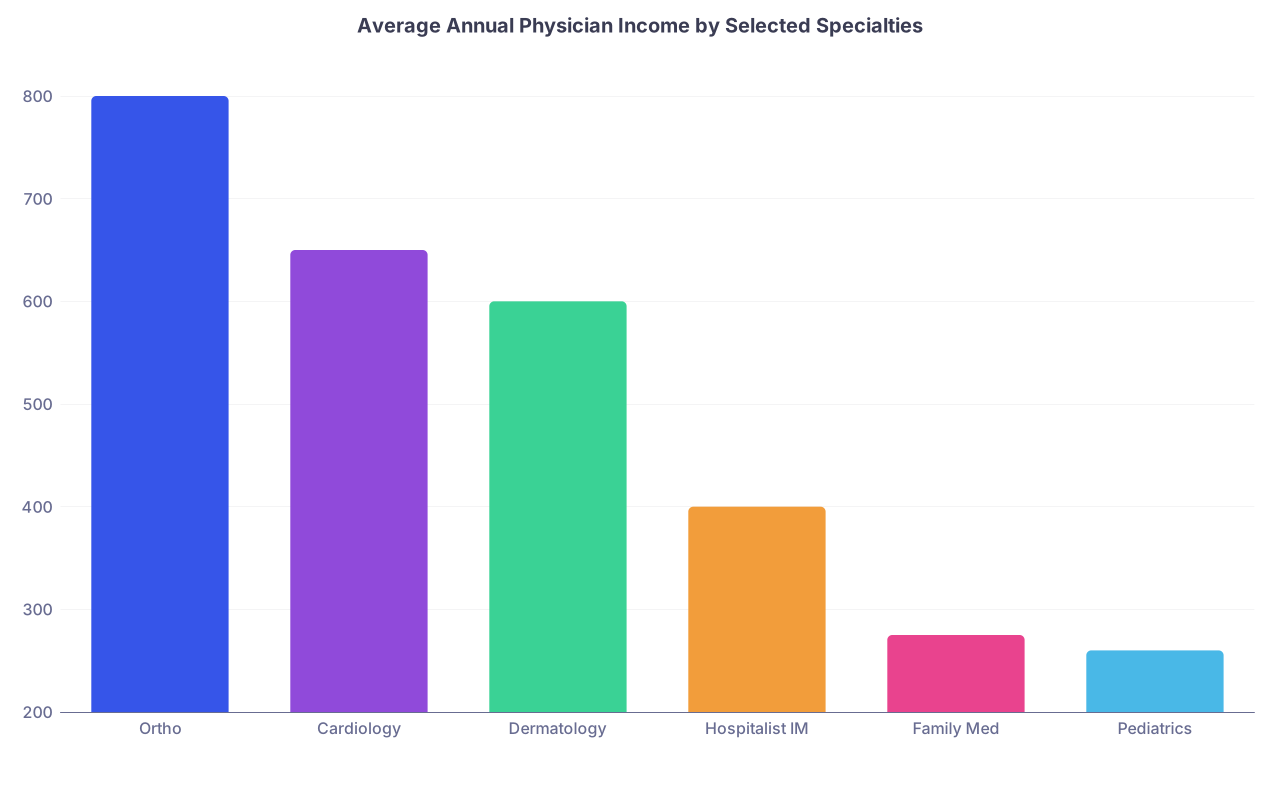
To visualize the relative scale, here’s a simple comparison of average annual earnings for representative specialties:
| Category | Value |
|---|---|
| Ortho | 800 |
| Cardiology | 650 |
| Dermatology | 600 |
| Hospitalist IM | 400 |
| Family Med | 275 |
| Pediatrics | 260 |
Values in thousands of dollars. Spread that over 20 attending years and you can see how the gap compounds.
Quick Specialty Snapshots: 20‑Year Takeaways
Very high earners over 20 years (attending phase only):
Neurosurgery / Ortho / Interventional Cardiology / Cardiac Surgery
Very likely in the $14–18M gross range across 20 attending years if you stay full time and in-demand.Radiology / Derm / GI / Urology / Anesthesia
Often $11–15M over 20 years.EM / General Surgery / Pulm/CC / Heme-Onc / Hospitalist IM
Roughly $7–10M.FM / IM clinic / Psych / Peds / Neuro
Typically $5–7M.
Is the extra from the top tier real? Absolutely.
Is it automatic? No. You still have to match, survive training, and not burn out or cut back dramatically.
FAQ: 5 Common Questions About Long-Term Specialty Income
1. Does starting in a lower-paid specialty and later switching wipe out the income gap?
Usually, yes. Switching specialties often means repeating years of residency, taking a big temporary pay cut, and delaying higher attending income. If you do FM for 8 years and then switch to Ortho (and somehow complete another residency), the “ortho millions” arrive late and in reduced form. Do not pick a specialty with the expectation you’ll later “upgrade” to a higher-paid one. That is rarely how this goes.
2. How much do taxes reduce these big differences?
Taxes shrink the absolute numbers but do not erase the ranking. Top earners pay higher marginal rates, but their after-tax income is still significantly larger. A very rough cut: Ortho might net 55–60% of gross after all taxes and retirement contributions; FM might net 60–65%. Even then, 60% of $800k ($480k) beats 65% of $275k (~$179k) by a mile.
3. What if I want to work part-time or 0.7 FTE eventually?
Higher pay specialties scale down better. If a cardiologist drops to 0.7 FTE, they may still clear $400k+. A part-time pediatrician might land closer to $130–180k. So if you know you want to go part-time by your 40s, a higher-paying field gives you more room. But if you hate the work at 1.0 FTE, you may never make it that far.
4. Will AI, midlevels, or reimbursement cuts nuke the high-earning fields first?
Some, yes—radiology and pathology are constant targets of AI speculation; primary care faces NP/PA competition. But the pattern so far: the entire system shifts, not just one field. Procedural specialties have pricing power and lobbying strength. I would not pick or avoid a specialty solely based on future policy guesses. Choose something where, even if everyone makes 20% less, you still like your work.
5. If I genuinely like two specialties, should I just pick the higher paid one?
If you are truly neutral on day-to-day work and lifestyle—and that is rare—then yes, pick the higher-earning option. Money will not solve everything, but it will solve a lot of logistics and give you more options later. Just make sure you are not lying to yourself about being “neutral” when you actually know you prefer one type of patient, pace, or environment.
Open a blank page right now and write down your top 3 specialties. Next to each, write a realistic average income, training length, and the schedule you actually want in your 40s. Then underline the one whose day-to-day work you enjoy and whose 20-year math you can live with.