
What’s the actual difference between a $550k offer and a $650k offer… and how often is the “lower” number actually the better deal?
Let me be blunt: in the highest-paid specialties (ortho, neurosurgery, derm, GI, IR, cards, etc.), the headline number gets all the attention and is usually the least reliable part of the contract.
You’re not just picking a salary. You’re picking a revenue engine, a lifestyle, and a legal cage you might not escape for years.
Let’s walk through the metrics that actually matter, in the order I’d evaluate them.
1. The Single Most Important Metric: Realistic Take-Home in Year 3
Ignore year 1. Ignore the signing bonus. Ignore the “up to” BS.
The core question:
What is my realistic, sustainable take-home pay by year 3, after overhead and call-related nonsense, in this exact practice?
That number is not printed anywhere. You have to derive it.
You want three things:
- Actual comp range for current partners in your specialty
- How long it usually takes to reach that level
- How much work (wRVUs, cases, shifts) it takes to get there
Here’s what I tell people to press for:
- “What did your last three hires in my specialty make in years 1, 2, and 3?” (Range, not fairy tales.)
- “For current partners with 3–7 years here, what’s their total annual comp range?”
- “What’s the median wRVU/collections per doc in my specialty in your group?”
Then map that to your likely reality:
- If you’re a new interventional cardiologist joining a saturated city group where the last hire is still fighting for cases: your year 3 “potential” is fiction.
- If you’re the only new ortho in a growing community hospital with a 6‑month wait list: the ramp-up will be fast, and partner comp numbers matter more.
So the key metric here:
Realistic Year‑3 Total Comp = Base/Guarantee + Likely Productivity Bonus – Known Deductions (malpractice tail, buy-ins, etc. spread over early years)
That’s the number to compare across offers.
2. Compensation Model Metrics: Base, wRVUs, and Collections
High-paying jobs almost always use one of these models:
- Straight salary (rare at the top end except in some academics)
- Salary + productivity bonus (wRVU-based or collections-based)
- Pure productivity (usually for partners)
- Hybrid with quality or call stipends sprinkled in
You need to understand the math of the incentive.
If it’s wRVU-based
Key metrics:
- wRVU rate ($/wRVU)
- wRVU threshold (how many before you earn bonus)
- Historical wRVU production for your specialty in that group
| Model | Base Salary | wRVU Rate | wRVU Threshold | Expected wRVUs | Projected Total Pay |
|---|---|---|---|---|---|
| Offer A | $450,000 | $50 | 6,000 | 9,000 | ~$600,000 |
| Offer B | $525,000 | $43 | 7,500 | 9,000 | ~$602,500 |
| Offer C | $400,000 | $60 | 5,000 | 9,000 | ~$640,000 |
What matters more than the rate alone:
- Are the thresholds actually achievable?
- What are the median wRVUs for docs there at year 3–5?
- Are you inheriting an existing practice or starting from scratch?
A “generous” $60/wRVU rate is meaningless if nobody in the group hits the threshold.
If it’s collections-based
Metrics that move your income far more than the headline percentage:
- Collection percentage (you get, say, 40% of collections)
- Payer mix (private vs Medicare vs Medicaid vs self-pay)
- Billing/collection efficiency (actual % of charges collected)
Two 40% deals can be wildly different:
- Group A: 65% private, 30% Medicare, excellent billing team
- Group B: heavy Medicaid, sloppy billing, lots of denials
Always ask:
- “What are average annual collections per physician at my stage?”
- “What’s your historic collection rate (charges vs collected) for my specialty?”
If they can’t or won’t give ballpark numbers? That’s your red flag.
3. Call: The Most Underpriced Part of High-Pay Jobs
In high-paying specialties, call is currency. A lot of contracts pretend it’s free.
Metrics you must pin down:
- In-house vs home call
- Weeknight call frequency (q2, q3, etc.)
- Weekend call frequency (call days per month)
- Call pay (per shift, per case, or baked into salary)
That “$700k trauma ortho” offer looks different if:
- You’re q2 weekdays + every other weekend
- In-house call required
- No extra call pay
- Malpractice risk through the roof
Compared to:
- $550k ortho, q6 call, mostly home, with protected OR block time
- Extra call is voluntary and paid on top
Here’s how I’d mentally value call:
- In-house 24-hour call in a busy service: that’s not just “part of the job.” That’s another FTE’s worth of work.
- If they’re not paying extra for it, they’re getting a discount… from your life.
At a minimum, write down:
Call Load Metric = (Weeknight calls per month + Weekend calls per month) x Intensity (low/medium/high) x In-house vs home
Use that to compare across jobs like you’d compare wRVU rates.
4. Partnership Track and Equity: The Hidden Multiplier
In the highest-paid specialties, real money is often in partnership, not in the employed phase.
Metrics that matter more than the initial salary:
- Partnership timeline (exact, not “typically 1–3 years”)
- Buy-in cost and structure (cash, withheld income, stock)
- What you get as partner (ownership in ancillaries, real estate, ASC, imaging, etc.)
- Real partner income ranges, not “sky’s the limit” nonsense
I’ve seen situations like:
- Employed IR: $525k, “no buy-in, no risk”
- Same group’s partners: $900k–$1.4M from ASC + imaging + office ancillaries
If there’s a partnership track, insist on clarity:
- “What did the last three people pay as buy-in?”
- “What was their first full-year partner income?”
- “Is partnership actually equal, or are there tiers?”
Huge red flag: partnership terms that are “to be determined” or purely verbal.
5. Noncompete and Exit Costs: The Price of a Mistake
If you’re in a high-paying specialty, you’re usually not drop-in replaceable. Groups know that, and some use noncompetes aggressively.
Metrics that hit you hard:
- Radius (miles from primary site or any site?)
- Duration (12 vs 24 vs 36 months)
- Scope (all practice of medicine vs your specialty vs procedures)
- Trigger (applies whether you’re fired or leave for any reason?)
Some noncompetes are basically a ransom note. Example I’ve seen:
- 50-mile radius from any office or hospital they cover
- 2 years
- Applies if they choose not to renew you
- No buyout clause
That’s not just a hassle. That can kill your earning potential in an entire metro area.
Treat this as a hard metric:
Noncompete Pain Index = (Radius x Years) x Lack of Exceptions
Ask specifically:
- “Does noncompete apply if you terminate me without cause?”
- “Is there a buyout option, and is that number fixed or ‘negotiated later’?”
If they’re vague or defensive, assume the worst.
6. Practice Infrastructure: Throughput and Support
You can’t earn “neurosurgery money” in a clinic that runs like a DMV.
Metrics here aren’t as glamorous, but they massively change whether you hit those high-income ceilings:
- OR / procedure block time (number of blocks per week and how protected they are)
- Clinic support (number of MAs, scribes, PAs/NPs, RNs)
- Imaging / lab access (on-site vs off-site delays)
- Average new patient wait time (5 days vs 5 weeks tells you volume potential)
This is especially critical for:
- Ortho, neurosurgery, ENT, urology, IR – procedure-heavy
- GI, cards – needing endo labs, cath labs, etc. with real access
Ask bluntly:
- “How many half-day OR blocks per week will I have starting out?”
- “What’s your current wait time for a new patient in my specialty?”
- “Do your PAs/NPs see their own follow-ups and post-ops, or is that all me?”
If you’re promised $800k but given no block time and one MA to float among three rooms, the math doesn’t work.
7. Quality of Life Metrics That Actually Matter
I’m not talking about “work-life balance” in the abstract. I mean quantifiable stuff:
- Clinic hours (real departure times, not “posted” hours)
- Admin burden (RVU targets plus wRVUs lost to admin demands)
- Vacation weeks (and whether they’re truly useable or sabotaged by call/coverage)
- Number of sites you’re commuting between (one main site vs 4 satellites 40 minutes apart)
One sneaky metric to ask about:
- “How many weeks of vacation do your current partners actually take per year?”
If the contract says 8 weeks but everyone uses 3 because of coverage or pressure, then it’s 3.
8. Putting It Together: A Simple Comparison Framework
Here’s a crude but effective way to compare two “high pay” offers.
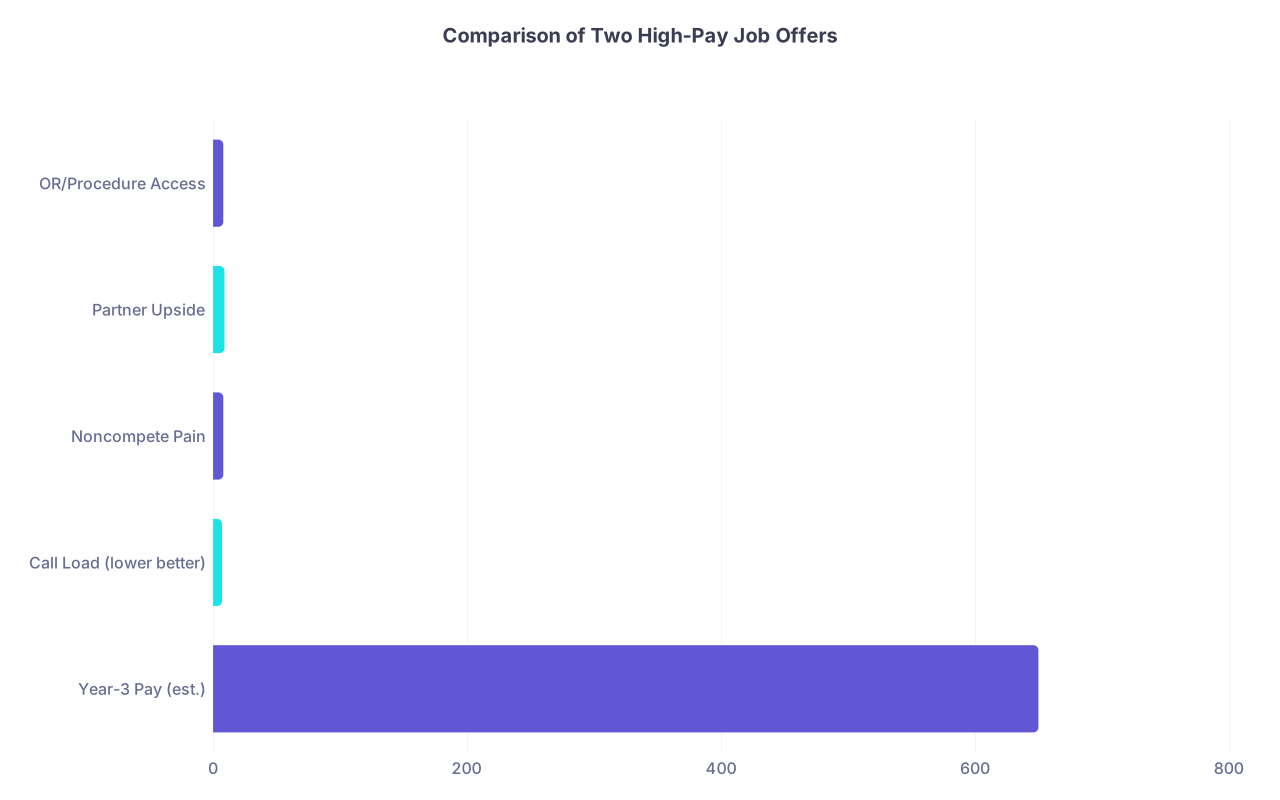
| Category | Value |
|---|---|
| Year-3 Pay (est.) | 650 |
| Call Load (lower better) | 7 |
| Noncompete Pain | 8 |
| Partner Upside | 9 |
| OR/Procedure Access | 8 |
Imagine:
Offer 1 – Big Number, Ugly Details
- $700k “potential” with $500k base + wRVU bonus
- q3 in-house call, no extra call pay
- 35-mile, 2-year noncompete from all sites
- Partnership “usually” by year 4, no written terms
- OR blocks “as available” behind senior surgeons
Offer 2 – Slightly Smaller, Actually Better
- $550k base, guaranteed for 2 years, realistic path to $650–750k by year 3 based on recent hires
- q6 home call, extra call optional and paid
- 10-mile, 1-year noncompete from primary site only
- Partnership in writing at year 2, fixed buy-in, clear ancillaries spelled out
- 2 full OR days per week, documented
On paper, people chase Offer 1. In real life, I’d push almost everyone toward Offer 2.
Because the numbers that stick (noncompete, call, partnership, infrastructure) look way better.
9. A Few Metrics That Impress People But Don’t Matter Much
Some things sound fancy but are mostly fluff:
- “Top 5% MGMA potential” without hard data from that group
- Vague RVU bonuses tied to “organizational performance”
- “Leadership opportunities” with no protected time or pay
- CME allowance differences of a few thousand dollars (noise at $600k+ incomes)
Don’t let those distract you from the heavy hitters: year-3 realistic pay, call, noncompete, partnership terms, and actual practice capacity.
10. Process: How to Evaluate a High-Pay Offer Step-by-Step
Here’s a simple flow that won’t waste your time:

| Step | Description |
|---|---|
| Step 1 | Get Contract Draft |
| Step 2 | Calculate Year 3 Pay |
| Step 3 | Quantify Call Load |
| Step 4 | Review Noncompete |
| Step 5 | Check Partnership Terms |
| Step 6 | Assess Practice Infrastructure |
| Step 7 | Negotiate or Walk |
| Step 8 | Compare With Other Offers |
| Step 9 | Have Contract Reviewed |
| Step 10 | Decide and Sign |
| Step 11 | Deal Breakers? |
Run every offer through that exact mental checklist.
If you hit multiple hard “No”s (brutal noncompete, unclear partnership, unsafe call coverage), stop trying to rationalize the money.
There’s always another high-paying job. There isn’t another you.
FAQs
1. What’s a “good” wRVU rate for high-paying specialties?
It depends heavily on region and payer mix, but rough ranges:
- Procedure-heavy specialties (ortho, neurosurgery, GI, IR, urology): often $50–$80 per wRVU in private practice, $45–$65 in hospital-employed
- Cognitive specialties (cards non-invasive, heme/onc): usually lower, $40–$60 per wRVU
The rate means nothing without knowing historical wRVU production and thresholds. A “low” rate with achievable volume can beat a flashy rate with impossible thresholds.
2. How much should I care about signing bonuses?
Signing bonuses are nice, but in high-paying specialties they’re usually noise over a few years. A $50k–$100k bonus doesn’t fix:
- A toxic call schedule
- A 2-year, 50-mile noncompete
- A dead-end non-partnership job in a saturated market
Use the signing bonus strategically (debt, moving costs, cash cushion), but don’t pick worse long-term terms for an extra $25k up front.
3. Is it ever smart to take lower pay for better lifestyle?
Absolutely, and many docs quietly do this in their second or third job. The key is to be intentional:
- If you’re in a very high-paying field, dropping from $750k to $550k for half the call and better hours can massively improve your life and still leave you very comfortable.
- Just make sure the lower-paying job is actually lower stress and not just lower paying with the same headaches.
I’d rather see you take a “smaller” job you can sustain for 10–15 years than flame out in 3.
4. What red flags in a high-pay contract should be immediate deal breakers?
A few I treat as near-automatic no’s:
- Noncompete with huge radius (20+ miles) and 2–3 years duration, especially if tied to every site
- No written partnership pathway, just verbal “you’ll do great here”
- Call obligations that are vague (“shared equitably among partners”) with no specifics
- Penalties or repayment obligations that dramatically exceed signing/relocation amounts
- Refusal to show any real data on what recent hires actually earned
You can negotiate a lot. But if the culture is hiding the ball, believe what they’re telling you.
5. Do I really need a healthcare attorney to review my contract?
If you’re in a highest-paid specialty and the numbers are large, yes. It’s not about “catching typos.” It’s about:
- Understanding noncompete enforceability in your state
- Spotting one-sided termination clauses and repayment traps
- Clarifying vague partnership and bonus language before you’re locked in
Think of a $1,500–$3,000 legal review as an insurance policy on a multi-million-dollar career decision.
6. What’s one metric I can calculate today to compare my offers?
Build a simple Year‑3 snapshot for each offer:
- Estimated base/guarantee in year 3
- Realistic bonus at median productivity (using the group’s own numbers)
- Subtract an estimated “cost” for heavy call (put your own dollar value on each extra 24-hour call)
- Factor in partnership upside if it’s clear and near-term (you can conservatively add 20–30% to expected comp if partners are consistently that much higher and you’re eligible by year 3–4)
Put that on a single sheet of paper for each job. Seeing real side-by-side Year‑3 estimates, plus call and noncompete notes, makes decisions much easier.
Open your top offer now and do one thing: write “Realistic Year‑3 Take-Home?” at the top and start filling in the numbers. If you can’t, you don’t understand the deal yet.