The obsession with “highest paid specialties” is one of the fastest ways to end up rich, burned out, and miserable.
If you are asking “Is chasing a highest paid specialty worth it for me personally?”, you are already more self-aware than half the pre-meds and early med students I’ve met. Let’s answer it properly.
Step 1: Understand what “highest paid” actually buys you
People throw around “derm, ortho, ENT, plastics, IR, neurosurgery” like lottery tickets. They rarely look under the hood.
Here is the core tradeoff in blunt terms:
| Category | High-Paid Procedural (e.g., Ortho, Derm, IR) | Moderate-Paid Cognitive (e.g., IM, Peds, Psych) |
|---|---|---|
| Typical Training Length | 5–7+ years | 3–4 years |
| Average Weekly Hours | 55–80+ (many surgical) | 45–60 |
| Lifestyle Predictability | Lower (call, emergencies) | Higher (more clinic-based) |
| Median Attending Income | $500k–$900k+ | $220k–$350k |
| Residency Competitiveness | Very High | Moderate to High |
Higher income does three big things for you:
- Speeds up debt payoff and investing
- Gives more margin for mistakes and bad luck
- Buys optionality: more freedom to cut back later, move, switch practice models
But here’s what students routinely underestimate:
- The price in training years and call
- The personality fit required to not hate that lifestyle
- The risk of not matching that specialty at all
If money is your only strong reason, it’s usually not enough to carry you through 5–7 years of brutal training in something you only “kind of” like.
Step 2: Check your real motivations (not the ones you tell interviewers)
Let me be direct: “I just want to help people” is not your real reason for eyeing ortho or derm.
The common real reasons I hear, usually off the record:
- “I grew up poor and never want to worry about money again.”
- “I’m terrified of ending up a 40-year-old hospitalist working nights I hate.”
- “If I’m sacrificing my 20s, I want a clear financial payoff.”
- “I like procedures, but I also like the idea of a $700k income.”
None of those are bad reasons. They’re honest. But you need to distinguish between:
- Money as primary driver
- Money as tie-breaker between specialties you actually like
- Money as fear response to debt and uncertainty
Here’s the mental check:
- If this specialty paid $250k instead of $600k, would I still be seriously interested?
- When I shadowed or rotated in it, did I care about the work itself, or just the lifestyle/pay story?
- Can I name specific parts of the day-to-day that energize me? Or am I mostly reciting Reddit talking points?
If you would not seriously consider the specialty at half the pay, be very cautious. You’re probably chasing money more than fit.
Step 3: Look at your personality, not just your CV
Students love to talk stats: Step scores, research, Top 10 schools. Programs care about those. But the specialty you can tolerate for 30 years is more about personality and tolerance for specific pain points.
Here’s a quick “does a highest-paid/procedural specialty fit me?” checklist:
You’re more likely to thrive in high-paying, high-intensity fields (ortho, neurosurg, IR, CT surgery, some interventional cards) if:
- You genuinely like fast decisions, limited ambiguity, and “fix it now” mindsets
- You get energy from procedures, gadgets, and OR time
- Long hours bother you less than boredom
- You can handle hierarchy and blunt feedback without spiraling
- You’d rather have 1–2 big problems to solve than 12 vague clinic complaints
You’re more likely to be miserable there if:
- You hate being on call or having your phone dictate your life
- You’re anxious with high-stakes rapid decisions under time pressure
- You value flexibility over prestige
- You’re drawn to long-term relationships and talking through complexity more than “cut it out / stent it / fix the fracture”
Flip side: “moderate” paid specialties (IM, FM, psych, peds) feel better if you:
- Like longitudinal care and knowing patients over years
- Can tolerate lots of documentation and cognitive work
- Prefer predictable clinic days over emergencies
- Care more about control of time/location than squeezing every dollar out of your degree
Money can’t fix a long-term mismatch with your personality. You’ll just be a well-compensated, exhausted mismatch.
Step 4: Run the actual numbers, not vibes
You’re in the HIGHEST PAID SPECIALTIES category, so let’s talk dollars like an adult.
Assume:
- $300–350k total med school debt
- Average attending income after training:
- High-paid procedural: $600–800k
- Solid cognitive: $250–300k
The difference is huge on paper. But adjust for:
- Training length: 3 vs 6–7 years
- Hours worked
- Years of attending-level income lost
Here’s a simplified lifetime picture (yes, simplified, but it gets you out of fantasyland):
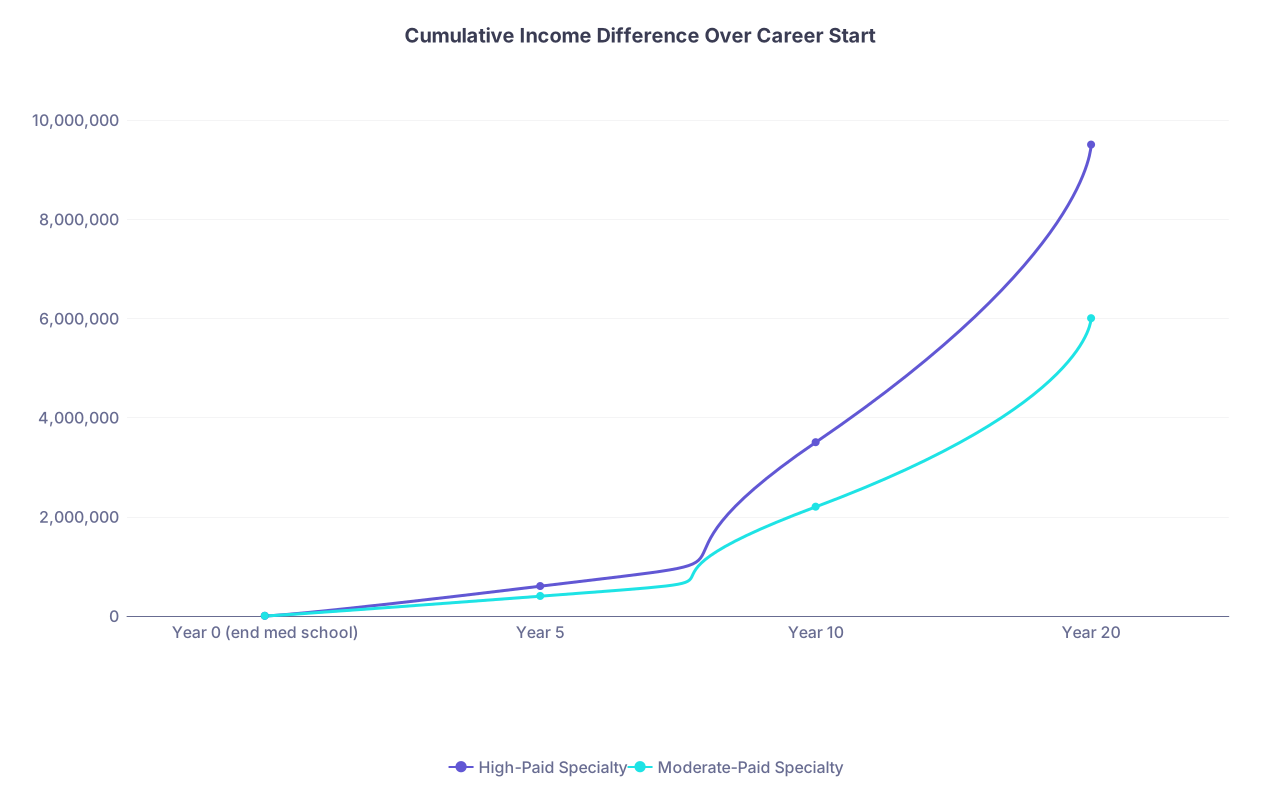
| Category | High-Paid Specialty | Moderate-Paid Specialty |
|---|---|---|
| Year 0 (end med school) | 0 | 0 |
| Year 5 | 600000 | 400000 |
| Year 10 | 3500000 | 2200000 |
| Year 20 | 9500000 | 6000000 |
Key takeaway:
Yes, high-paid specialties usually win financially across a full career. The gap can be several million dollars. But that’s only if:
- You actually match that field
- You don’t burn out and cut back dramatically or leave clinical medicine early
- You don’t spend so much extra (house, cars, private school) that you’re still living check to check
And this is the part students refuse to hear: a disciplined internist or hospitalist who lives like a resident for 3–5 years, invests sensibly, and keeps their lifestyle reasonable can still become multimillionaire-level wealthy.
The income gap matters. But it’s not binary “rich vs not rich.” It’s “rich vs richer,” assuming you behave like a grown-up with your money.
Step 5: Assess your actual competitiveness and risk tolerance
Here’s the unromantic piece: wanting derm, ENT, or ortho doesn’t mean you get derm, ENT, or ortho.
You need to look at:
- Step/Level scores compared to recent NRMP charts
- Your school’s match history in that field
- Research, letters, away rotations, connections
- Whether you’re ready to go all-in (geographic flexibility, backup plans, potentially doing a research year)
High-paid ≈ high-risk from a match standpoint. You’re betting your whole residency outcome on:
- One specialty
- In a small number of positions
- Competing against people who may have been building that application since M1
If you’re risk-averse by nature, that’s going to grind your mental health. Some people handle a 20–30% chance of not matching into their dream specialty and just shrug. Others lose sleep for years.
Ask yourself bluntly:
- If I don’t match this specialty, will I be okay with my backup?
- Am I actually willing to do a research year or extra work if needed?
- Or am I just hoping it “works out” because that’s emotionally easier than facing odds?
If your mindset is “This or nothing,” you’re not chasing a high-paying specialty. You’re gambling your entire post-grad life on a single number and some committee rooms you’ll never see.
Step 6: Lifestyle: what do you actually want your Tuesday to look like?
Forget the fantasy Instagram version of each specialty. Go smaller: a random Tuesday afternoon in mid-career.
Picture two you’s at 2:30 pm on a typical day:
High-paid interventional/procedural you:
- Post-call, doing a complex case, phone occasionally buzzing with consults, still has admin stuff stacking up
- Probably earning more per hour of direct work, but with more chaos, more acute stakes
Cognitive/moderate-paid you:
- In clinic, on your 12th follow-up of the day, EMR open, maybe a bit bored, but you know when you’re going home
- Less adrenaline, more routine, usually fewer midnight emergencies
Which one of those days feels more “right” to you most of the time?
Not on your best days. On your average days. Because that’s 90% of a career.
If you hate monotony and thrive in chaos, the “crazy call schedule” might be a price you’re happy to pay. If you value control and predictability more than intensity, a “moderate” specialty is going to fit better, even if your income ceiling is lower.
Step 7: Use money as a tie-breaker, not the starting point
Here’s the framework I push on students who actually listen:
Filter by absolute no-gos first.
Can you tolerate the OR? Night shifts? Blood? Psych patients? Pediatrics? Cross off what you can’t stomach at all, regardless of money.From what’s left, identify 2–4 specialties where you actually enjoy the work.
Enjoy ≠ every minute is magical. Just: “I can see myself doing this most days without dread.”Among those, compare:
- Training length
- Lifestyle (call, nights, location flexibility)
- Compensation range
Now let money and lifestyle become tie-breakers.
If you like GI and general IM both, and GI pays more but requires 3 extra years, that’s a rational tradeoff question. Same with EM vs IM + hospitalist, or psych vs FM, etc.
Money should not pick your specialty for you. But it’s completely legitimate to let money break ties between specialties that are all a decent fit.
Step 8: When is chasing a highest-paid specialty absolutely worth it?
I’d say it is worth chasing a top-compensation specialty if:
- You’ve actually rotated in it and still like it after seeing the ugly parts
- You have realistic competitiveness (scores, letters, research)
- You’re okay with a backup you could accept without resentment
- The lifestyle tradeoffs line up with your temperament
- You’ve thought about debt, family plans, and where you want to live
And it’s not worth it if:
- You’re miserable in the OR but love clinic, yet keep saying “ortho pays better”
- Your primary driver is fear of being “underpaid” as an internist or pediatrician
- You’re banking on a 5–10 percentile match shot with no backup
- You’ve never honestly compared “average day in this specialty” across options
A quick decision flow (be honest when you answer it)

| Step | Description |
|---|---|
| Step 1 | Do you like the actual day to day of a high paid specialty? |
| Step 2 | Use income as tie breaker only |
| Step 3 | Are you realistically competitive? |
| Step 4 | Strengthen app or pick better fit |
| Step 5 | Do you have a backup you can accept? |
| Step 6 | Too risky - rethink |
| Step 7 | Chase it - strategically |
If you land at G, then yes—it might be worth going after the highest paid option that fits you. If you land anywhere else, don’t contort your life around a fantasy.
FAQs
1. Is it “wrong” to choose a specialty mainly for the money?
It’s not morally wrong. But it’s strategically risky. Choosing only for money ignores personality fit, lifestyle tolerance, and what actually drains or energizes you. I’ve watched residents in very high-paying fields quit fellowships or switch careers entirely because they misjudged how much the work would grind them down. Money helps, but it does not compensate for daily dread.
2. Can I still become wealthy in a lower or mid-paying specialty?
Yes, if you behave like a financially literate adult. A full-time hospitalist, internist, EM doc, or psychiatrist at $250–400k who saves 20–30% of income, avoids massive lifestyle creep early, and invests in boring index funds will almost certainly hit multi-million net worth territory over a career. A $700k ortho surgeon who spends $690k a year is “richer” on paper, but not in actual freedom.
3. What if I’m interested in a competitive high-paid specialty but my scores are average?
You need brutal clarity. Talk to advisors who know your school’s match statistics. Ask recent grads in that field what it took. If you still want to try, make a concrete plan: research, away rotations, targeted programs, and a believable backup specialty you can live with. “Average scores, no research, aiming for derm with no backup” is not ambition—it’s denial.
4. How do I actually compare lifestyles across specialties without sugarcoating?
Stop listening only to pre-meds and curated social media. On rotations, explicitly ask residents and attendings: “What does your last bad week look like?” and “If your kid had to pick a specialty, would you recommend this?” Watch call schedules. Look at who seems exhausted vs content. An honest 10-minute hallway conversation with a PGY-4 is worth more than a month of online threads.
5. So, is chasing the highest paid specialty worth it for me personally?
It’s worth it if you genuinely like the work, your personality fits the demands, you’re competitive enough that it’s not a delusional long shot, and you have a backup plan you don’t secretly hate. It’s not worth it if money is your only real driver, you dislike the day-to-day, or you’re gambling your entire future on a specialty you barely know. Use money as a powerful tie-breaker, not the sole architect of your career.
Bottom line:
- Pick from what you can actually see yourself doing daily, not from a salary list.
- Within that smaller set, then use income and lifestyle as rational tie-breakers.
- Don’t trade 30 years of your life for a paycheck you’ll be too burned out to enjoy.