The most lucrative specialties with a livable lifestyle are not what pre-meds on Reddit think they are.
If you’re trying to balance big money with a sane life, you’re not choosing between neurosurgery and dermatology. You’re choosing between a small set of “goldilocks” fields that sit at the sweet spot of: high pay, controllable hours, and reasonable training demands.
Let me walk you straight to them.
The Short List: High Pay AND Reasonable Lifestyle
Here’s the core truth: almost every high-paying specialty can be made miserable if you choose the wrong practice setting. But some fields are structurally kinder than others.
These are the specialties that, in real life, most often give you the best lifestyle–income tradeoff:
- Dermatology
- Radiology (especially outpatient / telerad)
- Anesthesiology (in the right group)
- Ophthalmology
- Radiation Oncology
- Certain outpatient-heavy subspecialties of Internal Medicine:
- Gastroenterology
- Cardiology (non-invasive / imaging-heavy)
- Endocrinology and rheum are lifestyle-friendly but pay notably less
Let’s put some numbers around this before we go deeper.
| Specialty | Typical Full-Time Comp* | Typical Hours/Week | Call Burden |
|---|---|---|---|
| Dermatology | $450k–$650k+ | 35–45 | Minimal/none |
| Radiology | $450k–$700k+ | 40–55 | Home call only |
| Anesthesiology | $400k–$600k+ | 45–60 | OR-based; varies |
| Ophthalmology | $350k–$600k+ | 40–50 | Light |
| Rad Onc | $400k–$600k+ | 40–50 | Very light |
*US, attending-level, non-academic private practice, mid-career ranges. Local markets vary a lot.
Now let’s unpack the tradeoffs specialty by specialty.
Dermatology: The Poster Child for High-Pay / High-Lifestyle
If you’re looking for “best lifestyle per RVU,” derm wins.
What’s good:
- Clinic hours. Most derms work classic office hours, maybe 8–4 or 9–5. Nights and weekends are rare unless you want them.
- Minimal emergencies. Almost nothing is “rush to the ER” level. Call is often phone-only, and not every practice even has formal call.
- Procedures without the OR chaos. Excisions, biopsies, MOHS, cosmetics. High revenue density per hour.
- High ceiling on income. Private cosmetic-heavy practices can clear way above the salary ranges people quote publicly.
Tradeoffs:
- Ridiculously competitive. You’ll need top board scores, AOA, research, strong letters. If you’re not in the top 10–15% of your class, matching derm is an uphill battle.
- Some markets are saturated. Big coastal cities can be tough to break into as a new grad if you’re picky on location.
- Cosmetics can blur the line between medicine and business. Great for income; not everyone loves that identity shift.
Who thrives here:
- You like clinic more than the hospital.
- You enjoy pattern recognition, chronic disease management, and minor procedures.
- You want 3–4 days/week to be an option without detonating your finances.
Radiology: High Income, Flexible, and “Invisible” Call
Radiology is one of the most underrated lifestyle specialties—if you can handle the cognitive load and sitting.
What’s good:
- Pay per hour is strong. Especially in private practice groups, telerad setups, and high-volume practices.
- Call is usually from home. You’re covering ER/STAT reads, but you’re not driving in for a ruptured something.
- Flexibility with shifts. Nights, evenings, 7-on/7-off, part-time, remote. Lots of levers you can pull to adjust lifestyle vs income.
- No clinic. No patient panel, no “MyChart” inbox exploding.
Tradeoffs:
- Sedentary, high-volume, high-focus work. Staring at a screen all day isn’t for everyone.
- Pressure and liability. Missed diagnoses haunt radiologists. You live in the land of “you didn’t see it, but the plaintiff’s expert did.”
- Training is longish. 5 years total (1 intern + 4 rads) plus optional fellowship (which almost everyone does now).
The lifestyle spread:
- Academic rads: ~40–50 hours/week, decent pay, more teaching/research.
- High-powered private groups: 45–55+ hours, very high pay, busy days.
- Telerad: variable, but often: work hard for blocks of time, then disappear.
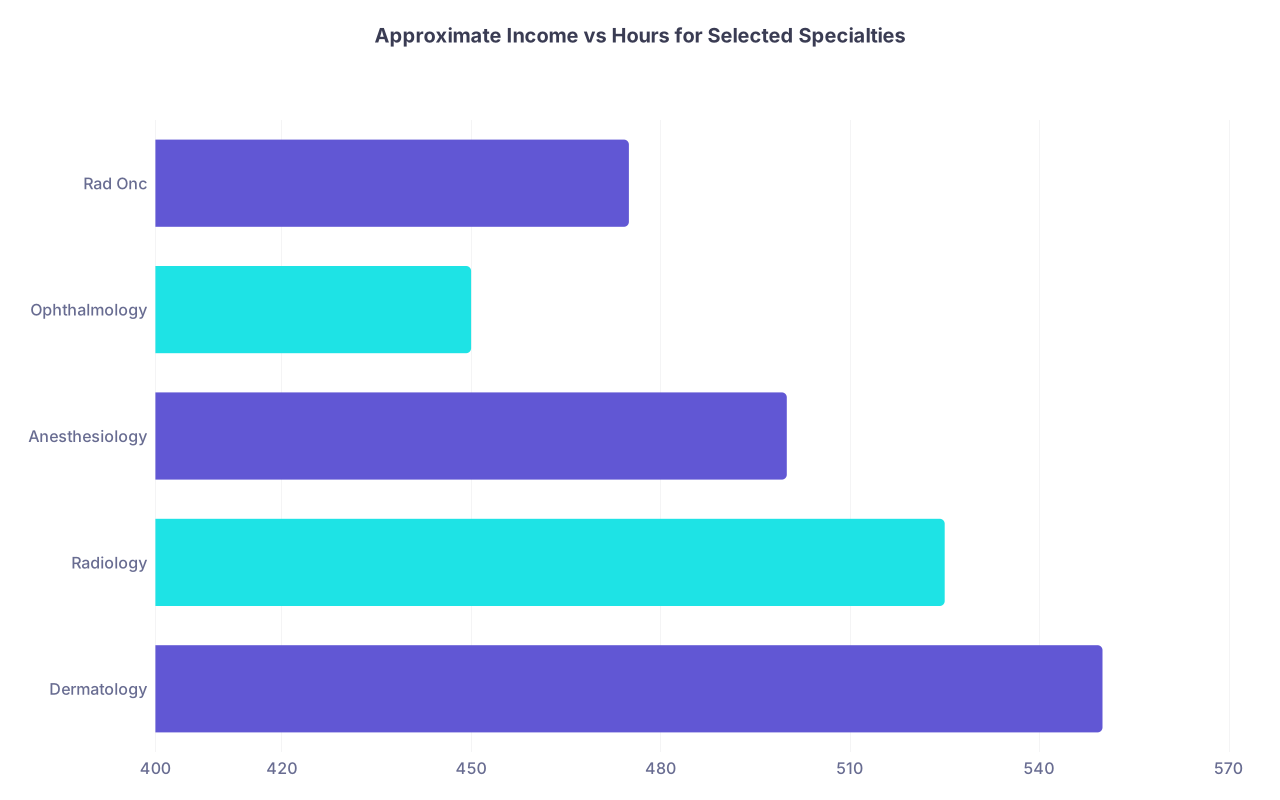
| Category | Value |
|---|---|
| Dermatology | 550 |
| Radiology | 525 |
| Anesthesiology | 500 |
| Ophthalmology | 450 |
| Rad Onc | 475 |
(Think of the values above as a rough “thousands of dollars per year” marker.)
Anesthesiology: High Pay, Variable Lifestyle
Anesthesia is where lifestyle goes from “amazing” to “brutal” depending on your group, hospital, and region.
What’s good:
- Strong compensation. Especially private practice, cardiac/OB/locums-heavy groups, or partnership-track practices.
- Shift-based work. When your last case is done and your call is over, you go home. No panel. No clinic.
- Clear boundaries. You’re not dealing with endless outpatient follow-up. You care intensely for a few hours and then hand off.
Where it hurts:
- Early mornings. OR days start early. 6:30–7:00 am is normal.
- Call and post-call. Some groups have 1:4 or 1:5 call—busy nights, trauma, emergent cases. That wears on you.
- Variability by market. In some metros, anesthesiologists are squeezed by large corporate groups and staffing models.
Best setups:
- Community hospitals with decent staffing and reasonable trauma volume.
- Groups with protected post-call days and transparent workload expectations.
- High-income areas where you can cut back to 0.8 FTE and still be very comfortable.
If you want big money but only want to work 3–4 days a week eventually, anesthesia can be a solid path—if you pick your practice carefully.
Ophthalmology: Surgical, High Income, Predictable Days
Ophtho is the “quietly excellent” specialty. Surgical, relatively low drama, and financially strong.
What’s good:
- Procedure-heavy with high efficiency. Cataracts, glaucoma procedures, retina injections, etc. You can stack a lot of cases in a day.
- Clinic + OR rhythm. You’re not writing hour-long notes on 15 problems. Visits are focused.
- Emergencies do exist (retinal detachments, angle-closure glaucoma) but are rarer than, say, general surgery emergencies.
Lifestyle perks:
- Call is typically light. Many issues can be triaged or seen the next day.
- Hours can be very predictable. Plenty of ophtho groups do 4-day workweeks.
- Tech and diagnostics help streamline visits; you’re not guessing in the dark.
Tradeoffs:
- Microsurgery is demanding. If your hands shake or you hate delicate work, this will be painful.
- The pipeline is competitive. Not as brutal as derm, but up there.
- Vision outcomes are emotionally loaded. When things go wrong, they really hit.
For many people who like surgery but don’t want surgical lifestyle (trauma, nights, big cases going to midnight), ophtho is a fantastic compromise.
Radiation Oncology: Great Lifestyle, Mixed Job Market
Rad Onc used to be an automatic win: high pay, chill lifestyle, academic vibe. The pay and lifestyle mostly remain; the job market is the catch.
What’s good:
- Clinic hours, very predictable. This is probably the most “9–5” of the high-paying specialties.
- Minimal real emergencies. Cancer care is urgent, but very few true middle-of-the-night situations.
- Strong patient relationships. You see patients repeatedly through treatment.
Lifestyle:
- 40–50 hours/week is standard.
- Call is often home call and not intense.
- Weekends are relatively protected in many settings.
Major downside:
- Job market has tightened. Oversupply in some regions, big consolidation into hospital systems, and fewer positions in some desirable cities.
- You need to be flexible on geography or accept academic salaries that run lower than peak private practice.
If you’re okay being geographically flexible and you like oncology, this can still be one of the best lifestyle trades in medicine.
High-Paying IM Subspecialties: GI and Cards (Non-Invasive)
These are not derm-level lifestyles. But they’re some of the highest-paying cognitive/procedural fields and can be shaped into decent lifestyles over time.
Gastroenterology
- Pay: Often $550k–$800k+ in busy private practice with procedures.
- Work: Mix of clinic + endoscopy (EGDs, colonoscopies, ERCP if advanced).
- Lifestyle:
- Call can be rough in training and early years (GI bleeds at 2 am).
- As you gain seniority or structure your practice, some GI docs transition to mostly elective outpatient scopes and clinic with limited hospital work.
- Long pipeline: IM residency (3 years) + GI fellowship (3 years). That’s 6 post-MD years before attending pay.
Cardiology (Non-Invasive / Imaging-Focused)
- Pay: Non-invasive cards can land in the $400k–$600k+ range; invasive/interventional more, but with worse lifestyle.
- Lifestyle:
- Many cardiologists carry weekends and call, especially in smaller groups.
- But non-invasive + imaging-heavy roles (echo, nuclear, CT, MRI) can look almost like radiology with consults.
- Tradeoff: You pay with a long training path (3 IM + 3 cards; interventional adds more) and heavier call than derm/optho/rads—especially early in your career.
If your main goal is absolutely max income, GI and cards (especially in rural/suburban private practice) can beat most other fields. But you’ll sacrifice lifestyle more than in derm/rads/optho.
The Real Decision: Money vs Control
Let’s simplify your problem. You’re really solving this equation:
“Given I want to earn at least $X and work at most Y hours, which specialties make that realistic without me being a unicorn?”
Use this mental framework:
If your top priority is lifestyle, and you still want high pay:
- Top picks: Dermatology, Ophthalmology, Radiology, Radiation Oncology
- Runner-up: Anesthesiology in a well-staffed group
If your top priority is max income with decent lifestyle (but not derm-level):
- Top picks: GI, Cardiology, Anesthesiology (especially overtime/locums), high-volume Radiology
If you want high meaning + solid lifestyle + good pay:
- Consider: Rad Onc, Ophtho, some outpatient-heavy IM subspecialties, or even well-structured Hospitalist work (pay is lower but lifestyle can be very stable and shift-based).

| Step | Description |
|---|---|
| Step 1 | Main priority? |
| Step 2 | Best lifestyle |
| Step 3 | Highest income |
| Step 4 | Balance of both |
| Step 5 | Derm, Rads, Ophtho, Rad Onc |
| Step 6 | GI, Cards, Anesth, High volume Rads |
| Step 7 | Ophtho, Anesth, Rads, GI non-call heavy |
Huge Caveat: Practice Setting > Specialty
You can wreck derm lifestyle by joining a toxic, productivity-obsessed cosmetic mill with 5-minute visits and no time off. You can make EM or hospitalist medicine surprisingly livable with a stable group, protected shifts, and a lower cost-of-living town.
For every specialty, ask these during interviews:
- What’s the real hours/week expectation for partners and for new grads?
- How often is call? Is call from home or in-house? How busy is it actually?
- Post-call days truly off, or just “lighter”?
- How many weeks of vacation/CME combined?
- How many RVUs or patients/day do partners typically do?
Those answers will matter more than the name of the specialty on your badge.
FAQ: High-Paying Specialties and Lifestyle
1. Which specialty has the best lifestyle overall?
Dermatology usually wins. Typical setup is:
- 4–5 day clinic weeks
- Very little call
- High income per hour
Radiology, ophthalmology, and radiation oncology are close behind for many people, but derm is the classic “work less, earn more” field.
2. What’s the highest-paying specialty with a reasonable lifestyle if I like procedures?
If you want procedures and still want your evenings:
- Ophthalmology and dermatology (procedural tracks, MOHS) are excellent.
- GI can be great long-term once you shape your practice more toward elective scopes and limit inpatient work.
- Anesthesiology can work if you join a well-run group with sane call.
3. Is radiology lifestyle really that good in practice?
Often, yes—but it depends on your group and subspecialty. Outpatient or telerad-heavy roles with home call can be very lifestyle-friendly. High-volume ER coverage in an understaffed group? That’s a grind. The field has the tools for lifestyle; you still need to choose your job wisely.
4. Does anesthesiology burn people out more than other high-paying fields?
It can. Long OR days, high-stakes moments, production pressure, and frequent early mornings add up. In my experience, anesthesiologists in stable groups with fair call and good staffing do well. Those in understaffed hospitals with punishing call cycles burn out fast.
5. Which specialty would let me work 3–4 days a week and still earn big?
Derm, ophtho, and radiology are at the top of this list. Many attendings in these fields intentionally go 0.6–0.8 FTE and still out-earn full-time primary care peers. Some anesthesiologists and GI docs do this too once they’ve established themselves.
6. Is GI or cardiology lifestyle “bad”?
Not inherently—but it’s heavier than derm/optho/rads/rad onc. You’ll deal with:
- More nights/weekends on call
- Longer training
- Sicker inpatient loads when you’re on
Plenty of GI and cards attendings are happy. But if you’re ultra lifestyle-focused, you’ll probably be happier in derm, rads, ophtho, or rad onc.
7. What’s one concrete step I can take now to choose a good lifestyle specialty?
Shadow two attendings in each specialty you’re considering—and not just at big-name academic centers. Find a private practice derm, a community radiologist, a non-academic anesthesiologist, etc. Spend a full day with each and write down:
- When they started and ended work
- How often they were interrupted after hours
- How tired or stressed they seemed at 3 pm
Then compare.
And do that this month: email one community doc today and ask to shadow for a day.