The biggest mistake ambitious students make is deciding on a high-paying specialty either way too early… or two years too late.
If you are aiming for dermatology, orthopedics, plastics, ENT, interventional cardiology, or another high-compensation pathway, your timeline is not optional. It is the game.
I am going to walk you from M1 to Match and tell you, phase by phase, when you must decide, what you should test, and exactly what to have done by each checkpoint.
Big-Picture Timeline: Decision Deadlines for High-Paying Paths
At this point, you need a sense of the whole road before we zoom in.
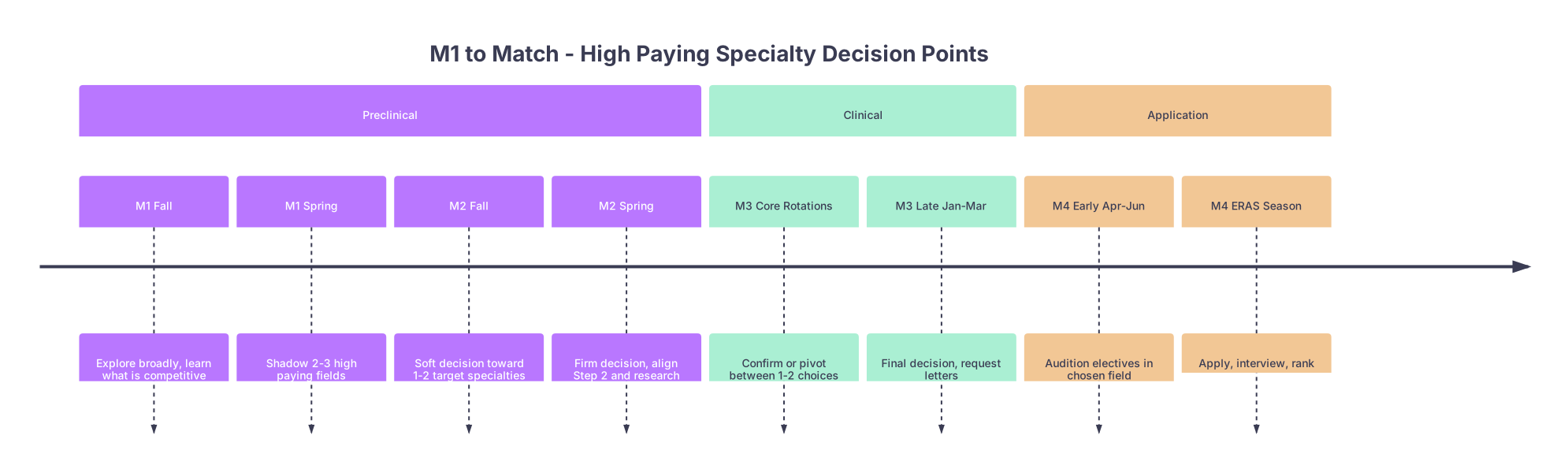
| Period | Event |
|---|---|
| Preclinical - M1 Fall | Explore broadly, learn what is competitive |
| Preclinical - M1 Spring | Shadow 2-3 high paying fields |
| Preclinical - M2 Fall | Soft decision toward 1-2 target specialties |
| Preclinical - M2 Spring | Firm decision, align Step 2 and research |
| Clinical - M3 Core Rotations | Confirm or pivot between 1-2 choices |
| Clinical - M3 Late Jan-Mar | Final decision, request letters |
| Application - M4 Early Apr-Jun | Audition electives in chosen field |
| Application - M4 ERAS Season | Apply, interview, rank |
Here is the blunt version:
- Latest realistic time to seriously enter a top-tier, high-paying specialty:
End of M2 if you are starting from zero;
Middle of M3 if you already have research and connections in that lane. - Dream of derm or ortho starting M4? You are functionally a reapplicant. You will probably need a research year or some creative detour.
Let us walk it year by year, then month by month.
M1: Curiosity With Strategy (Not Commitment)
M1 Fall (August–December): Learn the Landscape, Not the Acronyms
At this point you should:
- Understand which specialties are genuinely high-paying and competitive, not just “seem fancy.”
- Start quietly tracking your own competitiveness (grades, work ethic, test performance).
Do this in your first 3–4 months:
Learn the rough tiers of competitiveness and pay.
High-paying, highly competitive examples:- Dermatology
- Orthopedic surgery
- Plastic surgery
- Neurosurgery
- ENT (otolaryngology)
- Interventional cardiology / procedural subspecialties after internal medicine
- Radiology (especially interventional)
- Anesthesiology (at strong academic or high-volume private practices)
Look at actual data, not Reddit narratives.
Approximate Compensation by Specialty Tier (Attending Level) Specialty Tier Example Fields Typical US Range (Mid-Career) Ultra-high compensation Ortho, Plastics, Derm $550k–$900k+ High compensation ENT, Neurosurg, IR, Cards $500k–$800k Upper-mid compensation Anesthesia, EM, GI $400k–$600k Core fields (variable) IM, FM, Peds, Psych $200k–$350k Start a simple “specialty log.”
One page per specialty. Columns:- What I think I like (short)
- What I think I would hate
- Lifestyle notes (call, hours, training length)
- Competitiveness (Step expectations, research needs) Add to it as you go.
Protect your academic foundation.
For high-paying fields, top-quarter performance helps. For the ultra-competitive, top 10–15% is closer to the truth. At this point:- Dial in your study system.
- Learn how you actually perform on standardized-style questions.
You do not need to “pick” a specialty in M1 fall. You do need to stop pretending the choice will magically solve itself.
M1 Spring (January–May): Controlled Exposure to High-Paying Fields
By the end of M1, if you are leaning toward a high-paying route, you should have:
- Shadowed at least 2–3 candidates from your list.
- Spoken to at least one resident in a competitive specialty.
- Identified your preliminary “top 2–3” specialties.
Targeted actions:
Shadowing (2–4 half-days).
- Dermatology clinic half-day.
- OR time with ortho, neurosurgery, ENT, plastics, or cardiac surgery.
- One “cognitive but still strong-pay” field: radiology, anesthesia, cardiology clinic.
Do not just watch. Ask specific questions:
- “If you were an M1 again and aimed for your specialty, what would you start doing now?”
- “What do you see applicants consistently underestimate?”
Attend specialty interest group events. Go to:
- One ortho or surg subspecialty meeting.
- One procedural medicine or radiology/anesthesia talk. Listen for patterns: research expectations, away rotations, letters.
Do an honest self-audit by May.
In your specialty log, for each competitive field you have seen, rate:- Tolerance for long training.
- Comfort with blood/OR environment.
- Appetite for research and CV-building.
- Need for geographic flexibility.
At this point, you should not be “locked in.”
But if you are strongly considering an ultra-competitive, high-paying path, that thought needs to be on paper, not just in the shower.
Summer After M1: Light Tests, No Overcommits
This summer is not about grinding 70 hours a week in lab for most people. However, if you are leaning derm / ortho / plastics / neurosurg, you cannot burn the entire summer on vacation either.
Your decision checkpoint here:
- If you have a strong leaning toward one high-paying field: start one small, realistic project in that lane.
- If you are totally unsure but want a competitive path: do something that keeps doors open (e.g., generic surgery or internal medicine research).
Possible setups:
- 6–8 week research project (case series, chart review, resident-led project).
- Funded SURF or similar program in a surgical or radiology department.
- Structured shadowing block (e.g., 2 weeks splitting mornings in OR, afternoons in clinic).
Your goal by August before M2:
- Know whether you enjoy the culture and pace of at least one high-paying procedural field.
- Have met at least one attending or fellow who might become a mentor.
M2: The Decision Year For Top-Tier Specialties
M2 is where people quietly separate into “possible derm/ortho candidates” and “probably not, at least not without a research year.”
M2 Fall (August–December): Soft Decision Toward 1–2 Targets
At this point you should:
- Narrow your serious interest list to no more than 2 high-paying specialties.
- Align your early CV-building toward those fields.
You do not have to choose definitively yet, but you do have to stop trying to keep 6 totally different options alive.
Concrete moves:
Align your existing efforts.
- Pick one home department to show your face in: ortho, derm, neurosurg, ENT, plastics, rads, anesthesia, cardiology, etc.
- Ask a resident: “What are 1–2 realistic projects I could contribute to this year?”
Check your academic trajectory.
- Even if Step 1 is Pass/Fail, your school exams, NBME subject exams, and early Step-style questions will tell you your ceiling.
- If you are struggling to pass courses, stop fantasizing about derm and fix the foundation first.
Reality check your competitiveness with real numbers.
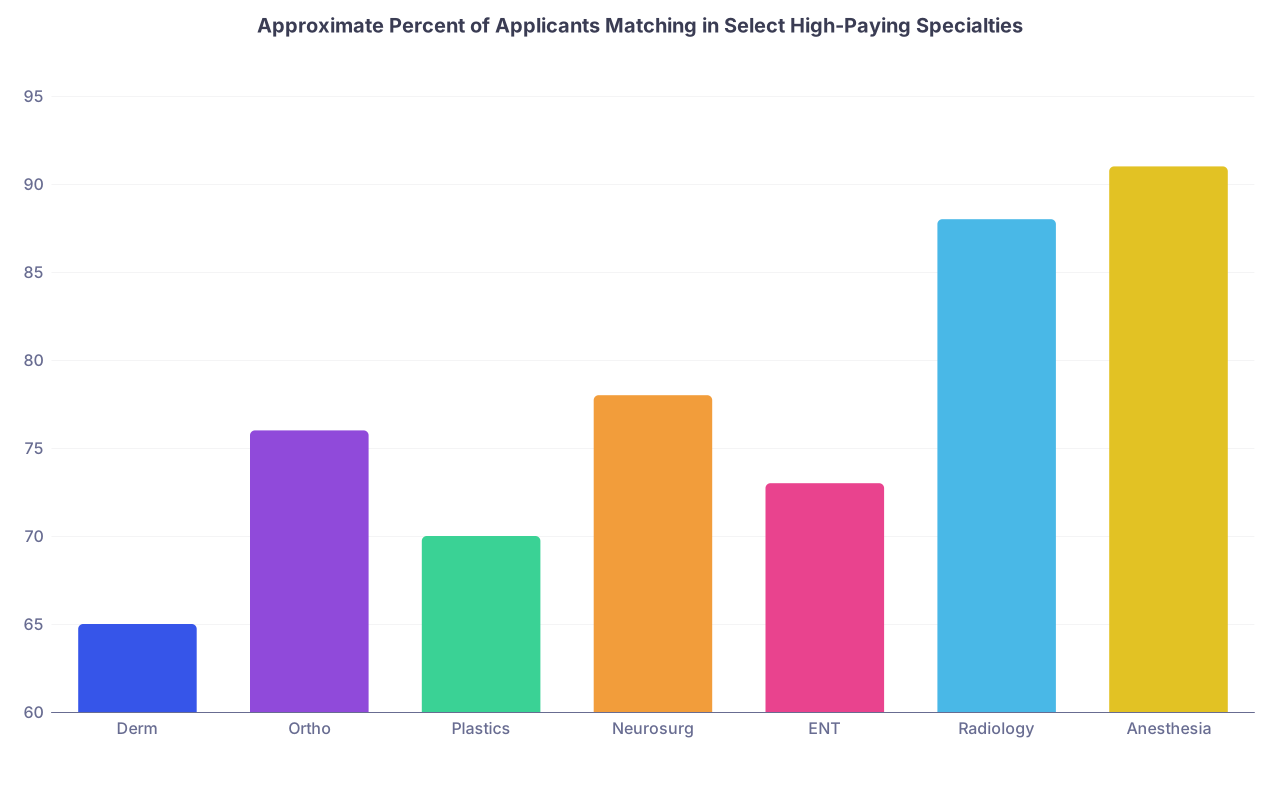
Approximate Percent of Applicants Matching in Select High-Paying Specialties Category Value Derm 65 Ortho 76 Plastics 70 Neurosurg 78 ENT 73 Radiology 88 Anesthesia 91 I have seen too many M4s “decide” on derm after a nice M3 rotation with zero research and an average Step 2, then act surprised on Match Day. Do not be that person.
M2 Spring (January–May): Firm Decision for Ultra-Competitive Fields
By the end of M2, if you want an ultra-competitive, high-paying specialty, you should have:
- A primary choice specialty.
- At least one ongoing project in that specialty.
- A very clear plan for:
- Step 2 CK timing and target score.
- Which rotations in M3 will matter most for your specialty.
At this point you should:
Make a primary choice. Your decision should sound like:
- “I am primarily targeting ortho. Backup could be anesthesia or general surgery depending on M3.” Or:
- “I am aiming for radiology. If that changes, it will likely be cardiology via IM.”
Clarify what your specialty actually wants.
Key Application Priorities by High-Paying Specialty Specialty Emphasis Typical Needs Dermatology Research, letters, AOA Multiple derm projects, strong Step 2 Ortho Ortho research, ortho letters Sub-I performance, athletic/team fit Plastics Research, early mentorship Strong portfolio, sometimes extra year Neurosurgery Heavy research, long-term involvement Substantial CV, strong Step 2 ENT ENT research, strong letters Good Step 2, strong clerkships Radiology Strong Step 2, letters, some research Solid internal medicine evals Plan Step 2 CK. For nearly all competitive high-paying specialties now, Step 2 CK is critical.
Decide:- When you will take Step 2 (often late M3 or early M4).
- What score range your mentors say is “competitive” for your target.
This is your quiet cutoff point. If you reach May of M2 with no research, mediocre academic trajectory, and no real connection to a high-paying specialty, you either:
- Accept a delayed pathway (research year), or
- Pivot to solid but less cutthroat options.
M3: Confirm, Prove, Or Pivot
M3 is where the decision goes from theoretical to real. Now you are being watched.
Early M3 (First 3–4 Core Rotations): Test Your Assumptions
At this point you should:
- Use every core rotation as both:
- A test of “could I actually do this specialty?”
- A way to strengthen your application even if it is not your final choice.
Strategy:
If you are eyeing a surgical high-paying field:
- Treat surgery, OB/GYN, and any procedural rotation as auditions for your work ethic.
- Show up early, own tasks, be the student people fight to have back.
If you are eyeing radiology, anesthesia, cards, or other internal medicine–based high-paying fields:
- Crush internal medicine and ICU-type rotations.
- Ask explicitly for feedback: “If I were to apply to radiology/cards/anesthesia, what would I need to improve?”
Track your reactions honestly. After each rotation, jot down:
- Did I enjoy the daily work?
- Could I realistically do this 60+ hours a week for years?
- How did I feel about the culture?
A lot of students discover in M3 that they love the idea of money more than they love 4 a.m. trauma calls. Better to discover that in September than in ERAS season.
Mid-Late M3 (January–March): Hard Decision and Letters
By January–March of M3, for a high-paying specialty, you must:
- Make a final decision on what you are actually applying to.
- Start securing letters of recommendation in that field.
At this point you should:
Lock in your primary specialty. Examples:
- “I am applying ortho. Backup plan is gen surg only if forced, but I will focus my application on ortho.”
- “I am applying radiology categorical, no prelim-only strategy.”
Line up letters deliberately. For each high-paying field, you usually need:
- 2–3 strong letters from attendings in your field.
- 1 medicine or surgery letter (depending on specialty) showing core clinical strength.
Gap I see constantly: deciding on a specialty in February but having no rotation in that field scheduled until July. That is basically a lost cycle.
Schedule M4 rotations accordingly.
- Book at least one home Sub-I in your chosen field early M4.
- For some surgical subspecialties: plan 1–3 away rotations June–September M4.
M4: Execution Phase, Not “Figure It Out” Phase
By the time you hit M4, the “when to decide” question should already be answered. Now you are executing.
Early M4 (April–July): Sub-Is, Aways, Step 2 Done
At this point you should:
- Be acting like an applicant in that field, not a tourist.
- Be known by name by at least a few faculty in your specialty.
Checklist:
Complete at least one Sub-I in your chosen specialty (or a close cousin) early.
- Ortho: Ortho Sub-I at home.
- Derm: Dermatology rotations, including consult experience.
- Radiology: Strong rads elective plus IM to show clinical chops.
- Anesthesia: Anesthesia Sub-I plus ICU or surgical subs.
Finish Step 2 CK early enough for programs to see the score.
- Competitive pathway? Step 2 ideally done by July–August of M4.
- Aim to beat your school’s typical match scores for that field.
If doing away rotations (surgical subs, derm, ENT, etc.):
- Treat each away as a month-long interview.
- Show consistency: punctuality, reliability, good team behavior.
- Seek one strong letter from your best-performing site.
ERAS Season (September–Match): Staying Cohesive
At this point, you are no longer deciding. You are defending your decision with a coherent application.
During application season:
- Your personal statement should match your history: if you say “I have long been committed to ortho,” there better be more than one random elective and zero research.
- Your letters should all tell the same story: evolving competence, strong work ethic, clear interest in that field.
Backup Plans And Late Realizations
Reality: some people will not “decide” effectively until it is borderline late. You still have options, but they cost time.
Common late scenarios:
Late M3 realization: “I want derm / ortho / plastics” with almost no prior involvement.
- Honest answer: you probably need:
- A dedicated research year in that field.
- Excellent Step 2.
- Strategic mentorship.
- Trying to rush this in one ERAS season is usually a waste of an application.
- Honest answer: you probably need:
Strong Step 2 but no research, wanting high-paying competitive field.
- Some fields (anesthesia, radiology) can be more forgiving if the rest of your app is solid.
- Surgical subs and derm? Much less forgiving on research and letters.
Realizing you hate your chosen field M4 year.
- You can pivot to a related but less competitive high-paying option:
- Ortho → anesthesia or radiology.
- Neurosurg → neurology with procedural focus, or radiology.
- Derm → IM with a plan for procedural subs (GI, cards).
- You can pivot to a related but less competitive high-paying option:
None of these are ideal. All are survivable. But they are worse than making a firm decision by late M2 / mid-M3.
Quick Visual: Decision Pressure Over Time
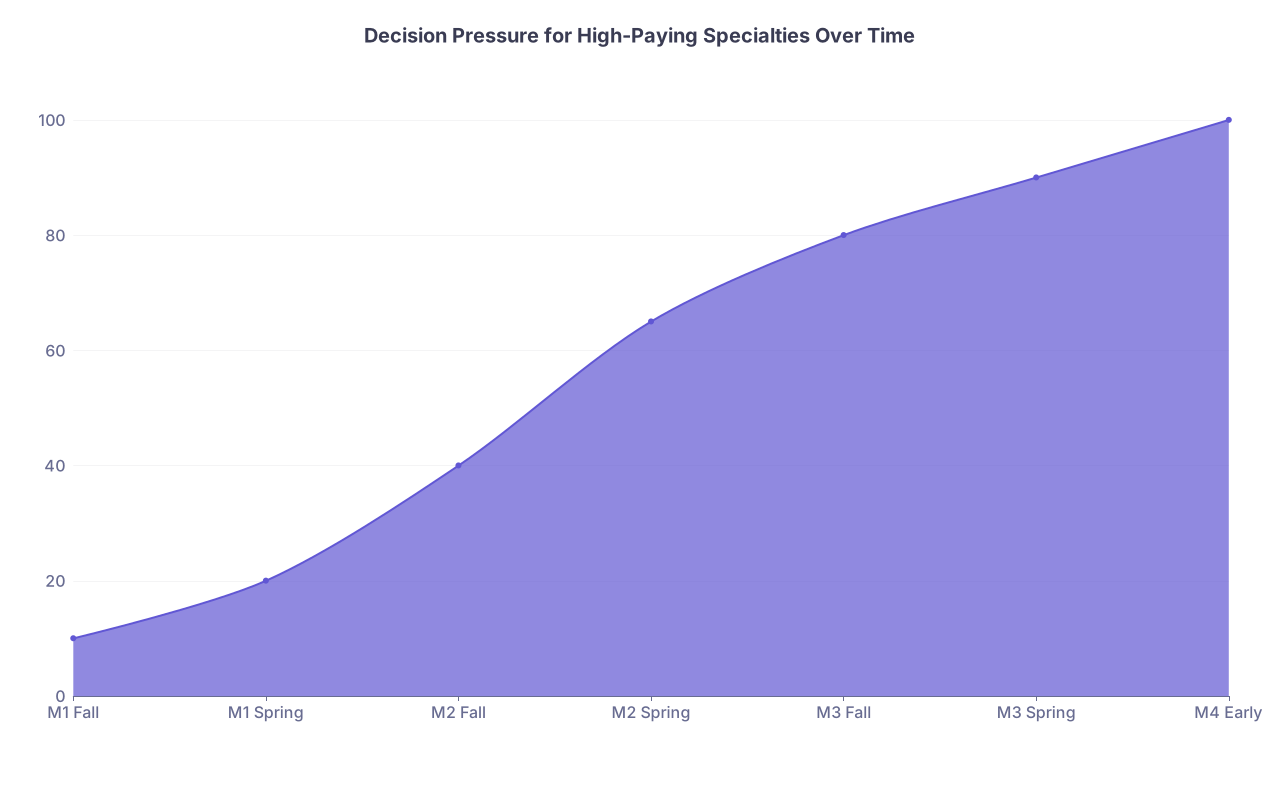
| Category | Value |
|---|---|
| M1 Fall | 10 |
| M1 Spring | 20 |
| M2 Fall | 40 |
| M2 Spring | 65 |
| M3 Fall | 80 |
| M3 Spring | 90 |
| M4 Early | 100 |
The longer you wait, the less freedom you have and the more everything must go perfectly.
Final Snapshot: What You Should Have Decided By When

By:
End of M1:
- Shortlist 3–5 specialties, including at least 1–2 high-paying options you have actually seen in real life.
End of M2:
- Primary target specialty chosen, especially for derm / ortho / plastics / neurosurg / ENT.
- At least one mentor and one project in that lane.
January–March of M3:
- Final decision made on what you will apply to.
- Letter strategy and M4 rotation schedule aligned with that choice.
Early M4:
- Sub-I and/or away rotations locked in.
- Step 2 scheduled (or completed) with a clear score target from mentors in your field.

Core Takeaways
- You do not need to choose a high-paying specialty in M1, but by end of M2 you must have a primary target if you want a real shot at the ultra-competitive fields.
- Every year has a job: M1 explore, M2 commit and build, M3 prove and confirm, M4 execute. If you mix those up, you pay with time.
- Ambition is cheap. Timelines are not. Decide early enough that your CV, letters, and Step 2 score all tell the same story. That is what programs actually read.