
You are here
You are a premed sophomore staring at specialty salary tables. Or an M1 who just heard that ortho residents matched with “10+ pubs.” Or an M3 on surgery who realized dermatology pays more than your parents make combined.
Wherever you are, you are asking the same question:
“When do I need to start subspecialty research if I want a high‑paying field—and how late is too late?”
Let me be blunt: for the highest paid specialties, research is not optional window dressing. It is currency. You are competing against people who started lining this up years earlier than you think is reasonable.
I will walk you through a timeline. Premed through residency. Month by month and year by year, what you should be doing if you care about:
- ortho
- plastics
- derm
- neurosurgery
- ENT
- interventional cards / EP / structural
- GI
- IR
- rad onc
- some of the high‑end anesth / pain / critical care tracks
Not all of these require the same research intensity. But if you aim at the top programs or the densest RVU jobs, you act like they do.
Big picture timeline at a glance
For high‑paying specialties, this is the “safe” research start window by stage:
| Stage | Ideal Start | Latest Competitive Start | Notes |
|---|---|---|---|
| Premed | Sophomore | Late Junior Year | Any clinical or QI beats nothing |
| M1 | Fall M1 | Early Summer after M1 | Core foundation for competitive fields |
| M2 | Early M2 | Before Dedicated Step | Push to submit/accept projects |
| M3 | Early M3 | Mid‑M3 | Late for derm/plastics/neurosurg, still useful |
| M4 | Early M4 | Before ERAS Submission | Mostly for polishing, not starting from zero |
Premed years: “optional but powerful” (T‑3 to T‑1 years from ERAS)
T = ERAS application year. For most, that is M4 year. So premed = 3–6 years before that.
If you are reading this as a college student and you know (or strongly suspect) you want a high‑paying procedure‑heavy field, starting now is a cheat code.
Sophomore year (T‑6 / T‑5)
At this point you should:
- Stop doing random bench work “because research.”
- Start aiming at clinically flavored projects that could plausibly connect to:
- surgery / ortho / neurosurg
- cardiology / interventional
- procedural GI
- radiology / IR
Month‑by‑month rough plan:
January–March (Sophomore spring)
- Identify 3–5 subspecialties that actually interest you and pay well:
- Example list: ortho, neurosurg, IR, GI, cardiology.
- For each, find:
- 2–3 faculty at your local med school or big hospital
- 1–2 residents/fellows who publish regularly
- Start sending concise, focused emails asking for:
- chart review projects
- outcomes studies
- case reports / series
- Identify 3–5 subspecialties that actually interest you and pay well:
April–August
- Commit to one environment (one department, one lab group). Stability matters more than chasing the “shiniest” PI.
- Aim for:
- 5–10 hrs/week during semester
- 20–30 hrs/week if you stay for the summer
- At this point, forget about first‑author in Nature. You are trying to:
- learn study workflow
- get your name on posters/abstracts
- have one or two people later willing to write, “This student showed up and finished work.”
This premed research does not have to be in your final field. It just proves you can generate academic output and follow through.
But if you already know you want ortho, plastics, neurosurg, derm, or IR? Align it early. It compounds.
M1: This is where serious candidates really start (T‑3)
If you want derm, plastics, neurosurg, ENT, or top‑tier ortho, M1 is not early. It is normal.
By the middle of M1, your strongest competition already:
- joined a subspecialty interest group
- found a mentor
- is on a spreadsheet with active project titles next to their name
Fall M1 (August–December)
At this point you should:
- Choose one or two target high‑paying fields. Not ten.
- You can switch later, but you cannot do deep research in five areas at once.
- Attend the relevant interest group meetings:
- Ortho, derm, neurosurg, IR, ENT, plastics, radiology, GI, cardiology.
- Identify productive mentors:
- Look at PubMed, find the attending with 10+ pubs in the last 3–5 years.
- Ask upper‑years, “Who actually gets students on papers here?”
Your concrete weekly goal:
- 1–2 hours/week of “infrastructure work”:
- IRB training modules
- learning REDCap / data tools
- reading a couple of recent papers in the field
You are laying track, not trying to publish yet.
Spring M1 (January–May)
This is when you move from “interested” to “on a project.”
At this point you should:
- Be attached by name to at least one live project:
- Retrospective chart review
- Database study (NSQIP, SEER, NIS)
- Case series
- Educational project in the subspecialty
Ideal timeline:
- January–February:
- Meet with mentor, ask for:
- 1 project you can own a piece of
- a realistic authorship goal (3rd–6th author is fine to start)
- Meet with mentor, ask for:
- March–May:
- Do the grunt work:
- data collection
- data cleaning
- building tables/figures
- Do the grunt work:
Do not obsess about topic glamour. A boring chart review on post‑op infections in hip fractures beats a hypothetical “maybe we will write this up” that never leaves someone’s Dropbox.
Summer after M1 (June–August)
For competitive high‑paying fields, this summer is prime time. People who use it well create a multi‑year pipeline.
You should:
- Commit to a full‑time research block if possible:
- 6–10 weeks, 40 hrs/week, paid or unpaid fellowship
- Aim to:
- finish at least one abstract or poster
- start at least one manuscript draft
Ideal output from this summer:
- 1 submitted abstract (regional/national conference)
- 1 manuscript in progress (data done, draft started)
- Maybe 1 small side project or case report
This does not guarantee matching derm or neurosurg. It does guarantee you will not be the person entering M3 with “no research” and asking how to fix that in 6 months. (You cannot.)
M2: Converting work into lines on your CV (T‑2)
M2 is where people split into two groups:
- Group A: Started M1, now harvesting abstracts and papers they already worked on.
- Group B: Woke up late, doing “panic research” right before Step/Level.
You want to be Group A.
Early M2 (August–December)
At this point you should:
- Have at least:
- 1–2 projects with real data collected
- your name somewhere on an abstract or poster (even if still “in prep”)
- Meet with your mentor and timeline the output:
- When does the target conference open for submissions?
- When do you need a near‑final manuscript to submit to a journal?
Your monthly goals:
August–October
- Turn summer project → abstract
- Write intro + methods
- Send to mentor, revise, submit
- Start thinking about Step/Level prep. Your Step/COMLEX scores + research will be evaluated together.
- Turn summer project → abstract
November–December
- Push manuscripts:
- You want at least one or two submissions by end of M2 or early M3.
- If you are aiming at:
- Derm / plastics / neurosurg / ENT: target total of 4–8+ “items” (posters, abstracts, papers, chapters) by ERAS.
- Ortho / IR / rad onc / high‑end rads: similar ballpark, maybe slightly more lenient depending on school and Step scores.
- Push manuscripts:
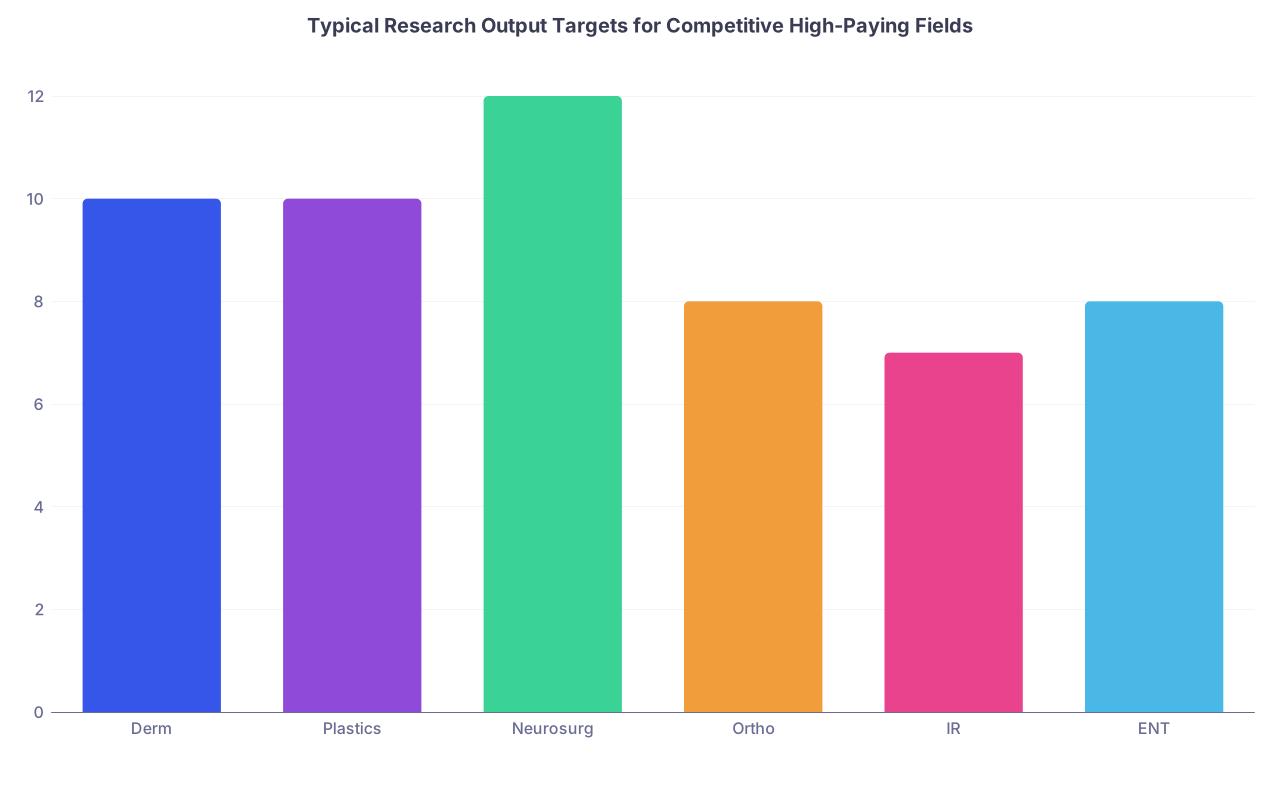
| Category | Value |
|---|---|
| Derm | 10 |
| Plastics | 10 |
| Neurosurg | 12 |
| Ortho | 8 |
| IR | 7 |
| ENT | 8 |
Numbers above are total “scholarly items” often seen in successful applicants at very competitive programs. Not requirements, but reality.
Late M2 (January–April)
This is usually Step/Level dedicated or close to it. Research is not the main show here.
At this point you should:
- Freeze new project intake.
- Focus on:
- finishing revisions
- responding to coauthor comments
- pushing previously started work over the finish line
Practical rule:
- New projects started after February of M2 rarely turn into published pieces before ERAS, unless they are small case reports or brief communications. They still help, but you lose the time multiplier.
So the answer to “When is it too late to start subspecialty research for a high‑paying field?” for ultra‑competitive ones?
- Starting your very first project after late M2 puts you at a serious disadvantage for derm/plastics/neurosurg/ENT unless:
- you have off‑the‑charts scores,
- insane letters,
- or you are willing to consider a full‑time research year.
M3: Clinical year, research has to ride shotgun (T‑1)
M3 is where your clinical performance starts to matter more. For high‑paying fields, you need both: strong clerkship evals and a research record that looks alive.
Early M3 (May–September, depending on school calendar)
At this point you should:
- Already have ongoing communication with your subspecialty mentor:
- Send them updates every 1–2 months.
- Be selective about new projects:
- Prefer things with short timelines:
- case reports
- review articles
- small retrospective add‑on projects
- Prefer things with short timelines:
Important reality:
- If you are only just starting subspecialty research in early M3, here is the situation by specialty:
| Specialty | Chances If Starting M3 Only | Comment |
|---|---|---|
| Derm | Tough | Need huge scores or research year |
| Plastics | Tough | Research year often required |
| Neurosurg | Very tough | Programs expect long track record |
| ENT | Tough | Possible at mid-tier with strong story |
| Ortho | Hard but not impossible | Heavy late push + strong Step scores |
| IR (through DR) | Reasonable | 1–2 strong radiology projects can help |
| GI/Cardiology (as fellow) | Fine | Fellowship cares more about IM residency output |
So yes, you can improve your application starting M3. But you are no longer playing on easy mode.
Mid–Late M3 (October–March)
At this point you should:
- Identify away rotation targets for M4 (especially for ortho, ENT, neurosurg, plastics, IR).
- Work with your mentor to:
- align your research with places where you might rotate or apply
- maybe coauthor something with faculty at those institutions (not required, but gold if you can pull it off)
Your realistic research goals during this period:
- Maintain momentum:
- respond to emails
- do manageable analysis/writing tasks
- Get your name onto:
- 1–2 additional abstracts or posters for meetings that will occur around your M4 year
Remember: by now, most of what counts on ERAS for this cycle has already been started. You are mostly finishing, not initiating.
M4 and ERAS year: Packaging, not starting from zero (T‑0)
If you are asking, “When should I start subspecialty research?” during M4, you are 2–3 years behind your most competitive peers in the highest paid specialties.
That does not mean “give up.” It means adjust expectations and strategy.
Early M4 (April–July)
At this point you should:
- Do sub‑I and away rotations in your target field.
- Use research strategically:
- bring a printed CV with a clean “Publications/Presentations” section
- when attendings ask, “What are you interested in?”, answer with:
- a clinical interest and
- a short line about your current or recent project
New projects now?
- Only if:
- they are short form (case report, educational piece)
- and you accept they probably will not be published in time to change this cycle, but may help with:
- interviews
- rank meetings
- backup plans or fellowship later
ERAS submission (September)
By the time you click “submit,” you want:
For top‑tier competitive, high‑paying fields (derm, plastics, neurosurg, ENT, ortho at big names):
- ideally 6–15 “scholarly activities”
- mix of:
- peer‑reviewed papers
- conference abstracts/posters
- book chapters / review articles
- QI or education projects
- mix of:
- ideally 6–15 “scholarly activities”
For IR, high‑end rads, rad onc, early‑procedural IM:
- numbers can be slightly lower, but quality and relevance matter:
- a couple of IR/rads‑focused pieces go further than random M1 microbiology bench work
- numbers can be slightly lower, but quality and relevance matter:
Subspecialty research if you are already in residency
Maybe you matched into:
- internal medicine
- anesthesiology
- general surgery
- radiology
and now you want the better‑paid subspecialty: cards, GI, EP, ICU, IR, etc.
For fellowships, the timing shifts, but the logic is the same: start early in your new timeline.
PGY‑1: Orientation and early positioning
At this point you should:
Decide on fellowship direction by mid PGY‑1 if possible:
- Cards vs GI vs pulm/crit vs heme/onc for IM
- IR vs MSK vs neuro for DR
- Pain vs cardiac vs ICU for anesthesia
Attach yourself to:
- 1–2 attendings in that field who publish
Goal:
- By end of PGY‑1, you have:
- at least one live project started
- preferably one abstract submitted or accepted
PGY‑2: Main research push for fellowship
Fellowship apps (especially cards and GI) go in early PGY‑3 at most programs. So PGY‑2 is your M2 equivalent.
At this point you should:
- Have multiple active projects in your fellowship interest area
- Aim to:
- submit at least 1–3 manuscripts by mid‑PGY‑2
- present at at least one national meeting (ACC, ACG, SCCM, SIR, RSNA, etc.)
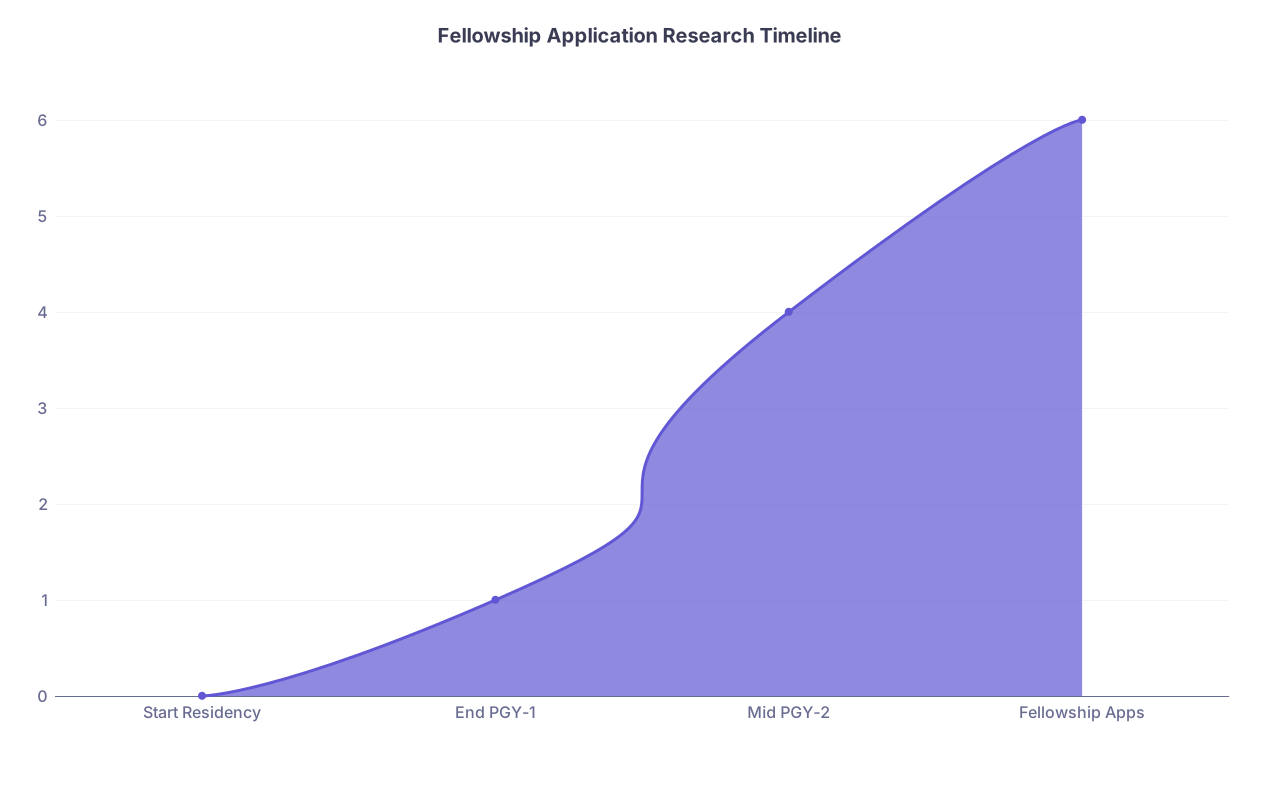
| Category | Value |
|---|---|
| Start Residency | 0 |
| End PGY-1 | 1 |
| Mid PGY-2 | 4 |
| Fellowship Apps | 6 |
Values above = approximate cumulative “serious” projects or outputs in your chosen subspecialty if you are being realistic about competitiveness for high‑end jobs.
PGY‑3 and fellowship applications
By the time you apply:
- Cards / GI / advanced pulm‑crit / IR:
- Want to see a coherent story:
- “This resident has been doing cardiology/GI/IR research for >2 years and can finish work.”
- Want to see a coherent story:
Starting that in PGY‑2 is late but salvageable. Starting in PGY‑3 is “I’m interested,” not “I’m competitive.”
So when exactly should you start?
If you want a direct, no‑hedge answer, here it is:
For derm, plastics, neurosurg, ENT, and top‑tier ortho:
- Ideal: Fall of M1
- Latest “still rational”: Early Summer after M1
- Later than that, you should at least consider a research year if your school and life can support it.
For IR, radiology, rad onc, mid‑tier ortho, “solid” surgical paths:
- Ideal: Spring of M1 / Summer after M1
- Latest “still OK”: Early M2
For high‑paying fellowships out of IM/anesthesia/rads:
- Ideal: PGY‑1 year
- Latest “still OK”: Early PGY‑2
If you are premed and already thinking about this? You are early, which is good. Start small but directed.
If you are M3 and just waking up? Pick a subspecialty, find a hungry mentor, accept that you are sprinting uphill, and do not waste time on vague, slow projects.
Key takeaways
- For the highest paying, most competitive specialties, M1 is on time to start subspecialty‑aligned research. Later than early M2 and you are playing catch‑up.
- The real deadline is not “when you publish,” but “when you start.” Most of what shows on ERAS must be in motion by early M2 (med school) or early PGY‑2 (residency).
- When in doubt, start one concrete project now, in the field you are most likely to pursue, with a mentor who actually publishes. The calendar will not slow down for you.