
The biggest lie students tell themselves about high-paying specialties is this: “I’ll decide later and just work hard meanwhile.” That is how you end up with a very average CV in a brutally competitive field.
You do not “fall into” dermatology, orthopedic surgery, plastics, IR, or radiology. You build into them. Year by year. Detail by detail.
Here is the year‑by‑year, season‑by‑season checklist to build a high‑value CV for the highest paid specialties.
Overview Timeline: What Must Be Done When
At this point you should understand the basic arc:
- Preclinical / Early Years: Grades, Step scores, early specialty exposure, basic research.
- Clinical Years: Honors in key rotations, strong letters, targeted research, leadership.
- Application Year: Polished portfolio (CV, ERAS, personal statement) that screams “cohesive, credible, ready.”
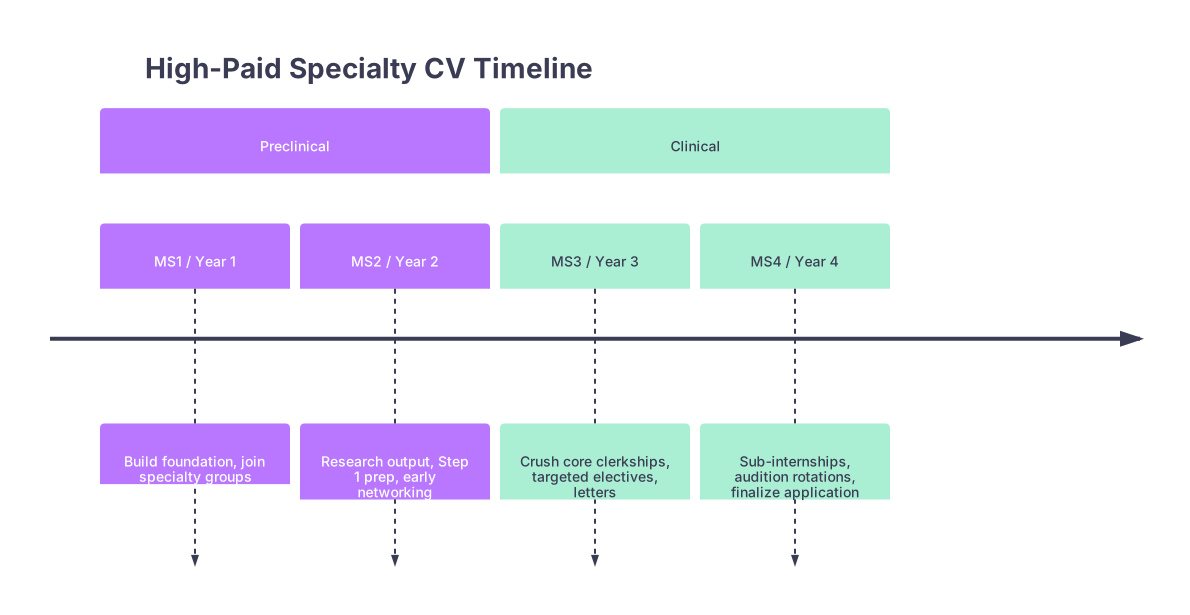
| Period | Event |
|---|---|
| Preclinical - MS1 / Year 1 | Build foundation, join specialty groups |
| Preclinical - MS2 / Year 2 | Research output, Step 1 prep, early networking |
| Clinical - MS3 / Year 3 | Crush core clerkships, targeted electives, letters |
| Clinical - MS4 / Year 4 | Sub-internships, audition rotations, finalize application |
We will go year by year. Then within each year, roughly by semester / season.
Year 1 (MS1 / Preclinical 1): Lay the Foundation Without Wasting Time
This is where people either set themselves up or quietly self‑sabotage. At this point you should keep your universe intentionally narrow: grades, basic involvement, and a realistic idea of which high-paying fields might fit you.
Fall MS1 (Months 1–4): Stabilize and Sample
Objectives:
- Prove you can handle medical school academically.
- Get light exposure to multiple high‑paid fields.
- Start a paper trail of involvement (but do not overcommit).
Checklist:
Academics (non‑negotiable)
- Learn your school’s grading scheme. For competitive specialties, “Honors in everything possible” is the expectation, not the bonus.
- Build a study system you can actually sustain:
- Question banks (Anki + boards-style questions) from week 2–3.
- Weekly review calendar for high-yield systems.
Early Specialty Exposure
- Aim to shadow at least 2–3 of these before the end of the year:
- Dermatology
- Orthopedic surgery
- Plastic surgery
- Interventional radiology
- Diagnostic radiology
- Neurosurgery
- 2–3 half days for each is plenty; you are just collecting data.
- Aim to shadow at least 2–3 of these before the end of the year:
Join the Right Student Groups
- Sign up (not lead, yet) for:
- Ortho / surgery interest group
- Derm interest group
- Radiology / IR interest group
- Attend 1–2 events per month, max. You are observing the culture and meeting residents and faculty.
- Sign up (not lead, yet) for:
Start the “CV Log”
- Keep a live document (or spreadsheet) with:
- Date
- Activity
- Role
- Contact person
- Possible bullet for future CV
- If you do not track it now, you will forget it when ERAS opens.
- Keep a live document (or spreadsheet) with:
Spring MS1 (Months 5–10): Position Yourself for Research
At this point you should start quietly angling toward research that aligns with one or two potential high-paying specialties.
Checklist:
Narrow to 1–3 Candidate Specialties
- Based on:
- What you liked shadowing.
- What lifestyle you can realistically tolerate.
- Your tolerance for long training (e.g., neurosurgery vs derm).
- You are not committing. You are prioritizing.
- Based on:
-
- Identify 2–3 productive faculty in those fields:
- Look at PubMed for recent papers with your institution’s name.
- Ask residents: “Who actually gets students on papers?”
- Send short, specific emails:
- 3 sentences max: who you are, why their work, what you want.
- Goal: land 1 consistent longitudinal research project starting late MS1 or early MS2.
- Identify 2–3 productive faculty in those fields:
Take 1 Concrete Role
- Example:
- Research assistant on an ortho outcomes project.
- Chart review in IR.
- Helping with a derm case series.
- Do not chase 6 projects. Do 1 or 2 and actually finish something.
- Example:
Micro‑Leadership
- Volunteer for a small, time‑limited job:
- Organizing one interest group event.
- Managing a sign‑up list for shadowing.
- This seeds future leadership roles.
- Volunteer for a small, time‑limited job:
Summer After MS1: First Real Deliverables
At this point you should stop “collecting experiences” and start producing: abstracts, posters, tangible output.
Primary goals:
- Turn early research into something visible.
- Get mentors who know your name and work ethic.
Checklist:
Intensive Research Block (6–8 weeks)
- Treat it like a job:
- 30–40 hours/week on 1–2 projects.
- Weekly deliverables: data pulled, charts done, draft written.
- Ask explicitly: “What is the realistic endpoint: poster, abstract, or paper within 12 months?”
- Treat it like a job:
Aim for at Least One Submission
- Abstract to:
- Specialty meetings (e.g., AAD for derm, AAOS for ortho, RSNA for rads, SIR for IR).
- Or at least:
- Local institutional research day.
- Abstract to:
Document Skills
- Update your CV log:
- Data analysis tools (R, SPSS, Excel).
- IRB navigation, REDCap use.
- Specific project titles.
- Update your CV log:
Early Mentorship Meeting
- Sit with your PI or senior resident:
- Ask bluntly: “If I wanted to match into [X], what should my CV look like in 3 years?”
- Write down the numbers and targets they give you.
- Sit with your PI or senior resident:
Year 2 (MS2 / Preclinical 2): Board Scores and Real Output
This is a make‑or‑break year for high‑value CVs. At this point you should be transitioning from “potential” to “producing.”
Fall MS2: Lock In Academics and Step Prep
Checklist:
Dominate Courses
- Maintain or improve class rank.
- High‑paid specialties notice patterns: consistent excellence vs “late bloomer.”
Structured Step Exam Plan
- Whether your school is Step 1 P/F, programs still care about your knowledge base, and Step 2 will carry weight.
- Build:
- Daily Qbank questions schedule.
- Subject-based spaced repetition.
Research: Move From Data to Drafts
- At this point you should:
- Have at least 1 abstract submitted or in draft.
- Be a named co‑author on something in progress.
- Push your mentor:
- “Can we target submission before end of MS2?”
- At this point you should:
Start One Formal Leadership Role
- Examples:
- Officer in derm/ortho/rads interest group.
- Coordinator for student journal club in that specialty.
- Aim for visible, specific responsibilities: not “member at large” fluff.
- Examples:
Spring MS2: Convert to Publications and Plan Clinical Year
At this point you should be visibly on track—on paper—to be a serious applicant.
Checklist:
Research Conversion Targets
- Minimums to aim for by end of MS2:
- 1–2 posters or oral presentations.
- 0–1 publications submitted or accepted.
- Stronger candidates will have:
- 3+ presentations.
- 1+ accepted papers (often case reports, reviews, or smaller studies early on).
- Minimums to aim for by end of MS2:
Light Specialty Skills / Exposure
- Example:
- Scrub into a few ortho or plastics cases.
- Attend radiology readouts once or twice a month.
- Sit in derm clinic periodically.
- These give you stories for interviews and letters.
- Example:
Plan MS3 Rotations Strategically
- Try to schedule:
- For surgery‑oriented fields (ortho, plastics, neurosurg): core surgery earlier.
- For derm/rads: medicine earlier, elective time preserved for MS4 away rotations.
- Talk to the registrar early. Spots disappear.
- Try to schedule:
Finalize Step Study Schedule
- Dedicated period mapped out with:
- Weekly NBME or practice exams.
- Target score ranges that support your specialty goal.
- Dedicated period mapped out with:
MS3 / Clinical Year: Where Your CV Either Explodes or Stalls
This year is brutal and decisive. At this point you should treat every core rotation as a multi‑month audition.
Before MS3 Starts (4–8 weeks out)
Checklist:
Rebuild Efficient Study Habits for the Wards
- Shelf‑focused question banks queued up.
- Short daily reading habits (not 3‑hour marathons you cannot sustain).
Confirm Research Continuity Plan
- Decide:
- One main project you will keep moving with low weekly time (2–3 hours).
- Set:
- Biweekly check‑ins by email with your PI.
- Decide:
Re‑clarify Specialty Priorities
- Rank 1–2 top choices.
- Decide which rotations must be honored to be credible:
- Ortho/plastics: surgery + any ortho elective.
- Derm: medicine + dermatology elective.
- Rads / IR: medicine and surgery help; rads electives, IR rotations.
During MS3: Rotation‑by‑Rotation Mindset
At this point you should be gunning for:
- Honors on as many core rotations as possible.
- At least 1–2 glowing letters from core faculty.
Rotation Checklist (for EVERY rotation):
Week 1
- Ask the senior or attending:
- “What does an Honors student look like on this rotation?”
- Start a note on your phone: “Potential letter writer – [Name], [rotation].”
- Ask the senior or attending:
Mid‑Rotation
- Request feedback:
- “What can I do in the next two weeks to be at the top of the group?”
- Adjust. Aggressively.
- Request feedback:
Final Week
- If feedback has been excellent:
- Ask: “Would you feel comfortable writing a strong letter for competitive fields like [X]?”
- Strong means strong. If they hedge, you move on.
- If feedback has been excellent:
Specialty‑Specific Targets in MS3
Dermatology
- Aim: Honors in Internal Medicine, strong performance in derm elective.
- CV‑critical:
- Multiple derm-focused projects.
- At least 2–3 derm presentations, ideally at derm meetings.
Orthopedic / Plastic / Neurosurgery
- Aim: Honors in Surgery and any ortho/plastics/neuro electives.
- CV‑critical:
- Trauma / outcomes / basic science projects tied to those divisions.
- Evidence that you can tolerate long operative days (letters that say this explicitly).
Radiology / Interventional Radiology
- Aim: Strong performance in Medicine, Surgery; excellent Step 2 score.
- CV‑critical:
- Imaging‑based research, quality improvement in radiology/IR.
- Demonstrated interest via electives, conferences, radiology teaching sessions.
Summer After MS3: Sub‑I Planning and Application Prep
At this point you should be locking in the final shape of your CV.
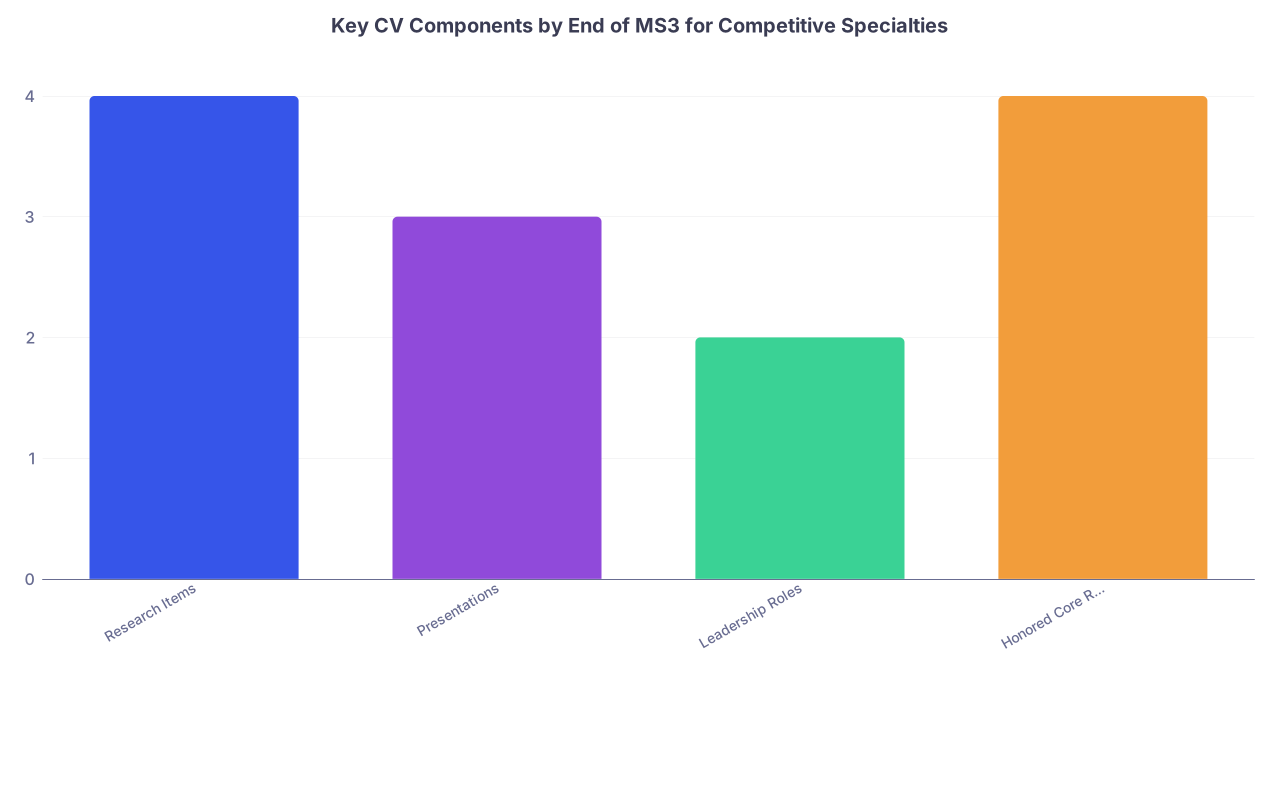
| Category | Value |
|---|---|
| Research Items | 4 |
| Presentations | 3 |
| Leadership Roles | 2 |
| Honored Core Rotations | 4 |
Step 2 and Application Core
Checklist:
Step 2 CK
- Block 4–6 weeks if possible.
- For high‑paid specialties, Step 2 often becomes the differentiator now; aim to be clearly above your specialty’s average.
Finalize Letters Strategy
- You should know:
- 2–3 home institution faculty in your target specialty who will write for you.
- 1–2 strong core clerkship letter writers (medicine or surgery).
- You should know:
Choose and Schedule Sub‑Internships / Audition Rotations
- Rules of thumb:
- Do a home sub‑I in your field early MS4.
- Consider 1–3 away rotations at programs you would seriously attend.
- Confirm dates well ahead; competitive places fill early.
- Rules of thumb:
CV Drafting
- Convert your CV log to ERAS‑style bullets:
- Clear verbs.
- Quantifiable outcomes (e.g., “Co‑authored retrospective study; abstract accepted to RSNA 2025”).
- Convert your CV log to ERAS‑style bullets:
MS4 / Application Year: Converting the CV into an Offer
Now the focus shifts from building your CV to presenting it convincingly. At this point you should already have the substance. You are packaging it.
Early MS4 (Before Applications Open)
Checklist:
Home Sub‑I in Target Specialty
- Goal:
- Be the hardest‑working, most reliable sub‑I on the team.
- Daily behavior:
- Know every patient cold.
- Anticipate attending needs.
- Volunteer for early/late tasks.
- Goal:
Lock in Final Letters
- Ask during or at the end of sub‑I:
- “Would you be willing to write me a very strong letter for [specialty] residency? I am targeting competitive programs.”
- Provide:
- CV.
- Short one‑pager of your projects and goals.
- Personal statement draft if ready.
- Ask during or at the end of sub‑I:
Refine Research Outputs
- Push for:
- Manuscripts under review or accepted.
- Final posters submitted to upcoming conferences during interview season.
- Update your CV in real time as acceptances come in.
- Push for:
ERAS / CV Polish
- Every entry:
- Action verb.
- Clear scope (“n=120 patient chart review,” “Led 8‑person student team”).
- Outcome if possible (“Resulted in new clinic workflow adopted by department”).
- Every entry:
| Specialty | Research Focus | Key Clinical Signal | Extra Edge |
|---|---|---|---|
| Dermatology | Derm-focused, multiple abstracts | Honors in Medicine, strong derm elective | Derm-specific leadership / free clinic |
| Orthopedic Surgery | Ortho/Trauma outcomes, case series | Honors in Surgery, strong OR evals | Athletic background, team leadership |
| Plastic Surgery | Plastics, reconstruction, craniofacial | Honors in Surgery/electives | Artistic portfolio, microsurgery interest |
| Radiology | Imaging/QI projects | Strong Medicine, high Step 2 | Teaching or tech background |
| Interventional Radiology | IR procedure/outcomes | Strong Surgery and Medicine | Evidence of procedural aptitude |
Mid–Late MS4: During Interview Season
At this point you should be using your CV as a storytelling tool.
Checklist:
Own Every Line on Your CV
- For each entry, you must be able to answer:
- “What did you actually do?”
- “What did you learn?”
- “Would you do it again?”
- For each entry, you must be able to answer:
Highlight a Coherent Narrative
- In interviews, thread the same themes:
- Example for ortho: resilience, team sports, long‑term commitment to musculoskeletal care, relevant research.
- Example for derm: visual pattern recognition, chronic disease management, early derm exposure and sustained research.
- In interviews, thread the same themes:
Keep Updating Programs (Strategically)
- Send one well‑written update letter if:
- You get a new publication.
- You win an award.
- Do not spam with minor updates.
- Send one well‑written update letter if:
Retrospective: What Your CV Should Look Like If You Did This Right
By the time you submit ERAS for a top‑paid, competitive specialty, your CV should roughly hit:
- Academics:
- Mostly Honors in preclinical and clinical courses.
- Strong Step 2 CK (solidly above average for your specialty).
- Research:
- 3–10 total items (abstracts, posters, publications).
- Majority in your chosen specialty or clearly adjacent.
- Leadership:
- 1–3 real roles with clear responsibilities and outcomes.
- Specialty Engagement:
- Meaningful shadowing.
- Sub‑Is and possibly away rotations.
- Attendance at at least one national or major regional meeting.
If you are short in one category (say, fewer publications), you compensate with something else (stellar clinical performance, unbeatable letters). But you cannot be average in all domains and aim at the top‑paid, top‑competitive fields. That combination does not work.
What You Should Do Today
Do one concrete thing now that moves your CV forward on the right timeline:
If you are preclinical:
Email one potential research mentor in your target field with a specific ask.If you are clinical:
Pick your current attending and ask what “Honors” performance looks like this week—and then hit it.
Open your CV log right now and add three entries from the last month. Date, role, impact. You are not just collecting experiences anymore. You are building a deliberate, year‑by‑year case that you belong in the highest paid, most selective specialties in medicine.