
The fourth‑year schedule will make or break your shot at the highest‑paid specialties. Most people design it backwards.
They start with: “What sounds fun?”
You need to start with: “What will a PD see on ERAS on September 15?”
This is a timeline guide for building a fourth‑year schedule targeting:
(See also: M1 to Match: When to Decide on a High-Paying Specialty Pathway for guidance on timing your specialty choice.)
- Dermatology
- Orthopedic surgery
- Neurosurgery
- Plastic surgery (integrated)
- Interventional radiology (integrated)
- ENT (otolaryngology)
Same rules also apply, with minor tweaks, to things like urology and rad onc.
I’ll walk you month‑by‑month from January of MS3 through Match Week of MS4 and show you, at each point, what your schedule should look like and what you should be pushing your dean’s office to allow.
Big Picture: What Your Fourth Year Must Accomplish
At this level, “good enough” is a rejection. Your schedule has to hit four concrete goals on time:
- Lock in a strong home rotation + home letter
- Do 1–3 away rotations strategically timed before ERAS opens
- Finish and upload Step 2 CK early with a competitive score
- Leave enough buffer months for backup plans and sanity
Here’s the rough architecture you’re aiming for if you want a competitive, high‑paid specialty:
| Rotation Type | Count | Timing Focus |
|---|---|---|
| Home Sub-I (target) | 1 | Early MS4 |
| Away Rotations | 1–3 | Jun–Aug mostly |
| Step 2 CK Study | 0.5–1 | Late MS3/early MS4 |
| Backup Rotations | 1–2 | Late MS4 |
| Lighter Electives | 2–3 | During interview season |
You’ll tweak around this based on your school’s calendar (traditional July–June vs block systems), but the principles do not change.
January–March of MS3: Foundation and Positioning
At this point you should stop thinking “I’m just a third‑year” and start thinking “I’m six months from audition season.”
By end of January (MS3)
Your tasks:
Pick a primary target specialty (not 3, not 5—one):
Dermatology, ortho, neurosurgery, plastics, IR, or ENT.Pick 1–2 realistic backup specialties
Example:- Derm → backup: IM with derm interest, or pathology
- Ortho → backup: general surgery, PM&R
- Neurosurgery → backup: neurology, general surgery
If your backup is equally competitive (e.g., plastics → derm), that’s not a backup. That’s denial.
Meet with your specialty advisor
Sit down with:- Department’s student advisor or program director
- Or the most honest senior resident you know
Ask specifically:
- “What Step 2 CK range gets taken seriously here?”
- “How many aways do your matched students usually do?”
- “Which programs regularly take our students for away rotations?”
Document their answers. You’re going to use them to design your schedule.
February–March (MS3)
By this point you should:
Know your school’s fourth‑year rules
- Earliest start date for MS4
- How many weeks required for:
- Sub‑Is
- ICU
- EM
- Primary care
- Max number of away rotations they’ll approve
- How early you can take Step 2 CK
Rough‑draft your MS4 year
You’re not submitting anything yet, but you should have a skeleton like:- June: Away 1 – Target specialty
- July: Home Sub‑I – Target specialty
- August: Away 2 – Target specialty
- September: Light elective + ERAS
- October–January: Interview‑friendly, lighter months
- February–March: Backup specialty, graduation requirements
You’ll refine this once schools release VSLO/VSAS details and once you see your Step 1 result (if relevant to your cohort).
April–June of MS3: Applications, Step 2, and Locking Rotations
At this point you should be actively applying for away rotations and blocking time for Step 2 CK.
April (MS3): Away Rotation Applications
Most competitive specialties expect at least one away. Many expect two. Timing is everything.
Applications usually go out through VSLO around March–May. Your tasks:
- Submit away apps for June–August blocks in your target specialty.
- Prioritize:
- Programs that actually take students from your school
- Regions you’d realistically live in
- Mix of reach and realistic programs
Do NOT:
- Stack 3 aways back‑to‑back without any break if your stamina is questionable. These are month‑long interviews.
May–June (MS3): Step 2 CK Strategy
For competitive, high‑pay specialties, Step 2 CK is your lifeline, especially if Step 1 is pass/fail.
Plan like this:
Target Step 2 CK test date:
- Late June to late July of MS3/MS4 transition
- Score report back before ERAS submission (so by early September)
Build in:
- 3–4 dedicated weeks if your school allows
- Or 2 lighter rotations where you can study intensely in evenings
For ultra‑competitive specialties, I like:
Option A (strong test‑taker):
- May: Lighter core rotation
- June: 2–3 weeks dedicated, test late June
- July: Start home or away sub‑I
Option B (need more time):
- May–June: Core + studying
- July: Dedicated 3–4 weeks
- Test late July
- Start first heavy sub‑I in August
If your Step 2 CK is late (October, November), many derm/ortho/neurosurg programs won’t see it before interview decisions. That’s a real handicap.
Month‑by‑Month MS4 Schedule Blueprint (Competitive Track)
Assume a July–June academic year. Adjust one month forward/back if your school starts MS4 earlier.
I’ll walk you through the ideal setups for a high‑paid procedural specialty (ortho/neurosurg/plastics/ENT/IR) and then touch derm separately, since derm plays a slightly different game.
June (End of MS3 / Start of MS4)
At this point you should:
- Finish Step 2 CK (ideal)
- Or be in last weeks of dedicated prep
Schedule options:
- 2‑week light elective + 2‑week Step 2 CK dedicated
- Or full‑month Step 2 CK dedicated if school allows
Avoid:
- Heavy inpatient rotations
- ICU, EM, night float
That month is for your score.
July: Home Sub‑I in Target Specialty
July is prime time.
- Goal: Impress your own department and secure:
- 1–2 strong home letters
- Someone who will pick up the phone for you in October/November
For high‑paid surgical specialties (ortho, neurosurg, plastics, ENT) and IR:
- Do your home sub‑I/acting internship in July or August.
- Show up like an intern. On time, pre‑rounded, reading the night before.
For dermatology:
- If your school has a derm department:
- Do home derm rotation now or very soon.
- If you already did one in MS3: confirm if you can/should repeat as a sub‑I.
You want PDs to know your name before away letters start arriving.
August: Away Rotation #1 (Audition)
At this point you should:
- Be stepping onto your first major away rotation in your chosen specialty.
Treat it like a month‑long interview:
- Show up early.
- Never be the first one to leave.
- Read on every case you see.
- Be coachable—and visibly improve week to week.
Timing detail:
- August away allows:
- Evaluation to be complete
- Letter to be written
- Letter to be uploaded before ERAS reads your application
If you’re doing two aways, the July–September pattern works well:
- July: Home sub‑I
- August: Away 1
- September: Away 2 (more on that in a second)
September: ERAS Submission + Strategic Rotations
ERAS usually opens for submission mid‑September. By then you should have:
- Step 2 CK score back
- Home letter(s) uploaded
- Possibly one away letter uploaded, one pending
Your September rotation should:
- Not be so crushing you cannot write your personal statement or finalize ERAS
- Still be close enough to your specialty to look committed (if you can handle it)
Common patterns:
- Away Rotation #2 in September
- Works if you’re efficient finishing ERAS early.
- Good chance for a second away letter.
- Or lighter elective in your specialty at home
- Or ICU/EM requirement if:
- Your Step 2 is already done
- You can tolerate the workload while finishing ERAS
If your Step 2 CK didn’t go as planned and you’re recalculating, this is also when you start being brutally honest about backup specialties.
October–November: Interview‑Friendly, Mild Rotations
By this point you should:
- Have ERAS out
- Be receiving your first wave of interview invites
- Not be stuck on an ICU month where you can’t leave
October–November rotations should be:
- Light enough to:
- Respond to emails quickly
- Swap days as needed
- Travel 1–2 days per week sometimes
Good choices:
- Outpatient clinic in your specialty
- “Read and run” electives (radiology, pathology, consult services)
- Research elective to finalize a manuscript or poster
Bad choices:
- ICU
- EM
- Required heavy inpatient rotations
- Night float
Those can go after prime interview season.
December–January: Peak Interview Season
At this point you should expect:
- The bulk of your interviews for derm/ortho/neurosurg/plastics/ENT/IR to cluster in December–January (some spillover into November/February depending on specialty).
Your schedule here:
- Ultra‑light.
Honestly, if you can take:- Scheduled time off
- Or a “vacation” block
Do it.
If your school forces rotations:
- Choose:
- Very flexible outpatient
- Preceptor‑style electives where your absence won’t tank the team
You’ll thank yourself when you’re on your 8th flight in three weeks.
February–March: Backup Plans and Finishing Requirements
(Related: Negotiation Secrets High-Earning Attendings Teach Their Own Trainees)
This is where your risk management shows.
If you’re targeting a hyper‑competitive specialty, then by February you’ll have a sense:
- Many interviews → reasonable shot
- Few or no interviews → things are not good
Your February–March strategy:
If you’re getting interviews in your target:
- Finish institutional requirements (ICU, EM, primary care)
- Do a rotation in your backup specialty anyway, so there’s a plausible path if you SOAP or reapply.
If you’re not getting target interviews:
- Double down on backup specialty:
- Sub‑I in backup specialty (even late shows real interest)
- Letters from backup attendings
- Make yourself a credible applicant in Plan B.
- Double down on backup specialty:
You don’t want to be inventing your backup identity during SOAP.
April–June: Coasting, Cleaning Up, and SOAP Contingency
At this point you should:
- Have submitted your rank list (early March)
- Be in “do not screw anything up” mode
April–June rotations:
- Easy pass rotations
- Finishing requirements
- Last‑minute research/performance projects if needed but don’t overdo it
If you end up in SOAP:
- Having a recent, strong rotation in your backup specialty can help:
- You have someone who can advocate quickly
- You have credibility switching lanes
Specialty‑Specific Tweaks
The overall skeleton is similar, but there are differences in how each high‑paid specialty reads your schedule.
Dermatology
Derm cares intensely about:
- Research productivity
- Publication track record
- Relationships with derm faculty
Your fourth‑year schedule should:
- Front‑load:
- 1 home derm month
- 1–2 derm aways (July–September)
- Carve out:
- 1 or more research months early MS4 (even March–April of MS3) to finalize projects
- Include:
- Some form of IM/family/medicine‑adjacent rotation to show you’re not allergic to general patient care
Derm‑specific wrinkle: you can’t just be a tourist. If you haven’t done significant derm work before MS4, a strong schedule alone won’t save you.
Orthopedic Surgery / Neurosurgery / Plastics / ENT
These programs look closely at:
- Surgical sub‑Is
- How many weeks you actually lived in the OR on their turf
- Letters from surgeons they know
Your schedule should:
- Include:
- 1 home sub‑I early (July/August)
- 1–2 aways at realistic target programs
- Also show:
- At least one critical care or trauma ICU month somewhere in MS3/early MS4
- One or two general surgery experiences (for neurosurg and ENT, gen surg is still watched closely)
Step 2 CK: higher is better. For some neurosurgery programs, 250+ still matters quite a bit.
Integrated Interventional Radiology
IR is still evolving, but patterns are clear:
- Strong internal medicine or surgery background helps.
- Dedicated IR and diagnostic radiology rotations are expected.
Fourth‑year structure:
- 1 home IR month
- 1–2 IR aways
- 1 diagnostic radiology month (if not already done)
- Strong ICU or medicine sub‑I to prove you can handle acutely ill patients
Your backup specialty is often diagnostic radiology. Make the schedule reflect that path as well.
Sample Year‑Long Timelines
Here’s what a practical year might actually look like for two different targets.
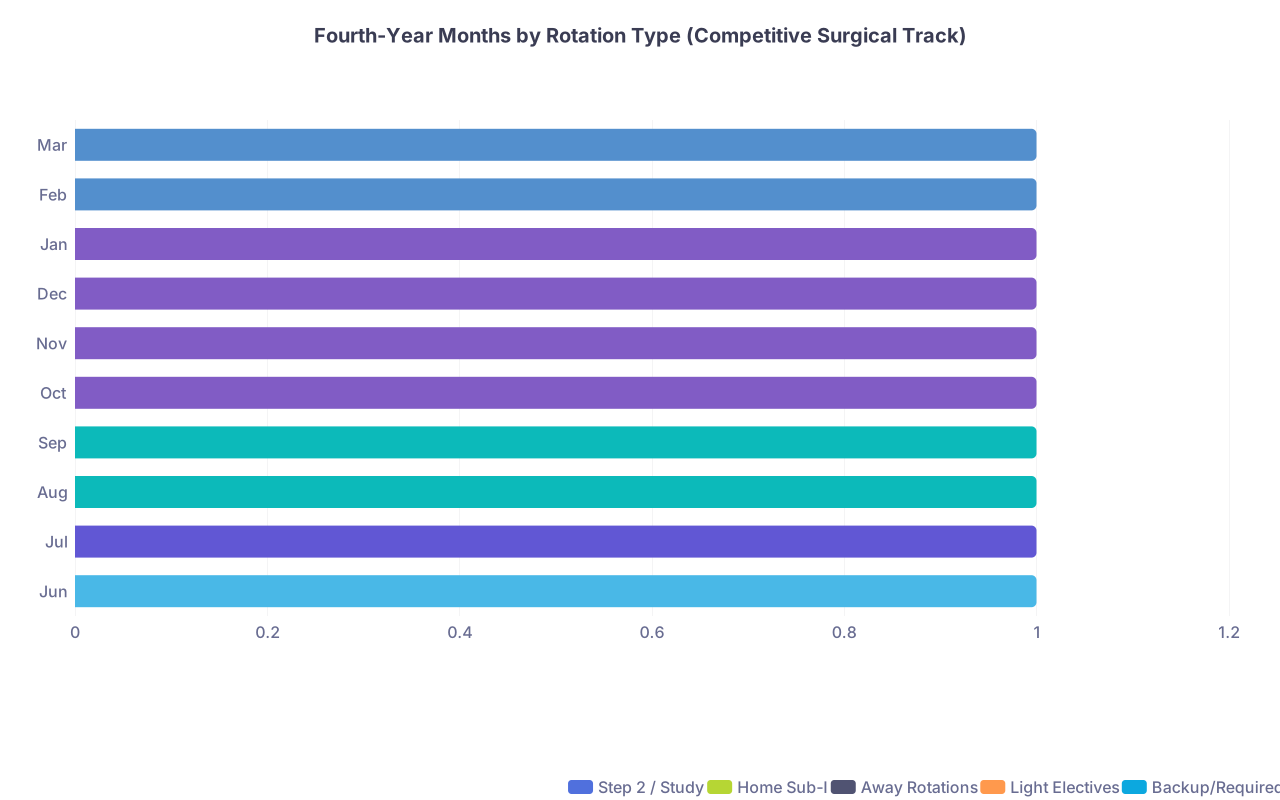
| Category | Step 2 / Study | Home Sub-I | Away Rotations | Light Electives | Backup/Required |
|---|---|---|---|---|---|
| Jun | 1 | 0 | 0 | 0 | 0 |
| Jul | 0 | 1 | 0 | 0 | 0 |
| Aug | 0 | 0 | 1 | 0 | 0 |
| Sep | 0 | 0 | 1 | 0 | 0 |
| Oct | 0 | 0 | 0 | 1 | 0 |
| Nov | 0 | 0 | 0 | 1 | 0 |
| Dec | 0 | 0 | 0 | 1 | 0 |
| Jan | 0 | 0 | 0 | 1 | 0 |
| Feb | 0 | 0 | 0 | 0 | 1 |
| Mar | 0 | 0 | 0 | 0 | 1 |
Example: Ortho‑Focused MS4
- June: Step 2 CK dedicated + exam
- July: Ortho home sub‑I
- August: Ortho away #1
- September: Ortho away #2 + ERAS submission
- October: Outpatient sports medicine
- November: Radiology or PM&R elective
- December: Light MSK clinic (interview heavy month)
- January: Time off / research elective (interviews)
- February: General surgery or ICU requirement
- March: PM&R or general backup specialty month
Example: Dermatology‑Focused MS4
- May–June (late MS3): Derm research elective, writing manuscripts
- June: Step 2 CK dedicated + exam
- July: Home derm rotation (if not already done)
- August: Derm away #1
- September: Derm away #2 + ERAS submission
- October: Outpatient IM / rheumatology
- November: Derm research follow‑up month
- December: Light elective (clinic or radiology)
- January: Time off or easy outpatient elective (interviews)
- February: IM sub‑I (backup pathway)
- March: Primary care requirement or pathology elective
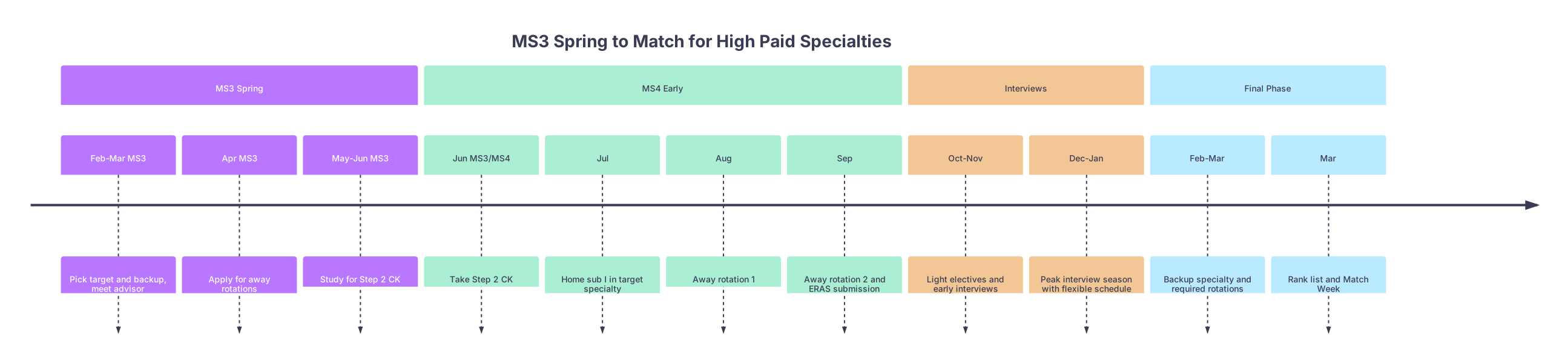
Visual Timeline: From MS3 Spring to Match
| Period | Event |
|---|---|
| MS3 Spring - Feb-Mar MS3 | Pick target and backup, meet advisor |
| MS3 Spring - Apr MS3 | Apply for away rotations |
| MS3 Spring - May-Jun MS3 | Study for Step 2 CK |
| MS4 Early - Jun MS3/MS4 | Take Step 2 CK |
| MS4 Early - Jul | Home sub I in target specialty |
| MS4 Early - Aug | Away rotation 1 |
| MS4 Early - Sep | Away rotation 2 and ERAS submission |
| Interviews - Oct-Nov | Light electives and early interviews |
| Interviews - Dec-Jan | Peak interview season with flexible schedule |
| Final Phase - Feb-Mar | Backup specialty and required rotations |
| Final Phase - Mar | Rank list and Match Week |
Two Things People Get Wrong (That You Should Not)
They chase “fun” rotations during audition season.
You are not on vacation. June–September is not the time for international missions or unrelated electives if you’re gunning for derm or neurosurg. Do those later.They schedule Step 2 CK too late.
A great Step 2 that no one has seen is functionally a mediocre Step 2. Competitive specialties want the number in hand when they screen.
Final Checkpoints Before You Lock Your Schedule
When you sit down with the registrar to submit your official fourth‑year schedule, run this checklist:
- Do I have:
- 1 home sub‑I in my target?
- 1–2 aways in my target, June–September?
- A realistic Step 2 CK date with time to study and score release pre‑ERAS?
- Are October–January rotations light and flexible for interviews?
- Do February–March make me credible in my backup specialty?
- Does each month have a purpose I can explain in one sentence to a PD?
If you can answer yes to all of that, you’re ahead of most of your competition.
Key points:
- Build your fourth‑year schedule around when programs see things, not when it’s convenient for you. Early Step 2, early sub‑I, early aways.
- Treat June–September as your audition window and October–January as your interview survival window; everything else is backup and cleanup.
- Every rotation should either strengthen your primary specialty case, your backup case, or your ability to survive interview season without falling apart. Anything else is fluff.