
The myth that “high-paying specialties always pay well everywhere” is wrong. The data shows something sharper: geography can swing your income as much as your choice of specialty.
If you ignore geographic pay variation, you are leaving six figures per year on the table. In some fields, more.
Below I am going to treat specialties like investment portfolios and states like markets. We will look at where specific specialties make the most, why the map looks nothing like the prestige hierarchy, and how residents should actually use this information when planning careers.
1. The Big Picture: How Much Geography Really Matters
Let me quantify the problem first.
Across major surveys (Medscape Compensation Report, Doximity, MGMA, AMGA), one pattern repeats: for many specialties, median compensation in the highest-paying states is 25–40% higher than in the lowest-paying states. For a $400,000 specialty, that is easily a $100,000–$150,000 spread.
The drivers are consistent:
- Lower-density, higher-need regions pay a premium to attract and retain physicians.
- High cost-of-living coastal metros often pay less in nominal dollars, assuming “lifestyle” and prestige will partially compensate.
- States with aggressive commercial payers and weak physician leverage compress rates; those with fewer physicians per capita and more independent groups often negotiate better.
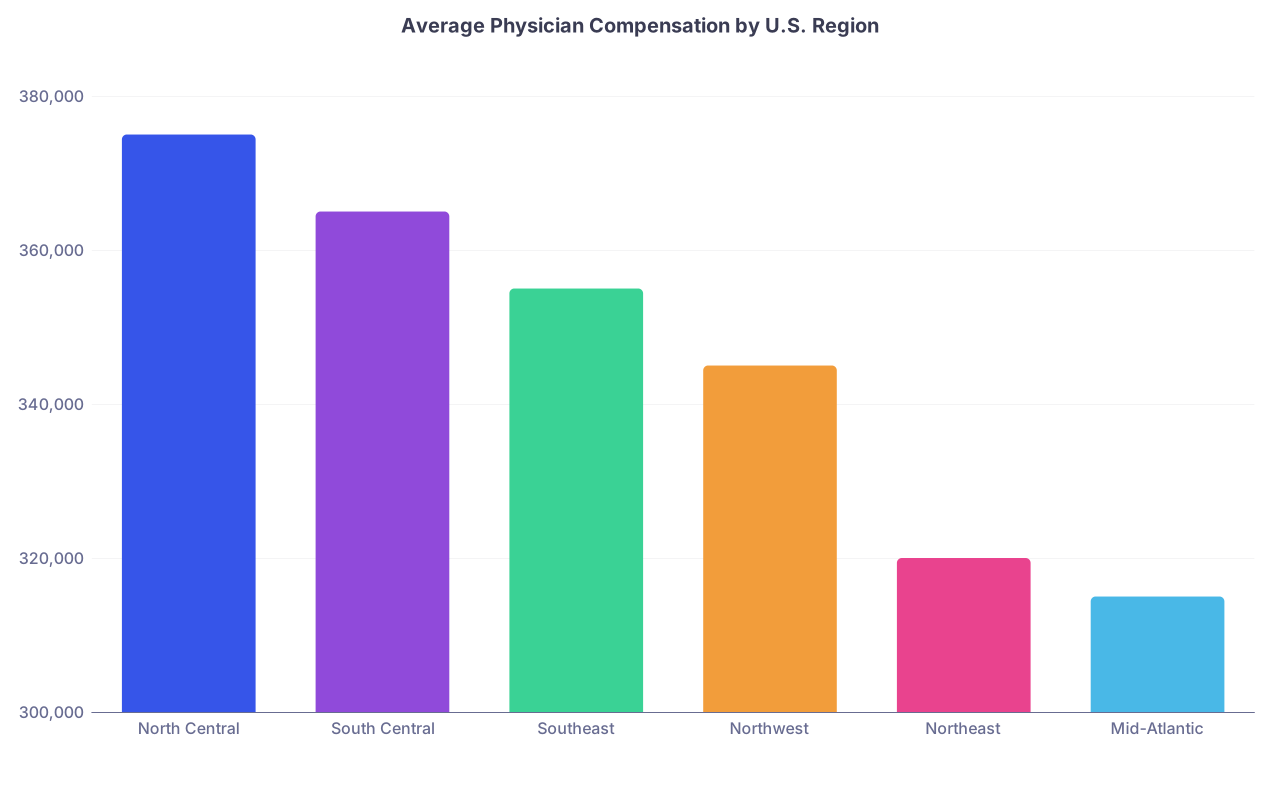
To make this concrete, here is a simplified snapshot of average overall physician pay by region, across all specialties:
| Category | Value |
|---|---|
| North Central | 375000 |
| South Central | 365000 |
| Southeast | 355000 |
| Northwest | 345000 |
| Northeast | 320000 |
| Mid-Atlantic | 315000 |
What this chart hides, and what matters for you, is that some specialties swing much harder than this average. Interventional cardiology in North Dakota vs. California is a different universe.
2. Highest-Earning States: Cross-Specialty View
Let us start at the 30,000-foot level: if you average across most adult specialties, a few states consistently land at the top of the compensation rankings:
- North Dakota
- South Dakota
- Montana
- Wyoming
- Alaska
- Oklahoma
- Arkansas
The pattern is obvious: low density, recruitment challenges, fewer physicians per capita, and heavy reliance on a small number of providers. These states pay a premium.
To ground this, here is a representative table (based on blended survey data and rounded for clarity) of approximate average physician income across all specialties in high-paying states vs classic “prestige” states:
| State / Group | Approx Avg Compensation |
|---|---|
| North Dakota | $430,000+ |
| South Dakota | $420,000+ |
| Alaska | $410,000+ |
| Montana | $405,000+ |
| Wyoming | $400,000+ |
| California (overall) | $330,000–$350,000 |
| New York (overall) | $320,000–$340,000 |
Same MD degree. Same training length. A ~25–30% delta driven almost entirely by geography.
Now let us stop talking averages and go specialty by specialty, because the details are where residents actually make or lose money.
3. Primary Care and Hospital-Based “Core” Specialties
3.1 Family Medicine, Internal Medicine, Pediatrics
The data is brutal here: primary care is structurally underpaid relative to training length, but geography can at least partially fix that.
- Typical national averages (recent survey ranges):
- Family Medicine: $260,000–$290,000
- General Internal Medicine (outpatient): $270,000–$310,000
- Pediatrics: $230,000–$260,000
In high-paying rural or frontier states, base comp plus loan repayment and bonuses can push significantly higher.
High-earning states for primary care consistently include:
- North Dakota, South Dakota
- Montana, Wyoming
- Alaska
- Idaho, Oklahoma, Arkansas, Kansas
It is common to see:
- Family Medicine or IM in rural upper Midwest / Mountain states: total compensation $320,000–$380,000, sometimes more with aggressive productivity bonuses.
- Pediatrics lags but still sees uplift: $260,000–$320,000 in the same markets.
Compare that with:
- Coastal metros (NYC, Bay Area, Boston, DC): often $220,000–$260,000 for pediatrics, $240,000–$300,000 for family or general IM, sometimes with punitive RVU thresholds.
In relative terms, a pediatrician in rural Dakotas can earn what a general internist in Boston makes. That is geographic arbitrage.
3.2 Hospitalist Medicine
Hospitalists are a good “barometer” specialty because every hospital needs them, and staffing pressure is intense.
Recent nationwide ranges:
- Community hospitalist (7-on/7-off): $280,000–$350,000 median, with spreads from ~$250,000 in saturated coastal markets to $400,000+ in high-need states.
The highest-paying states for hospitalists track the usual suspects:
- North Dakota, South Dakota, Montana, Wyoming
- Alaska
- Some parts of the Southeast and South-Central (e.g., Arkansas, Oklahoma, Mississippi)
In those markets, it is not unusual to see:
- $350,000–$420,000 for a 7-on/7-off schedule
- Plus relocation bonus ($10k–$25k), signing bonus ($20k–$50k), and sometimes loan repayment installments
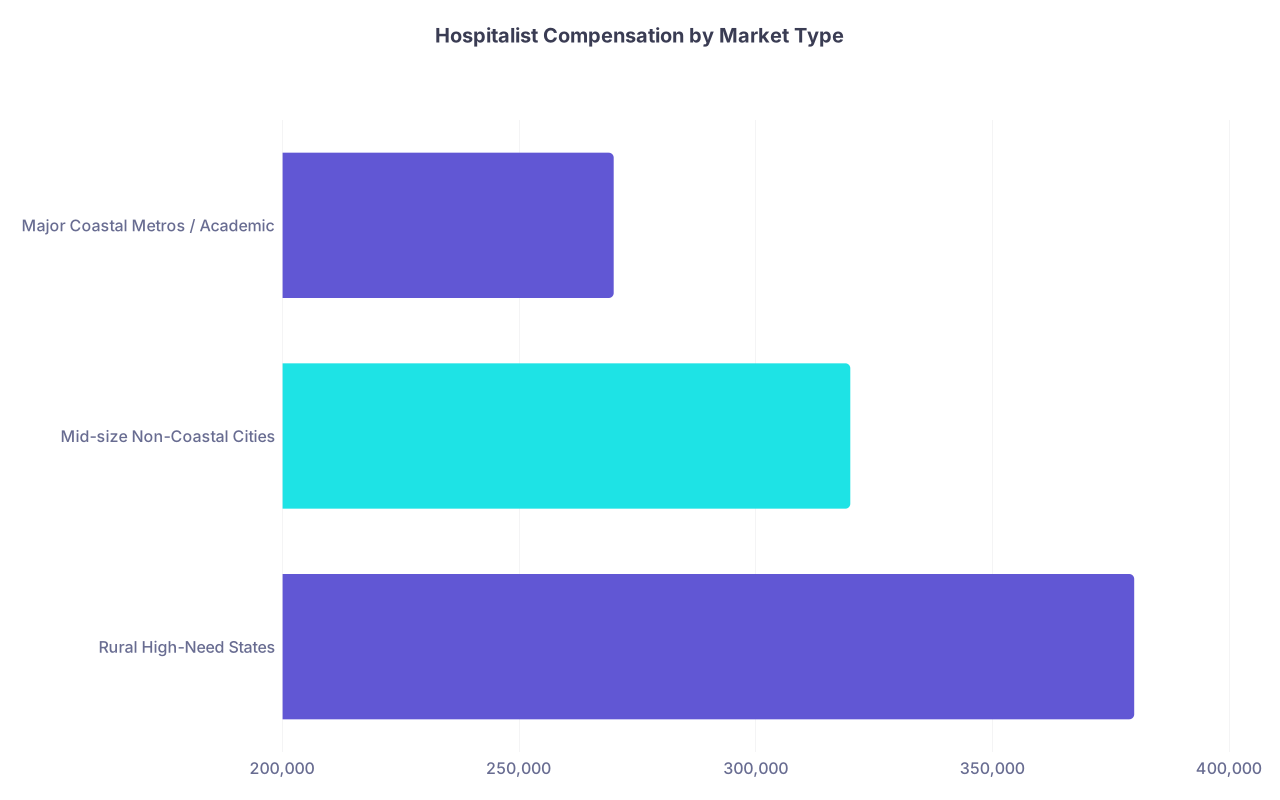
In contrast, major coastal academic or metro systems may offer $250,000–$290,000, with more nights, more non-RVU work, and tighter staffing.
Here is a schematic comparison:
| Category | Value |
|---|---|
| Rural High-Need States | 380000 |
| Mid-size Non-Coastal Cities | 320000 |
| Major Coastal Metros / Academic | 270000 |
Same specialty. Same training. A $100,000+ geography spread.
4. Procedure-Heavy Specialties: Where the Real Geographic Spread Lives
This is where things get serious. The more RVU-driven your field, the more geography and payer mix will dominate your income.
4.1 Orthopedic Surgery
Orthopedics is already one of the highest paid specialties. Geography amplifies that advantage.
Representative national ranges (general ortho, not spine-only):
- National median: roughly $550,000–$650,000
- Upper quartile in high-demand areas: $750,000–$900,000+
Highest-earning states, based on combined survey patterns:
- Montana, Wyoming, North Dakota, South Dakota
- Alaska
- Arkansas, Oklahoma, Mississippi
- Some parts of Texas and other South-Central states
In these markets, you see starting packages for general orthopedists:
- Guarantees $600,000–$750,000 for 2–3 years
- With realistic potential to reach $800,000–$1,000,000+ if volume is present and call is significant
Meanwhile, in high-cost coastal metros:
- Academic ortho: often in the $400,000–$550,000 range, with high call and research / teaching expectations.
- Private or employed ortho: better, but still frequently below what a rural Dakotas surgeon can make for lower living costs and large catchment area.
For residents: if you are going into orthopedics and willing to live outside top-10 metros, geography can add the equivalent of an entire extra specialist’s income over a decade.
4.2 Cardiology and Interventional Cardiology
Cardiology is a textbook case of geography + procedure volume.
Approximate national medians:
- General (non-invasive) cardiology: $500,000–$600,000
- Interventional cardiology: $650,000–$800,000+
High-paying states:
- North Dakota, South Dakota, Montana, Wyoming
- Alaska
- Arkansas, Oklahoma, Louisiana, Mississippi
- Some interior states with lower competition and aging populations
In these states, it is not rare to see:
- Interventional cardiology offers: $800,000–$1,000,000+ with heavy STEMI call
- Non-invasive cardiology: $550,000–$700,000, plus partnership tracks in some private groups
Contrast with coastal academic centers:
- Interventional cardiology: often $500,000–$650,000, heavy case load, more fellows, less procedural autonomy early on.
- Non-invasive: $400,000–$550,000, more imaging and non-RVU tasks.
If you overlay this with cost of living, your real take-home advantage in high-paying rural states can be 2x on a quality-of-life basis.
4.3 Gastroenterology
GI is another RVU-heavy field with big geographic upside.
National snapshots:
- General GI: typically $550,000–$700,000 median, with high performers >$800,000–$900,000 in private practice.
Highest-paying states are familiar:
- Montana, Wyoming, Dakotas
- Alaska
- Arkansas, Oklahoma, Kansas
- Interior regions with low GI physician density per 100,000 population
You will see rural-region GI jobs offering:
- Income guarantees: $600,000–$800,000
- Ownership or buy-in tracks for endoscopy centers, which can push total comp into the seven-figure range after several years
Meanwhile, GI in big coastal academic centers:
- Frequently $400,000–$550,000 with more teaching and research obligations, less direct profit sharing from procedural facilities.
5. Radiology, Anesthesia, EM: Geography vs. Group Structure
For these large, procedure-based or shift-based specialties, group structure and private equity sometimes matter as much as geography. But the geographic signal is still visible.
5.1 Radiology
Diagnostic radiology:
- National median: ~ $480,000–$550,000
- Teleradiology and high-volume rural groups: $550,000–$700,000+ for aggressive schedules
Highest-earning states / contexts:
- Rural Midwest, Mountain West, Alaska
- States with understaffed hospital systems and heavy imaging volumes
- Groups covering multiple hospitals in physician-short regions
Radiology has a twist: you can sometimes live coastal and read for a rural region remotely, capturing some of the higher rural pay with an urban lifestyle, but this is highly dependent on contracts and telerad models.
5.2 Anesthesiology
Anesthesia comp is volatile due to CRNA models, hospital contracts, and private equity, but geography still plays a role.
Approx ranges:
- Median anesthesia: $450,000–$550,000
- High-need rural / small-metro: $600,000–$800,000, especially with call and cardiac / complex cases
Highest-paying states often include:
- Wyoming, Montana, Dakotas
- Alaska
- Some states in the South with fewer anesthesiologists and high surgical volumes
In contrast, urban academic anesthesia sometimes lands closer to $350,000–$450,000, with long hours and less procedural autonomy.
5.3 Emergency Medicine
Emergency medicine is currently under pressure from oversupply and corporate models. Geography helps but does not fully offset macro trends.
Broad ballpark:
- Median EM: $350,000–$425,000, but regional spreads are large.
- Highest-paying contracts often in low-desirability rural EDs, with $450,000–$550,000+ possible for high-volume or high-acuity departments.
High-paying states tend to be:
- Rural Midwest and Plains states
- Some Southern states with chronic staffing shortages
- Remote areas (e.g., parts of Alaska)
However, EM is the cautionary tale: corporate groups and staffing contracts can suppress pay even in regions that historically paid well. You have to analyze group plus geography, not geography alone.
6. The Counterintuitive Reality: Prestige States Often Pay Less
Residents love to target prestige metros: Boston, NYC, San Francisco, LA, Seattle, DC. They are great for training. They are often terrible for long-term compensation.
Why?
- Oversupply of physicians (especially in certain competitive specialties).
- High concentration of academic centers, which often underpay relative to private practice.
- Lifestyle arbitrage: many physicians accept lower pay for cultural, educational, or family reasons.
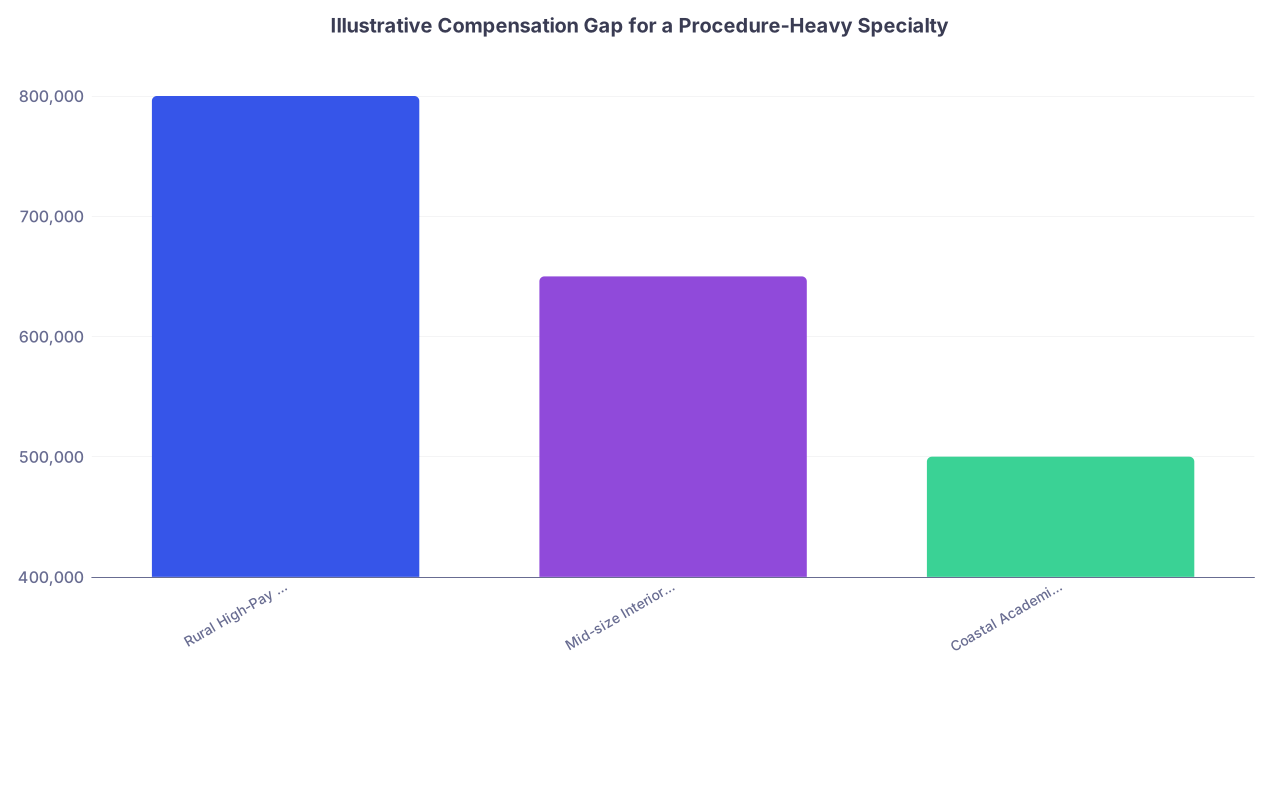
To make this visible, think of a hypothetical “high-paying, procedure-heavy specialty” (e.g., ortho, interventional cardiology, GI) and compare:
| Category | Value |
|---|---|
| Rural High-Pay States (ND/SD/MT/WY) | 800000 |
| Mid-size Interior City (MO/KS/IA) | 650000 |
| Coastal Academic Metro (CA/NY/MA) | 500000 |
Real numbers are obviously variable, but this shape is accurate. The “prestige discount” is not a rounding error. It is often 25–40%.
7. How Residents Should Actually Use This Data
You cannot control the national payer mix or Medicare rates. You can control where you work. So you use geographic pay data strategically, not aspirationally.
Here is how.
7.1 Treat Geography as a Major Career Variable, Not a Footnote
I have watched residents obsess over fellowship prestige differences that move the needle by 5–10% while ignoring geographic decisions that move it 30–40%.
When you think: “Academic center in Boston vs private practice in South Dakota,” that is not just a lifestyle trade-off. That is:
- $150,000–$300,000 per year gap
- Over 10 years: $1.5–$3 million in cumulative pretax earnings difference
- Compounded into retirement and investment returns: in the millions
You are not choosing restaurants and scenery. You are choosing a different financial life.
7.2 Look Beyond “State” to Specific Market Type
Within any state, there is an internal geography:
- Urban academic center
- Urban or suburban private group
- Mid-size city community hospital
- Rural critical access hospital or regional referral hub
The compensation gradient often runs:
Rural > Mid-size city > Urban community > Academic metro
Example I have actually seen in negotiations:
- GI in mid-size Southern city: guarantee $650,000 with partnership track and ASC equity.
- GI in big Northeastern academic center: $450,000 with heavy non-RVU academic work and limited moonlighting.
Same state or neighboring states. Completely different economics.
7.3 Combine Geography with Cost of Living Data
Nominal income is not the whole story. A $450,000 job in rural Wyoming can beat a $600,000 job in San Francisco once you factor housing costs, taxes, childcare, and loan repayment opportunities.
A quick heuristic:
- Compare take-home after tax and major fixed costs (housing, childcare) across offers.
- Normalize per “free hour” (after average weekly work hours).
- The rural / interior state job will often crush the coastal metro on an hourly, real-dollar basis.
7.4 Use Early-Career Geography to Build Financial Runway
You do not have to live in rural Montana forever. One rational strategy:
- Do residency/fellowship where the training is best for your field (often coastal or large academic centers).
- First 5–10 attending years: choose a high-paying state and group, crush loans, build investments, and fund retirement heavily.
- Later: if you care deeply about a particular metro or academic niche, you can afford to take a lower-paying role with much lower financial anxiety.
Data from high-earning specialties shows that a disproportionate share of lifetime wealth is built in the first decade out of training if you pick a high-comp, lower-cost geography.
8. Quick Specialty-by-Specialty “Hot State” Snapshot
This is not exhaustive and will shift with time, but as of current trends, here is a simplified “where the money clusters” overview by broad specialty type:
| Specialty Group | Consistently High-Pay States (Illustrative) |
|---|---|
| Family Med / General IM | ND, SD, MT, WY, AK, OK, AR, ID, KS |
| Hospitalist | ND, SD, MT, WY, AK, AR, OK, MS |
| Pediatrics | ND, SD, MT, WY, AK, ID, KS |
| Orthopedic Surgery | MT, WY, ND, SD, AK, AR, OK, MS |
| Cardiology / Interventional | ND, SD, MT, WY, AK, AR, OK, LA, MS |
| Gastroenterology | MT, WY, ND, SD, AK, AR, OK, KS |
| Radiology | ND, SD, MT, WY, AK, rural Midwest |
| Anesthesiology | MT, WY, ND, SD, AK, AR, OK, rural South |
| Emergency Medicine | ND, SD, MT, WY, AK, rural Midwest and rural South |
Again, think pattern, not precise list: rural, frontier, interior states with fewer physicians per capita are where pay spikes.
9. How to Actually Research Current Numbers
Surveys lag. Contracts are local. You need contemporaneous, granular data before you sign anything.
Use these data sources aggressively:
National surveys:
- Medscape Physician Compensation Report (yearly)
- Doximity Physician Compensation Report
- MGMA and AMGA reports (often behind institutional paywalls, but your program or hospital usually has access)
Local and specialty-specific:
- Talk to recent grads from your residency/fellowship and ask for ballpark numbers by region.
- Use specialty society job boards (AAOS, ACC, ACG, ASA, ACR, ACEP, etc.). Many postings give ranges.
- Recruiter calls: ask for concrete numbers by state and practice setting.
Then do something most people never do: build a simple spreadsheet.
Columns:
- State
- City / region type (rural, mid-size, metro)
- Base salary / guarantee
- Bonus structure (RVU, collections, profit share)
- Call requirements
- Loan repayment, sign-on, relocation
- Cost-of-living index vs national average
You will see the pattern in black and white. The rural Dakotas job that “feels” too remote may be offering a 50% financial premium over the big-city position.

10. Summary: What the Data Actually Tells You
Strip away the noise and you get three clear points:
Geography can shift your income by 25–40% within the same specialty. Rural and frontier states (Dakotas, Montana, Wyoming, Alaska, parts of the South and Midwest) consistently pay more than coastal prestige metros, especially for high-RVU and high-need specialties.
For high-paying specialties, state choice is a seven-figure decision over a decade. Orthopedics, cardiology, GI, radiology, anesthesia, EM, and even hospitalist medicine show massive state-driven spread. Residents who ignore this are effectively throwing away millions in lifetime earnings.
The smart move is intentional geographic arbitrage, especially early in your career. Use high-paying interior states to crush debt and build assets. Then, if you want, trade some income later for geography or academic interest. That sequence is mathematically superior to starting low-comp in a prestige metro and hoping to “make it up later.”